
垂域大模型

Search documents
中国平安(601318.SH)2025年度归母净利增加至1347.78亿元,寿险及健康险业务持续增长
智通财经网· 2026-03-26 16:13
Group 1: Financial Performance - The company reported a total revenue of 1,050.506 billion RMB for 2025, representing a year-on-year growth of 2.1% [1] - Net profit attributable to shareholders reached 134.778 billion RMB, an increase of 6.5% year-on-year [1] - The net profit excluding non-recurring gains and losses was 143.773 billion RMB, showing a significant growth of 22.5% [1] - Basic earnings per share were 7.68 RMB [1] - Operating profit attributable to the parent company was 134.415 billion RMB, up by 10.3% year-on-year [1] - The net assets attributable to shareholders exceeded 1 trillion RMB for the first time, reaching 1,000.419 billion RMB [1] - Total cash dividends for the year amounted to 48.891 billion RMB, marking 14 consecutive years of growth [1] Group 2: Business Growth and Strategy - The new business value in life and health insurance grew by 29.3% year-on-year [1] - The company has deepened its comprehensive financial customer operations, with individual customer numbers reaching 251 million, a 3.5% increase from the beginning of the year [2] - The average monthly active online customer count is approximately 90 million [2] - The retention rate for customers holding three or more products within the group is 99% [2] - The company accelerated its strategic layout in medical and elderly care, with nearly 12 million annual users of AI doctors and over 240,000 customers qualifying for home care services [2] - The company has invested over 10.88 trillion RMB to support the development of the real economy [2] - The MSCI ESG rating has been upgraded to AAA, ranking first in the Asia-Pacific region for four consecutive years in the "comprehensive insurance and brokerage" category [2]

全国政协常委金石:以人工智能点燃高等教育的“新质引擎”
Xin Lang Cai Jing· 2026-02-12 20:34
Core Viewpoint - The core focus of the article is on how higher education must adapt and iterate in response to the rapid advancements in artificial intelligence, which is reshaping human knowledge at an exponential rate [1]. Group 1: Education and AI Integration - The gap between the rapid evolution of algorithms in laboratories and the slower pace of traditional education and talent cultivation is a critical issue that needs to be addressed [1]. - The transformation in education should not merely involve digitizing teaching methods but should focus on reshaping the underlying logic of academic disciplines [1]. - There is a pressing need to integrate AI deeply into educational frameworks to better serve talent development and promote educational reform [1]. Group 2: AI4SEU Action Plan - The "AI4SEU" initiative aims to embed artificial intelligence into every traditional discipline through supply-side structural reforms [2]. - The university has made early investments in emerging fields such as low-altitude technology, 6G, organ chips, and future robotics [2]. - The focus should shift from teaching basic AI operations to promoting deep integration of AI into core research areas, enhancing both technology and professional capabilities [2]. Group 3: Development of Domain-Specific Models - The shift from general large models to "domain-specific large models" represents a strategic battleground for higher education to support industry transformation [2]. - The university has supported the development of several domain-specific models, including quantum computing software and models in concrete materials and law [2]. - Combining "professional depth" with "intelligent breadth" is seen as a core element of new productive forces, with a recommendation for universities to create proprietary domain models to gain asymmetric advantages in international tech competition [2]. Group 4: Future of Talent Development - The emphasis is on breaking down disciplinary barriers through AI empowerment and timely assessment of technological trends to reconstruct talent cultivation models [3]. - The goal is to provide sustainable and systematic support for the formation of new productive forces, thereby strengthening the foundation for China's modernization [3].
量化私募集体跨界AI领域暗自较劲有奇招
Zhong Guo Zheng Quan Bao· 2025-11-20 20:08
Group 1 - The core viewpoint of the articles highlights the growing enthusiasm in the investment community for the integration of quantitative methods and AI, with leading domestic quantitative private equity firms actively exploring AI applications across various sectors, particularly healthcare [1][4] - Several founders of top quantitative private equity firms have established AI companies or enhanced their AI research labs, indicating a shift from traditional financial applications to broader AI-driven solutions [2][3] - The trend of quantitative firms entering the AI space is characterized by diverse strategies, with some focusing on healthcare and others on technology applications, showcasing a variety of approaches to leverage AI capabilities [1][4] Group 2 - Lingjun Investment's founder has launched a tech company, Diantu Technology, which is collaborating with top hospitals to structure medical data for health consultation applications, indicating a significant move into the healthcare sector [2] - Other quantitative firms, such as Shiji Investment and Nian Kong Technology, have also established AI-focused companies, with a focus on developing large language models and innovative algorithms for various applications [3] - The integration of quantitative investment principles with AI methodologies is seen as a natural evolution, as both rely on high-quality data and algorithmic models for decision-making and predictions [5][6] Group 3 - The industry is witnessing a trend where quantitative firms are not only investing in AI but also creating venture platforms to support AI-related projects across various technological fields, including robotics and quantum computing [4] - The unique advantages of quantitative firms in data quality, model iteration, and talent development are expected to drive significant advancements in AI applications, particularly in healthcare, psychological support, education, and financial consulting [6] - Future developments in AI by these firms aim to replicate expert knowledge and provide solutions to everyday challenges, emphasizing the importance of human-centered AI applications [6]
小度与海尔智慧家庭达成战略合作
Xin Lang Cai Jing· 2025-11-13 11:42
Core Insights - Baidu Technology and Haier Smart Home have officially announced a strategic partnership focused on deep collaboration across three dimensions: ecology, scenarios, and technology [1] Group 1: Strategic Collaboration - The partnership will leverage Baidu's multimodal AI assistant, Super Baidu, to enhance joint efforts [1] - Both companies will work on building foundational capabilities by integrating Super Baidu with Haier's UhomeOS system [1] - There will be a joint research and development initiative for domain-specific large models [1]

孩子王:公司着力打造垂域大模型及超级育儿智能体
Zheng Quan Ri Bao· 2025-08-07 12:21
Core Viewpoint - The company is actively embracing AI technology to enhance its services and operations, focusing on developing specialized AI models and tools for parenting support [2] Group 1: AI Technology Integration - The company has launched a specialized AI model called KidsGPT, which serves as a parenting assistant, providing guidance, product recommendations, online discounts, and offline store activities for members [2] - Internally, the company has implemented various AI tools, such as "Dora" and "Vortex," to automate the entire marketing process [2]

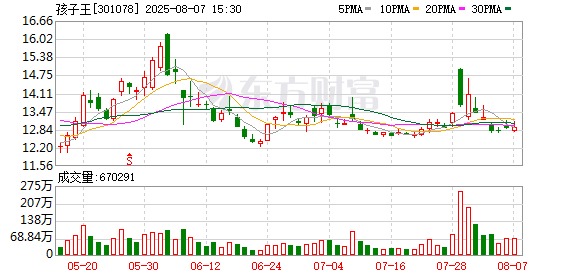
孩子王:暂未涉及社区托育业务
Xin Lang Cai Jing· 2025-08-07 07:53
Core Insights - The company has not yet engaged in community childcare services [1] - The company is actively embracing AI technology, focusing on developing domain-specific large models and super parenting intelligent agents [1] - The company has launched the KidsGPT parenting assistant, which offers various membership services including parenting guidance, product recommendations, online discounts, and offline store activities [1] - Internally, the company has implemented various AI tools such as "Dora" and "Vortex" to support the automation of the entire marketing process [1]