
个人养老金储蓄类产品

Search documents
2025年四类个人养老金产品的收益率对比,分红型个人养老金保险产品表现突出!
13个精算师· 2025-12-10 11:03
Core Viewpoint - The article discusses the development of personal pension systems in China, highlighting the increasing elderly population and the government's initiatives to establish a robust pension framework as a response to aging demographics [3][4]. Personal Pension Development Status - By the end of 2024, the elderly population aged 65 and above in China is projected to reach 22.023 million, accounting for 15.6% of the total population, indicating a deep aging phase [3]. - The State Council issued guidelines in 2022 to promote personal pensions as the "third pillar" of the pension insurance system, utilizing a model of "government tax incentives + voluntary individual participation + market-oriented professional operation" to address gaps in pension security [4]. - As of now, over 70 million personal pension accounts have been opened nationwide, with a diverse range of products available [4]. Product Supply Overview - There are currently 926 personal pension products available, categorized into four main types: - Savings products: 466, primarily consisting of exclusive fixed deposits and large time deposits from state-owned and joint-stock banks [5]. - Insurance products: 118, including exclusive commercial pension insurance and participating pension insurance [6]. - Fund products: 305, designed specifically for pensions with discounted purchase rates and tax benefits, covering equity, mixed, and bond types [6]. - Wealth management products: 37, focusing on low-risk fixed-income assets [6]. Yield Analysis of Personal Pension Products - Different types of personal pension products exhibit significant yield differentiation based on investment strategies and risk levels, catering to various investor risk preferences [7]. - Fund products show the highest yield potential, with a weighted average return of 18.5% and a simple average return of 14.0% for 304 pension fund products as of now [8]. - Passive index funds tracking major indices like the CSI 300 and CSI 500 have performed well, with some products exceeding a 40% return, while others have shown negative returns, highlighting the high volatility associated with fund products [11]. - Savings products offer stable but lower returns, with rates concentrated between 1.3% and 1.8%, appealing to conservative investors [11]. - Wealth management products aim for steady growth, with an annualized weighted return of approximately 2.2% and a simple average return of 2.6% [13]. - Insurance products, particularly participating insurance, provide a dual benefit of guaranteed returns and potential dividends, with average client returns reaching 3.2% in 2024, and some products achieving 3.5% [15]. Comparative Yield Ranking - In 2025, fund products are expected to lead in average yield, followed by insurance products, wealth management products, and finally savings products [17]. Analysis of Participating Insurance Products - The structural bull market in 2025 is expected to draw investors towards high-yield equity funds, but caution is advised due to the inherent risks associated with high returns [19]. - Participating insurance products offer a safety net with guaranteed returns of 1.5% to 1.75%, insulated from market fluctuations, while also allowing for profit-sharing through dividends [20]. - The dual mechanism of guaranteed returns and floating dividends positions participating insurance as a preferred choice for long-term pension planning, addressing both safety and growth needs [20].

对个人养老金基金“亏转盈”的三点思考
Zheng Quan Ri Bao· 2025-09-17 16:13
Core Insights - The personal pension accounts in China have shown a significant recovery, with nearly 15% profit realized by many investors, indicating a positive trend in the market [1] - As of September 17, 98% of personal pension public fund products have positive returns since inception, with an average return of 15% and 67% of products seeing net value increases exceeding 10% [1] Group 1: Market Performance - The growth in net value of personal pension fund products reflects the stabilization and improvement of the capital market this year [2] - The long-term investment and compound interest design of the personal pension system is expected to catalyze the growth of China's third pillar of pension [2] Group 2: System Optimization - The personal pension system, launched at the end of 2022, has undergone continuous optimization, expanding its coverage and increasing the variety of investment products available [2] - Future enhancements may include adjustments in annual contribution limits, investment product ranges, and tax incentives [2] Group 3: Investment Strategies - Investors are encouraged to deepen their understanding of the system and actively participate in pension planning to capitalize on long-term investment benefits [3] - Emphasis is placed on maintaining a long-term investment philosophy, prioritizing safety and stability in asset allocation [3] - Selecting professional institutions and enhancing active management capabilities are crucial for navigating market volatility and ensuring better investment outcomes [3][4] Group 4: Lifecycle Investment Approach - A lifecycle matching principle is recommended for product selection, with younger investors favoring high-volatility products, middle-aged investors balancing risk and return, and those nearing retirement focusing on stable products [4] - The impressive performance of personal pension funds reflects market confidence in China's pension system reforms, which are expected to provide more investors with benefits from economic transformation and institutional changes [4]
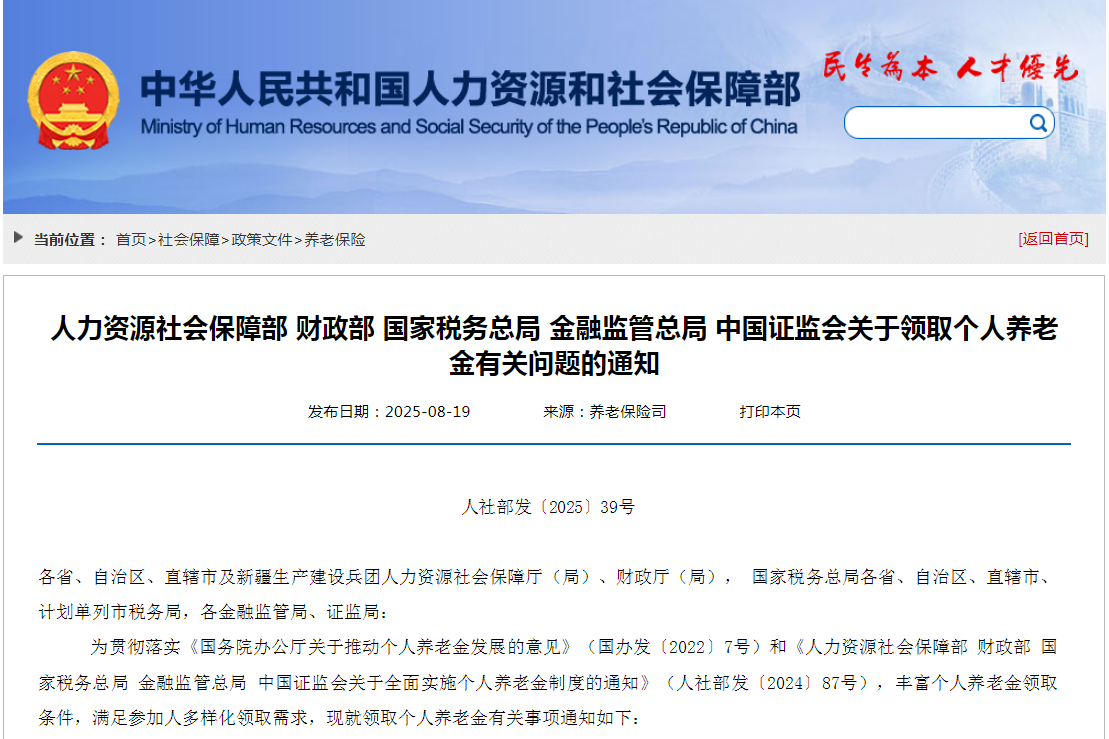
官宣!个人养老金新增3种领取情形 9月1日起实施
Guo Ji Jin Rong Bao· 2025-08-19 17:36
Core Viewpoint - The recent notification from multiple government departments enhances the flexibility of personal pension withdrawals, effective from September 1, 2023, allowing for additional circumstances under which individuals can access their pensions [1][3]. Group 1: New Withdrawal Conditions - Three new conditions for early withdrawal of personal pensions have been introduced: 1. Medical expenses exceeding the previous year's average disposable income in the province incurred by the individual or their family within the last 12 months [3]. 2. Accumulated unemployment insurance claims for 12 months within the last two years [3]. 3. Currently receiving urban or rural minimum living security benefits [3]. Group 2: System Overview - The personal pension system is a government-supported, voluntary, market-oriented supplementary pension scheme, operating on an individual account basis, with a maximum annual contribution limit of 12,000 yuan [4]. - Participants can deduct contributions from their taxable income, benefiting from personal income tax incentives [4]. Group 3: Implementation and Participation - The personal pension system was piloted in 36 regions, including Beijing and Shanghai, starting in November 2022, with a nationwide rollout planned for December 2024 [5]. - As of now, over 70 million individuals have opened personal pension accounts, with 947 products available, including various financial instruments [5].
吸引真缴存银行个人养老金业务进入“留客”深水区
Zhong Guo Zheng Quan Bao· 2025-08-12 21:06
Core Insights - The personal pension products in China are experiencing a surge in interest, with some investors reporting returns exceeding 9% [1] - Despite the increase in account openings, the actual contribution rates remain low, indicating a disparity between account growth and active participation [3][4] - Banks are implementing various incentives to encourage contributions, including cash rewards and promotional activities [2][3] Group 1: Market Trends - The number of personal pension accounts has surpassed 70 million, but the actual contribution volume is not satisfactory [4] - The current trend shows a "hot opening but cold contribution" phenomenon, where many customers open accounts without a strong intention to contribute [3][4] - Financial institutions are focusing on enhancing customer retention and increasing actual contribution rates rather than just acquiring new accounts [3][4] Group 2: Incentives and Promotions - Banks are offering various incentives such as WeChat cash rebates for new account openings and contributions, with amounts ranging from 38 to 388 yuan depending on the contribution level [2] - Agricultural Bank and other banks have introduced promotional packages to encourage contributions, with potential rewards for meeting specific deposit thresholds [2][3] - The competitive landscape among banks is intensifying, with many institutions providing attractive benefits to attract and retain customers [3][4] Group 3: Product Development - The market for personal pension products has expanded significantly, with over 1,100 products available, including savings, funds, insurance, and wealth management products [4][5] - The average return for FOF-type personal pension funds has been around 5% this year, with some products achieving returns over 15% [5][6] - The development of a diverse product matrix is essential for attracting investors and enhancing customer loyalty [6][7] Group 4: Future Outlook - The personal pension system in China has substantial market potential and requires a gradual and steady approach for widespread adoption [6][7] - Banks are encouraged to innovate and collaborate with external institutions to enhance the variety of investment options available to customers [6][7] - Long-term strategies should focus on integrating non-financial services and improving asset allocation capabilities to strengthen customer engagement [7]
中国个人养老金演进与养老理财透视:养老理财稳中求进,未来可期
Hua Yuan Zheng Quan· 2025-06-27 13:06
1. Report Industry Investment Rating No relevant content provided. 2. Core Viewpoints of the Report China's personal pension system has been fully implemented for half a year, and pension wealth - management products are rising rapidly in the multi - level pension system with low - risk and stable returns as core advantages, showing investment potential of "seeking progress while maintaining stability and promising future" [1]. 3. Summary According to Related Catalogs 3.1 China's Personal Pension System's Full - scale Implementation and Global Insights 3.1.1 China's Pension System: From "Multi - level" to "Multi - pillar" China's pension system is structured around the internationally - recognized "three - pillar" framework. By the end of 2024, the total scale of China's multi - level pension security system was about 18.8 trillion yuan, a 12.77% increase from the previous year. The first pillar (social security fund + basic pension) accounted for about 63.9% (about 12 trillion yuan), the second pillar 35.8%, and the third pillar about 0.3%, showing the characteristics of "dominated by basic security and the supplementary level awaiting breakthrough" [2][11]. 3.1.2 Full - scale Implementation of Personal Pension The personal pension system was fully implemented in December 2024, with core breakthroughs in national coverage, diversified product systems, and flexible services and withdrawals. By the end of May 2025, the number of account - opening exceeded 72 million, and the number of products increased to 1,031, but the phenomenon of "hot account - opening and cold deposit" was prominent [15][16]. 3.1.3 International Comparison of Personal Pension Systems The core of the US personal pension system is the Individual Retirement Account (IRAs), with an asset scale of about 17 trillion US dollars by the end of 2024. The UK's personal pension started in 1986, and by the end of 2021, its scale was about 470 billion pounds. Japan's personal pension system consists of iDeCo and NISA. Different countries have different tax mechanisms, access conditions, annual payment limits, investment ranges, and withdrawal conditions [17][21][22]. 3.2 Domestic Personal Pension Product Hierarchical Competition and Global Experience 3.2.1 Formation of the Domestic Personal Pension Product Hierarchical Competition Pattern As of the end of May 2025, savings, insurance, wealth - management, and fund products accounted for 45%, 23%, 3%, and 29% respectively in terms of product quantity. The market is dominated by leading institutions, and small and medium - sized institutions seek breakthroughs through characteristic products [33]. 3.2.1.1 Savings Products with Stable Returns As of June 4, 2025, joint - stock banks were the main issuers of savings products, accounting for 58% of the total product quantity. The interest rate of long - term savings products was generally about 0.6 percentage points higher than that of short - term products [40]. 3.2.1.2 Insurance Products: Coexistence of Guaranteed Stability and Return Elasticity As of the end of May 2025, there were 233 insurance products. The market was dominated by leading institutions, and professional pension insurance companies performed prominently. Some products of National Pension Insurance had a settlement interest rate of over 4% in 2024 [45]. 3.2.1.3 Steady Development of Wealth - management Products As of the end of May 2025, there were 35 wealth - management products, mainly from large bank - affiliated wealth - management subsidiaries. The average one - year return rate as of June 6, 2025, was 2.7%, and the average annualized return rate since establishment was 3.1% [54][58]. 3.2.1.4 New Index Products in the Fund Category, with Leading Funds Dominating the Market Pattern As of the end of May 2025, there were 297 fund products. R3 (medium - risk) products dominated, and pension target FOF accounted for the main proportion. Index funds were included in the product catalog in December 2024, and leading institutions dominated the market [61]. 3.2.2 Higher Allocation Ratio of Equity Assets in Developed Countries' Personal Pensions The US IRA's asset allocation has shifted from deposits to equity assets. The UK's Vanguard target funds had an average annualized return rate of about 7.3% (target risk funds) and 7.8% (target date funds) from 2012 - 2024. Japan's iDeco has increased foreign stock allocation, and NISA has a higher risk preference. Compared with developed countries, domestic personal pension products have a lower allocation ratio of equity assets and relatively lower returns [73][79][81]. 3.3 Pension Wealth - management Products Promising in the Future 3.3.1 Overview of Pension Wealth - management Products As of the end of May 2025, 10 out of 11 approved wealth - management companies had issued 51 pension wealth - management products. The market was dominated by state - owned large banks and leading wealth - management companies. There were 271 pension target funds with a management scale of about 60 billion yuan at the end of 2024, and 1,018 annuity pension products with a management scale of about 2.3 trillion yuan at the end of 2024 [87][91][93]. 3.3.2 Structure of Pension Wealth - management Products As of the end of May 2025, pension wealth - management products were mainly fixed - income, with R2 - level (low - medium risk) products accounting for 96.1%. They had lower management and custody fees compared to pension target funds [98][100]. 3.3.3 Bond - based Asset Allocation in Pension Wealth - management As of Q1 2025, pension wealth - management products mainly allocated fixed - income assets (75.3%), with bonds and non - standard debt assets as the main components. Pension target funds highly relied on public funds, and annuity pension products were mainly allocated to fixed - income assets [101].


