
个人征信报告

Search documents
逾期已“消除”,个人信用迎“新生”
Xin Lang Cai Jing· 2026-01-11 21:22
Core Viewpoint - The People's Bank of China has implemented a one-time credit repair policy that allows individuals with overdue credit records to restore their credit status, benefiting many citizens who meet specific criteria [1][2][4]. Group 1: Policy Implementation - The one-time credit repair policy started on January 1, 2026, and has led to a 22% increase in daily credit report inquiries in Jiangsu Province compared to December 2025 [1]. - The policy is designed to help individuals who have overdue records from January 1, 2020, to December 31, 2025, provided they repay their overdue debts by March 31, 2026 [2][4]. Group 2: Beneficiaries and Impact - Individuals like Mr. Li and Mr. Fang have successfully benefited from the policy, with Mr. Fang receiving a loan approval of 200,000 yuan to expand his agricultural business [2]. - The policy aims to stimulate consumer spending and support small businesses by improving access to credit, thereby revitalizing the micro-market resources [4]. Group 3: Financial Institutions' Response - Financial institutions, including major banks, have enhanced their services to facilitate the policy's implementation, ensuring eligible individuals can easily check their credit status and access benefits [3]. - Banks have optimized their mobile banking apps and established customer support systems to assist clients in understanding and utilizing the new policy [3]. Group 4: Future Directions - The People's Bank of China plans to further advance credit repair and credit services, aiming to inject sustained momentum into consumer spending and the development of the real economy in Jiangsu [5].
花钱“修复征信”?不靠谱,小心摊上“新麻烦”
Xin Lang Cai Jing· 2026-01-07 06:54
Core Viewpoint - The People's Bank of China has announced a one-time credit repair policy effective from January 1, 2026, aimed at specific historical periods of personal small overdue records, allowing users to clear their overdue records under certain conditions [1][4]. Group 1: Policy Details - The credit repair policy is not a long-term arrangement but is targeted at specific groups, with strict conditions for eligibility [4]. - Eligible overdue records must be from January 1, 2020, to December 31, 2025, with a single overdue amount not exceeding 10,000 yuan, and the overdue debt must be fully repaid by March 31, 2026 [4]. - The policy aims to assist individuals who have economic difficulties but are willing to fulfill their obligations, rather than providing leniency to malicious defaulters [9]. Group 2: Market Response and Risks - Some institutions are offering paid services to "repair" credit records, claiming to use legal knowledge to eliminate bad records, but these claims are often dubious [5][6]. - The costs for these services vary significantly, with some charging as low as hundreds of yuan per record, while others may charge thousands [5]. - There are numerous reports of scams in the credit repair industry, where individuals or companies promise to remove bad records but fail to deliver after payment [7][8]. Group 3: Expert Insights - Experts emphasize that credit information cannot be arbitrarily deleted or modified, and any disputes should be handled through official channels [9]. - The new policy is seen as a positive step towards restoring credit for specific individuals, which could help stimulate consumption and support economic growth [9].

“我的逾期记录消除了!”多网友晒出征信报告截图
Zhong Guo Ji Jin Bao· 2026-01-03 09:02
Core Insights - The People's Bank of China has implemented a one-time credit repair policy that allows individuals to clear overdue records from their credit reports if they repay debts by March 31, 2026 [1][5][6] Group 1: Policy Implementation - The one-time credit repair policy officially took effect on January 1, 2026, with many individuals reporting the removal of overdue records on social media platforms [2][3] - The policy applies to overdue information generated between January 1, 2020, and December 31, 2025, for amounts not exceeding 10,000 RMB per instance [5][6] Group 2: Impact on Individuals - Individuals who have previously missed payments but have since repaid their debts are experiencing relief as their credit reports are being updated to reflect this [3][4] - The policy aims to assist those who are not malicious defaulters but have made genuine mistakes, allowing them to restore their credit status [5][7] Group 3: Benefits for Financial Institutions - The credit repair policy is expected to enhance credit decision-making for banks by providing a clearer picture of borrowers' creditworthiness [6][7] - Financial institutions will benefit from improved asset quality as more individuals are encouraged to repay overdue debts, potentially expanding their customer base [7] Group 4: Accessibility and Convenience - The credit repair process is designed to be user-friendly, requiring no additional applications or fees, as the system automatically updates qualifying records [6][7] - This "automatic benefit" approach ensures that individuals can enjoy the advantages of the policy without needing to visit bank branches or fill out forms [7]
2026年的第一天,“我的贷款逾期记录消除了”,多地网友晒出截图
Mei Ri Jing Ji Xin Wen· 2026-01-01 14:57
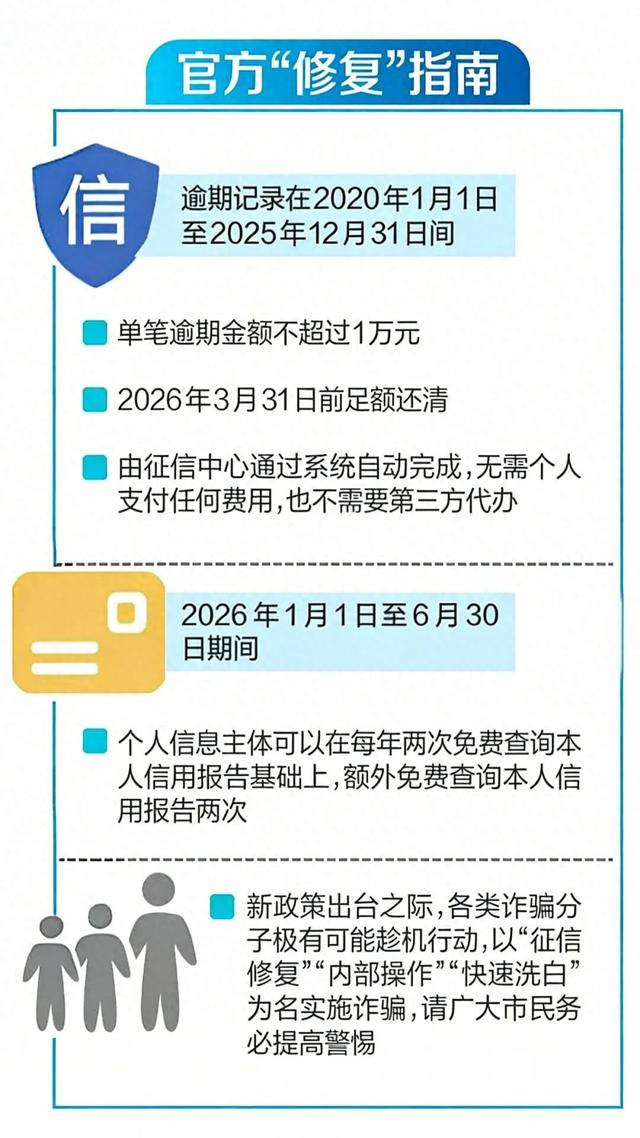
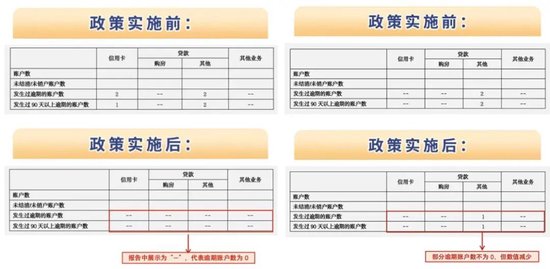
Core Viewpoint - The People's Bank of China has implemented a one-time credit repair policy that allows individuals with overdue loan records under 10,000 yuan to have these records removed if they repay by March 31, 2026, in an effort to support those with damaged credit due to the impacts of the COVID-19 pandemic [1][4]. Group 1: Policy Implementation - The policy was announced on December 22, 2025, to assist individuals who have been actively repaying their debts and to promote economic recovery [1][4]. - Individuals who repay overdue debts by November 30, 2025, will have their overdue information not displayed from January 1, 2026, while those who repay between December 1, 2025, and March 31, 2026, will have their information removed by the end of the following month [4]. Group 2: Individual Experiences - Many individuals have reported that their overdue records have been cleared, with examples including a person who had 47 months of overdue status now seeing their report cleared [2][3]. - Another individual noted a reduction in overdue records from 9 to 2, with the removed records primarily from 2021, all of which have been repaid [2]. - A third individual shared that their previously existing 11 overdue records were reduced to just 2 after the update, indicating a significant impact of the new policy on personal credit reports [3]. Group 3: Technical Processing - The Credit Reporting Center of the People's Bank of China is responsible for the technical processing of eligible overdue information, which does not require individuals to apply for removal [4]. - Individuals can report any discrepancies in their credit reports to the Credit Reporting Center, which is obligated to complete the verification process within 30 days [4].
事关你的征信!央行发布一次性信用修复政策,符合条件即可免审免费统一重塑
Xin Lang Cai Jing· 2025-12-23 00:45
Core Viewpoint - The People's Bank of China (PBOC) has introduced a one-time credit repair policy aimed at supporting individuals with overdue credit records who have actively repaid their debts, facilitating credit restoration and aiding economic recovery post-COVID-19 [2][6]. Group 1: Policy Details - The credit repair policy applies to individuals with overdue credit information recorded in the PBOC's credit system, specifically for overdue records generated between January 1, 2020, and December 31, 2025 [3][6]. - Eligible overdue amounts are capped at 10,000 yuan per instance, and individuals must fully repay their overdue debts by March 31, 2026, to benefit from the policy [3][4]. - The credit repair process is automatic, requiring no application from individuals, as the PBOC's credit center will handle the technical processing of eligible overdue information [3][6]. Group 2: Additional Measures - As a complementary measure, the number of free credit report inquiries for individuals will increase by two additional times in the first half of next year [2][3]. - Individuals can now access their credit reports for free twice a year, with the additional two free inquiries available from January 1 to June 30, 2026 [3]. Group 3: Implications and Reactions - The policy is designed to alleviate small overdue risks and improve the overall health of the credit market, reflecting a more humane approach to financial regulation in the post-pandemic era [8]. - The PBOC emphasizes that this credit repair does not equate to a relaxation of credit constraints, and it is not a means to erase credit records without fulfilling repayment obligations [6][8]. - The initiative aims to combat fraudulent practices by illegal intermediaries claiming to offer credit record deletion services, reinforcing that the credit repair process is free and does not require third-party involvement [8].
政务服务从“政府定时间”到“群众选时间”
Ren Min Ri Bao· 2025-12-12 13:28
Core Viewpoint - The article highlights the transformation of government services from fixed hours to flexible, extended hours, enhancing accessibility for citizens and businesses [1][7]. Group 1: Innovations in Government Services - Various regions have implemented extended and staggered service hours, allowing citizens to access services like identity card replacement and business license printing at their convenience [1][2]. - The "Gankai Ban" platform in Gansu allows online appointment scheduling for services during weekends and holidays, improving efficiency for both clients and service providers [2][3]. Group 2: Enhanced Service Models - Inner Mongolia's Ordos City has introduced a service model that includes early and late hours, as well as weekend services, ensuring that urgent business needs can be met promptly [3][6]. - The "Tide Window" system in Lanzhou dynamically adjusts staffing based on real-time demand, successfully handling over 20% of peak business during busy periods [4][5]. Group 3: Technology and Resource Optimization - The use of AI-driven platforms, such as the "Dong Su Zhi Ban" program in Inner Mongolia, has facilitated real-time consultation and service guidance for citizens [5]. - In Anhui, the "Wan Shi Tong" app has enabled 99.3% of application-based services to be processed online, significantly reducing the need for in-person visits [5]. Group 4: Sustainable Service Mechanisms - Various regions are exploring mechanisms to ensure the sustainability of extended service hours, including flexible scheduling and performance incentives for staff [6][7]. - Ordos City has implemented a "flexible scheduling + compensatory time off" system to balance work and rest for service personnel [6]. Group 5: Future Directions - Experts suggest that to maximize the potential of extended service hours, there should be a push for integrated digital governance systems that enhance data sharing and operational efficiency [7].