二年期定期存款

Search documents
手握存款的居民,建议提前做好三个方面准备,很多人还没有意识到
Sou Hu Cai Jing· 2025-11-23 23:41
Core Insights - The continuous decline in bank deposit interest rates in China has led to a significant increase in residents' savings, with new deposits reaching 11.09 trillion yuan from January to July this year [1][3] Group 1: Deposit Trends - The three-year deposit interest rate has fallen below 3%, marking the beginning of a "two-digit" era for domestic bank deposits [1] - Despite low interest rates, the demand for savings remains strong as residents view savings as a crucial buffer against uncertainties such as unemployment and unexpected medical expenses [3] Group 2: Investment Strategies - Residents are advised to pay attention to liquidity when choosing deposit terms, as locking funds in long-term deposits can lead to significant interest losses if early withdrawal is necessary [5] - A suggested strategy is to divide savings into three parts, investing in one-year, two-year, and three-year fixed deposits to ensure annual liquidity while maximizing interest [5] Group 3: Risk Management - It is recommended that depositors avoid concentrating all funds in a single bank, especially smaller banks that may offer higher rates but carry bankruptcy risks [7] - Depositors should diversify their savings across multiple banks, ensuring that no single bank holds more than 500,000 yuan to protect against potential losses [7] Group 4: Awareness of Financial Products - Caution is advised against purchasing high-risk financial products that may be misrepresented as innovative deposit options by bank staff [9] - Depositors should personally verify the nature of the products they are purchasing to avoid misunderstandings and potential financial losses [9] Group 5: Maximizing Returns - In addition to the above strategies, depositors should actively seek out opportunities for higher returns through large-denomination certificates of deposit or government bonds, which typically offer better rates than standard fixed deposits [10]


首次,有银行取消五年期定期存款产品,还下调了其他期限的利率,什么情况?
Mei Ri Jing Ji Xin Wen· 2025-11-12 03:28
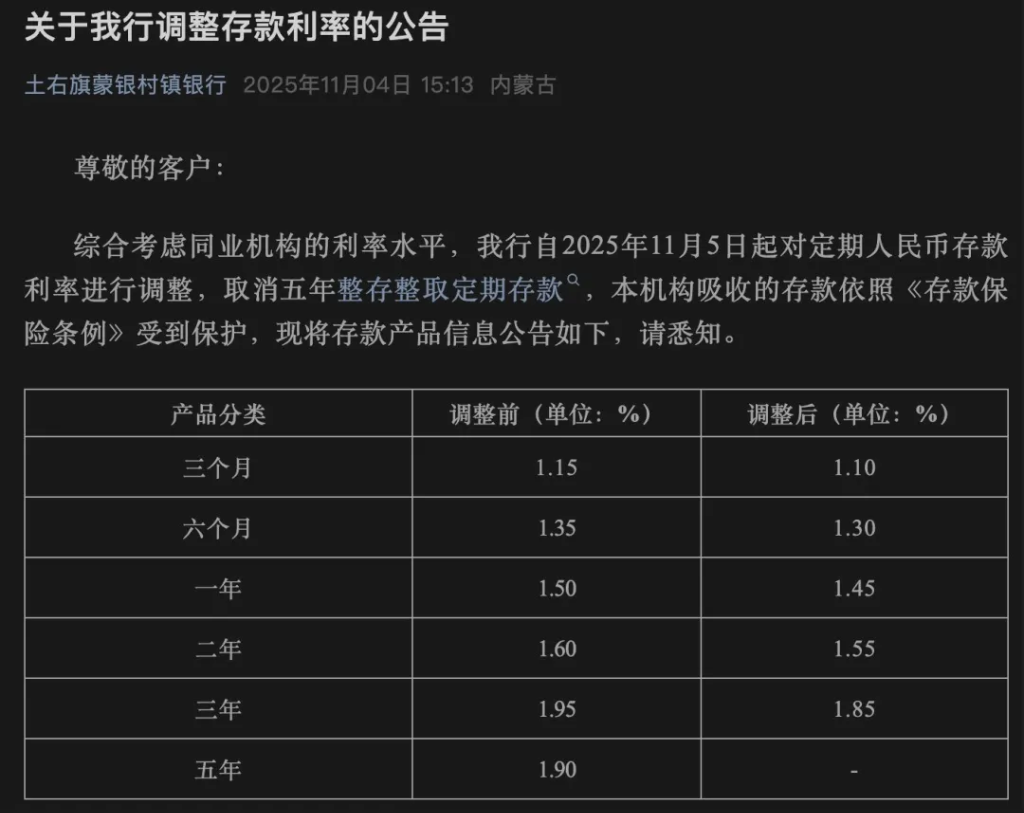
Core Viewpoint - The announcement by Inner Mongolia's Tuyuqi Mengyin Village Bank to cancel its five-year fixed deposit product starting November 5, 2025, marks a significant shift in the banking industry, reflecting ongoing pressure on net interest margins and prompting other banks to adjust their deposit rates and products accordingly [1][5][12]. Summary by Category Product Adjustments - Tuyuqi Mengyin Village Bank is the first commercial bank to explicitly announce the removal of the five-year fixed deposit product, alongside lowering interest rates for other deposit terms [1][5]. - The bank has reduced the interest rates for various deposit terms: three-month from 1.15% to 1.10%, six-month from 1.35% to 1.30%, one-year from 1.50% to 1.45%, two-year from 1.60% to 1.55%, and three-year from 1.95% to 1.85% [3][6]. - Similar actions have been observed in other banks, with some private banks reporting "sold out" or removal of mid to long-term deposit products [1][7]. Market Context - The adjustments in deposit products are a response to the persistent pressure on net interest margins faced by banks, particularly smaller banks that are more sensitive to funding costs [4][8]. - The overall trend shows that many banks are actively lowering deposit rates to manage their liabilities and improve their financial stability amid a challenging interest rate environment [7][9]. Implications for the Banking Sector - The cancellation of long-term deposit products and the reduction of interest rates are seen as proactive measures by banks to optimize their balance sheets and mitigate the impact of declining asset yields [11][12]. - This shift may lead to a "deposit migration" effect, where funds move from traditional bank deposits to capital markets, potentially increasing liquidity in stocks, bonds, and funds [12][13]. - Analysts suggest that the market is witnessing a more pronounced adjustment mechanism for deposit rates, indicating a trend towards stabilizing net interest margins in the banking sector [13].