
五年期整存整取定期存款

Search documents
六大行停售五年期大额存单
新华网财经· 2025-11-27 04:46
Core Viewpoint - The recent collective removal of five-year large-denomination time deposits by six major state-owned banks reflects the ongoing pressure on net interest margins within the banking industry, prompting a shift in deposit product offerings [2][3][4]. Group 1: Changes in Deposit Products - Six major state-owned banks have collectively removed five-year large-denomination time deposits, with only three-year products remaining, which have seen interest rates drop to between 1.5% and 1.75% [2]. - Several small and medium-sized banks have also begun to adjust or cancel three-year and five-year ordinary time deposit products, indicating a broader trend of declining long-term deposit offerings in the banking sector [2]. - The first bank to announce the cancellation of five-year time deposits was the Tongyu County Mengyin Village Bank, effective November 5, 2025 [2]. Group 2: Reasons Behind the Changes - The adjustments in long-term deposit products are a response to the pressure on net interest margins faced by banks, particularly private banks, which have seen a quarter-on-quarter decline of 0.08 percentage points in net interest margins [2][3]. - The competitive landscape for deposits has intensified, with high funding costs and declining loan rates squeezing banks' asset-side returns [2][3]. Group 3: Impact on Savers - As long-term deposit options decrease and interest rates decline, savers are forced to reconsider their financial strategies. A survey indicated that 62.3% of urban savers preferred "more savings," a decrease of 1.5 percentage points from the previous quarter [3]. - The trend suggests that while long-term deposits may not disappear entirely, they will likely exhibit differentiated supply characteristics, with state-owned banks possibly retaining five-year deposits as service tools but at lower rates [3][4]. Group 4: Future Outlook - The ongoing pressure on net interest margins is expected to persist, leading more banks to shorten deposit terms and lower interest rates to balance asset and liability returns [4]. - It is anticipated that more banks will follow suit in adjusting long-term deposit products in the future [4].


倒挂!存5年利率比存3年还要低
Nan Fang Du Shi Bao· 2025-11-18 23:11
Core Viewpoint - The cancellation of five-year fixed-term deposits by banks, starting with the Inner Mongolia Tuyuqi Mengyin Village Bank, indicates a potential industry trend rather than an isolated case, as many private and internet banks are following suit due to declining interest rates and the phenomenon of interest rate inversion [2][4]. Group 1: Reasons for Cancellation - Banks are discontinuing five-year fixed-term deposits primarily to address the narrowing net interest margin, as loan rates are decreasing faster than deposit rates, leading to higher costs for long-term deposits [3][4]. - The Tuyuqi Mengyin Village Bank has also lowered rates for other term deposits, with the one-year rate dropping to 1.45% and the two-year rate to 1.55% [4]. Group 2: Market Response and Trends - The average annualized yield for bank wealth management products has risen to approximately 2.12%, significantly higher than the current one-year fixed deposit rate of 0.95%, prompting a shift in investor preference towards these products [7]. - The number of individuals holding bank wealth management products has increased by 12.70% year-on-year in the first three quarters of this year, indicating a growing trend towards these alternatives [6][7]. Group 3: Future Directions for Banks - The shift away from long-term fixed deposits towards wealth management services reflects a broader transformation in the banking industry, where competition will increasingly focus on providing diversified asset allocation solutions [8]. - Banks that can effectively meet customer needs with stable and competitive yield products are expected to gain an advantage in the evolving market landscape [8].

存款搬家加速?有银行下架5年期定存,银行理财规模创新高
Nan Fang Du Shi Bao· 2025-11-14 03:17
Core Viewpoint - The trend of long-term, high-interest fixed deposits is fading, as evidenced by a village bank's decision to remove its five-year fixed deposit product, indicating a shift in asset allocation due to declining interest rates [2][3]. Group 1: Changes in Deposit Products - A village bank announced the cancellation of its five-year fixed deposit product effective November 5, 2025, signaling a shift in strategy among commercial banks, particularly smaller ones, to lower long-term liabilities in response to ongoing pressure on net interest margins [2]. - The average one-year fixed deposit rate among major domestic banks has dropped to 0.95%, reflecting a broader trend of declining deposit rates [2]. - Experts suggest that traditional views on saving in banks need to change, as high-interest earnings from fixed deposits are no longer viable, prompting investors to consider alternative low-risk, liquid products like bank wealth management and government bonds [2][4]. Group 2: Growth of Wealth Management Products - The number of individuals holding bank wealth management products increased by 12.70% year-on-year in the first three quarters of this year, with third-party platforms experiencing even more significant growth [3]. - For instance, the user base of the "Stable Profit Treasure" product from MyBank saw a remarkable 67% year-on-year increase, significantly outpacing the industry average [3]. - The average annualized yield for bank wealth management products is approximately 2.12%, while some cash management products like "Stable Profit Treasure" have achieved yields around 2.58%, making them more attractive than traditional fixed deposits [4]. Group 3: Banking Industry Transformation - The withdrawal of long-term fixed deposits and the rise of wealth management products reflect a broader transformation in banking business models, with a focus shifting towards wealth management services [4]. - Future competition among banks will center on their ability to provide diversified asset allocation solutions rather than just the number of branches or deposit volumes [4]. - Market observers predict that more small and medium-sized banks may follow suit in adjusting their long-term deposit strategies, emphasizing the need for investors to enhance their financial literacy and diversify their investment portfolios in a low-interest-rate environment [4].

首次,有银行取消五年期定期存款产品,还下调了其他期限的利率,什么情况?
Mei Ri Jing Ji Xin Wen· 2025-11-12 03:28
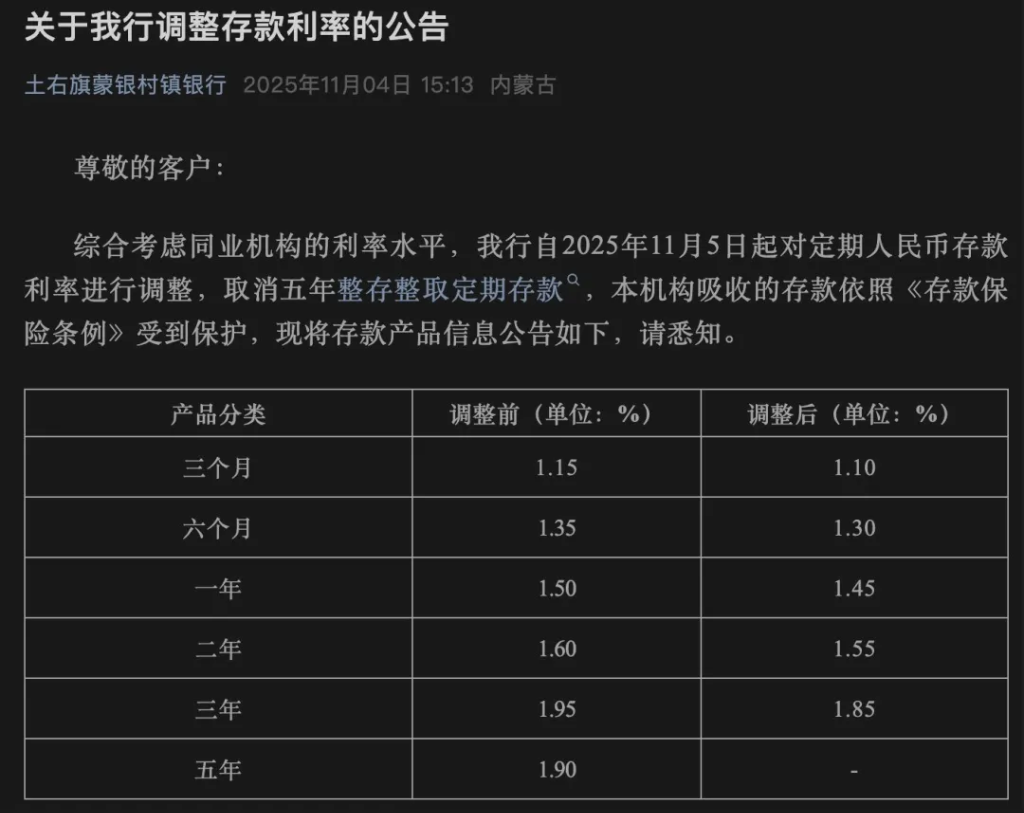
Core Viewpoint - The announcement by Inner Mongolia's Tuyuqi Mengyin Village Bank to cancel its five-year fixed deposit product starting November 5, 2025, marks a significant shift in the banking industry, reflecting ongoing pressure on net interest margins and prompting other banks to adjust their deposit rates and products accordingly [1][5][12]. Summary by Category Product Adjustments - Tuyuqi Mengyin Village Bank is the first commercial bank to explicitly announce the removal of the five-year fixed deposit product, alongside lowering interest rates for other deposit terms [1][5]. - The bank has reduced the interest rates for various deposit terms: three-month from 1.15% to 1.10%, six-month from 1.35% to 1.30%, one-year from 1.50% to 1.45%, two-year from 1.60% to 1.55%, and three-year from 1.95% to 1.85% [3][6]. - Similar actions have been observed in other banks, with some private banks reporting "sold out" or removal of mid to long-term deposit products [1][7]. Market Context - The adjustments in deposit products are a response to the persistent pressure on net interest margins faced by banks, particularly smaller banks that are more sensitive to funding costs [4][8]. - The overall trend shows that many banks are actively lowering deposit rates to manage their liabilities and improve their financial stability amid a challenging interest rate environment [7][9]. Implications for the Banking Sector - The cancellation of long-term deposit products and the reduction of interest rates are seen as proactive measures by banks to optimize their balance sheets and mitigate the impact of declining asset yields [11][12]. - This shift may lead to a "deposit migration" effect, where funds move from traditional bank deposits to capital markets, potentially increasing liquidity in stocks, bonds, and funds [12][13]. - Analysts suggest that the market is witnessing a more pronounced adjustment mechanism for deposit rates, indicating a trend towards stabilizing net interest margins in the banking sector [13].
银行负债结构往深了调 五年期存款产品首见“下架”
Zheng Quan Shi Bao· 2025-11-10 22:24
Core Viewpoint - The recent decision by the Tongyu County Mengyin Village Bank to cancel its five-year fixed deposit product reflects the broader trend among small and medium-sized banks to adjust their deposit structures in response to declining interest margins and pressures on profitability [1][2][5]. Group 1: Bank Adjustments - Tongyu County Mengyin Village Bank is the first commercial bank to eliminate the five-year fixed deposit product, indicating a direct transmission of pressure from declining interest margins to product offerings [2]. - The bank has also reduced interest rates on other fixed deposit products, with the one-year rate decreasing from 1.50% to 1.45%, the two-year rate from 1.60% to 1.55%, and the three-year rate from 1.95% to 1.85% [2]. - Other small and medium-sized banks have similarly announced reductions in deposit rates, with some experiencing cuts of up to 80 basis points [2]. Group 2: Industry Trends - The adjustments made by small and medium-sized banks are indicative of a larger industry trend, where banks are reluctant to accept longer-term deposits due to cost control and liability structure management [3]. - The five-year large denomination certificates of deposit (CDs) have also seen a decline, with many banks no longer offering them, and new issuances reflecting lower interest rates compared to previous offerings [4]. - Analysts suggest that the downward trend in net interest margins will likely continue, prompting more banks to adjust their long-term deposit products [5][6]. Group 3: Future Outlook - Industry experts predict that more banks may follow suit in adjusting their long-term deposit products as net interest margins remain under pressure [5]. - The ongoing decline in loan market quoted rates (LPR) and the need for banks to manage funding costs effectively will drive further reductions in deposit rates [6]. - Banks are expected to continue lowering deposit rates to alleviate the pressure on interest margins, with varying degrees of adjustment based on market competition and customer positioning [6].
【Fintech 周报】年内超400家小贷退出;小红书拿下支付牌照;央行连续第12个月增持黄金
Sou Hu Cai Jing· 2025-11-10 09:22
Regulatory Dynamics - The People's Bank of China has increased its gold reserves for the 12th consecutive month, reaching 74.09 million ounces (approximately 2,304.457 tons) as of the end of October, up by 30,000 ounces (approximately 0.93 tons) from September [2] - The State Administration of Foreign Exchange reported that China's foreign exchange reserves rose to $3.343 trillion at the end of October, up from $3.339 trillion at the end of September, influenced by major economies' monetary policies and macroeconomic data [2] Industry Dynamics - Seven banks have surpassed 100,000 private banking clients, with notable growth rates exceeding 10% in several institutions, including Minsheng Bank, Beijing Bank, and Nanjing Bank, which all reported growth rates above 15% [6] - The number of small loan companies in China has decreased to 4,863 as of the end of September, with a total loan balance of 722.9 billion yuan, reflecting a significant industry contraction [7] - The insurance sector has seen a 30% year-on-year increase in technology insurance premium income in the first three quarters of the year, significantly outpacing the industry average [7] Corporate Dynamics - Qingdao Bank announced that Guoxin Chanquan Holdings increased its stake in the bank's H-shares by 49 million shares, raising its total ownership from 13.55% to 14.39% [8] - Ant Group has restructured its organization, upgrading its digital healthcare division to a health business group, aiming to make healthcare a strategic pillar of its operations [8] - Xiaohongshu has acquired a payment license by fully controlling Dongfang Electronic Payment Co., increasing its registered capital from 121.3 million yuan to 200 million yuan [8] - Xinjiang Rural Commercial Bank has received approval to establish, marking the sixth provincial-level rural commercial bank in the country, with assets exceeding 700 billion yuan [9] - Jiujiang Bank has initiated a capital increase plan, proposing to issue up to 860 million domestic shares and 175 million H-shares [10]

中国央行连续第12个月增持黄金;有银行停售五年期定存产品 | 金融早参
Sou Hu Cai Jing· 2025-11-09 23:31
Group 1: Foreign Exchange Reserves - As of the end of October 2025, China's foreign exchange reserves stood at $33,433 billion, an increase of $47 billion from the end of September, representing a growth rate of 0.14% [1] Group 2: Gold Reserves - By the end of October, China's gold reserves reached 7.409 million ounces, with a month-on-month increase of 30,000 ounces, marking the 12th consecutive month of gold accumulation [2] - The steady increase in gold reserves indicates the central bank's strategic positioning of gold as a reserve asset, enhancing long-term support for gold prices [2] Group 3: Banking Sector Adjustments - A bank in Inner Mongolia has announced the cancellation of its five-year fixed deposit product, reflecting a broader industry trend to lower deposit rates and reduce funding costs [3] - The bank continues to offer shorter-term deposit products with rates ranging from 1.10% to 1.85% for three months to three years [3] Group 4: Gold Tax Regulations - Following the implementation of new gold tax regulations, banks have reported stable prices and sufficient supply of investment gold bars, indicating minimal impact from the new rules [4] - The regulations distinguish between investment and non-investment gold, with investment gold bars purchased from banks remaining largely unaffected [4] Group 5: New Bank Establishment - The establishment of Xinjiang Rural Commercial Bank has been approved, marking a significant step in the unified legal person reform of rural financial institutions in Xinjiang [5] - This will be the sixth provincial-level unified legal person rural commercial bank in the country and the first in the northwest region [5]
压降负债成本 有银行停售五年期定存产品
Zhong Guo Zheng Quan Bao· 2025-11-06 20:15
Core Viewpoint - The recent decision by a village bank in Inner Mongolia to discontinue five-year fixed-term deposits reflects a broader trend in the banking industry aimed at reducing liability costs through lower deposit rates and the removal of high-cost deposit products [1][2][3] Summary by Sections Deposit Products - A village bank in Inner Mongolia announced the cancellation of five-year fixed-term deposits effective November 5, 2025, while still offering shorter-term deposits with rates of 1.10%, 1.30%, 1.45%, 1.55%, and 1.85% for three months, six months, one year, two years, and three years respectively [1] - Many banks continue to offer five-year fixed-term deposits, but some have stopped offering high-value certificates of deposit, indicating a unique situation in the market [1][2] Interest Rates and Trends - The five-year fixed-term deposit rate at Industrial and Commercial Bank of China is 1.3%, which is lower than the three-year rate of 1.55% [2] - China Postal Savings Bank's researcher suggests that banks are reducing long-term liabilities to lower costs due to uncertain interest rate trends [2] Net Interest Margin - The overall net interest margin for banks is under pressure, with a reported decline to 1.42% in Q2 2025, down 0.01 percentage points from Q1 [2][3] - Many banks have adjusted deposit rates downward, with state-owned and joint-stock banks' rates falling below 2% [2] Strategic Responses - Analysts indicate that banks are collectively choosing to lower deposit rates and reduce liability costs as a strategy to stabilize net interest margins [3] - Future strategies may include further reductions in deposit rates and minimizing implicit costs associated with deposits [3][4] Market Outlook - Some listed banks are showing signs of marginal improvement in net interest margins, with expectations that the decline in margins will stabilize, potentially leading to positive growth in net interest income by 2026 [4]
首次,有银行停售5年期定存
财联社· 2025-11-06 06:22
Core Viewpoint - The cancellation of the five-year fixed deposit product by the Tongyu County Mengyin Village Bank marks a significant shift in the banking industry, potentially indicating expectations of declining interest rates and pressure on interest margins [1][3]. Summary by Sections Cancellation of Five-Year Fixed Deposit - The Tongyu County Mengyin Village Bank announced the cancellation of its five-year fixed deposit product effective November 5, 2025, making it the first bank to do so in the industry [1][3]. - The bank adjusted its deposit rates, lowering the one-year rate from 1.50% to 1.45%, the two-year rate from 1.60% to 1.55%, and the three-year rate from 1.95% to 1.85% [3][4]. Industry Context - Several other small and medium-sized banks have recently lowered their deposit rates, with some reductions reaching up to 80 basis points, yet they continue to offer five-year fixed deposit products [5]. - The cancellation of the five-year product is unprecedented, as banks typically opt to withdraw three-year or five-year large deposits instead [5][6]. Comparison with Larger Banks - Major banks such as Industrial and Commercial Bank of China and China Merchants Bank still offer five-year fixed deposit products, with rates of 1.55% and 1.30% respectively [6][7]. - The differing strategies among banks regarding fixed deposit offerings may be influenced by their unique liability situations and the need to balance deposit scales under interest margin pressures [7].

行业首次,内蒙古一村镇银行停售5年期定存
Jing Ji Guan Cha Wang· 2025-11-06 03:37
Core Viewpoint - The announcement by the Tongyu County Mengyin Village Bank regarding the adjustment of deposit interest rates marks a significant shift in the banking sector, particularly with the cancellation of the five-year fixed deposit product, which is the first case in the industry [1] Summary by Category Interest Rate Adjustments - The bank has adjusted the one-year fixed deposit rate from 1.50% to 1.45% [1] - The two-year fixed deposit rate has been changed from 1.60% to 1.55% [1] - The three-year fixed deposit rate has been reduced from 1.95% to 1.85% [1] Cancellation of Deposit Products - The bank has explicitly canceled the five-year fixed deposit product, which previously had an interest rate of 1.90%, leaving it as a vacant option [1] - This cancellation is noted as the first clear case in the industry to eliminate a five-year fixed deposit product [1] Regulatory Context - The deposits accepted by the bank are protected under the "Deposit Insurance Regulations" [1]