人参归脾丸

Search documents
中成药价差超3000倍,多地整治价格风险线索
3 6 Ke· 2025-11-26 07:00
Core Insights - The article highlights the significant price discrepancies in traditional Chinese medicine (TCM), with some products showing price differences exceeding 3000 times compared to the lowest daily treatment costs in the same province [1] Group 1: Price Discrepancies - There are over 88,000 types of TCM listed nationwide, with some products having daily treatment costs more than five times the lowest daily treatment costs for the same type of medicine in certain provinces [1] - The price differences are attributed to variations in ingredients, quality standards, and manufacturing by different companies, but extreme discrepancies indicate potential price manipulation [1] Group 2: Regulatory Actions - The National Healthcare Security Administration has initiated a special governance action targeting TCM products with daily treatment cost discrepancies greater than ten times and listed prices above 100 yuan [1] - Multiple regions, including Anhui, Tianjin, Shanxi, and Liaoning, have begun to release new price risk clues and require companies to conduct self-checks on their pricing practices [1] Group 3: Specific Cases - In Tianjin, a list of 886 drugs was published, with most daily costs within ten times the minimum daily cost for the same type, but some products showed price differences exceeding a thousand times [2] - Specific examples include the "Xiaoyao Wan" from Yaodu Pharmaceutical Group priced at 2129.40 yuan daily, compared to a minimum of 0.70 yuan, resulting in a 3042 times difference [2] - Other notable products include "Buzhong Yiqi Wan" priced at 3807.00 yuan daily, with a minimum of 1.50 yuan, showing a 2538 times difference [2]



有中成药差价高达3000倍,多地紧急出手整治
2 1 Shi Ji Jing Ji Bao Dao· 2025-11-25 14:43
Core Viewpoint - The recent crackdown on abnormal pricing of traditional Chinese medicine (TCM) is intensifying, with multiple regions in China implementing price governance measures to address significant price discrepancies in TCM products [2][10]. Group 1: Price Governance Measures - Various provinces, including Anhui, Shanxi, Shandong, Inner Mongolia, Tianjin, and Liaoning, have issued notifications requiring TCM companies to self-reduce prices between November 25 and November 28, 2025 [2]. - The price governance initiative began in July 2023, following the release of a document titled "First Batch of Medical Price Risk Clue Notifications" by the National Healthcare Security Administration (NHSA) [2][6]. - The NHSA has distributed clues regarding suspected high-priced TCM products, particularly those with daily treatment costs exceeding ten times the minimum daily cost [6][10]. Group 2: Price Discrepancies - There are over 88,000 TCM products listed nationwide, with some products showing daily treatment costs that are five times higher than the lowest daily treatment costs in certain provinces [5]. - In Tianjin, a list of 886 TCM products revealed that while most had daily costs within ten times the minimum, some exceeded a thousand times, with the highest discrepancy reaching 3042 times [6][7]. Group 3: Impact on Companies - The price governance measures are expected to significantly impact companies, as products with price differences exceeding ten times may be suspended from listing, affecting sales and profitability [10]. - Larger companies may adapt better to cost pressures through improved production processes, while smaller firms may struggle to survive in a more competitive environment [10][11]. - The governance is likely to force companies to shift focus towards quality and production efficiency, moving away from reliance on high marketing costs [11][12]. Group 4: Long-term Pricing Mechanism - The establishment of a long-term pricing control mechanism is essential, which may include expanding the coverage of centralized procurement for TCM and conducting regular price checks to identify and address abnormal pricing [10][12]. - A quality and pricing linkage system is proposed to enhance regulatory oversight and reduce price manipulation, alongside a credit system for procurement to penalize companies that engage in price fraud [12].

有中成药差价高达3000倍,多地紧急出手整治
21世纪经济报道· 2025-11-25 14:35
Core Viewpoint - The article discusses the recent developments in the governance of traditional Chinese medicine (TCM) pricing, highlighting the significant price discrepancies and the regulatory measures being implemented across various provinces in China to address these issues [4][5][12]. Group 1: Pricing Governance Measures - Multiple provinces, including Anhui, Shanxi, and Tianjin, have issued notifications requiring TCM companies to self-reduce prices between November 25 and November 28, 2025, as part of a broader initiative to regulate TCM pricing [4][5]. - The governance initiative began in July 2023, following the release of a document by the National Healthcare Security Administration (NHSA) aimed at guiding companies to standardize pricing behavior [5][7]. - The NHSA has identified over 88,000 TCM products, with some showing daily treatment costs exceeding five times the lowest daily treatment costs for the same product in certain provinces [7][12]. Group 2: Price Discrepancies - In Tianjin, a recent list revealed that some TCM products had daily costs that were over 3,000 times higher than the lowest daily costs for the same type of product, indicating significant price inflation [5][6][8]. - Specific examples include the "Xiaoyao Wan" from Yaodu Pharmaceutical Group, priced at 2,129.40 yuan per day, compared to a minimum daily cost of 0.70 yuan, resulting in a price difference of 3,042 times [8]. Group 3: Impact on the Industry - The pricing governance is expected to impact companies and the industry significantly, with potential sales declines for products that exceed the price thresholds set by the NHSA [12]. - Larger companies may adapt better to these changes through improved production processes, while smaller firms may struggle to survive due to their inability to manage costs effectively [12]. - The governance measures are anticipated to force companies to shift focus towards product quality and clinical efficacy, moving away from reliance on high marketing expenses [12][13]. Group 4: Long-term Pricing Mechanism - Experts suggest that expanding the coverage of TCM centralized procurement and establishing a pricing system linked to product quality could help create a long-term pricing control mechanism [13]. - Continuous monitoring and timely warnings for unusually high prices are recommended to form a dual defense system of "centralized procurement pressure + online price control" [13].

3000倍价差!中成药价格异常 多地启动专项整治
2 1 Shi Ji Jing Ji Bao Dao· 2025-11-25 10:52
Core Viewpoint - The recent price governance initiative for traditional Chinese medicine (TCM) is intensifying, with multiple regions in China implementing measures to address abnormal pricing, requiring companies to self-reduce prices by the end of November 2025 [1][3]. Group 1: Price Governance Measures - Various provinces, including Anhui, Shanxi, Shandong, Inner Mongolia, Tianjin, and Liaoning, have issued notifications for TCM companies to lower prices, following a national directive from the National Healthcare Security Administration (NHSA) [1][3]. - The price governance initiative began in July 2023, with the NHSA distributing a document titled "First Batch of Medical Price Risk Clue Notifications" to guide companies in standardizing pricing behavior [1][3]. - The governance has led to increased transparency, with some regions publicly disclosing price discrepancies, such as Tianjin revealing that some TCM daily treatment costs were over 3,000 times higher than the lowest daily costs for the same products [1][3]. Group 2: Price Discrepancies and Implications - A report indicated that among over 88,000 TCM products listed nationwide, some had daily treatment costs exceeding five times the lowest daily costs for the same products in certain provinces [3]. - The NHSA has identified high-priced TCM products with daily treatment costs greater than 10 times the lowest price and has initiated special governance actions to address these discrepancies [3][4]. - In Tianjin, a list of 886 drugs was published, with some products showing price differences exceeding 1,000 times, prompting the local procurement center to require companies to reduce prices to within three times the lowest daily cost [4]. Group 3: Industry Impact and Long-term Mechanisms - The price governance is expected to significantly impact companies and the industry, with potential sales declines for products with excessive price differences, leading to a dual challenge of price reduction and maintaining performance [7]. - Larger companies may adapt better to cost pressures through improved production processes, while smaller firms may struggle to survive if they cannot achieve economies of scale or quality control [7]. - The governance is anticipated to drive a transformation in the industry, pushing companies to focus on product quality and clinical efficacy rather than relying on high marketing costs [7][8]. Group 4: Future Strategies for Price Control - To further reduce price discrepancies in TCM, experts suggest expanding the scope of centralized procurement and incorporating high-priced products into procurement processes, alongside regular price checks [8]. - Establishing a pricing system linked to product quality and enhancing regulatory oversight throughout the supply chain are recommended to minimize gray pricing areas [8]. - Implementing a credit system for procurement, with penalties for companies that engage in price fraud or refuse to adjust prices, is also proposed as a strategy to ensure compliance [8].

多个知名品种被点名!中成药挂网价格治理风暴来袭
Bei Jing Shang Bao· 2025-07-27 12:11
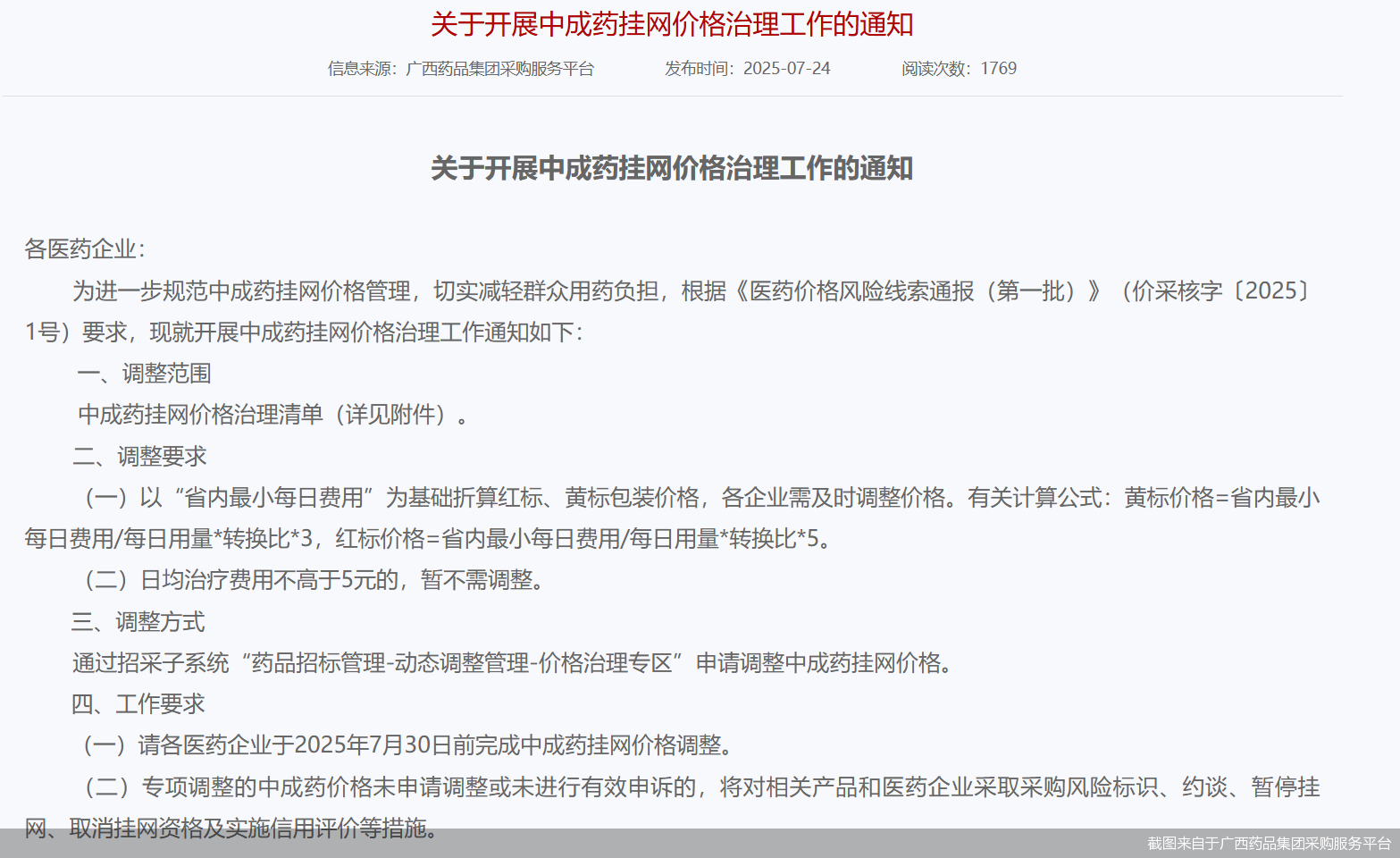
Core Viewpoint - The nationwide governance of traditional Chinese medicine (TCM) pricing is intensifying, marking a shift from a "policy safe haven" to a "transparent competitive pool," indicating the TCM industry is entering a "cost + efficacy" dual pricing era [1][11][12] Group 1: Price Governance Actions - Multiple regions, including Inner Mongolia, Hebei, Ningxia, Jilin, and Guangxi, have initiated special governance on TCM prices, requiring companies to adjust prices of products deemed excessively high [1][3] - The Guangxi Drug Group Procurement Service Platform announced a governance notice targeting 169 high-priced TCMs, mandating price adjustments based on the "minimum daily cost" within the province [3][4] - A total of 123 TCMs were identified with price discrepancies, with some exceeding the minimum daily treatment cost by over 915 times [3][4] Group 2: Industry Impact and Future Outlook - The governance is expected to pressure companies that have relied on high pricing and marketing costs, pushing them to focus on cost control, process innovation, and genuine clinical value [1][9] - The combination of "volume-based procurement + price governance" is seen as a key path to standardizing drug prices, addressing unreasonable premiums in the distribution chain [11] - Long-term, companies with strong compliance and cost advantages are likely to dominate the market, while smaller firms may face elimination risks if they cannot achieve scale and quality standardization [12] Group 3: Specific Products and Companies Affected - Notable TCM products such as Xiao Chai Hu Granules, Niu Huang Jie Du Pian, and Ban Lan Gen Granules are included in the governance list, with specific pricing adjustments mandated [8][9] - Well-known companies like Shandong Hongjitang Pharmaceutical Group and Taiji Group's subsidiaries are among those named in the governance actions [8][11] - A-share listed company Keyuan Pharmaceutical is planning to acquire 99.42% of Hongjitang, indicating potential consolidation in the industry [8]