
人工智能设计助手

Search documents
欧派家居再度获人民日报点赞!
Zhong Jin Zai Xian· 2025-11-25 03:05
Core Viewpoint - The article emphasizes the importance of building a modern industrial system in China, focusing on "intelligent, green, and integrated" industrial upgrades, with a spotlight on Oppein Home's strategic transformation from a "product manufacturer" to an "ecological service provider" [1][3][4]. Group 1: Industry Transformation - The production of new energy vehicles in China has surged from less than 10,000 units in 2010 to over 12 million units in 2024, achieving a penetration rate of 40.9% [3]. - Oppein Home is set to launch an AI design assistant that will provide a one-stop home furnishing solution, showcasing the integration of manufacturing and modern services [3][8]. - The trend of companies transitioning from "product manufacturers" to "ecological service providers" is gaining momentum, enhancing value chains and extending industrial chains [3][10]. Group 2: Emerging Pillar Industries - The concept of "emerging pillar industries" is introduced, which combines characteristics of both emerging and pillar industries, playing a crucial role in economic growth and requiring high technological content and added value [4][5]. - By 2025, the added value of strategic emerging industries is expected to account for over 17% of GDP, an increase of approximately 5.3 percentage points compared to the "13th Five-Year Plan" [5][6]. - The low-altitude economy is highlighted as a significant example, with a projected market size of 1.5 trillion yuan in 2023, expected to reach 3.5 trillion yuan by 2035 [5][6]. Group 3: Oppein's Strategic Direction - Oppein's integration of AI technology into its design and manufacturing processes is seen as a transformative step, creating a closed-loop system of "design as manufacturing, manufacturing as service" [8][10]. - The company aims to strengthen its foundation in the real economy while promoting deep integration between manufacturing and modern services, contributing to the modernization of China's economy [10][12]. - The recognition by People's Daily of Oppein's transformation path underscores the importance of industry integration and innovation in achieving a robust industrial system [12].


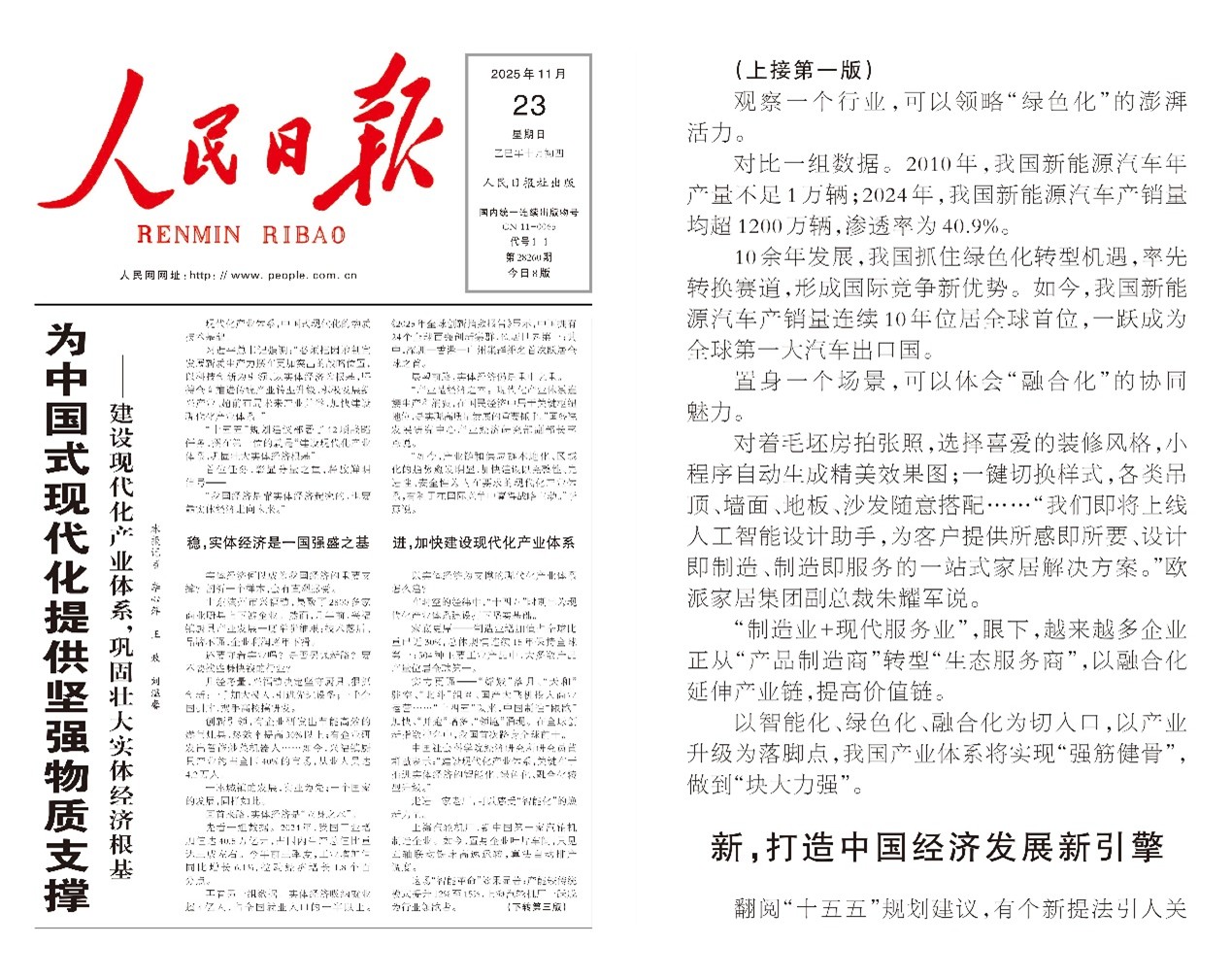
为中国式现代化提供坚强物质支撑——建设现代化产业体系,巩固壮大实体经济根基
Ren Min Ri Bao· 2025-11-23 02:45
Core Viewpoint - The article emphasizes the importance of building a modern industrial system as the material and technological foundation for Chinese-style modernization, highlighting the need for innovation and the strengthening of the real economy [1][5]. Group 1: Importance of the Real Economy - The real economy is identified as the cornerstone of national strength, with a focus on its role in supporting economic growth and employment [3][4]. - In 2024, China's industrial added value reached 40.5 trillion yuan, accounting for about 30% of GDP, with a year-on-year growth of 6.1% in the first three quarters [4]. - The real economy employs over 400 million people, representing more than half of the national employment population [4]. Group 2: Modern Industrial System Construction - The construction of a modern industrial system is crucial for connecting production and consumption, serving as a key pivot in the national economy for achieving high-quality development [5][6]. - The manufacturing sector's added value accounts for nearly 30% of the global total, maintaining the world's largest scale for 15 consecutive years [7]. - The shift towards intelligent, green, and integrated transformations in the real economy is essential for building a modern industrial system [7][10]. Group 3: Emerging Pillar Industries - The article introduces the concept of emerging pillar industries, which combine characteristics of both emerging and pillar industries, playing a significant role in economic growth [12][16]. - By 2025, the added value of strategic emerging industries is expected to exceed 17% of GDP, an increase of approximately 5.3 percentage points from the end of the 13th Five-Year Plan [16]. - The development of new industries such as low-altitude economy is highlighted, with a projected market size of 1.5 trillion yuan in 2023, potentially reaching 3.5 trillion yuan by 2035 [18]. Group 4: Future Outlook - The article stresses the need to optimize traditional industries while proactively planning for future industries, which are seen as potential strategic emerging industries [19]. - The traditional industries currently account for about 80% of the added value in manufacturing, with an estimated market space of 10 trillion yuan to be added in the next five years [19]. - Strengthening the foundation of the real economy and accelerating the construction of a modern industrial system will lay a solid material foundation for Chinese-style modernization [19].
为中国式现代化提供坚强物质支撑——建设现代化产业体系 巩固壮大实体经济根基
Ren Min Ri Bao· 2025-11-22 22:04
Core Viewpoint - The construction of a modern industrial system is essential for China's economic development, emphasizing the importance of the real economy and technological innovation as foundational elements for future growth [1][5]. Group 1: Importance of the Real Economy - The real economy is highlighted as the cornerstone of national strength, with a focus on its role in supporting economic stability and growth [1][3]. - In Shandong's Bingzhou, the local kitchenware industry, which includes over 2,800 enterprises, has transformed through innovation and investment, now accounting for 40% of the national market [2][4]. Group 2: Current Economic Data - In 2024, China's industrial added value is projected to reach 40.5 trillion yuan, constituting about 30% of the GDP, with a year-on-year growth of 6.1% in the first three quarters of the current year [4]. - The real economy employs over 400 million people, representing more than half of the national employment population [4]. Group 3: Future Directions and Strategies - The modern industrial system is crucial for achieving high-quality development, with a focus on localizing and regionalizing industrial and supply chains [5][6]. - The "14th Five-Year Plan" has laid a solid foundation for building a modern industrial system, with China's manufacturing value added accounting for nearly 30% of the global total [6][7]. Group 4: Technological Advancements - The shift towards intelligent, green, and integrated transformations in the real economy is essential for enhancing competitiveness [7][10]. - The "smart revolution" in manufacturing has led to a 12% to 15% increase in productivity, exemplified by Shanghai's turbine manufacturing plant [8]. Group 5: Emerging Pillar Industries - The concept of "emerging pillar industries" combines characteristics of both emerging and traditional industries, playing a significant role in economic growth and technological advancement [12][17]. - By 2025, the added value of strategic emerging industries is expected to exceed 17% of GDP, indicating a substantial increase from previous years [18]. Group 6: Market Opportunities - The low-altitude economy is projected to reach a market size of 1.5 trillion yuan this year, with expectations of growing to 3.5 trillion yuan by 2035 [20]. - The traditional industries, which currently account for about 80% of manufacturing value added, are also expected to see significant market expansion, potentially adding around 10 trillion yuan in the next five years [21].