
人才保

Search documents
宁夏高层次人才可享二十二项清单化服务
Xin Lang Cai Jing· 2026-01-25 19:17
Core Viewpoint - The Ningxia Hui Autonomous Region has revised and issued the "High-level Talent Service Guide" to streamline policies aimed at high-level talents, ensuring that benefits reach them effectively and stimulate their innovation and entrepreneurship [1][3]. Group 1: Policy Overview - The "Service Guide" categorizes high-level talents into five groups (A, B, C, D, E) and outlines specific work and living benefits, including 22 types of services such as title evaluation, research project applications, financial services for innovation and entrepreneurship, spouse placement, healthcare, tourism, public transportation, and vacation [1][2]. - The guide provides a standardized checklist for application materials, processing procedures, completion timelines, responsible departments, and contact information, making it easier for high-level talents to access various benefits [1][2]. Group 2: Financial and Healthcare Services - High-level talents can access financial products like "Talent Loan," "Talent Insurance," "Talent Investment," and "Talent Board," allowing them to apply for low-interest, unsecured loans from commercial banks under controlled risks and sustainable business conditions [2]. - In healthcare, high-level talents can choose from designated medical institutions for annual health check-ups, with A and B category talents receiving a check-up standard of 6,000 yuan per person, while C and D category talents receive 2,000 yuan per person, funded by the regional talent work special fund [2]. Group 3: Additional Benefits - High-level talents can enjoy free admission to scenic spots by presenting their high-level talent certificate and can obtain free public transport cards in designated cities [2]. - A, B, C, and D category talents are eligible for a free vacation service approximately every five years [2]. Group 4: Strategic Importance - The issuance of the "Service Guide" is a significant step in optimizing the talent development ecosystem, effectively addressing the implementation challenges of talent policies and providing solid support for attracting and retaining high-level talents [3].
科技利好!深圳重大发布!
Xin Lang Cai Jing· 2026-01-22 04:32
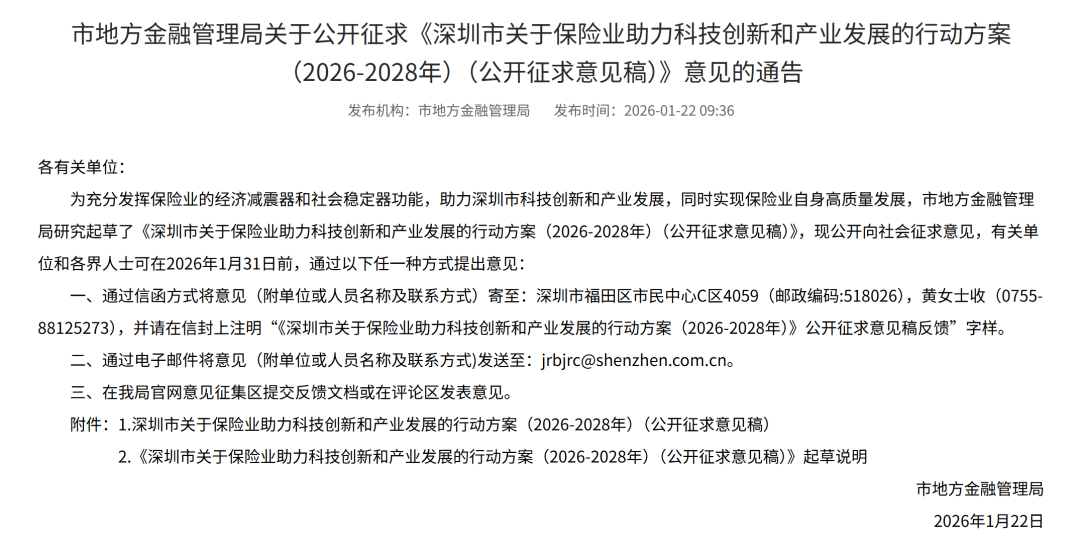
Core Insights - The core viewpoint of the news is the release of the "Action Plan for the Insurance Industry to Support Technological Innovation and Industrial Development (2026-2028)" by the Shenzhen Municipal Financial Management Bureau, which aims to enhance risk protection for technology enterprises and promote the development of the insurance industry in emerging sectors like artificial intelligence and low-altitude economy [1][6]. Group 1: Action Plan Overview - The Action Plan includes sixteen policies targeting various emerging technology fields, proposing to accelerate the development of risk protection measures and products [1][6]. - By the end of 2028, Shenzhen aims for an annual growth rate of over 10% in technology insurance premium income, providing over 5 trillion yuan in risk protection for technology enterprises each year [1][6]. - The total assets of insurance entities in Shenzhen are expected to exceed 11 trillion yuan, with over 700 billion yuan in premium income over three years [1][6]. Group 2: Customized Insurance Services - The Action Plan emphasizes the development of insurance products tailored to the needs of emerging sectors such as artificial intelligence and low-altitude economy [2][7]. - Insurance institutions are encouraged to conduct research in cutting-edge technology areas like humanoid robots and quantum technology, and to innovate insurance product offerings [2][7]. - The establishment of an artificial intelligence insurance innovation center is encouraged to develop comprehensive insurance products covering the entire AI industry chain [2][7]. Group 3: Low-altitude Insurance Development - The Action Plan proposes to expedite the implementation of a liability insurance mechanism for drones and promote mandatory insurance for drone operations [3][8]. - Insurance institutions are encouraged to develop commercial insurance products for high-risk scenarios in low-altitude logistics and eVTOL [3][8]. - The plan also aims to enhance data sharing and monitoring capabilities within the low-altitude industry to improve insurance product pricing and claims processes [3][8]. Group 4: Support for New Energy Vehicle Insurance - The Action Plan seeks to optimize the supply of new energy vehicle insurance and adjust commercial vehicle insurance rates [4][9]. - Insurance institutions are encouraged to collaborate with smart driving developers to refine insurance products based on accumulated risk analysis data [4][9]. - The establishment of standards for repairs and claims in the new energy vehicle sector is also a focus to reduce maintenance costs [4][9]. Group 5: Strengthening Cross-border Insurance Cooperation - The Action Plan highlights the importance of enhancing cooperation between Shenzhen and Hong Kong's insurance industries, particularly in developing medical and pension insurance products [5][10]. - It supports the establishment of a comprehensive service system for enterprises going abroad, utilizing export credit insurance policies [5][10]. - The promotion of a service model for overseas intellectual property risk management is also included, providing a full range of risk solutions [5][10]. Group 6: Continuous Expansion and Quality Improvement of the Insurance Industry - The Action Plan supports the establishment of subsidiaries by domestic and foreign insurance institutions in areas like asset management and healthcare [11]. - It encourages the creation of insurance innovation centers focused on key sectors to better serve technological innovation and industrial development [11]. - The plan promotes digital transformation within insurance institutions to enhance operational management capabilities [11].
深圳重磅发布!
Zhong Guo Ji Jin Bao· 2026-01-22 04:06
Core Insights - The article discusses Shenzhen's new action plan aimed at leveraging the insurance industry to support technological innovation and industrial development from 2026 to 2028 [1][11]. Group 1: Action Plan Overview - The action plan outlines sixteen measures to enhance insurance support for technology innovation and industrial development, with specific responsibilities assigned to various units [3][4]. - The plan aims to establish a modern insurance service system aligned with Shenzhen's economic development, supporting strategic emerging industries and enhancing financial cooperation with Hong Kong [4][12]. Group 2: Goals and Targets - By the end of 2028, the plan targets an annual risk coverage of over 5 trillion yuan for technology enterprises, with an average annual growth rate of over 10% in technology insurance premium income [4][12]. - The total assets of insurance entities in Shenzhen are expected to exceed 11 trillion yuan, with total premium income surpassing 700 billion yuan over three years [5][13]. Group 3: Specific Measures - The plan includes optimizing insurance fund utilization, promoting technology insurance, and enhancing support for the "20+8" strategic emerging industry clusters [6][14]. - It encourages insurance institutions to invest over 1 trillion yuan in Shenzhen, focusing on key sectors such as artificial intelligence, biotechnology, and low-altitude economy [6][7]. Group 4: Collaboration and Innovation - The action plan emphasizes collaboration between the insurance industry and various sectors, including the establishment of insurance innovation centers and the development of tailored insurance products for emerging technologies [8][15]. - It also highlights the importance of enhancing the insurance service system for the marine industry and promoting cross-border insurance cooperation with Hong Kong [17][19]. Group 5: Support and Coordination - The plan outlines measures to strengthen organizational coordination and promote public awareness of insurance policies and products [21][22]. - It aims to facilitate the integration of insurance services with industrial needs, enhancing the efficiency and effectiveness of insurance offerings [21][22].

北京出台政策支持青年人才创新创业
Ren Min Ri Bao· 2025-10-29 20:58
Core Viewpoint - Beijing has introduced measures to support young talent in innovation and entrepreneurship through various policy initiatives aimed at addressing housing, financial support, and service improvements [1][2] Group 1: Housing and Living Support - The policy aims to provide approximately 30,000 youth talent apartments with targeted rent reductions to alleviate high living and office space costs [1] - Young talents renting these apartments can withdraw their housing provident fund based on actual rent paid, without deposit limits, and some may benefit from "direct rent payment" services [1] - The initiative also includes activating idle resources to offer 3 million square meters of free or low-cost office space [1] Group 2: Financial Support - The policy encourages districts to establish a youth talent development fund with a total scale of around 30 billion yuan, guiding financial institutions to innovate products like "talent investment," "talent loans," "talent insurance," and others [1] - This aims to create a comprehensive financial service chain that supports the initial development of enterprises [1] Group 3: Government Services - To enhance government services, the policy proposes assigning 3,000 dedicated service managers to startups led by young talents, providing "one-on-one" and "fast track" services for policy consultation, business processing, and government affairs coordination [1] - This approach aims to address pain points related to policy accessibility and usability [1] Group 4: Community and Cultural Development - Beijing plans to create around 20 innovation and entrepreneurship districts in areas where young talents gather, integrating various functions such as talent apartments, incubation spaces, investment, and recreational facilities [2] - The city will also design "City Walk" routes and organize activities like mountain hiking and river rafting to foster a livable and workable urban environment [2]

“青创十条”润泽青年人才创新创业沃土
Bei Jing Qing Nian Bao· 2025-10-20 03:09
Core Points - Beijing has introduced the "Ten Measures to Further Support Youth Talent Innovation and Entrepreneurship" to enhance housing security, entrepreneurial space, and government services for young talents [1][2] - The initiative aims to create a favorable environment for youth innovation and entrepreneurship, reflecting Beijing's commitment to improving the talent development ecosystem [1][2] - The measures include the establishment of a youth talent development fund with a total scale of approximately 30 billion yuan to address funding challenges faced by young entrepreneurs [1][2] Group 1 - The "Ten Measures" will provide 3 million square meters of office space for young entrepreneurs at low or no cost, significantly reducing their operational burdens [2] - A dedicated service team of 3,000 will be assigned to assist young startups, offering personalized support to enhance their entrepreneurial experience [2] - The initiative emphasizes the importance of nurturing young talent, with at least 70% of city-level talent plans directed towards supporting young individuals [2] Group 2 - The measures include the provision of around 30,000 affordable apartments for young talents, with rent reductions or subsidies to ensure they can live comfortably while pursuing their careers [2] - Successful implementation of these policies requires continuous effort from various departments to ensure they meet the needs of young talents effectively [3] - The initiative aims to foster a supportive environment for youth innovation and entrepreneurship, ultimately benefiting both the talents and the city [3]
北京“青创十条”发布,三百万平米空间助青年创业
Bei Ke Cai Jing· 2025-10-17 07:15
Core Viewpoint - China is transitioning from a "demographic dividend" to a "talent dividend," with youth talent becoming a driving force for innovation and high-quality development in the capital. The "Several Measures to Further Support Youth Talent Innovation and Entrepreneurship" (referred to as "Youth Innovation Ten Measures") was released on October 17, marking a new phase in the support system for youth talent innovation and entrepreneurship in Beijing [1]. Group 1: Supportive Measures for Youth Entrepreneurs - The "Youth Innovation Ten Measures" is a systematic refinement of experiences from pilot areas in Haidian, Changping, and the Economic Development Zone, aimed at creating a supportive ecosystem for youth entrepreneurs [1]. - The measures address key concerns of youth entrepreneurs, such as high office rental costs and the need for comprehensive professional guidance, with 52.2% of youth citing high costs as a challenge and 53.6% seeking full-process support [2]. - Beijing is providing 3 million square meters of office space at low or no cost to youth startups, with specific initiatives in districts like Haidian and Fengtai offering significant free or discounted space [2]. Group 2: Financial Support and Capital Access - A significant challenge for youth entrepreneurs is the lack of funding, with 62.1% identifying it as their biggest issue. In response, Beijing is building a "patient capital" financial system to support innovation [3][4]. - The city has implemented financial policies to guide capital towards long-term investments, encouraging the establishment of a youth talent development fund with a total scale of around 30 billion yuan [4]. - Financial products tailored for youth entrepreneurs, such as "talent loans" and "talent insurance," are being introduced to create a comprehensive financial service chain [4]. Group 3: Platforms for Display and Practice - To enhance visibility for youth projects, Beijing is creating platforms for showcasing talent and projects, including competitions specifically for youth entrepreneurs [6]. - The city is promoting deep integration of industry, education, and research, establishing bases for practical training in fields like AI and biomedicine, and organizing entrepreneurial training camps [7]. - Initiatives like the "HICOOL" competition and "Overseas Talents Beijing Tour" aim to attract global youth talent and provide them with practical experiences [6]. Group 4: Creating a Vibrant Ecosystem - Beijing is focusing on building vibrant neighborhoods and collaborative spaces to foster innovation, with new types of communication venues being established around universities and research institutions [8]. - The city is developing "youth entrepreneurship bases" linked to major transportation lines, creating dynamic environments for startups [8]. - Community initiatives are being launched to support youth networking and collaboration, including the establishment of "youth talent lounges" for events and discussions [9].

湖州银行:金融支持市场主体抗疫稳增长八条政策举措
Xin Hua Wang· 2025-08-12 06:26
Core Viewpoint - Huzhou Bank is implementing a series of financial support measures to assist market entities in stabilizing growth and recovering from the impacts of the pandemic, in alignment with government directives [2][3]. Group 1: Financial Support Measures - The bank has allocated 5 billion yuan in special funds to prioritize credit support for small and micro enterprises, agriculture, and individual businesses affected by the pandemic [5]. - Huzhou Bank is promoting innovative credit products such as "no repayment renewal loans" and various specialized loans to meet the financial service needs of clients during the pandemic [7]. - The bank is reducing fees and providing low-cost loans to small and micro enterprises significantly impacted by the pandemic, while also waiving overdue interest and penalties for affected clients [8]. Group 2: Loan Management and Assistance - The bank supports businesses and individuals facing repayment difficulties due to the pandemic by allowing a three-month grace period for loan repayments, with the possibility of further extensions based on the pandemic situation [10]. - For clients who have overdue credit due to hospitalization or loss of income related to COVID-19, the bank allows for the adjustment of overdue credit records upon approval [12]. - Huzhou Bank is enhancing support for severely impacted sectors such as culture, tourism, and hospitality by collaborating with local platforms to distribute consumer coupons and providing full fee subsidies for payment processing during specific periods [13]. Group 3: Fast-Track Financing and Risk Management - The bank is prioritizing financing needs for enterprises involved in pandemic prevention, ensuring rapid approval processes for related medical and logistical support [15]. - Huzhou Bank is committed to not blindly withdrawing or reducing loans for severely affected industries, actively providing reasonable renewal support [15]. - The bank is improving its internal mechanisms to facilitate loan extensions for affected clients and is increasing the risk tolerance for small and micro enterprises to encourage loan disbursement [17].

政府性融资担保精准发力
Jin Rong Shi Bao· 2025-08-08 07:52
Core Viewpoint - The Chinese government emphasizes support for technological innovation, green development, consumption, and small and micro enterprises, highlighting the importance of government financing guarantees in alleviating financing difficulties for these sectors [1][5]. Group 1: Government Financing Guarantees - The State Council has issued guidelines to enhance the role of government financing guarantees, focusing on inclusive finance and optimizing services for small and micro enterprises, rural revitalization, and social welfare [1][3]. - The recent issuance of the "Government Financing Guarantee Development Management Measures" provides clear guidance for the operation of financing guarantee institutions, aiming to better serve small and micro enterprises and the agricultural sector [1][3]. Group 2: Challenges and Innovations - Small and micro enterprises face long-standing financing challenges due to their small scale, weak risk resistance, and lack of effective collateral, which also affects the agricultural sector [1][3]. - Financing guarantee institutions are innovating in product offerings and service models, collaborating with banks to streamline loan approval processes and improve financing efficiency [3][4]. - Experts point out existing issues in the financing guarantee system, such as low compensation rates and inadequate coverage for small enterprises, indicating a need for improvement [3][4]. Group 3: Future Directions - There is a call to enhance assessment and guidance for small micro financing guarantees, increase risk tolerance, and innovate financing models tailored to regional industries [4][5]. - The Zhejiang Provincial Guarantee Group aims to align its operations with the government's goals for high-quality development, focusing on supporting technological innovation through specialized guarantee products [4][5]. - The role of government financing guarantees is becoming increasingly vital in supporting small and micro enterprises, rural revitalization, and overall economic development in China [5][6].