
人民币跨境同业融资

Search documents
人民币跨境同业融资新规发布
Xiangcai Securities· 2026-03-01 12:20
Investment Rating - Industry rating: Overweight (maintained) [4] Core Insights - The recent issuance of regulations on RMB cross-border interbank financing by the People's Bank of China aims to support domestic banks in conducting RMB cross-border interbank financing with foreign institutions, enhancing the development of the offshore RMB market [6][32]. - The new regulations will improve the rules and transparency of RMB cross-border interbank financing management, facilitating stable liquidity supply in the offshore RMB market [8][34]. - The macro-prudential management parameters set in the new regulations consider market demand and banking operations, promoting a risk-neutral approach for banks [34]. Summary by Sections Industry Performance - Over the past twelve months, the industry has shown relative returns of -0.2%, -14.1%, and -19.3%, with absolute returns of -0.1%, -9.8%, and -0.6% [5]. Market Review - The banking index fell by 0.92% during the period from February 23 to March 1, 2026, underperforming the CSI 300 index by 2.00 percentage points [12]. Investment Recommendations - The decline in bank funding costs is expected to stabilize interest margins, supported by policies that enhance asset quality, leading to relatively stable operating performance [10][35]. - Current high dividend yields in bank stocks present significant allocation value, with potential for valuation recovery amid market adjustments [10][35]. - Recommended banks include Industrial and Commercial Bank of China, Bank of China, CITIC Bank, Jiangsu Bank, Shanghai Rural Commercial Bank, Chongqing Rural Commercial Bank, Suzhou Bank, and Changshu Bank [10][35].
人民币跨境同业融资管理升级 农村金融机构有条件参与
2 1 Shi Ji Jing Ji Bao Dao· 2026-02-27 09:15
Core Viewpoint - The People's Bank of China (PBOC) issued a notification to regulate the cross-border interbank financing business in RMB, aiming to support the development of the offshore RMB market and enhance the scientific management and transparency of cross-border capital flows [1][2]. Summary by Relevant Sections Business Regulation - The notification establishes three main aspects for regulating RMB cross-border interbank financing: 1. It emphasizes the principle of "substance over form," including all RMB financing activities with substantial creditor-debtor relationships between domestic banks and foreign institutions [4]. 2. It introduces a counter-cyclical adjustment mechanism linking the net financing outflow balance to the capital level and funding strength of domestic banks, allowing for adjustments based on market conditions [4]. 3. It supports domestic banks in conducting business in accordance with market demand and legal compliance, requiring banks to have strong international settlement capabilities and robust risk management systems [4]. Applicable Institutions - The notification applies to domestic banks legally established with international settlement capabilities, including state-owned banks, foreign-owned banks, and joint-venture banks. It specifies that rural financial institutions generally should not engage in RMB cross-border interbank lending, although some qualified institutions may participate cautiously [5][6]. Risk Management and Limits - The notification sets a cap on the net financing outflow balance, which is linked to the bank's capital or funding strength, and allows for dynamic adjustments based on macro-prudential management parameters. For domestic banks, the cap is calculated as the net capital multiplied by adjustment parameters [7]. - Certain types of business, such as those based on genuine trade financing and loans to foreign enterprises through foreign banks, are excluded from the net financing outflow balance calculation to better serve the real economy [8]. Implementation and Future Steps - The PBOC aims to ensure that the notification aligns with existing RMB cross-border interbank financing management policies, without creating new business types. The implementation will be gradually advanced to enhance the service of cross-border interbank financing to the real economy and promote the healthy development of the offshore RMB market [9].

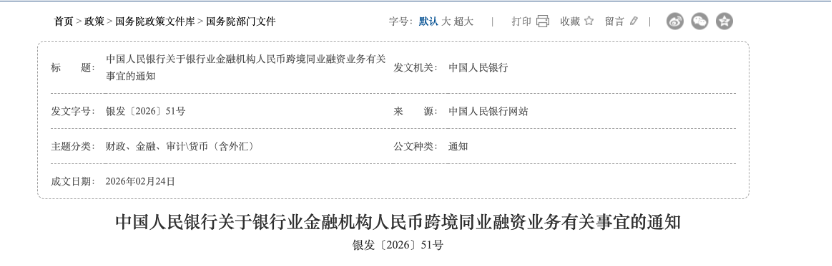
人民币跨境同业融资管理升级,农村金融机构有条件参与
2 1 Shi Ji Jing Ji Bao Dao· 2026-02-27 09:03
Core Viewpoint - The People's Bank of China (PBOC) issued a notification to regulate the cross-border interbank financing business in RMB, aiming to support the development of the offshore RMB market and enhance the management of cross-border capital flows [1][2]. Group 1: Business Regulation - The notification covers RMB cross-border interbank financing, which includes various forms such as account financing and bond repurchase, serving as a crucial link between onshore and offshore markets [2][3]. - It introduces a counter-cyclical adjustment mechanism linking the net financing balance of RMB cross-border interbank financing to the capital level and funding strength of domestic banks, allowing for adjustments based on market conditions [3][7]. - The notification emphasizes that banks should possess strong international settlement capabilities and establish sound risk management and internal control mechanisms [3][4]. Group 2: Applicable Institutions - The notification applies to domestic banks legally established with international settlement capabilities, including state-owned banks, foreign-owned banks, and joint-venture banks [4]. - Rural financial institutions are generally prohibited from engaging in RMB cross-border interbank lending, but those meeting certain qualifications may participate cautiously [4][6]. Group 3: Net Financing Balance Limits - The notification sets a limit on the net financing balance for RMB cross-border interbank financing, which is linked to the bank's capital or funding strength and can be dynamically adjusted based on macro-prudential management parameters [7][8]. - For domestic banks, the upper limit is calculated as the net capital multiplied by the cross-border business adjustment parameter and the macro-prudential adjustment parameter [7]. - The PBOC requires banks to ensure that the net financing balance does not exceed the established limits at any given time [8]. Group 4: Exclusions from Net Financing Balance Calculation - Certain types of business are excluded from the net financing balance calculation, including those based on genuine trade financing and loans to foreign enterprises through offshore banks [9]. - Additionally, financing activities conducted with offshore RMB clearing banks are also excluded, provided they follow specific guidelines [9]. Group 5: Implementation and Future Steps - The PBOC aims to implement the notification in a manner that aligns with existing RMB cross-border interbank financing management policies, without creating new business types [10]. - Future steps will focus on gradually implementing the notification to enhance the service of cross-border interbank financing to the real economy and promote the healthy development of the offshore RMB market [10].
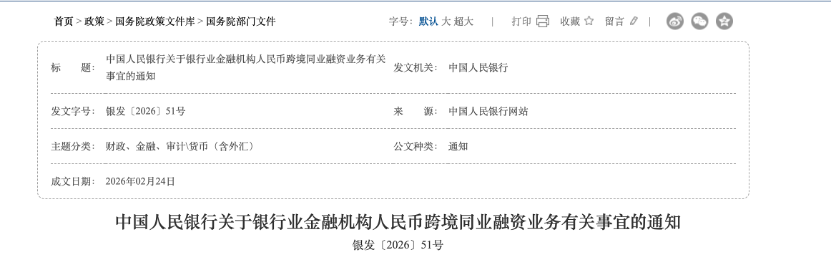
增强人民币融资功能 完善跨境资金双向流动宏观审慎管理
Jin Rong Shi Bao· 2026-02-27 00:48
Core Viewpoint - The People's Bank of China has officially released a notice to support domestic banks in conducting cross-border RMB interbank financing, enhancing the capital account openness and promoting the use of RMB in international markets [1][6]. Group 1: Coverage of Various Businesses - The notice covers all types of RMB cross-border interbank financing, adapting to market development needs by unifying various financing activities under a single regulatory framework [2][3]. - It allows domestic banks to flexibly manage their business structures within the net lending limit, promoting innovation while ensuring regulatory compliance [2][3]. Group 2: Management and Risk Control - The new regulation enhances banks' autonomy, providing a more stable RMB liquidity to offshore markets and improving the balance of RMB supply and demand [3][4]. - The notice requires that the business be managed by the bank's headquarters, establishing robust risk management and internal control mechanisms to ensure controllable risks [3][4]. Group 3: Macro-Prudential Management - The notice introduces a counter-cyclical adjustment mechanism for cross-border capital flows, linking the net lending limit to the bank's tier-one capital net amount [4][5]. - It emphasizes that banks should ensure their net lending does not exceed the established limits, promoting stability in providing RMB liquidity to offshore markets [4][5]. Group 4: Enhancing RMB Financing Functionality - The notice aims to enhance the RMB financing function and improve the macro-prudential management of cross-border capital flows, responding to the increasing demand for RMB liquidity in offshore markets [6][7]. - It supports banks in providing liquidity to offshore markets, which is expected to stimulate overseas RMB financing demand and facilitate the use of RMB in cross-border trade and investment [6][7].