
代建

Search documents
出险房企化债超1.2万亿元 行业风险出清进程加速
Zheng Quan Ri Bao· 2025-10-30 16:41
Core Insights - The real estate companies in distress have made substantial progress in debt restructuring, with a total debt reduction scale of approximately 1.2 trillion yuan as of October 30, involving 21 companies [1] - The restructuring efforts are expected to alleviate short-term debt repayment pressures and facilitate a safer operational environment for these companies, thereby accelerating the overall risk clearance process in the real estate sector [1][2] Group 1: Debt Restructuring Progress - As of October 30, 21 distressed real estate companies have received approval for debt restructuring, with a total debt scale nearing 2 trillion yuan [1] - Companies such as Sunac China Holdings, Guangzhou R&F Properties, and CIFI Holdings have completed their debt restructuring, while others like Kaisa Group and Country Garden have received approval for overseas debt restructuring [1] - The restructuring methods employed include debt-to-equity swaps, asset swaps, and full-term extensions, significantly reducing the debt burden for many companies [2] Group 2: Impact on Industry and Companies - The concentration of debt restructuring among distressed companies indicates a faster risk clearance in the industry, which is beneficial for the overall credit environment [2] - Post-restructuring, many companies are accelerating their delivery processes and shifting their strategic focus towards light asset businesses such as property management and asset management [2][3] - The transition from incremental development to stock asset management is seen as a reasonable path for companies to revitalize resources and improve operational efficiency [3] Group 3: Future Outlook - The development of light asset businesses is expected to be a crucial support for distressed companies to overcome challenges, as operational efficiency and service capabilities become more important than capital scale [3] - Companies that successfully complete debt restructuring and enhance their operational efficiency are likely to achieve stable operations and sustainable development, contributing to a healthier and more stable real estate market [3]
出险房企近2万亿债务进入安全期,加速房地产风险出清进程
3 6 Ke· 2025-10-30 08:36
Core Viewpoint - A total of 21 distressed real estate companies have completed or received approval for debt restructuring, with a total debt reduction scale of approximately RMB 1.2 trillion, significantly alleviating their short-term debt repayment pressure and entering a safer period [1][2]. Debt Restructuring Overview - As of October 2025, companies such as Sunac, R&F, Aoyuan, and others have completed domestic and overseas debt restructuring, with the total amount of debt nearing RMB 2 trillion [2]. - The restructuring efforts will accelerate the overall risk clearance process in the real estate sector [2]. Debt Reduction Methods - Distressed companies are employing various methods to reduce debt, including debt-to-equity swaps, asset offsets, and full-term extensions, aimed at lowering actual debt burdens and improving balance sheets [6]. - For instance, Longguang's domestic debt restructuring plan includes cash offers, debt-to-equity swaps, and asset offsets [6]. Debt Reduction Ratios - Some companies have publicly disclosed their overseas debt restructuring plans, with debt reduction ratios ranging from 40% to 70%. Longguang achieved a 70% reduction in overseas debt after restructuring [9]. - Sunac's overseas debt underwent a second restructuring, resulting in a total debt reduction of approximately USD 9.55 billion [11]. Strategic Focus Post-Restructuring - After completing debt restructuring and ensuring project delivery, many distressed companies are shifting their focus to light asset businesses, such as construction agency, property management, and asset management [12]. - This strategic pivot allows companies to recover their "blood-making" capabilities with minimal capital investment while leveraging their existing core competencies [12]. Development Strategies - Companies like Jinke and Xuhui are actively seeking to transform their business models, focusing on light asset operations and low-debt, high-quality development [13]. - The industry is transitioning from incremental development to stock operation, with significant opportunities in property and asset management sectors [12].



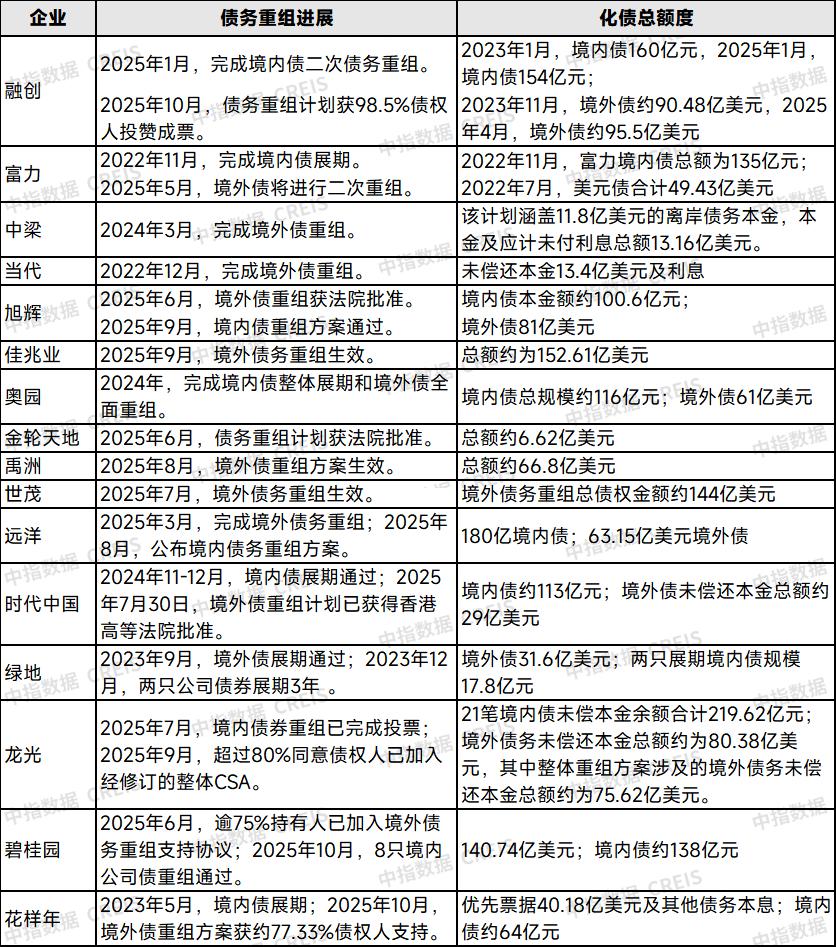
中指研究院:出险房企近2万亿元债务进入安全期
Zheng Quan Shi Bao Wang· 2025-10-30 07:10
Core Insights - 21 distressed real estate companies have undergone debt restructuring or reorganization, with a total debt reduction scale of approximately RMB 1.2 trillion, indicating a significant step towards risk clearance in the real estate sector [1] - The total interest-bearing liabilities of these companies are close to RMB 2 trillion, suggesting manageable short-term repayment pressures and a transition into a safer period [1] Group 1: Debt Restructuring Details - Companies that have completed domestic and overseas debt restructuring include Sunac, R&F, Aoyuan, and others, with notable approvals for overseas debt restructuring from companies like Kaisa and Greenland [1] - Typical methods for debt restructuring include debt-to-equity swaps, asset offsets, and full-term extensions, aimed at reducing actual debt burdens and improving balance sheets [1][2] - For instance, Longguang's domestic debt restructuring involved cash tender offers, debt-to-equity swaps, and asset offsets, while its overseas debt restructuring utilized cash payments and convertible bonds [1] Group 2: Debt Reduction Ratios - Some companies have publicly disclosed their overseas debt restructuring plans, with debt reduction ratios ranging from 40% to 70%, exemplified by Longguang achieving a 70% reduction [2] - Sunac's second round of overseas debt restructuring resulted in a complete debt reduction, while its domestic debt restructuring achieved over 50% reduction [2] - Other companies like CIFI, Kaisa, Aoyuan, and Shimao also reported debt reduction ratios exceeding 50% following their restructuring efforts [2] Group 3: Strategic Focus Post-Restructuring - After ensuring project delivery and completing debt restructuring, many distressed companies are shifting their focus towards light asset businesses, such as property management and asset management [2] - This strategic pivot is due to the ongoing pressure on their balance sheets, as light asset businesses require less capital investment and do not increase interest-bearing liabilities, aiding in recovery [2] - The core competencies of these companies, including product strength and brand influence, remain intact, providing a solid foundation for transitioning to resource revitalization and operational management [2]