
行业风险出清

Search documents
珠海万达商管任命许粉担任CEO;花样年境外债务重组香港会议下月召开|房产早参
Mei Ri Jing Ji Xin Wen· 2026-01-18 23:12
Group 1: Policy Changes - The minimum down payment ratio for commercial property loans has been adjusted to no less than 30% [1] - Local financial authorities can set lower limits for down payment ratios based on city-specific policies [1] - This policy change is expected to create opportunities for inventory reduction, business upgrading, and financing innovation in the commercial real estate market [1] Group 2: Corporate Leadership Changes - Zhuhai Wanda Commercial Management appointed Xu Fen as CEO, who previously served as COO [2] - Xu Fen outlined eight operational strategies focusing on long-termism, incremental expansion, product strength, and competitive breakthroughs [2] - This leadership change reflects a broader trend of governance optimization and transformation within the commercial real estate sector [2] Group 3: Asset Sales and Financial Restructuring - Oriental Yuhong announced plans to sell certain real estate and debt assets, expecting a disposal loss of 29.04 million yuan [3] - The asset sales are part of a strategy to optimize asset structure and focus on core business amid industry challenges [3] - This approach represents a "short-term pain for long-term rebirth" strategy for building material companies [3] Group 4: Debt Restructuring Initiatives - Fantasia Holdings is entering a critical phase of its debt restructuring process with a creditor meeting scheduled for February 20, 2026 [4] - This marks a significant step in addressing the company's prolonged debt issues, which is crucial for its survival and the broader industry's debt resolution [4] Group 5: Internal Debt Restructuring - Likao Group announced a debt settlement framework agreement with its subsidiary, involving the transfer of assets worth 159 million yuan [5] - The transaction aims to resolve liquidity issues faced by the group due to a prolonged downturn in the real estate market [5] - This internal restructuring is seen as a strategic move to enhance resource integration and prepare for future debt restructuring [5]
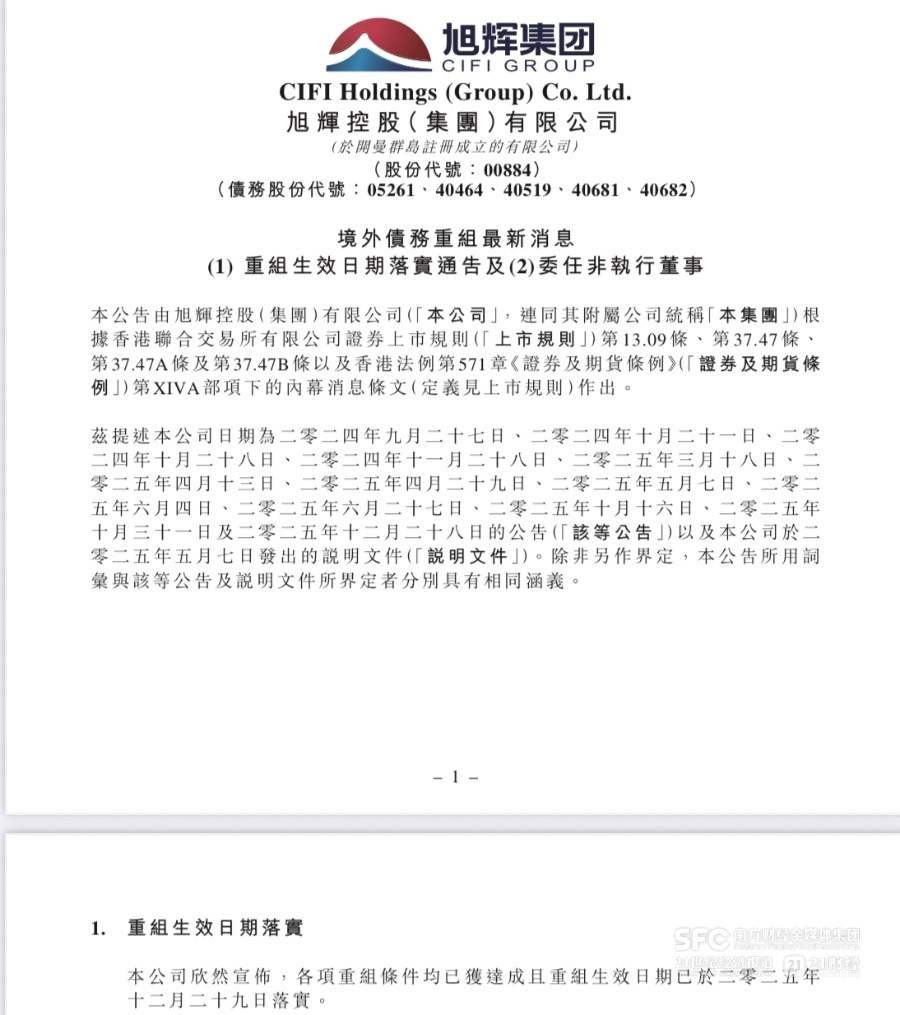
旭辉境外债重组生效 今年房企实现化债1.2万亿
2 1 Shi Ji Jing Ji Bao Dao· 2025-12-31 04:16
Core Viewpoint - The completion of debt restructuring by major private enterprises like CIFI Holdings marks a significant milestone in the real estate industry's debt resolution process, but the industry still faces multiple challenges ahead [1][9]. Group 1: Debt Restructuring Details - CIFI Holdings announced the effectiveness of its overseas debt restructuring plan, concluding a three-year process involving both domestic and international debts, totaling approximately 66.76 billion RMB [3]. - The overseas debt restructuring covers a total principal and interest amount of 8.1 billion USD (about 56.7 billion RMB), achieving a debt reduction of 38 billion RMB, with a debt reduction ratio of 67% [3]. - The domestic debt restructuring is expected to reduce over 5 billion RMB of debt through various methods, with a two-year exemption from principal and interest payments [3][4]. Group 2: Industry Trends and Implications - The successful debt restructuring of CIFI, along with other major players like Sunac and Country Garden, indicates a trend towards debt resolution in the real estate sector, with a total of approximately 1.2 trillion RMB in debt restructuring completed by about 21 distressed companies in 2025 [8]. - The industry is witnessing a shift towards two main debt resolution paths: the "coordinated restructuring" model represented by CIFI and Sunac, and the "judicial reorganization" model exemplified by Kaisa, providing valuable case studies for other distressed firms [8]. Group 3: Future Challenges - Despite the progress in debt restructuring, the industry is entering a critical phase where companies must navigate three major challenges: operational efficiency, transformation towards asset-light models, and securing long-term financing [10]. - The upcoming year is expected to be pivotal for the real estate sector, as companies that have completed debt restructuring will need to focus on converting inventory into cash flow and restoring market confidence [9][10].

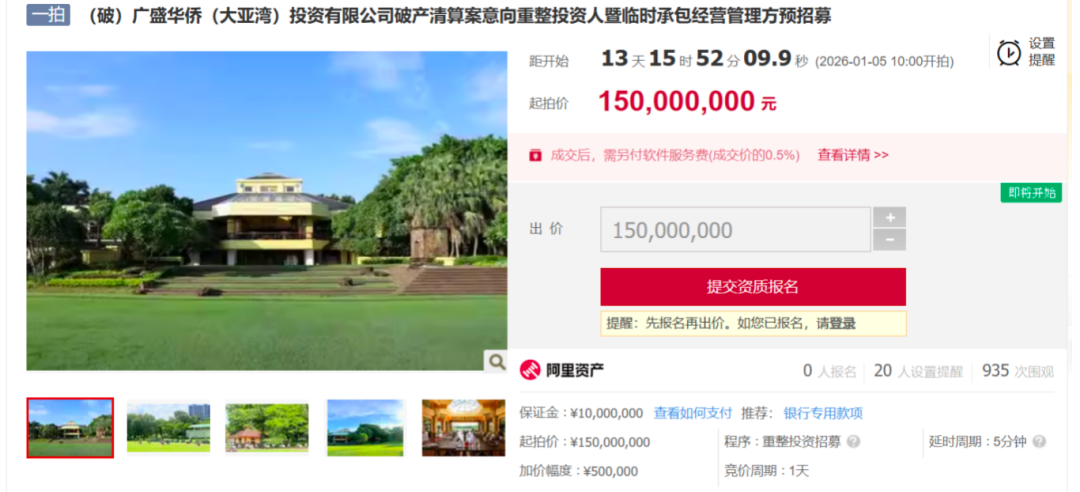
恒大资产处置新动向:高球场、主题乐园等打折拍卖,金融债权“地板价”转让
Mei Ri Jing Ji Xin Wen· 2025-12-30 22:37
Group 1 - Evergrande's assets are entering a concentrated disposal phase, with the auction of the Palm Island Golf Course and related assets scheduled for January 5, 2026, starting at a price of 150 million yuan [1][2] - The Palm Island project has a land use area of approximately 991,700 square meters and was originally developed by Guangsheng Overseas Chinese (Daya Bay) Investment Co., Ltd. in 1997 [5] - The project has an estimated value of 263 million yuan and a liquidation value of 131 million yuan, with additional costs for the winning bidder including employee salaries and temporary rental fees [5][6] Group 2 - Some assets of Changsha Evergrande Children's World have already been disposed of, with three entertainment and sports land parcels sold for 283 million yuan, significantly below the estimated value of 505 million yuan [7][8] - The project was initially planned as the world's largest fairy tale theme park but has been stalled due to Evergrande's liquidity crisis [10] - Other Evergrande Children's World projects across the country have also been revitalized, with various local entities taking over the land parcels [10] Group 3 - Financial debt and related land disposals are also progressing, with institutions like Minsheng Bank and Great Wall Asset Management actively transferring Evergrande's debts [11] - A debt package worth 2.36 billion yuan was sold for 319 million yuan, reflecting a significant discount of approximately 1.35 times [11][14] - The overall discount on asset disposals indicates a broader trend in the real estate industry regarding the pricing of non-performing assets, which is influenced by market recovery, asset quality, and policy support [14]
英大证券晨会纪要-20251211
British Securities· 2025-12-11 03:22
Market Overview - The A-share market experienced volatility with a "V-shaped" reversal on Wednesday, driven by a surge in a leading real estate company's stock, which boosted market sentiment [2][10] - The current market is characterized by technical resistance above and policy support below, indicating a likely path of repeated fluctuations and potential upward movement [2][10] - Recent data from the National Bureau of Statistics shows a 0.7% year-on-year increase in CPI for November, suggesting marginal improvement in domestic demand [2][10] Sector Analysis Precious Metals - The precious metals sector saw significant gains, attributed to factors such as the onset of a Fed rate cut cycle, increased geopolitical tensions, and strong demand from global central banks [6] - The weakening dollar and inflation concerns have led investors to view gold as a hedge against inflation, with rising demand for gold in technology applications further supporting this trend [6] Hainan Free Trade Zone - Stocks related to the Hainan Free Trade Zone were notably active, with multiple stocks hitting the daily limit up. The upcoming full island closure operation on December 18 is expected to enhance market activity [7] - The new policies will allow for freer movement of goods within Hainan while maintaining controlled access from the mainland, which is anticipated to benefit related stocks [7] Real Estate - The real estate sector experienced a rebound, driven by the upcoming discussion on debt restructuring for a leading real estate company and ongoing supportive policies from the government [8] - The industry is expected to see a gradual alleviation of risks, with a focus on high-quality companies that have strong land reserves and are returning to stable growth [8] Investment Strategy - Investors are advised to focus on low-entry opportunities across various sectors, including technology growth (semiconductors, AI themes, robotics), cyclical industries (solar, batteries, chemicals), and dividend stocks (banks, utilities) [3][10] - It is recommended to select stocks with strong earnings support while avoiding high-valuation stocks lacking performance backing [3][10]
出险房企化债超1.2万亿元 行业风险出清进程加速
Zheng Quan Ri Bao· 2025-10-30 16:41
Core Insights - The real estate companies in distress have made substantial progress in debt restructuring, with a total debt reduction scale of approximately 1.2 trillion yuan as of October 30, involving 21 companies [1] - The restructuring efforts are expected to alleviate short-term debt repayment pressures and facilitate a safer operational environment for these companies, thereby accelerating the overall risk clearance process in the real estate sector [1][2] Group 1: Debt Restructuring Progress - As of October 30, 21 distressed real estate companies have received approval for debt restructuring, with a total debt scale nearing 2 trillion yuan [1] - Companies such as Sunac China Holdings, Guangzhou R&F Properties, and CIFI Holdings have completed their debt restructuring, while others like Kaisa Group and Country Garden have received approval for overseas debt restructuring [1] - The restructuring methods employed include debt-to-equity swaps, asset swaps, and full-term extensions, significantly reducing the debt burden for many companies [2] Group 2: Impact on Industry and Companies - The concentration of debt restructuring among distressed companies indicates a faster risk clearance in the industry, which is beneficial for the overall credit environment [2] - Post-restructuring, many companies are accelerating their delivery processes and shifting their strategic focus towards light asset businesses such as property management and asset management [2][3] - The transition from incremental development to stock asset management is seen as a reasonable path for companies to revitalize resources and improve operational efficiency [3] Group 3: Future Outlook - The development of light asset businesses is expected to be a crucial support for distressed companies to overcome challenges, as operational efficiency and service capabilities become more important than capital scale [3] - Companies that successfully complete debt restructuring and enhance their operational efficiency are likely to achieve stable operations and sustainable development, contributing to a healthier and more stable real estate market [3]