
轻资产业务

Search documents
华润万象生活(01209):核心净利润维持两位数增长,连续三年实现100%派息率
CMS· 2026-03-31 08:05
Investment Rating - The report maintains a "Strong Buy" rating for China Resources Vientiane Life (01209.HK) with a target price of HKD 52.6 per share, indicating a potential upside from the current price of HKD 44.16 per share [1][4]. Core Insights - The company has achieved a core net profit growth of 14% in 2025, maintaining a 100% dividend payout ratio for three consecutive years. The total revenue, gross profit, and net profit attributable to shareholders for 2025 were CNY 18.02 billion, CNY 6.41 billion, and CNY 3.97 billion, respectively, representing year-on-year growth of 5%, 13%, and 10% [2][3]. - The growth in revenue is primarily driven by the commercial channel, which generated CNY 6.91 billion in revenue, up 10% year-on-year. The property channel saw a modest increase of 1% to CNY 10.85 billion, while the ecosystem business surged by 73% to CNY 270 million [2][9]. - The overall gross margin improved by 2.5 percentage points to 35.5%, with the commercial channel's gross margin rising by 2.9 percentage points to 63.1% [2][10]. Financial Performance - The projected earnings per share (EPS) for 2026, 2027, and 2028 are CNY 1.94, CNY 2.15, and CNY 2.37, respectively, reflecting year-on-year growth of 11%, 11%, and 10% [1][10]. - The company’s total revenue is expected to grow from CNY 17.15 billion in 2024 to CNY 21.51 billion by 2028, with a compound annual growth rate (CAGR) of approximately 6% [3][12]. - The return on equity (ROE) is projected to be 25.7% in 2025, with a gradual decline to 23.5% by 2028, indicating strong profitability [4][12]. Business Segments - In the commercial channel, the shopping center segment achieved a retail sales growth of 24% in 2025, with the overall revenue from this segment reaching CNY 4.77 billion, a 13% increase year-on-year [9]. - The office segment reported a revenue of CNY 2.14 billion, up 3% year-on-year, while the gross margin slightly decreased to 34.5% [9]. - The property channel experienced a slight revenue decline of 1% to CNY 8.81 billion, but the overall gross margin improved to 19.0% [10]. Valuation Metrics - The current price-to-earnings (PE) ratios for 2026, 2027, and 2028 are projected at 20.1, 18.2, and 16.5, respectively, suggesting a favorable valuation compared to historical averages [3][12]. - The price-to-book (PB) ratio is expected to decrease from 5.4 in 2024 to 3.9 by 2028, indicating an attractive valuation as the company grows [4][12].
中信证券(600030):境内外优势显著 杠杆提升业绩回暖
Xin Lang Cai Jing· 2026-03-28 06:32
Core Insights - The company reported a significant increase in revenue and net profit for 2025, with total operating income reaching 74.854 billion yuan, up 28.79% year-on-year, and net profit attributable to shareholders at 30.076 billion yuan, up 38.58% year-on-year [1] - The adjusted leverage ratio increased to 4.80 times, up 0.28, while the management fee rate decreased by 2.9 percentage points to 44.2% [1] - The international business segment showed growth, with overseas revenue reaching 15.5 billion yuan, accounting for 21% of total revenue, and further improvement in gross margin [1] Group 1: Business Performance - The brokerage business generated revenue of 14.753 billion yuan, an increase of 37.73% year-on-year, with distribution income at 2.025 billion yuan, also up 37%, representing 14% of brokerage business revenue [1] - Asset management income was 2.757 billion yuan, up 18.8% year-on-year, while fund business revenue reached 9.419 billion yuan, up 15.1% year-on-year, with a 22.31% increase in the management scale of Huaxia Fund [1] Group 2: Investment Banking and Financial Services - Proprietary investment income rose to 31.255 billion yuan, a 61% increase year-on-year, with financial investment assets up 10% [2] - Investment banking revenue reached 6.336 billion yuan, up 52.3% year-on-year, with a market share of 28.4% in domestic equity underwriting [2] - Capital intermediary income was 9.12 billion yuan, an increase of 11.78% year-on-year, with margin financing and securities lending interest income up 15.1% [2] Group 3: Market Outlook and Valuation - The company is expected to benefit from a cyclical recovery and increased market stability, maintaining a leading position in multiple business segments and a strong international presence [2] - The historical valuation center from 2019-2022 was 1.6x PB, with a current upward trend, suggesting a 2026 valuation of 1.4x PB, leading to a reasonable A-share value of 29.31 yuan per share [2]

未知机构:国泰商社三特索道推荐国资入主理顺机制增量项目打开空间投资-20260227
未知机构· 2026-02-27 02:10
Summary of Conference Call Notes Company Overview - **Company**: 三特索道 (SanTe Cableway) - **Industry**: Cableway and tourism industry Key Points Investment Recommendation - The company is a leading cross-regional cableway operator in China, with state-owned capital entering to optimize governance structure, which is expected to gradually clear historical burdens. The core projects have strong profitability, and future contributions from new projects are anticipated [1][2] Financial Projections - Projected revenues for 2025-2027 are expected to be 660 million, 748 million, and 882 million CNY respectively. - Projected net profits for the same period are expected to be 137 million, 170 million, and 207 million CNY respectively, with corresponding EPS of 0.77, 0.96, and 1.16 CNY [2] Valuation - A target price of 28.8 CNY is set based on a 30x PE ratio for 2026, with an initial "Buy" rating [2] Core Project Profitability - The company has seven major profitable projects expected to contribute 674 million CNY in revenue in 2024, accounting for 97.33% of total revenue, with a net profit of 278 million CNY. - Notable profit margins include 57.43% for the梵净山索道 (Fanjingshan Cableway) and 34.03% for the华山索道 (Huashan Cableway) [3] Industry Dynamics - The tourism industry is experiencing a strong recovery, with domestic travel numbers and spending surpassing 2019 levels, providing a favorable backdrop for the cableway industry. - The cableway business has high operational barriers and long-term gross margins above 70%, indicating strong profitability. The company is also expanding into light asset businesses such as cableway management and technical consulting, which may further enhance growth opportunities [4] Governance and Financial Structure - In June 2023, Wuhan High-Tech State-owned Holding Group became the controlling shareholder, leading to significant improvements in the financial structure. - The debt-to-asset ratio decreased from 38.03% in 2022 to 23.62% in 2024, and financial expenses dropped from 24 million CNY in 2022 to 742,300 CNY in 2024, a reduction of 94.14% [5] Future Projects - The Zhuhai project has seen profits increase over sixfold post-renovation compared to the previous full year. - The QianDaoHu MuXinGu project is under construction and is expected to be operational in the first half of 2027, potentially contributing over 40 million CNY in net profit [6] Potential for Upgrades - The Nanhai Monkey Island cross-sea cableway and Lushan SanDieQuan cable car have been operational for many years. Due to national policies aimed at accelerating the upgrade of special equipment and the dual pressures of growing tourism demand and aging facilities, these projects are likely to be included in future renovation plans. - The company stands to benefit from national policy incentives, with additional renovation projects and corresponding incremental releases expected in the future [8]

招商蛇口20260130
2026-02-02 02:22
Summary of the Conference Call for China Merchants Shekou (招商蛇口) Company Overview - **Company**: China Merchants Shekou (招商蛇口) - **Year**: 2025 Key Points Industry Performance - The overall contracted sales for 2025 reached **¥190.6 billion**, with the company ranking in the top three in sales across **10 cities**, including **Shanghai** [2][7] - The company is actively promoting its light asset business, with non-development revenue increasing, which helps to smooth out cyclical fluctuations [2][7] Financial Performance - The forecasted net profit attributable to shareholders for 2025 is expected to be between **¥1.005 billion and ¥1.254 billion**, representing a **69% to 75% decline** year-on-year [4] - The company has made provisions for asset impairment totaling **¥24 billion to ¥24.5 billion** from 2019 to 2024 to enhance asset quality [4][10] - The average financing cost at year-end is industry-leading, ensuring capital safety [2][6] Strategic Initiatives - The company has acquired over **40 plots** in high-energy cities like **Shanghai, Beijing, and Shenzhen**, with a total construction area exceeding **4 million square meters** and total land costs over **¥90 billion** [2][6] - The company is focusing on high-quality investments, particularly in first- and second-tier cities, while managing land exchanges in third- and fourth-tier cities [5][14] REITs Development - The company is actively advancing its REITs business, having become one of the first companies to expand its offerings and is currently applying for a second expansion [5][13] - A five-year plan has been established, covering industrial parks, affordable rental housing, and leasing housing, which will enhance asset management and operational capabilities [5][13] Cash Flow and Investment Strategy - The company maintains a good cash position through a strategy of "sales-driven investment," with new goods accounting for about **50%** of total value and an average return on invested capital (ROIC) of **12%-13%** [3][12] - The company emphasizes shareholder returns, committing to a cash dividend ratio of no less than **40%** of net profit attributable to shareholders over the next three years [2][9] Market Outlook - Despite short-term profit pressures, the company remains profitable and is focused on maintaining cash flow safety [6] - The company is prepared to adjust strategies based on market changes and will continue to conduct asset impairment tests annually [10] Future Plans - The company plans to deepen its development business to improve quality and efficiency while innovating in operational and property business models [8] - The land acquisition strategy for 2026 is set to contribute approximately **¥80.9 billion** in new sales value, with a focus on high-quality investments [14] Response to Market Conditions - The company is addressing the downward pressure on second-hand housing prices by focusing on resilient new housing performance, particularly in core urban areas [11][15] - The sales pace for the first quarter will be dynamically adjusted based on market conditions to ensure sales targets are met [15] Project Development - The Taiziwan project was delivered in the first half of 2025, and the company is accelerating development in the Qianhai area to leverage strategic resources [16]

项目扩张转向存量盘活,聚合型业态空间打造成趋势
Sou Hu Cai Jing· 2026-01-07 13:48
Core Insights - The report by the Viewpoint Index highlights the ongoing transformation in the retail real estate sector, emphasizing the trend of revitalizing existing properties and enhancing competitiveness through integrated operations [2][5]. Group 1: Company Developments - Link REIT reported a decline in total revenue and net property income by 4.6% and 4.9% year-on-year, respectively, for the first half of the 2025/2026 fiscal year, primarily due to adverse macroeconomic conditions and low consumer confidence [2]. - The rental adjustment rate for Link REIT's mainland retail properties was -16.4%, significantly impacted by poor performance in specific locations, while excluding these, the remaining properties showed a positive rental adjustment rate of 2.5% [2]. - The leasing rate for Link REIT's mainland retail portfolio remained high at 95.9%, with over 260 new leases signed, indicating sustained market attractiveness [3]. Group 2: Strategic Initiatives - Hang Lung Properties has signed significant leases, including a 20-year operating lease for the Meilong Town Plaza in Shanghai and a long-term lease for the Wuxi project, expanding its retail space significantly [4][5]. - The "Hang Lung V.3" strategy focuses on enhancing existing flagship projects and creating a super commercial cluster in Wuxi, aiming to rejuvenate the local shopping experience [5]. Group 3: Market Trends - The trend of creating food markets within shopping centers is gaining traction, with various companies like Yuexiu and Link REIT launching food-centric projects to attract foot traffic and enhance rental income [7][8]. - The shift towards revitalizing existing assets rather than expanding into new ones is becoming a primary focus, with urban renewal projects addressing the demand for modernized commercial spaces [6][7]. Group 4: Consumer Engagement - New retail concepts are being introduced, such as the "City Food Collection" by Yuexiu, which aims to integrate local culinary culture into shopping experiences, reflecting a shift towards personalized consumer engagement [7][8]. - The introduction of flagship stores and exclusive brands in key locations is part of a broader strategy to meet the evolving consumer demand for unique and specialized shopping experiences [9].

三季度多家房企化债迎破局,万亿债务风险缓释
Xin Lang Cai Jing· 2025-10-31 11:04
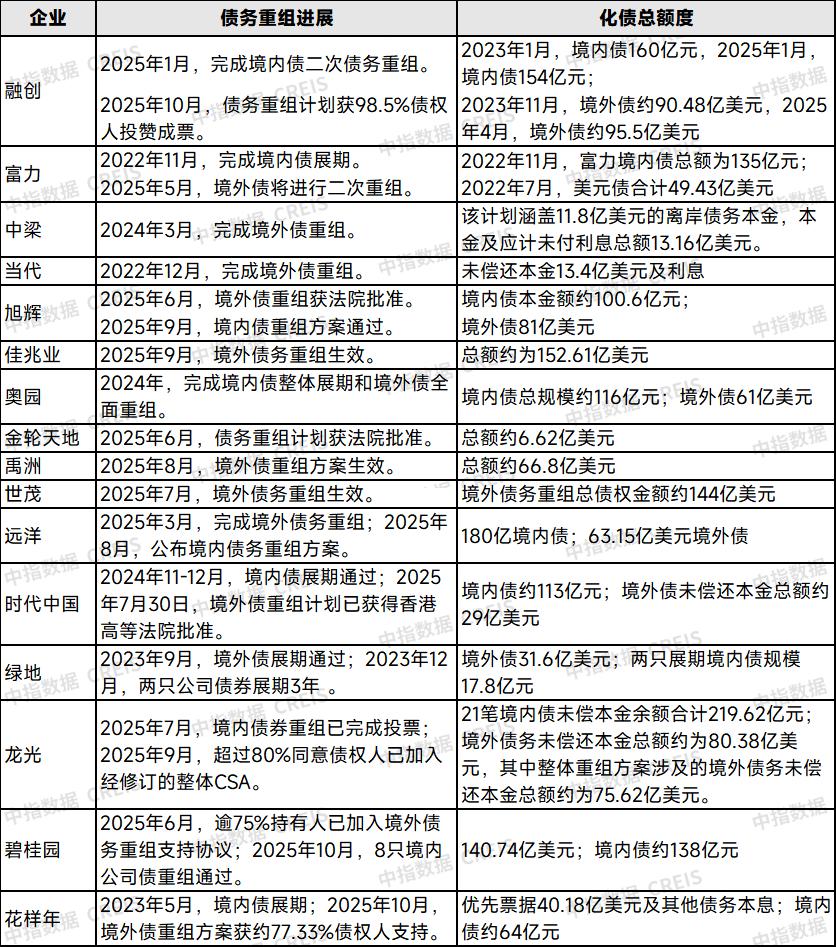
Core Viewpoint - The Chinese real estate industry has reached a critical turning point in debt risk resolution, with multiple large-scale companies announcing significant progress in debt restructuring, alleviating long-standing liquidity crises [1][2]. Debt Restructuring Progress - As of October 30, 2025, 21 real estate companies have completed domestic and overseas debt restructuring, resolving approximately 1.2 trillion yuan of debt, which corresponds to nearly 2 trillion yuan of total interest-bearing liabilities [1][2]. - Notable companies like Sunac, CIFI, and Longfor have successfully completed debt restructuring, utilizing both judicial and market-based approaches to expedite the risk clearance process [1][2]. - CIFI Holdings became the first major private enterprise to complete a synchronized domestic and overseas debt restructuring, while Sunac's innovative plan aims to convert approximately $95.5 billion of overseas debt into equity [2][3]. Financing Environment - Despite the progress in debt restructuring, the overall financing environment for the real estate industry remains tight, with a 30% year-on-year decline in financing scale, totaling 307.2 billion yuan in the first three quarters of 2025 [7][9]. - The financing cost for domestic bonds has decreased to 2.57%, while overseas bond financing costs stand at 8.95%, reflecting a significant disparity between state-owned and private enterprises [9][10]. Policy Support and Market Trends - The central and local governments have implemented supportive policies to stabilize the real estate market, including extending the "Financial 16 Measures" and operational property loans until December 31, 2026 [10][11]. - The rapid development of the public REITs market, with 74 products raising approximately 199.15 billion yuan, provides a pathway for real estate companies to transition from heavy asset to light asset models [10][11]. Future Development Paths - Companies that have completed debt restructuring face ongoing challenges, including sluggish sales and limited financing channels, necessitating a shift towards high-quality development and light asset operations [5][6]. - The industry is expected to move away from the previous high-leverage model, focusing on quality and service, with many companies exploring light asset businesses such as property management and asset management [5][6].

出险房企化债超1.2万亿元 行业风险出清进程加速
Zheng Quan Ri Bao· 2025-10-30 16:41
Core Insights - The real estate companies in distress have made substantial progress in debt restructuring, with a total debt reduction scale of approximately 1.2 trillion yuan as of October 30, involving 21 companies [1] - The restructuring efforts are expected to alleviate short-term debt repayment pressures and facilitate a safer operational environment for these companies, thereby accelerating the overall risk clearance process in the real estate sector [1][2] Group 1: Debt Restructuring Progress - As of October 30, 21 distressed real estate companies have received approval for debt restructuring, with a total debt scale nearing 2 trillion yuan [1] - Companies such as Sunac China Holdings, Guangzhou R&F Properties, and CIFI Holdings have completed their debt restructuring, while others like Kaisa Group and Country Garden have received approval for overseas debt restructuring [1] - The restructuring methods employed include debt-to-equity swaps, asset swaps, and full-term extensions, significantly reducing the debt burden for many companies [2] Group 2: Impact on Industry and Companies - The concentration of debt restructuring among distressed companies indicates a faster risk clearance in the industry, which is beneficial for the overall credit environment [2] - Post-restructuring, many companies are accelerating their delivery processes and shifting their strategic focus towards light asset businesses such as property management and asset management [2][3] - The transition from incremental development to stock asset management is seen as a reasonable path for companies to revitalize resources and improve operational efficiency [3] Group 3: Future Outlook - The development of light asset businesses is expected to be a crucial support for distressed companies to overcome challenges, as operational efficiency and service capabilities become more important than capital scale [3] - Companies that successfully complete debt restructuring and enhance their operational efficiency are likely to achieve stable operations and sustainable development, contributing to a healthier and more stable real estate market [3]
出险房企近2万亿债务进入安全期,加速房地产风险出清进程
3 6 Ke· 2025-10-30 08:36
Core Viewpoint - A total of 21 distressed real estate companies have completed or received approval for debt restructuring, with a total debt reduction scale of approximately RMB 1.2 trillion, significantly alleviating their short-term debt repayment pressure and entering a safer period [1][2]. Debt Restructuring Overview - As of October 2025, companies such as Sunac, R&F, Aoyuan, and others have completed domestic and overseas debt restructuring, with the total amount of debt nearing RMB 2 trillion [2]. - The restructuring efforts will accelerate the overall risk clearance process in the real estate sector [2]. Debt Reduction Methods - Distressed companies are employing various methods to reduce debt, including debt-to-equity swaps, asset offsets, and full-term extensions, aimed at lowering actual debt burdens and improving balance sheets [6]. - For instance, Longguang's domestic debt restructuring plan includes cash offers, debt-to-equity swaps, and asset offsets [6]. Debt Reduction Ratios - Some companies have publicly disclosed their overseas debt restructuring plans, with debt reduction ratios ranging from 40% to 70%. Longguang achieved a 70% reduction in overseas debt after restructuring [9]. - Sunac's overseas debt underwent a second restructuring, resulting in a total debt reduction of approximately USD 9.55 billion [11]. Strategic Focus Post-Restructuring - After completing debt restructuring and ensuring project delivery, many distressed companies are shifting their focus to light asset businesses, such as construction agency, property management, and asset management [12]. - This strategic pivot allows companies to recover their "blood-making" capabilities with minimal capital investment while leveraging their existing core competencies [12]. Development Strategies - Companies like Jinke and Xuhui are actively seeking to transform their business models, focusing on light asset operations and low-debt, high-quality development [13]. - The industry is transitioning from incremental development to stock operation, with significant opportunities in property and asset management sectors [12].


建行刷新半年成绩单!营收拨备双增,低利率环境下业绩缘何向好?
券商中国· 2025-08-30 05:25
Core Viewpoint - Under the low interest rate environment, China Construction Bank (CCB) has demonstrated resilience by achieving stable and positive mid-term operational indicators for the first half of 2025, with key performance metrics showing growth despite challenges [1][4]. Group 1: Financial Performance - As of June 30, 2025, CCB's total assets reached 44.43 trillion yuan, an increase of 9.52% compared to the end of the previous year [1][5]. - Operating income for the first half of 2025 was 385.9 billion yuan, reflecting a year-on-year growth of 2.95% [1]. - Net income before provisions was 290.1 billion yuan, up 3.37% year-on-year, with a provision coverage ratio of 239.4%, an increase of 5.8 percentage points from the end of the previous year [1][10]. Group 2: Asset and Liability Management - CCB has focused on optimizing its asset structure, with loans and bonds accounting for nearly 90% of its total assets [5]. - The bank has improved its net interest income by narrowing the decline, with average daily interest-earning assets growing by 7.45% year-on-year [5]. - The proportion of demand deposits exceeded 40%, contributing significantly to the stability of deposit growth and cost reduction [8]. Group 3: Non-Interest Income Growth - CCB's non-interest income saw a remarkable growth of nearly 26% year-on-year, reaching 99.2 billion yuan, accounting for over 25% of total revenue [9]. - The bank's fee and commission income represented 16.9% of operating income, leading among peers [9]. - The growth in wealth management and private banking clients exceeded 20%, indicating a shift towards light-asset and light-capital business models [9]. Group 4: Risk Management and Asset Quality - CCB maintained a stable asset quality with a non-performing loan (NPL) ratio of 1.33%, down 1 percentage point from the end of the previous year [10]. - The bank's core Tier 1 capital adequacy ratio stood at 14.34%, reflecting strong capital management [10]. - In the real estate sector, the NPL ratio decreased by 0.05 percentage points, demonstrating effective risk control while meeting reasonable financing needs [10][11].


远洋集团102亿盈利里的财务表象
3 6 Ke· 2025-08-29 02:43
Core Viewpoint - The Chinese real estate industry is entering a critical phase of risk clearance in 2025, with several companies, including Country Garden, Sunac, and Ocean Group, achieving breakthroughs in debt restructuring [1] Company Performance - Ocean Group reported a revenue of 6.203 billion yuan in the first half of 2025, a 53% decrease year-on-year, with a gross loss of 4.966 billion yuan, compared to a gross profit of 297 million yuan in the same period of 2024 [1] - The company achieved a profit attributable to shareholders of 10.202 billion yuan, recovering from a loss of 5.382 billion yuan in the previous year, although this profit was largely due to non-cash gains from overseas debt restructuring [2] Business Operations - In the first half of 2025, property development contributed 53.14% of Ocean Group's revenue, generating 3.296 billion yuan, a 68% decrease from the same period in 2024 [3] - The company’s contracted sales amounted to approximately 13.37 billion yuan, a year-on-year decrease of 27.06%, with a total saleable floor area of about 849,000 square meters, down 44% [3] - The average selling price increased by approximately 41% to 18,900 yuan per square meter, driven by the opening of several projects in first-tier cities [3] Debt Restructuring - Ocean Group completed a significant overseas debt restructuring totaling approximately 6.315 billion USD, converting it into about 2.2 billion USD of new debt and approximately 4.115 billion USD of new convertible bonds and perpetual securities [7] - As of June 30, 2025, the total borrowings of Ocean Group were 66.997 billion yuan, a 31.89% decrease year-on-year, with a net gearing ratio of approximately 743% [8] - The company is currently negotiating a domestic debt restructuring plan involving 18.05 billion yuan, utilizing methods such as cash buybacks, asset pledges, and long-term extensions [9][10]