
信记号茶叶

Search documents
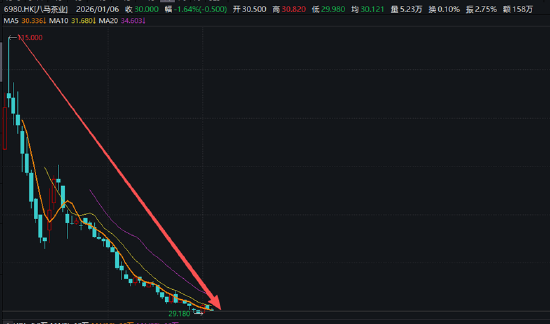
八马茶业股价破发后再创新低 业绩双降影响增长预期、高端叙事直面挑战、加盟扩张疲态尽显
Xin Lang Cai Jing· 2026-01-09 11:59
Core Viewpoint - The stock price of Baima Tea has experienced a significant decline after an initial surge post-IPO, reflecting investor concerns about the company's business model and growth prospects [1][3][16]. Financial Performance - Baima Tea's revenue from 2022 to 2024 was 1.818 billion, 2.122 billion, and 2.143 billion yuan, with growth rates of 16.8% in 2023 and 1.0% in 2024 [5][19]. - In the first half of 2025, the company reported a revenue of 1.06 billion yuan, a year-on-year decline of 4.2%, and a net profit of 120 million yuan, down 17.8% [6][19]. Market Reaction - The stock price surged by 86.7% on its first trading day, reaching 93.35 HKD per share, but fell below the issue price to 29.12 HKD by January 9, 2026 [3][16]. - The decline in stock price indicates a lack of enthusiasm from the capital market towards traditional tea companies [21]. Business Model Challenges - Baima Tea's reliance on a franchise model has shown signs of fatigue, with net growth in franchise stores dropping from 265 in 2023 to just 5 in 2024 [12][26]. - The average selling price of Baima Tea's high-end brand "Xinjihao" has decreased from 901 yuan/kg in 2022 to 715 yuan/kg in the first half of 2025 [22][23]. Pricing and Inventory Issues - The company has faced pricing confusion due to its "buyout franchise" model, which transfers inventory pressure to franchisees, leading to potential price undercutting in unauthorized channels [14][29]. - The suggested retail price range for major products has been significantly reduced, indicating a shift in product strategy [23][24]. Strategic Outlook - To regain investor confidence, Baima Tea needs to stabilize its high-end narrative and reduce reliance on the franchise model, focusing on product strength, brand culture, and consumer experience [29].

福建老板赴港敲钟,八马茶业上市涨超80%
3 6 Ke· 2025-10-28 08:50
Group 1 - Baima Tea officially listed on the Hong Kong Stock Exchange on October 28, 2023, becoming the third Chinese tea company to go public after Tianfu Tea and Lancang Ancient Tea [2] - The company offered 9 million H-shares at an issue price of HKD 50.00 per share, raising a net total of HKD 389.89 million [2] - Baima Tea's stock price surged to HKD 93.35 per share by the end of the trading day, marking an increase of 86.7% and a total market capitalization of HKD 79.35 billion [2][3] Group 2 - Baima Tea's business model includes 3,716 offline stores, with 234 direct stores and a significant portion of revenue coming from franchise sales, which accounted for approximately 50% of total revenue in recent years [4][5] - The average selling price of Baima Tea's products decreased from HKD 694 per kilogram in 2022 to HKD 657 per kilogram by mid-2025, indicating challenges in maintaining high-end pricing [5][6] - The company's marketing expenses have been high, exceeding 30% of revenue, which has impacted profitability [6] Group 3 - The founders of Baima Tea, Wang Wenli and Wang Wenbin, come from a family with a long history in tea production, and the company remains a family-controlled business [7] - The Wang family collectively holds 55.90% of the voting rights in Baima Tea, with a significant portion of shares held post-IPO [7][8] - The family connections extend to other prominent businesses, including the well-known brand Seven Wolves, indicating a network of influential relationships within the industry [8]
