倚天710服务器CPU

Search documents
马云钦定的“平头哥”赶上市潮,真武芯片打前锋
Sou Hu Cai Jing· 2026-01-29 07:06
Core Viewpoint - Alibaba's newly launched AI chip "Zhenwu 810E" marks the official unveiling of its self-developed PPU, part of the "Tongyun Ge" AI ecosystem, which aims to create a supercomputing platform integrating chips, cloud services, and models for maximum efficiency in AI applications [2][3] Group 1: Product and Technology - The "Zhenwu" PPU chip, developed since 2020, is designed for specific tasks like AI model training and gaming simulations, achieving higher efficiency and energy savings compared to traditional CPUs and GPUs [3] - The chip features a 96G HBM2e memory and an inter-chip bandwidth of 700 GB/s, making it suitable for AI training, inference, and autonomous driving applications [3] - The performance of the "Zhenwu" PPU reportedly exceeds that of Nvidia's A800 and mainstream domestic GPUs, being comparable to Nvidia's H20 [3] Group 2: Strategic Developments - The collaboration between Pingtouge, Alibaba Cloud, and Tongyi Qianwen creates a unique "chip-cloud integration" advantage, facilitating rapid commercialization of AI technologies [4] - The potential independent listing of Pingtouge signals a significant strategic shift for Alibaba, moving towards capitalizing on its technological advancements in the chip sector [7] - The decision to support Pingtouge's IPO process is driven by competitive pressures, technological maturity, and the need for substantial funding for AI initiatives [8] Group 3: Market Impact - If successful, Pingtouge's IPO could disrupt the AI chip market, which is currently dominated by Nvidia, by leveraging its integrated advantages and Alibaba's backing to reduce application costs in various sectors [9]


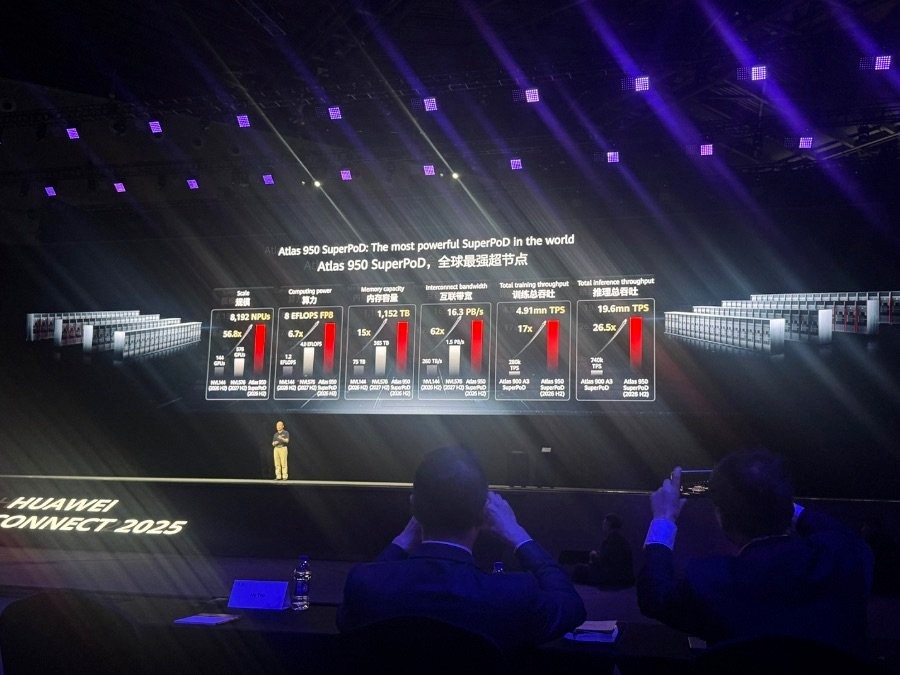
果然财经|华为万卡超节点破局,中国芯片从卡脖子到集群算力突围
Qi Lu Wan Bao· 2025-09-22 14:40
Core Insights - Huawei unveiled the complete development roadmap for its Ascend AI chips at the Global Connectivity Conference, establishing a self-controlled computing foundation for China's AI industry amid manufacturing constraints [2] - The domestic AI chip ecosystem is evolving with multiple players like Alibaba, Baidu, Tencent, and ByteDance adopting different strategies for market entry, creating a multi-path domestic substitution landscape [3][6] Huawei's Asymmetric Innovation Path - Huawei acknowledges that its single-chip computing power still lags behind Nvidia but opts for an asymmetric innovation path, focusing on system architecture and interconnection technology to compensate for performance gaps [3] - The key breakthrough is the Lingqu interconnection protocol, which addresses long-distance, high-reliability, and low-latency challenges, achieving significant improvements in reliability and bandwidth [3] Future Roadmap for Ascend Chips - Huawei's roadmap includes the launch of Ascend 950PR in Q1 2026, focusing on inference pre-fill scenarios, and Ascend 950DT in Q4 2026, which will shift to SIMD/SIMT architecture for general AI tasks [4] - The Ascend 960, set for Q4 2027, will double specifications, while the Ascend 970 in Q4 2028 will achieve significant increases in computing power and memory access bandwidth [4] Competitive Edge of Huawei's SuperNodes - Huawei's Atlas 950 SuperPoD and Atlas 960 SuperPoD support 8192 and 15488 Ascend cards respectively, leading in key metrics compared to Nvidia's upcoming NVL144S [4] - The Atlas 950 SuperCluster and Atlas 960 SuperCluster boast computing power exceeding 500,000 and 1 million cards respectively, marking a significant advancement in the industry [4] Software and Ecosystem Development - Huawei is enhancing its software and ecosystem by open-sourcing the CANN compiler and virtual instruction set interface, with plans to open-source the Mind series application enablement suite by the end of 2025 [5] - The company aims to build a competitive technology alliance against Nvidia's CUDA ecosystem through the open release of Lingqu 2.0 technology specifications [5] Other Players in the AI Chip Ecosystem - Alibaba is diversifying its AI chip strategy with self-developed inference chips and ARM architecture CPUs, while Baidu's Kunlun series has gained market recognition with significant contracts [8] - Tencent is optimizing software-hardware collaboration through cloud services and investments in AI chip companies, while ByteDance is engaging in supply chain partnerships to procure domestic AI chips [8] Policy and Patent Support - The Chinese government has implemented policies to support the chip industry, aiming for a 70% self-sufficiency rate by 2025, with various tax incentives for chip manufacturers [10] - Patent accumulation is crucial for technological breakthroughs, with Huawei holding over 150,000 global patents, including significant numbers in AI and communication fields [11][12] Conclusion - The advancements in Huawei's Ascend chips and the collaborative efforts of other domestic players are driving the growth of a self-controlled AI chip ecosystem in China, supported by robust government policies and patent strategies [12]