健康管理Agent

Search documents
AI 超级公司进化论:从技术突破到商业落地
Tai Mei Ti A P P· 2025-12-02 11:16
Core Insights - The article discusses the transformative impact of AI super companies on the business landscape, emphasizing their role in integrating AI technologies to enhance efficiency, innovation, and competitiveness [2][18]. Group 1: AI Super Products/Services - AI super companies are evolving hardware products from passive devices to intelligent systems capable of understanding context and intent, shifting the value focus from physical form to the intelligence they provide [3]. - Software is undergoing a fundamental restructuring, with the emergence of Agentic AI that allows for proactive task management and collaboration among specialized agents, moving beyond simple assistance to complex task execution [3][5]. Group 2: Service Models - AI services are transitioning from reactive to proactive, utilizing multi-dimensional data to anticipate user needs and provide continuous support throughout the product lifecycle, enhancing user experience [5][6]. Group 3: AI Super Infrastructure/Capabilities - The application of agents will be a key indicator of the depth of transformation within AI super companies, balancing between standard commercial applications and customized development to address specific business challenges [6][10]. - AI infrastructure is essential for supporting large model training and deployment, requiring high-performance computing resources and efficient data management systems to meet the demands of AI applications [10][11]. Group 4: Organizational Evolution - The integration of AI into organizations typically begins with the automation of standardized processes in departments like marketing and customer service, providing measurable returns on investment [13][15]. - As AI adoption deepens, organizations evolve from AI-enhanced to human-AI collaborative structures, ultimately leading to fluid, agile organizations where AI agents dynamically form teams based on project needs [15][20]. Group 5: Stages of AI Super Company Evolution - The evolution of AI super companies can be categorized into three stages: 1. AI Collaboration: AI becomes a standard capability for efficiency [18]. 2. AI Coordination: AI deeply integrates into business processes, acting as a collaborative partner [19]. 3. AI-Driven: AI becomes the central nervous system of the organization, facilitating a highly intelligent ecosystem [20]. Group 6: Evaluation Framework - An evaluation framework for AI super companies includes four dimensions and twelve key indicators, assessing aspects such as technological infrastructure, organizational collaboration, product service capabilities, and value creation [21].

Agent爆火,华人赢麻了
36氪· 2025-07-24 10:36
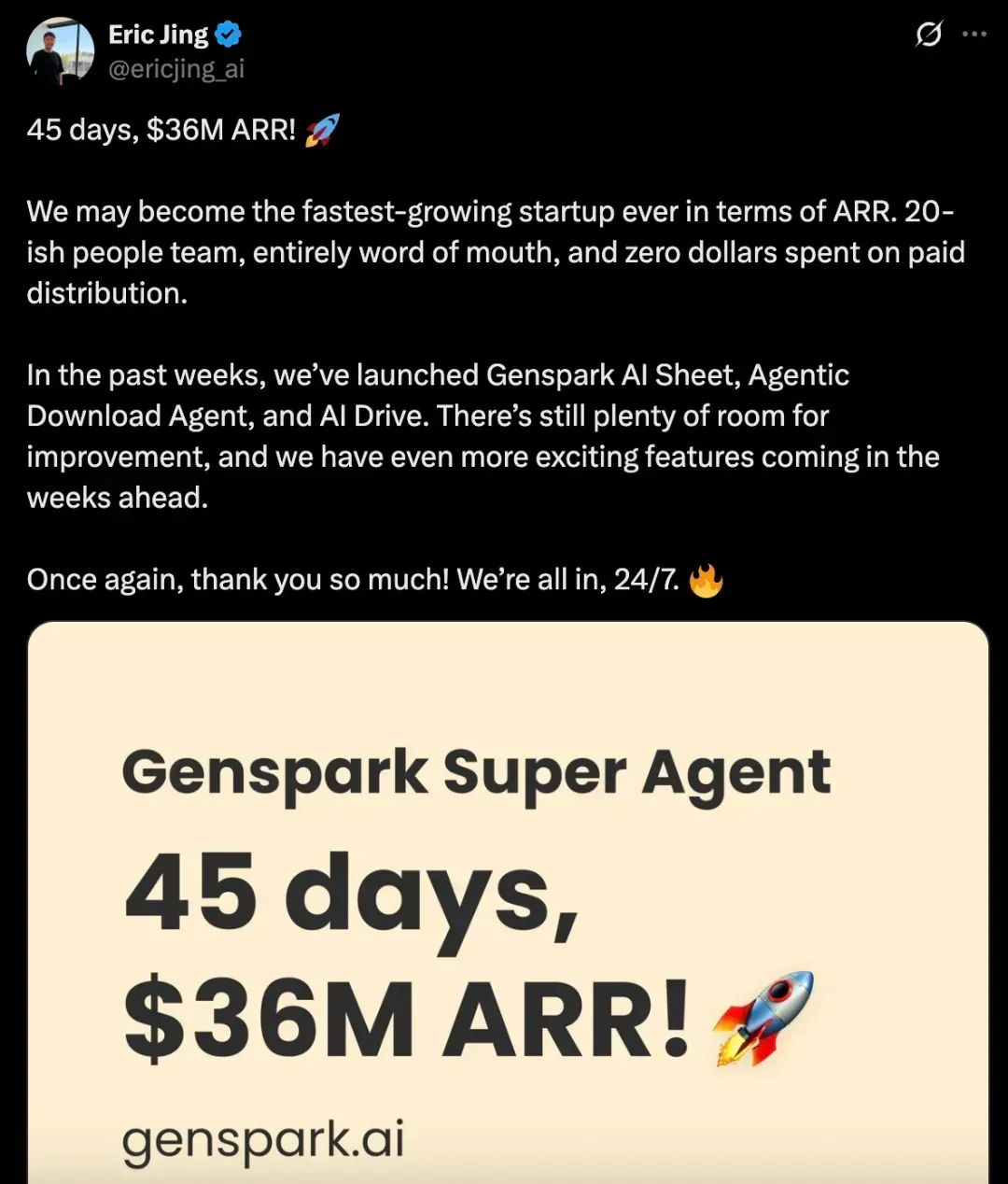
Core Viewpoint - The article discusses the emergence of AI Agents, particularly highlighting the rapid growth and success of Chinese companies in this sector, such as MainFunc and its product Genspark, which achieved $36 million in annual recurring revenue (ARR) within 45 days of launch [4][5][25]. Group 1: Industry Trends - The AI Agent wave is characterized by a significant increase in user engagement and revenue, with Manus achieving 23 million monthly active users (MAU) shortly after its launch [9][19]. - The competitive landscape has shifted, with startups outpacing larger companies in the AI Agent space, as evidenced by the rapid ARR growth of Genspark compared to established firms [25][26]. - The article notes a decline in user engagement for some leading products, with Manus's monthly visits dropping from 23.76 million in March to 17.3 million in June [19][34]. Group 2: Key Players - MainFunc's Genspark and Manus are highlighted as leading products in the AI Agent market, with Genspark's rapid revenue growth and Manus's significant user base [5][9]. - Other notable players include Flowith, Fellou, and MiniMax, each achieving substantial web traffic and user engagement [15]. - The article emphasizes the role of Claude and Manus as catalysts for the current AI Agent boom, with Claude's advanced model capabilities enhancing the overall ecosystem [16][37]. Group 3: Challenges and Future Directions - Despite initial success, there are concerns about sustaining growth, as the novelty of AI Agents begins to wear off, leading to declining user metrics [19][34]. - The geopolitical landscape poses challenges for Chinese companies operating internationally, with Manus reportedly withdrawing from the Chinese market due to external pressures [20][21]. - The article suggests a potential shift from general-purpose Agents to vertical-specific Agents, as the latter may better meet user needs and provide a competitive edge against larger firms [37][40].



「Manus+景鲲」领衔主演,华人AI Agent全球狂欢
3 6 Ke· 2025-07-24 10:07
Core Insights - The article highlights the rapid growth and attention surrounding AI agents, particularly focusing on Genspark and Manus, which have achieved significant milestones in revenue and user engagement within a short time frame [1][4][17] - The emergence of AI agents is characterized by a shift from basic functionalities to more complex, autonomous applications that can perform tasks similar to human capabilities [6][7] - The article discusses the challenges faced by these companies, including market saturation, declining user engagement, and geopolitical uncertainties affecting their operations [13][14][15] Company Performance - Genspark achieved an Annual Recurring Revenue (ARR) of $36 million in just 45 days after launch, showcasing the potential for rapid monetization in the AI agent space [1][17] - Manus reached 23 million Monthly Active Users (MAU) within the first month of its release and secured $75 million in funding, leading to a post-money valuation exceeding $500 million [4][8] - Other companies like Flowith and MiniMax also reported significant web traffic and revenue, indicating a broader trend of growth in the AI agent sector [8] Market Dynamics - The AI agent market is experiencing a renaissance in 2025, driven by technological advancements and a growing consensus on product forms, leading to increased user adoption and revenue generation [7][18] - Initial skepticism regarding the viability of AI agents has shifted, with many startups now leading the charge in product development and commercialization, contrasting with larger companies that are more cautious [18][22] - The article notes a trend where initial excitement is waning, as evidenced by declining monthly visits for both Manus and Genspark, suggesting a need for sustained innovation and user engagement strategies [13][27] Geopolitical and Regulatory Challenges - The geopolitical landscape and regulatory scrutiny, particularly from the U.S. government, are creating uncertainties for Chinese AI companies operating internationally, as seen with Manus's withdrawal from the Chinese market [14][15] - The article suggests that future funding and operational strategies for these companies may be influenced by international relations and regulatory pressures [15] Future Outlook - The article posits that while general-purpose AI agents are currently in vogue, there may be a shift towards more specialized, vertical-focused agents as companies seek to differentiate themselves and meet specific market needs [29][32] - The importance of speed and adaptability in product development is emphasized, with successful startups rapidly iterating on their offerings to capture market share [25][32]