储蓄寿险

Search documents
2025年前三季度保费大涨55.9% 分红险受追捧 港险为何持续升温?
Sou Hu Cai Jing· 2026-02-02 13:05
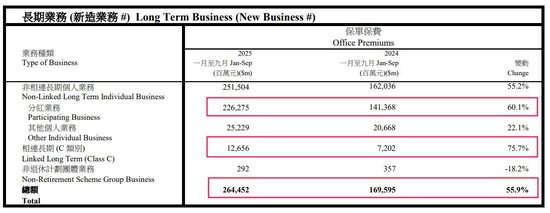
Core Viewpoint - The Hong Kong insurance market is experiencing a surge in sales, particularly from mainland customers, ahead of the new interest rate regulations set to take effect on July 1, 2025, indicating strong demand for investment-linked insurance products [1][2][5]. Group 1: Sales Growth and Market Dynamics - In the first three quarters of 2025, the new premium for long-term insurance (excluding retirement plans) reached HKD 264.45 billion, a 55.9% increase compared to the same period in 2024 [1][2]. - The new premium for participating insurance policies was HKD 226.28 billion, reflecting a 60.1% year-on-year growth [1][2]. - The growth in sales is attributed to the appeal of high-yield insurance products, particularly among high-net-worth individuals seeking diversified asset allocation in a low-interest-rate environment [3][5]. Group 2: Product Preferences and Trends - Investment-linked products, such as participating whole life insurance and savings insurance, have a high premium share among mainland customers, indicating a strong demand for savings-oriented insurance [1][3]. - The growth rates for various insurance types in the first three quarters of 2025 include: linked business at 75.7%, other personal business at 22.1%, and a decline in group business by 18.2% [2][3]. Group 3: Regulatory Changes and Impacts - The Hong Kong insurance market will see a new round of adjustments to the predetermined interest rates for life insurance starting July 2025, with significant reductions in rates for traditional and participating insurance products [4][5]. - The maximum illustrated interest rate for participating insurance products will be set at 6.0% for HKD-denominated products and 6.5% for non-HKD products, marking the end of the "7% era" [4][5]. Group 4: Competitive Landscape and Strategic Moves - Mainland insurance companies are increasingly expanding into the Hong Kong market, with major firms like Taikang Life and China Pacific Insurance establishing subsidiaries to capture the growing demand from mainland clients [7]. - The competitive drive is fueled by the unique advantages of the Hong Kong insurance market and the significant demand gap in mainland wealth management [7]. Group 5: Currency and Legal Considerations - The exchange rate of the RMB may influence the attractiveness of Hong Kong insurance; a depreciation of 2-3% could offset some of the interest rate advantages [6]. - Legal and regulatory differences between mainland China and Hong Kong present challenges for policyholders, including higher costs for legal recourse in case of disputes [8].
去年前三季度保费暴涨55.9%,港险为何持续升温?
Xin Lang Cai Jing· 2026-01-29 06:42
Core Insights - The Hong Kong insurance market continues to attract mainland customers, with new policy premiums reaching 264.45 billion HKD in the first three quarters of 2025, a 55.9% increase compared to the same period in 2024 [1][2][11] - Participating business premiums grew by 60.1% year-on-year, indicating strong demand for investment-linked insurance products among mainland residents [1][2][11] - The shift in interest rates in mainland China has led to a comparative advantage for Hong Kong insurance products, particularly in the context of low interest rates [6][15][16] Market Trends - The demand for participating and linked insurance products has surged, with growth rates of 60.1% and 75.7% respectively, reflecting a shift towards products with investment attributes [2][12][14] - The total new policy premiums from mainland visitors accounted for 29% of the personal business total in 2024, highlighting the significant role of mainland customers in the Hong Kong insurance market [4][13] Regulatory Environment - The Hong Kong Insurance Authority has implemented new regulations affecting the demonstration interest rates for insurance products, which has influenced customer behavior and sales trends [6][15] - The lack of disclosure of mainland visitor data in early 2025 indicates ongoing regulatory reviews, which may impact future reporting and market dynamics [4][14] Investment Considerations - The high expected returns from Hong Kong insurance products, particularly in the context of a 4.5% interest rate differential compared to mainland products, continue to drive demand [7][16] - The introduction of policies with guaranteed rates of 2.5% by mainland insurers in Hong Kong aims to attract high-end customers, indicating competitive pressures in the market [8][17] Customer Behavior - Investors are increasingly looking for alternatives to traditional financial products, with many expressing interest in Hong Kong insurance due to its attractive yields [2][11] - The focus on wealth diversification and the need for high-yield asset allocation among high-net-worth individuals are key drivers for the growth of Hong Kong insurance [5][14]

每3份港险就有1份卖内地客,港险是馅饼还是陷阱?
首席商业评论· 2025-10-03 04:57
Core Viewpoint - The article discusses the increasing trend of mainland Chinese customers purchasing insurance in Hong Kong, despite criticisms labeling it as a "carefully crafted scam" by some experts like Lang Xianping. It explores the reasons behind this trend, the perceived benefits of Hong Kong insurance, and the potential risks involved [5][6][9]. Group 1: Market Trends - The Hong Kong insurance market is experiencing significant growth, with new policy premiums expected to reach HKD 219.8 billion in 2024, a 22% increase from 2023. Mainland customers contributed HKD 62.8 billion, accounting for nearly 30% of new policies sold [5][8]. - The majority of new policies are savings-type insurance, which dominate the market with a 62.1% share in terms of policy count, and approximately 91% of new policy premiums come from savings-type products [8][9]. Group 2: Reasons for Popularity - Mainland customers are seeking higher returns due to declining interest rates on domestic savings products, which typically offer around 2% returns. In contrast, Hong Kong insurance products present more attractive expected returns, often around 6.5% [9][12]. - The historical stability of the Hong Kong insurance market, with no recorded bankruptcies among life insurance companies, and a robust regulatory framework contribute to its appeal. Most products maintain a dividend realization rate between 95% and 105% [9][11]. Group 3: Product Features and Risks - Hong Kong insurance products offer features such as multi-currency options, flexible beneficiary designations, and various payout structures, which enhance their attractiveness for wealth transfer and long-term financial planning [11][22]. - However, the article highlights the risks associated with these products, including the potential for high advertised returns to be misleading, as actual returns may only be around 3% to 4% over a 10-year period, with significant penalties for early withdrawal [13][16]. Group 4: Consumer Guidance - The article advises potential buyers to carefully evaluate the product's yield structure, company reputation, and historical dividend performance before purchasing. It emphasizes the importance of understanding the balance between guaranteed and non-guaranteed returns [24][26]. - Consumers are also cautioned about the risks of information asymmetry and the potential for aggressive sales tactics in a highly competitive market, which may lead to poor purchasing decisions [28].

郎咸平“炮轰”香港保险:针对大陆的精心“骗局”
Sou Hu Cai Jing· 2025-07-21 16:55
Core Viewpoint - The criticism of Hong Kong insurance by scholar Lang Xianping highlights seven major pitfalls, raising concerns about the industry's practices and the perceived risks associated with high-yield products [1][2]. Group 1: Criticism of Hong Kong Insurance - Lang Xianping identifies seven major pitfalls in Hong Kong insurance, including unrealistic 7% returns, penalties for early withdrawals, significant discrepancies in product returns, high rejection rates for health claims, expensive legal fees, foreign exchange controls, and invalid policies signed in mainland China [1]. - The recent adjustment of the dividend insurance demonstration interest rate cap from 7% to 6.5% by the Hong Kong Insurance Authority has intensified the scrutiny on the industry, as many mainland clients rushed to purchase insurance before the change [1][2]. Group 2: Industry Overview - The Hong Kong insurance industry has developed a unique model over more than a century, with total gross premiums reaching HKD 310.9 billion in the first half of 2024, a 5.1% increase year-on-year [4]. - Mainland clients accounted for HKD 29.7 billion of new premiums, representing 25.7% of the total new business [4]. - The industry manages assets exceeding USD 4.5 trillion, ranking first in Asia and second globally, attracting significant interest from global investors due to factors like broad investment options, high product pricing rates, and policy flexibility [4][5]. Group 3: Regulatory Environment - Hong Kong's insurance sector is governed by a stringent regulatory framework, ensuring detailed reporting of investments and preventing misleading asset inflation [5][6]. - The Insurance Authority can impose various measures on companies facing irregularities, ensuring that clients' reasonable returns are paid on time [6]. Group 4: Product Features and Market Dynamics - Hong Kong insurance products are diverse, including whole life, savings, medical, critical illness, and annuity plans, with a notable preference for whole life insurance among mainland visitors [6][7]. - The ability to change policyholders and beneficiaries multiple times, along with the option to convert non-guaranteed returns into guaranteed ones, enhances the appeal of these products [7]. - The market consists of 157 licensed insurance companies and 1,649 licensed insurance agents, with the top 50 companies generating total premiums of HKD 516.5 billion in 2023, reflecting a 2.33% growth from 2022 [17]. Group 5: AIA's Position and Recent Developments - AIA Group, a leading player in the Hong Kong insurance market, has faced scrutiny following Lang Xianping's criticisms, particularly regarding its product strategy in light of regulatory changes [14][18]. - AIA's recent launch of the "Universal Income Plan" aimed to comply with the new interest rate cap while offering attractive early returns, which has sparked debate about the sustainability of such strategies [18][19]. - The company's actions reflect broader industry challenges in balancing competitive offerings with regulatory compliance and risk management in a low-interest environment [19].