
儿童唇膏

Search documents
中新网评:儿童唇膏宣传“食品级” 商家不能揣着明白装糊涂
Zhong Guo Xin Wen Wang· 2026-01-27 12:57
中新网北京1月27日电(记者 查志远 实习生 刘曦)据人民网江苏频道、新京报等媒体报道,婴童护理品牌 品牌戴可思在其儿童唇膏宣传中使用"食品级"表述,涉嫌违反《儿童化妆品监督管理规定》,被当地监 管部门立案调查。随后,企业对外致歉,并撤回了相关宣传内容。 这并非该品牌首次因宣传问题被处罚。此前,戴可思旗下多款产品就曾因虚假宣传"孕妇可用""根源修 护"等内容,被监管部门认定为违反《中华人民共和国广告法》并处罚。 放眼行业,部分儿童化妆品也曾因夸大安全属性、滥用专业概念,被点名整改。概念"踩线",并不是第 一次出现。 2022年,国家药监局发布公告,对"小金盾"标志作出提示:"'小金盾'不是产品质量认证标志。化妆品包 装上标注'小金盾',仅说明这个产品属于儿童化妆品,并不代表该产品已经获得监管部门审批或者质量 安全得到认证。" 从搜索页面到商品详情,从不同产品到不同平台,反复踩线更像是一种对合规边界的试探。 营销可以创新,但边界必须清晰。企业有权强调产品优势,却不能建立在概念混淆之上。合规不应停留 在事后撤回和致歉,更应体现在事前审核与严格遵守法律法规之中。 儿童用品不是营销概念的试验田。"食品级"不是卖点,更 ...
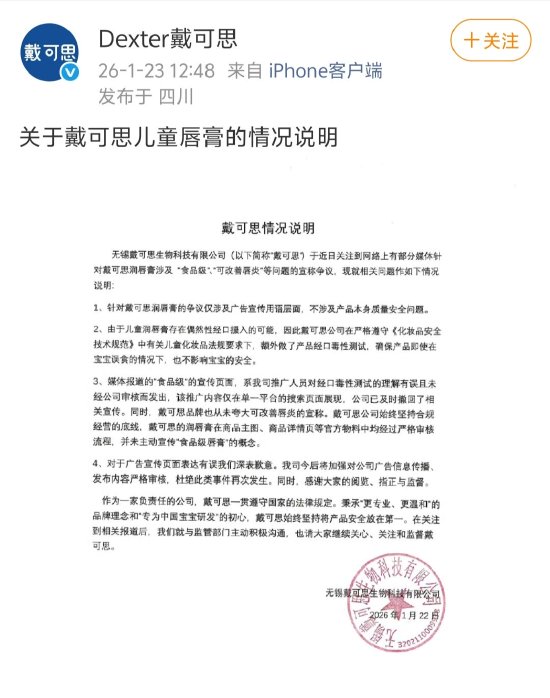
戴可思回应儿童唇膏宣传语涉嫌违规:并未主动宣传“食品级唇膏”的概念
Xin Lang Cai Jing· 2026-01-23 08:26
炒股就看金麒麟分析师研报,权威,专业,及时,全面,助您挖掘潜力主题机会! 1月23日,近日,郭晶晶、刘涛代言的婴童护理品牌"戴可思"被曝一款儿童唇膏宣称为"食品级润唇 膏",涉嫌违反《儿童化妆品监督管理规定》。 今日,戴可思在社交平台就此事发布声明。戴可思表示,针对戴可思润唇膏的争议仅涉及广告宣传用语 层面,不涉及产品本身质量安全问题。 戴可思表示,媒体报道的"食品级"的宣传页面,系我司推广人员对经口毒性测试的理解有误且未经公司 审核而发出,该推广内容仅在单一平台的搜索页面展现,公司已及时撒回了相关宣传。同时,戴可思品 牌也从未夸大可改善唇炎的宣称。戴可思公司始终坚持合规经营的底线,戴可思的润唇膏在商品主图, 商品详情页等官方物料中均经过严格审核流程,并未主动宣传"食品级唇膏"的概念。 声明中提到,由于儿童润唇膏存在偶然性经口摄入的可能,因此戴可思公司在严格遵守《化妆品安全技 术规范》中有关儿童化妆品法规要求下,额外做了产品经口毒性测试,确保产品即使在宝宝误食的情况 下,也不影响宝宝的安全。 戴可思声明中还提到,对于广告宣传页面表达有误我们深表歉意。我司今后将加强对公司广告信息传 播,发布内容严格审核,杜绝此 ...

小呵护驱动大增长:婴童护肤品何以韧性破局?
凯度消费者指数· 2025-07-29 03:05
Core Viewpoint - The article highlights the resilience of the baby skincare market in China, which is experiencing significant growth despite a declining birth rate and overall slowdown in the fast-moving consumer goods (FMCG) sector. The market is driven by three main factors: awakening consumer power in lower-tier cities, increasing demand for refined and scenario-based products, and the integration of multi-channel sales strategies [1][3][14]. Group 1: Market Trends - In 2024, China's birth population is reported at 954,000, showing a slight recovery but remaining low, contributing to a slowdown in the overall mother and baby FMCG market [1]. - The baby skincare segment has shown a robust annual spending growth of 26% per hundred households, indicating a strong market demand for innovative products [1][3]. - Lower-tier cities are emerging as key growth engines for the baby FMCG market, with spending growth in these areas significantly outpacing that of first-tier cities, with a growth index of 157 [3][10]. Group 2: Consumer Behavior - New parents in lower-tier cities are increasingly prioritizing product safety, reputation, and brand strength over low prices, reflecting a shift in consumer behavior and expectations [3][4]. - The demand for refined baby skincare products is rising, with categories such as children's sunscreen and lip balm experiencing sales growth of 28%, indicating a trend towards more specialized and high-quality products [6][7]. Group 3: Channel Diversification - The FMCG market is witnessing a trend towards channel diversification, with young families purchasing through more channels than the overall market average, necessitating a multi-channel approach for manufacturers [10]. - Despite a contraction in overall sales at mother and baby stores, the baby skincare segment has achieved growth, particularly in lower-tier cities, with a sales growth index of 137 [10][11]. - Manufacturers are encouraged to explore new high-experience channels and leverage local life platforms to capture immediate retail opportunities and expand market reach [11][14].
未知机构:信达消费轻工轻工品牌2月抖音数据跟踪卫生巾行业舆情消散-20250304
未知机构· 2025-03-04 02:05
Summary of Conference Call Records Industry Overview Personal Care Industry - Sanitary Napkins: The industry sentiment has dissipated, and the growth trend continues. Brands such as High Clean, Taotao Oxygen Cotton, and Princess Nais have seen over 300% growth in January-February. Free Point and She Yan She experienced high double-digit growth, while Sofy and Whisper saw a decline during the same period. Free Point's daily sales remain stable at over 2 million [1][1][1] - Toothpaste: Brands like Cold Acid Spirit and Shuke have maintained over 100% growth in January-February, while brands such as Canban, Haolai, Yunbai, and Colgate have shown rapid growth [1][1][1] - Pet Products: Brands like Frigat, Xianlang, and Royal have experienced over 200% growth, while Maifudi, Chengshi Yikou, and Wanpi have maintained rapid growth. However, Desire has seen a slight decline. Maifudi and Wanpi have a market share of around 50%, with the industry focusing on mid-tier and small influencers for self-broadcasting [1][1][1] Baby and Child Care Industry - Leading brands have generally maintained high-speed growth in January-February, with youth products gaining traction. Popular items include Kangaroo Mama's youth series (cleansing & lotion & body wash), Runben's anti-chapping cream, and Bedemei's baby & youth hair care products [2][2][2] Toys and Home Goods - Trendy Toys: Pop Mart continues to show strong growth, while Kayo and LEGO remained flat in January-February. Leading brands have a high self-broadcasting ratio, with Pop Mart and Kayo's self-broadcasting ratio reaching around 80% [2][2][2] - Home Goods: There was a recovery in February compared to January, with brands like Haotaitai showing rapid growth, along with Jiuzhou, Ruiter, Gongniu, Zhi Huashi, and Mosi experiencing relatively fast growth [2][2][2] Jewelry Industry - The performance of leading brands is differentiated, with brands like Chao Hong Ji, Cai Bai, and Lao Miao showing relatively fast growth. Chao Hong Ji's bracelet sales are particularly strong, while Cai Bai benefits from leading average prices due to investment gold advantages [2][2][2]