
公务员考试培训

Search documents
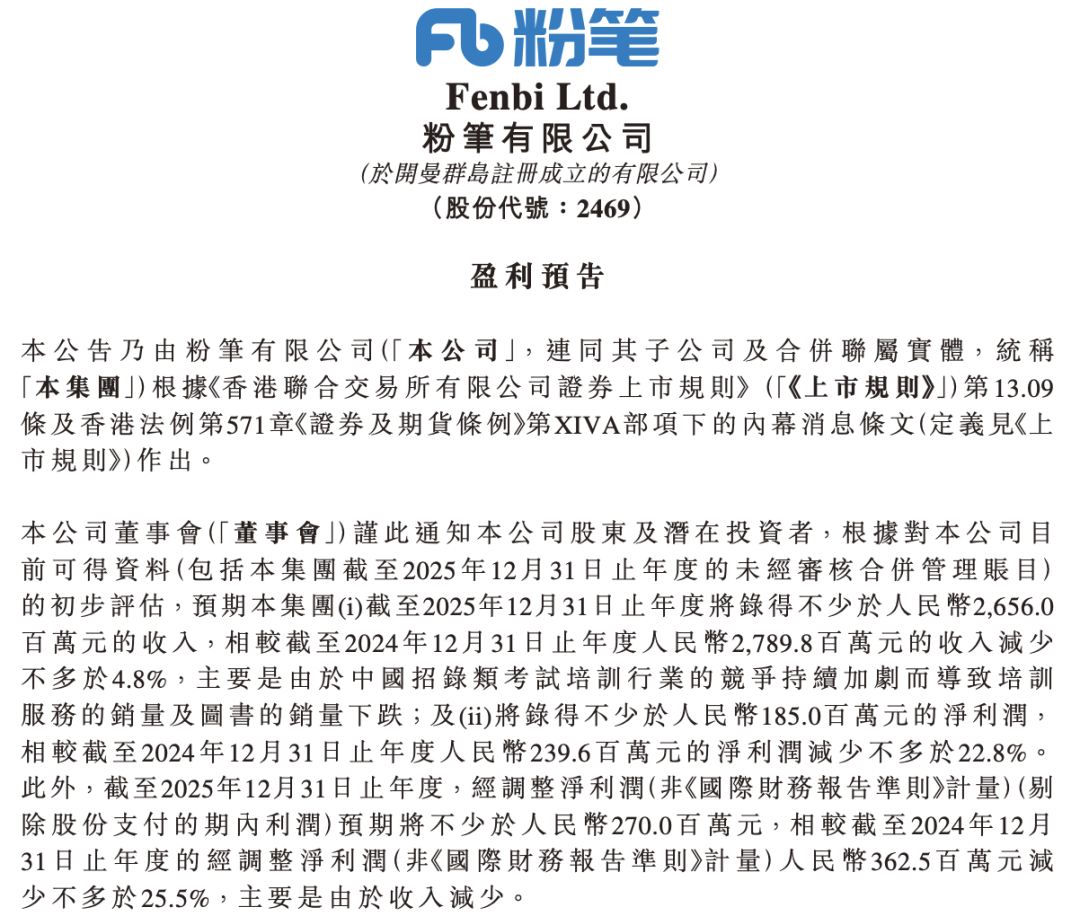
粉笔2025年预计营收26.56亿元,同比营收、净利润双下滑
Xin Jing Bao· 2026-02-26 04:08
Group 1 - The core viewpoint of the news is that the company Fenbi (粉笔) is forecasting a decline in both revenue and net profit for the fiscal year 2025, despite the ongoing popularity of civil service examinations in China [1][2] - For the fiscal year 2025, Fenbi expects revenue to be no less than 2.656 billion yuan, a decrease of no more than 4.8% compared to 2.79 billion yuan in 2024 [1] - The net profit forecast for 2025 is at least 185 million yuan, representing a decline of no more than 22.8% from 240 million yuan in 2024 [1] Group 2 - The decline in revenue and profit comes amid a competitive landscape in the civil service examination training industry, with over 1,100 related companies operating in China as of 2025, and more than 100 new companies registered in that year [2] - Fenbi's main business is focused on civil service exam training, but it also covers various other vocational exam training areas, which are facing increased competition leading to decreased sales of training services and books [2] - To counteract the decline, Fenbi is implementing an AI strategy and has formed a strategic partnership with Huatu to develop AI applications for the examination training industry [3]
粉笔预警,净利大降超两成
Shen Zhen Shang Bao· 2026-02-24 11:56
Core Viewpoint - The company, Fenbi, anticipates a decline in both revenue and net profit for the fiscal year ending December 31, 2025, primarily due to intensified competition in the Chinese civil service examination training industry [1][3]. Group 1: Financial Performance - For the fiscal year ending December 31, 2025, Fenbi expects to generate no less than 2.656 billion yuan in revenue, representing a decrease of no more than 4.8% compared to 2.79 billion yuan for the fiscal year ending December 31, 2024 [1]. - The projected net profit for 2025 is expected to be no less than 185 million yuan, a decline of no more than 22.8% from 240 million yuan in 2024 [1]. - Adjusted net profit for 2025 is anticipated to be no less than 270 million yuan, down by no more than 25.5% from 363 million yuan in 2024, mainly due to reduced revenue [1]. Group 2: Market Position and Competition - Fenbi's revenue for 2024 was 2.79 billion yuan, a decrease of 7.7% from 3.021 billion yuan in 2023, while the annual profit increased by 27.0% to 240 million yuan [3]. - The company specializes in civil service examination training and also covers various vocational examination training projects, including public institution recruitment, teacher recruitment, graduate school entrance exams, and accounting [3]. - Fenbi, along with Huatu and Zhonggong Education, is recognized as one of the "big three" in civil service training, and a strategic partnership was established between Fenbi and Huatu in December 2025, potentially altering the long-standing "tripod" market structure [3][4]. Group 3: Strategic Initiatives - The partnership with Huatu is viewed as a milestone that could fundamentally change the competitive landscape of the civil service education industry [4]. - Fenbi is increasing its investment in AI research and development, reallocating 60.8 million HKD of unutilized IPO funds, with 12 million HKD specifically for AI vertical model development and commercialization, and 48.8 million HKD for AI talent and infrastructure [4]. Group 4: Market Performance - Fenbi was listed on the Hong Kong Stock Exchange in January 2023 at an issue price of 9.9 HKD per share, achieving a market capitalization of 23.28 billion HKD on the first trading day [4]. - As of February 24, 2024, the stock price had fallen to 1.59 HKD per share, resulting in a market capitalization of only 3.51 billion HKD, indicating a market value loss of 19.77 billion HKD and an approximate 84% decline in stock price since listing [4].

华图山鼎:深度报告:战略转型职业教育,华丽蜕变“公考”龙头-20250304
Minsheng Securities· 2025-03-03 14:23
Investment Rating - The report maintains a "Recommended" rating for the company [5][7]. Core Viewpoints - The company has transformed into a new leader in offline civil service examination training, leveraging its strategic shift towards vocational education and extensive resource support from its major shareholder [1][5]. - The civil service examination training market is experiencing strong demand, with the company rapidly gaining market share due to the decline of its main competitor, and it is expected to expand into new training areas [2][5]. - The company has established a robust national network for vocational training, focusing on civil service, public institutions, and healthcare systems, which has led to significant revenue growth [3][5]. Summary by Sections Company Overview - The company, originally focused on architectural design, has undergone a strategic transformation to become a leader in civil service examination training, supported by its major shareholder's resources [1][11]. - The major shareholder has transferred various intangible assets related to vocational training to the company, facilitating its entry into the non-degree training market [1][3][46]. - The company has rapidly established over 1,000 training centers across 31 provinces, significantly expanding its operational footprint [1][19]. Industry Analysis - The vocational training market is characterized by strong demand, with a shift in market leadership occurring as competitors struggle [2][39]. - Government policies are increasingly supportive of vocational training, contributing to rapid growth in the non-degree training sector [28][31]. - The number of college graduates is at a record high, driving demand for examination training, particularly in competitive fields like civil service [35][36]. Financial Analysis - The company has a strong asset base with high liquidity, and its cash flow is robust due to a prepayment business model [4][5]. - Revenue from non-degree training has surged, with projections indicating continued growth in the coming years [3][5][6]. - The company is expected to achieve significant revenue growth, with forecasts indicating revenues of 27.01 billion, 33.28 billion, and 41.60 billion yuan for 2024, 2025, and 2026, respectively [5][6].
