
农牧渔ETF联接A(013471)

Search documents
农业农村部部署稳定肉牛生产!农牧渔ETF(159275)盘中涨超3%!机构:生猪产能去化或加速,禽类供给偏紧
Xin Lang Cai Jing· 2026-01-30 01:57
Group 1 - The core viewpoint of the news is that the agricultural and livestock ETF (159275) is showing a stable performance with a price increase of 2.71%, and notable movements in its constituent stocks [1][5] - Key performing stocks include Shennong Seed Industry, Dunhuang Seed Industry, and Nongfa Seed Industry, with increases of 15.51%, 10%, and 9.96% respectively [1][5] - Conversely, Jin Xin Nong, Jin He Biological, and Andis Su showed weaker performance with declines of 1.44%, 1.04%, and 0.58% respectively [1][5] Group 2 - The Ministry of Agriculture and Rural Affairs is focusing on stabilizing beef production and accelerating support for the dairy industry, aiming for sustainable industry development [1][5] - According to the National Bureau of Statistics, pork production in China is projected to exceed 59 million tons by 2025, with nearly 720 million pigs being slaughtered, providing a solid foundation for market supply [1][5] - Pacific Securities notes that pig farming capacity is gradually decreasing but at a slower pace, with short-term price rebounds expected during peak seasons, while mid-term prices may remain low [6] - The poultry industry is experiencing high capacity for white chickens, leading to potential price fluctuations, while yellow chicken supply is tight, which may drive prices up [6] - The animal health industry is seeing high volatility in core antibiotic prices [6] Group 3 - Financial analysis from Caitong Securities indicates that pig prices are fluctuating with ongoing supply pressures, and policy guidance may accelerate capacity reduction [2][6] - The poultry sector is facing uncertainties due to frequent outbreaks of avian influenza abroad, which may benefit the white feather chicken industry chain prices in the medium to long term [2][6] - The pet sector continues to grow domestically, with increasing market share for domestic brands [2][6] - The seed industry should focus on the progress of biological breeding expansion [2][6] - The animal health sector has ongoing growth potential, with new products being launched to drive growth [2][6] Group 4 - The agricultural and livestock ETF (159275) and its linked funds (Link A: 013471, Link C: 013472) passively track the agricultural and livestock index, with the top ten weighted stocks including Muyuan Foods, Wens Foodstuff Group, and Haida Group [2][6]
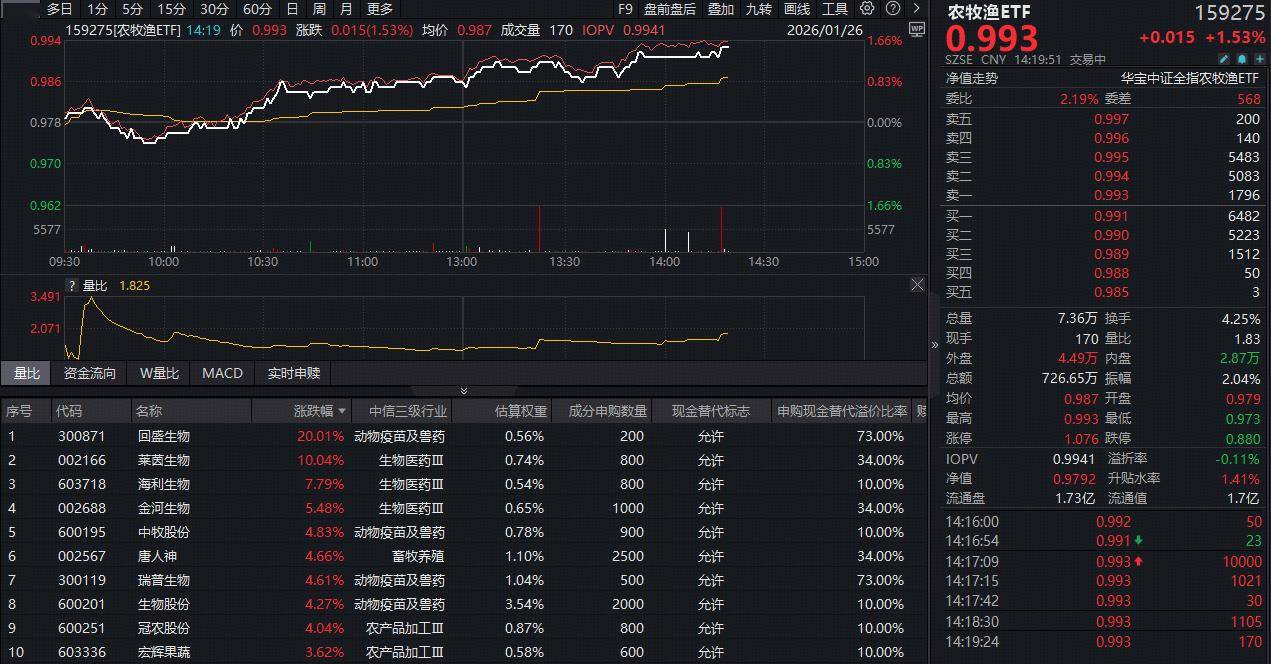
ETF盘中资讯|暴力反攻,回盛生物20CM涨停!农牧渔ETF(159275)盘中涨超1%连收三根均线!
Sou Hu Cai Jing· 2026-01-26 06:48
Core Viewpoint - The agricultural, animal husbandry, and fishery sector is experiencing a strong upward trend, with the only agricultural ETF (159275) showing a significant increase, recovering key moving averages [1][3]. Group 1: Market Performance - The agricultural ETF (159275) opened with fluctuations but quickly surged, closing with a gain of 1.53%, recovering the 5-day, 10-day, and 20-day moving averages [1]. - Key stocks in the sector, such as Huisheng Biological and Rhine Biological, reached their daily limit, while others like Haili Biological and Zhongmu Co. also showed significant gains [1][2]. Group 2: Industry Insights - The livestock farming sector faces supply pressures, and policy guidance may accelerate capacity reduction. The poultry farming sector is influenced by frequent outbreaks of avian influenza, creating uncertainty in breeding stock imports, which could benefit the white feather chicken industry in the medium to long term [1]. - The animal health industry continues to show potential for growth, with new products being launched to drive revenue. The seed industry should focus on the progress of biological breeding expansion, while the pet sector maintains a growth trend with increasing market share for domestic brands [1]. Group 3: Valuation and Investment Opportunities - The current valuation of the agricultural, animal husbandry, and fishery sector is relatively low, indicating a favorable time for investment. As of January 23, the agricultural ETF (159275) had a price-to-book ratio of 2.5, positioned at the 23.53 percentile over the past five years, highlighting its long-term investment value [3]. - Short-term forecasts suggest that pig prices may still decline, with industry capacity already reduced due to policy adjustments and supply pressures. The overall profitability of the pig farming sector remains strong, with opportunities for high-quality enterprises to capture excess profits [3].


饲料技术革新+种业振兴!农牧渔ETF(159275)拉升1.4%!机构:养殖业周期拐点将至
Xin Lang Ji Jin· 2025-11-24 01:40
Group 1 - The core viewpoint of the news highlights the performance of the Agricultural, Animal Husbandry, and Fishery ETF (159275), which showed a steady increase of 1.4% in price with a transaction volume of 2.3342 million yuan as of November 24 [1] - Among the constituent stocks, Zhongshui Fishery reached the daily limit, while Kaichuang International and Muyuan Foods followed with increases of 4.89% and 4.57% respectively [1] - Conversely, Huaying Agriculture, Meihua Biological, and Quanyin High-Tech experienced declines of 6.79%, 1.74%, and 1.44% respectively [1] Group 2 - The 9th International Feed Processing Technology Seminar will be held on November 12, 2025, in Kunshan, Jiangsu, focusing on cost reduction, efficiency enhancement, and technological innovation to promote high-quality development in the industry [1] - The Ministry of Agriculture and Rural Affairs held a national meeting on November 13 in Changsha, Hunan, emphasizing the acceleration of precise identification of germplasm resources and the planning of modern seed industry enhancement projects [1] - According to Shenwan Hongyuan Securities, the white feather broiler market will continue to face pressure in 2025, while the yellow feather broiler sector is expected to restart capacity reduction due to losses [2] - Guosen Securities noted a divergence in the agricultural, forestry, animal husbandry, and fishery industry, with optimism for the domestic beef and raw milk sectors, while the pig industry is undergoing orderly capacity reduction [2]