
利比里亚天然橡胶

Search documents
在中国大市场拥抱机遇
Ren Min Ri Bao· 2025-12-03 08:07
Core Insights - Starting from December 1, 2024, China will grant 100% zero-tariff treatment on products from the least developed countries that have diplomatic relations with China, expanding the zero-tariff policy to 53 African countries as announced in June 2023 [1] - The continuous upgrade of the zero-tariff policy has lowered the entry barriers for African products into the Chinese market, injecting strong momentum into China-Africa trade cooperation and contributing positively to global economic development [1] Group 1 - China is taking proactive steps to expand imports, showcasing its role as a major global player. As the world's second-largest goods import market, China is increasingly opening its doors to share development opportunities with more trade partners [1] - In the first three quarters of this year, imports from least developed countries that have diplomatic relations with China increased by 9.7% year-on-year. China has maintained its position as Africa's largest trading partner for 16 consecutive years, with imports from African countries growing by 10.8% year-on-year in the third quarter [1] Group 2 - The zero-tariff policy reflects a win-win scenario, allowing high-quality African products such as Sudanese cotton and Liberian natural rubber to enter the Chinese market for the first time, enriching consumer choices in China and opening markets for small and medium-sized enterprises in African countries [1] - This policy demonstrates China's commitment to high-level openness and serves as a bond for mutual benefit between China and Africa, providing opportunities for development and contributing to greater global economic growth [1]
零关税 让更多非洲产品丰富中国市场
Ren Min Ri Bao· 2025-12-03 01:55
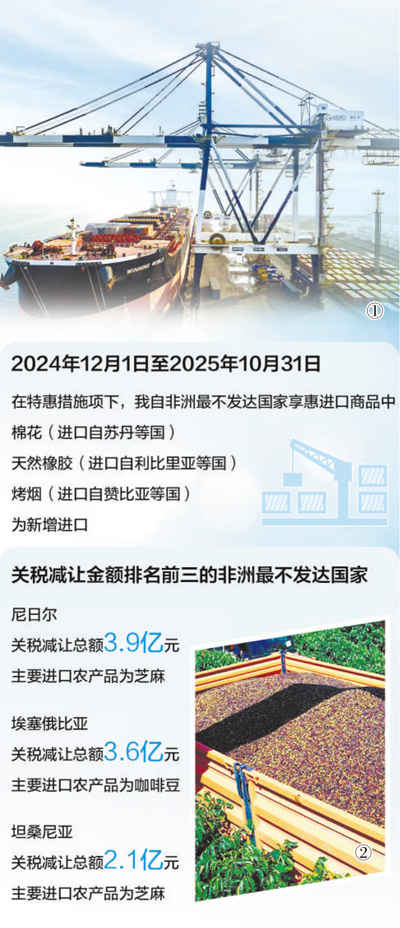
Group 1: Trade Policy Impact - China will implement a zero tariff policy on 100% of products from the least developed countries that have diplomatic relations with China starting December 1, 2024, which aims to promote mutual development [1] - The zero tariff policy is expected to enhance the competitiveness of Ethiopian coffee in the Chinese market, with exports to China growing significantly [2][3] Group 2: Coffee Industry Developments - Ethiopian coffee exports to China have been growing at an annual rate of 27%, with over 34,000 tons exported in the 2024/2025 fiscal year, generating over $218 million in revenue [2] - The zero tariff policy has increased the price competitiveness of Ethiopian coffee, benefiting local farmers and related industries [2] - The Ethiopian Coffee and Tea Authority indicates that China has become Ethiopia's fourth-largest coffee export market [2] Group 3: Supply Chain Efficiency - The import of sesame from Mozambique to China has become more efficient, with direct sourcing channels improving the supply chain [4][5] - The company in Chengdu has expanded its direct sourcing network, importing 1,120 tons of white sesame from Niger, enhancing the quality control from the planting stage [4][5] Group 4: Rubber Industry Developments - The implementation of the zero tariff policy has allowed Shandong Triangle Tire Co., Ltd. to import natural rubber from Liberia with a tariff reduction of approximately 300,000 yuan [6][7] - The company has utilized the cost savings from reduced tariffs to invest more in R&D, leading to the development of energy-saving tires suitable for electric vehicles [7] - In the first ten months of the year, Shandong Province's imports from Africa reached 87.645 billion yuan, a year-on-year increase of 50.3% [7]

零关税,让更多非洲产品丰富中国市场(经济聚焦)
Ren Min Ri Bao· 2025-12-02 22:33
Group 1: Trade Policy Impact - From December 1, 2024, China will implement a zero tariff policy on 100% of products from the least developed countries that have diplomatic relations with China, aiming to enhance mutual development [6] - The zero tariff policy is expected to boost trade vitality between China and Africa, particularly benefiting African industries and enriching consumer choices in China [6] Group 2: Coffee Industry Growth - Ethiopia's coffee exports to China have been growing at an annual rate of 27%, with over 34,000 tons exported in the 2024/2025 fiscal year, generating over $218 million in revenue [7] - The zero tariff policy has significantly increased the competitiveness of Ethiopian coffee in the Chinese market, leading to a substantial rise in export volumes [7][8] - Ethiopian coffee producers plan to increase production to meet the growing demand from China, driven by the favorable tariff conditions [7] Group 3: Sesame Supply Chain Efficiency - Sesame, as Africa's largest agricultural export to China, is being imported more efficiently through direct sourcing channels, enhancing the supply chain from Mozambique to China [9] - The company has expanded its direct sourcing network, importing 1,120 tons of white sesame from Niger, with the first batch arriving in May [9][10] - Efficient logistics and a paperless customs process have streamlined the importation of sesame, reducing costs and improving delivery times [10] Group 4: Rubber Import and Production - The implementation of the zero tariff policy has allowed companies like Triangle Tire to import natural rubber from Liberia without tariffs, saving approximately 300,000 yuan [11] - The reduction in tariff costs enables companies to invest more in R&D, leading to the development of new tire products suitable for electric vehicles and extreme conditions [12] - In the first ten months of the year, Shandong province's imports from Africa reached 87.645 billion yuan, a 50.3% increase year-on-year, with natural and synthetic rubber imports also seeing significant growth [12]

在中国大市场拥抱机遇(记者手记)
Ren Min Ri Bao· 2025-12-02 22:33
Core Viewpoint - The article highlights China's commitment to expanding zero-tariff policies for least developed countries (LDCs) that have diplomatic relations with China, effective from December 1, 2024, which aims to enhance trade cooperation with Africa and contribute positively to global economic development [1] Group 1: Zero-Tariff Policy - From June 2023, China announced the expansion of zero-tariff treatment to 53 African countries, significantly lowering the barriers for African products to enter the Chinese market [1] - The zero-tariff policy has been a part of China's strategy to actively increase imports, showcasing its role as a major global player in trade [1] Group 2: Trade Growth - In the first three quarters of this year, imports from LDCs that have diplomatic relations with China increased by 9.7% year-on-year [1] - China has maintained its position as Africa's largest trading partner for 16 consecutive years, with imports from African countries growing by 10.8% in the third quarter of this year [1] Group 3: Mutual Benefits - The introduction of African products such as Sudanese cotton and Liberian natural rubber into the Chinese market enriches consumer choices in China and opens up markets for small and medium-sized enterprises in Africa [1] - The zero-tariff policy is portrayed as a demonstration of China's responsibility as a major power and a means to foster mutual benefits between China and Africa [1]