
功能性服装

Search documents
安徽省市场监管局发布2025年衬衫等51种产品质量省级监督抽查结果
Zhong Guo Zhi Liang Xin Wen Wang· 2025-12-22 08:31
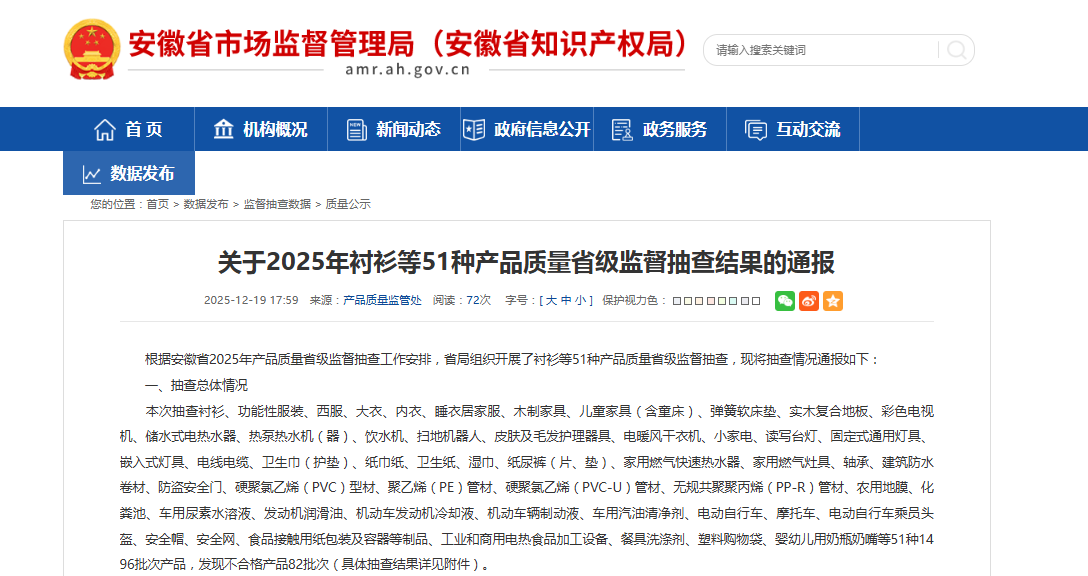
Overall Summary - The Anhui Provincial Market Supervision Administration released the results of the provincial quality supervision sampling inspection for 51 products, including shirts, functional clothing, and various household items, revealing that 82 out of 1496 batches were found to be non-compliant [3][4]. Group 1: Product Categories with Non-compliance - Shirts: Out of 50 batches inspected, 3 batches were non-compliant due to fiber content [4]. - Functional Clothing: Among 112 batches, 3 batches failed due to fiber content and hydrostatic pressure after washing [4]. - Underwear: 1 out of 62 batches was non-compliant due to fiber content [5]. - Wooden Furniture: 2 out of 12 batches were non-compliant due to woodworking requirements [6]. - Spring Mattresses: 3 out of 12 batches failed due to appearance performance (zipper) [6]. - Electrical Appliances: Various categories such as skin and hair care devices, small appliances, and lighting fixtures showed multiple non-compliance issues related to safety and performance standards [13][14][21]. Group 2: Specific Non-compliance Issues - Skin and Hair Care Devices: 3 batches failed due to protection against live parts, input power and current, and radiation interference [13]. - Small Appliances: 1 batch was non-compliant due to stability and mechanical hazards, and power connection issues [13]. - Lighting Fixtures: 10 out of 27 batches of fixed general lighting and 8 out of 27 batches of embedded lighting were found non-compliant due to various electrical interference and efficiency standards [14][15]. - Electrical Cables: 1 out of 112 batches failed due to insulation thickness issues [21]. Group 3: Additional Product Categories - Children’s Furniture: No non-compliance was found in 12 batches inspected [6]. - Household Gas Appliances: No non-compliance was reported in 12 batches of gas water heaters and stoves [19][20]. - Disposable Hygiene Products: Categories such as sanitary napkins, tissues, and diapers showed no non-compliance in their respective batches [15][16][17][18].

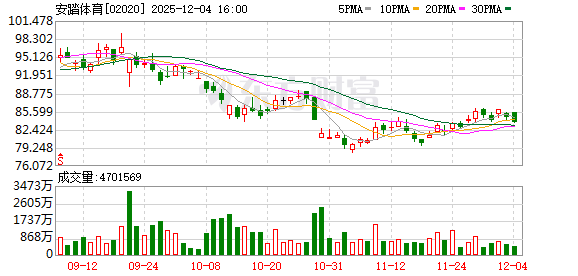
月底正式结束运营!狼爪小红书闭店,安踏渠道整合再提速?
Nan Fang Du Shi Bao· 2025-12-04 12:00
Core Insights - Anta Group has initiated the integration of the newly acquired German outdoor brand Jack Wolfskin, with the brand's Little Red Book flagship store set to close by December 31, 2025, due to a "strategic operational adjustment" [2][3][7] - This adjustment follows Anta's $290 million acquisition of Jack Wolfskin and the appointment of Yao Jian as the brand's president, indicating a clear signal of channel integration and brand restructuring [2][10] Company Strategy - The closure of the Little Red Book flagship store is part of a broader strategy to regain control over distribution channels, as the store was previously operated by a third-party distributor [7][8] - Anta aims to unify Jack Wolfskin's pricing and product strategy, addressing issues such as excessive discounting and a chaotic pricing system that conflicted with the brand's "high-end mass" positioning [7][8] Market Positioning - Jack Wolfskin, established in 1981, has a product line that includes outdoor apparel and gear, emphasizing functionality and comfort [9] - The brand's acquisition by Anta is part of a strategy to create a professional outdoor product matrix alongside other brands like Descente and Kolon [9][10] Leadership and Future Plans - Yao Jian's appointment is seen as a critical step in the brand's transformation, with plans for a 3-5 year revival strategy focusing on product and brand value [10] - The revival plan will prioritize channel management, product development, and marketing strategies to differentiate Jack Wolfskin in a competitive outdoor market [11] Challenges and Opportunities - Jack Wolfskin faces challenges in the market due to insufficient localization strategies and strong competition from established brands like The North Face and Columbia [10][11] - The brand's revival strategy will involve a focus on core product lines and innovative marketing approaches to establish a strong consumer presence [11]

苏州盛泽:从 “一根丝”到 “全球链”,绸都走好纺织开放创新之路
Su Zhou Ri Bao· 2025-09-16 09:14
Core Insights - Wujiang Shengze Town has established a complete textile industry chain, making it a significant silk textile production and export base in China [1] - The town is focusing on leveraging its industrial cluster advantages to promote transformation and sustainable development in the textile and apparel ecosystem [1] Industry Development - The cross-border e-commerce industrial park in Shengze has attracted 86 companies, including 37 cross-border e-commerce firms, achieving nearly $220 million in foreign trade import and export in the first half of the year [1] - Alibaba International Station has provided one-stop foreign trade solutions to over 400 local enterprises, with an average annual export growth of 25% for participating companies [2][4] - The Shengze Cross-Border E-commerce Selection Center showcases products from nearly 20 companies, highlighting the region's textile capabilities [3] Company Performance - Suzhou Xihe Textile Technology Co., established in 2021, has built a global smart supply chain and reported an export value exceeding 100 million yuan last year [4] - Wujiang Minsk Trading Co., established in 2011, has seen a year-on-year export growth of over 190% in the first seven months of this year, driven by simplified customs procedures [6] - The industrial park's supportive environment and complete supply chain have attracted businesses, enhancing the local economy [4] Economic Impact - Shengze Town reported an industrial output value of nearly 50.8 billion yuan and an import-export value of 10.961 billion yuan in the first half of the year, with cross-border e-commerce imports and exports reaching 2.464 billion yuan, a year-on-year increase of 292.5% [7] - The Dongfang Textile City, a key platform for the textile industry, has won multiple awards and is designed to integrate technology, fashion, and sustainability [7][8] Innovation and Leadership - Suzhou Roman Roland Fashion Group exemplifies innovation in the textile industry, developing unique materials that adapt to environmental changes [8] - The collaboration between leading companies and platforms like Dongfang Textile City is crucial for building a sustainable textile ecosystem [8]
新研究改写出汗机制传统认知
Ke Ji Ri Bao· 2025-07-29 01:00
Group 1 - The core finding of the research indicates that sweat does not form as droplets but rather emerges as a membrane that slowly rises from the pores and gathers on the skin surface, challenging traditional understanding of sweating mechanisms [1] - The study involved six healthy volunteers and utilized specialized clothing with internal water circulation and heating blankets to induce sweating, focusing on the forehead area [1] - The research revealed that sweat first penetrates the outermost layer of the skin (stratum corneum) before accumulating on the skin surface, and when cooling occurs, the sweat film evaporates, leaving a thin layer of salt [1] Group 2 - In a subsequent heating phase, sweat appeared more rapidly due to the salt layer formed during the first sweating phase, which accelerated the penetration of sweat through the stratum corneum, allowing for direct membrane formation on the skin [2] - Understanding the mechanisms of sweat generation can lead to the development of more efficient sweat-wicking materials, functional clothing, and skincare products, providing new insights for temperature regulation and skin health management in extreme heat environments [2]