
华为MateX6

Search documents
华为折叠屏国内份额超70%,坐等苹果入局
Guan Cha Zhe Wang· 2026-01-22 09:16
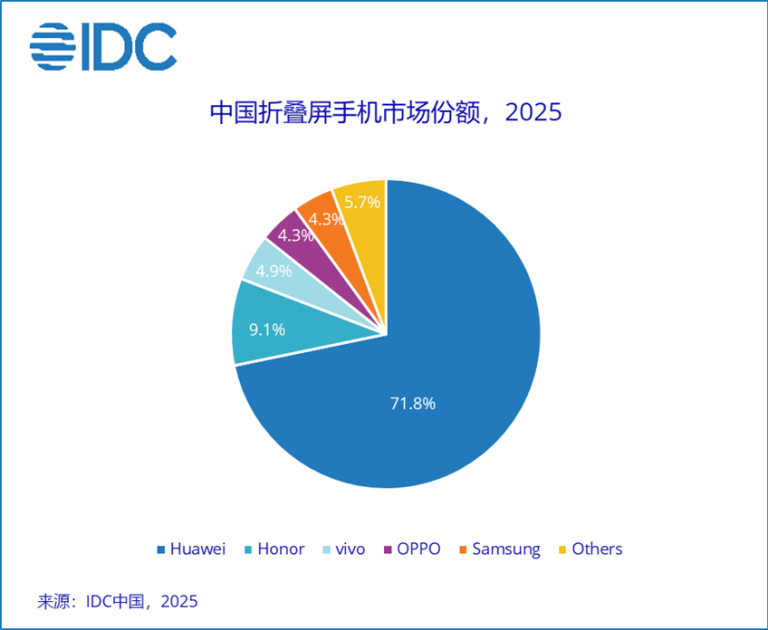
Core Insights - The Chinese foldable smartphone market is projected to see a shipment of approximately 10.01 million units in 2025, reflecting a year-on-year growth of 9.2%, contrasting with a slight decline of 0.6% in the overall smartphone market [1] - Huawei leads the market with a significant share of 71.8%, while other brands like Honor, Vivo, and OPPO have much smaller shares, indicating Huawei's dominant position [1][3] - Despite the emergence of competitive products from other manufacturers, Huawei's comprehensive product lineup and brand strength have solidified its market leadership [4][6] Market Dynamics - The foldable smartphone segment has reached a bottleneck since 2019, with manufacturers struggling to drive sales through hardware improvements alone, leading to a decline in the overall market in Q4 of the previous year [3][4] - Brand strength is increasingly influencing consumer preferences in the high-end market, with Huawei's focus on balanced capabilities and innovative designs contributing to its market share growth of over 20 percentage points in 2025 [4] - The foldable smartphone market still represents only 3.5% of total smartphone shipments in China, prompting some manufacturers to reconsider their strategies in this niche segment [4][6] Technological Innovations - Manufacturers are exploring soft-hard collaboration as a breakthrough direction, with Huawei's MateX7 focusing on AI integration rather than just hardware enhancements [6] - Other brands like OPPO and Vivo are also attempting to bridge compatibility with Apple ecosystems, indicating a trend towards cross-platform functionality [6] Future Outlook - The anticipated entry of Apple's foldable smartphone, expected to be released in the fall of 2026, is generating significant market interest, particularly regarding its potential to enhance hardware and software integration [7][8] - The overall smartphone market in China may face challenges in 2026 due to rising storage costs, which could lead to a noticeable decline in shipments [8]


华为折叠屏国内份额超70%,苹果今年能带来惊喜吗?
Guan Cha Zhe Wang· 2026-01-22 09:12
Core Insights - The Chinese foldable smartphone market is projected to see a shipment of approximately 10.01 million units in 2025, marking a year-on-year growth of 9.2%, contrasting with a slight decline of 0.6% in the overall smartphone market [1] - Huawei leads the market with a significant share of 71.8%, while other brands like Honor, Vivo, and OPPO have much smaller shares, with Xiaomi dropping out of the top five [1][3] - The foldable smartphone segment is experiencing a bottleneck phase, with hardware improvements no longer sufficient to drive significant sales growth, leading to a decline in market performance [3][4] Market Dynamics - Huawei's dominance is attributed to its comprehensive product lineup, including various foldable designs and a focus on balanced capabilities rather than just lightweight models [4] - Other manufacturers have introduced innovative products, such as OPPO's Find N5 and Vivo's lightweight foldable, but these have not significantly challenged Huawei's market position [3][4] - The foldable smartphone market only accounts for 3.5% of total smartphone shipments in China, leading some companies like Xiaomi to reconsider their strategies in this niche [4][6] Technological Innovations - Manufacturers are focusing on soft-hard collaboration to enhance user experience, with Huawei's MateX7 introducing AI capabilities to improve functionality [6] - Competitors like OPPO and Vivo are also exploring compatibility with Apple ecosystems to attract users [6] - The anticipated entry of Apple's foldable phone, expected in 2026, is generating significant market interest, with expectations for superior hardware and software integration [7][9] Future Outlook - The smartphone market is expected to face cost pressures due to rising storage prices, potentially leading to a noticeable decline in shipments in 2026 [9] - The success of Apple's foldable device and its impact on the market remains a key point of interest for industry stakeholders [9]
海南封关首日:30克金饰省近万元,居民排长队买榴莲
中国基金报· 2025-12-20 16:09
Core Viewpoint - The official launch of the Hainan Free Trade Port's full island closure on December 18 has led to a significant increase in consumer activity, particularly in duty-free shopping, with notable sales in electronics and gold products [1][8]. Duty-Free Sales Performance - On the first day of the closure, Sanya's total duty-free sales reached 118 million yuan, with a 60% increase in foot traffic to Sanya International Duty-Free City and an 85% increase in sales year-on-year [1]. - Apple and Huawei stores experienced long queues, with the iPhone 17 Pro Max priced at 9,299 yuan, 700 yuan cheaper than on Taobao, and the iPhone 17 Pro at 8,219 yuan, 780 yuan lower than the official website [3][4]. - Huawei's Mate X6 was priced at 10,899 yuan, over 1,000 yuan cheaper than Taobao, with potential savings of around 1,700 yuan when using government consumption vouchers [4]. Gold Products Popularity - Duty-free gold products are also seeing high demand, with the price at 1,187 yuan per gram, compared to the market price of 1,353 yuan, resulting in a difference of 166 yuan per gram [6]. - A consumer purchasing a 30-gram gold item could save approximately 9,116 yuan compared to market prices, after applying discounts and government vouchers [7]. Fresh Fruit Sales - The first batch of Malaysian durians sold out within an hour at a supermarket in Haikou, showcasing the strong consumer interest in imported goods following the closure [8]. Air Travel Trends - There has been a notable increase in flight bookings to Hainan for the upcoming New Year holiday, with over 720,000 tickets sold, a 10% year-on-year increase [9]. - Flight bookings to Haikou and Sanya have increased by 19% and 51% respectively, indicating a strong demand for travel to the region [11].

消息称我国低轨卫星通信系统进入公测阶段,卫星互联网应用侧市场有望加速打开
Xuan Gu Bao· 2025-05-25 14:37
Industry Insights - China's low Earth orbit (LEO) satellite communication system has entered the public testing phase, with expectations to achieve consumer-level satellite networking in the second half of the year, providing connectivity in areas without network coverage [1] - The trend of direct satellite connectivity for terminal devices has gained global attention, with significant advancements in product and service availability [1] - By April 2025, China Telecom, in collaboration with major brands like Huawei, Xiaomi, and Samsung, plans to launch 30 models of smartphones that support direct satellite connectivity, marking a shift from a "professional field" to a "mass consumer market" for satellite communication [1] - The year 2025 is identified as a critical turning point for the explosive growth of the satellite internet terminal market, with expectations of increased satellite launches and reduced manufacturing and launch costs [1] - The G60 satellite constellation has successfully launched 90 network satellites across five batches, while the GW constellation has launched three batches, indicating ongoing high-density launches [1] - The application of satellite technology is expanding internationally, with commercial developments in countries like Brazil and Thailand, and Huawei's MateX6 supporting low Earth orbit satellite connectivity [1] Company Highlights - Putian Technology is recognized as the "national team" in satellite internet, benefiting from its significant background and expected deepening collaborations, positioning it for important opportunities in the satellite internet trend [2] - Shaanxi Huada produces electrical connectors and interconnection products applicable across various aerospace fields, including high and low orbit satellites, manned spacecraft, and deep space exploration [2]
永赢国证商用卫星通信产业ETF:低轨星座补全天地互联互通,卫星通信产业投资价值凸显
Changjiang Securities· 2025-03-27 11:25
Investment Rating - The report highlights the investment value of the commercial satellite communication industry, particularly focusing on low Earth orbit (LEO) satellite constellations [3][9]. Core Insights - The satellite internet industry is expected to see significant growth, with the LEO satellite market projected to exceed 1 trillion yuan by 2030, driven by advancements in satellite manufacturing and ground equipment [8][54]. - The report emphasizes the importance of the satellite communication industry in achieving global connectivity and its military potential, which is expected to enhance industry prosperity [8][23]. Summary by Sections Satellite Internet: Application Growth - The satellite industry chain is divided into three segments: space segment (satellite manufacturing and rocket launch), ground segment (ground facilities), and user segment (user terminals and related services). Currently, the LEO satellite internet is in the space segment networking phase, while the high orbit satellite internet has entered the user segment growth phase [7][20]. - The user segment holds a higher value distribution compared to the space segment, indicating a greater potential for investment opportunities as LEO satellites continue to be deployed [20][29]. Market Potential and Growth - The LEO satellite market is estimated to reach approximately 400 billion USD in early 2023, accounting for 14% of the total satellite market. By 2030, the market size in China is expected to approach 1 trillion yuan [8][54]. - The report cites that the satellite manufacturing and ground equipment sectors are likely to experience the first wave of growth within the industry chain [8][54]. Investment Value of the National Commercial Satellite Communication Index - As of March 9, 2025, the satellite communication index shows that the communication industry accounts for 50.14%, followed by national defense and military at 28.67%, and electronics at 16.43% [9]. - The top ten constituent stocks of the index have a combined market capitalization of approximately 1,259.118 billion yuan, with a weighted average return on equity (ROE) of about 9.03% and a projected net profit growth rate of 42.34% over the next two years [9][10]. Policy Support and Industry Development - The report discusses the Chinese government's initiatives to promote the satellite internet industry, including the gradual implementation of business access systems and the encouragement of private sector participation [23][25]. - The "New Infrastructure Action Plan" emphasizes the construction of integrated satellite internet systems, which is expected to benefit related industries [25][29]. Military Applications and Strategic Importance - The military potential of LEO satellite constellations is highlighted, with the U.S. military actively exploring the use of Starlink for various applications, demonstrating the strategic importance of satellite communications in modern warfare [36][46]. - The report notes that the LEO satellite constellations can enhance navigation system accuracy and resilience against interference, making them valuable for military operations [36][42].



