
华商科创创业精选

Search documents
见好就收?年末基金“攻守战”,基金经理操作不一
Zheng Quan Shi Bao Wang· 2025-12-01 23:44
Core Viewpoint - The market is entering the fourth quarter, with many funds that have accumulated gains throughout the year adopting a defensive stance to lock in profits and mitigate ranking volatility risks [1][5]. Group 1: Fund Performance and Strategy - Several actively managed equity funds, such as Yimin Service Leading, have reportedly reduced their positions to preserve gains, evidenced by their stable net value despite market downturns [2][3]. - The Yimin Service Leading fund, which had a significant portion of its holdings in major stocks, managed to limit its decline to only 0.72% during a market drop, suggesting a strategic reduction in exposure [2][3]. - Historical performance indicates that the Yimin Service Leading fund has successfully navigated market downturns through flexible position adjustments, achieving over 30% returns this year with a maximum drawdown of approximately 6% [2][3]. Group 2: Fund Size and Flexibility - The flexibility in adjusting positions is attributed to the relatively small size of the funds, such as Yimin Service Leading with 44 million yuan and Yimin Advantage Enjoy with 55.53 million yuan, allowing for quicker tactical changes [3]. - Smaller fund sizes enable managers to execute both offensive and defensive strategies more effectively, enhancing their ability to respond to market conditions [3]. Group 3: Market Sentiment and Future Outlook - The fourth quarter is critical for performance evaluation, with institutions shifting focus from generating excess returns to securing existing profits and avoiding volatility [5][6]. - New funds launched in November, such as Ping An New Energy Selection, have shown significant net value changes, indicating a belief in future market performance despite recent volatility [5]. - The market sentiment reflects a divergence in views among institutions regarding future trends, with some optimistic about potential policy stimuli and market resilience [6].
见好就收?年末基金“攻守战”,基金经理操作不一
券商中国· 2025-12-01 23:31
Core Viewpoint - The article discusses the shift in investment strategies among mutual funds as they approach the end of 2025, with many funds adopting a defensive stance to lock in profits and mitigate risks associated with market fluctuations [1][2][3]. Group 1: Fund Performance and Strategy - As the market enters the fourth quarter, many previously high-performing sectors are experiencing volatility, prompting some actively managed equity funds to take profits and reduce positions to preserve gains [3]. - For instance, the Yimin Service Leading Fund, which had significant holdings in companies like BOE Technology Group and Ping An Insurance, managed to limit its decline to only 0.72% during a market downturn, suggesting a possible reduction in its position [3]. - Historical data indicates that the Yimin Service Leading Fund has successfully navigated market downturns by adjusting its positions, achieving over 30% returns this year with a maximum drawdown of approximately 6% [3]. Group 2: Fund Size and Flexibility - The flexibility in adjusting positions is largely attributed to the relatively small size of the funds, such as the Yimin Service Leading Fund with a size of only 44 million yuan, allowing for quicker tactical changes [4]. - Smaller fund sizes enable managers to execute defensive and offensive strategies more effectively, providing an advantage in rapidly changing market conditions [4]. Group 3: Market Sentiment and Future Outlook - Despite the general belief in long-term investment, fund managers are increasingly focusing on tactical adjustments to enhance investor experience amid market volatility [5]. - Some newly established funds are actively entering the market, with 41 new active equity funds launched in November alone, indicating a belief in future market opportunities despite recent fluctuations [6]. - Research from Dongwu Securities highlights that the fourth quarter is crucial for performance, with institutions shifting focus from seeking excess returns to securing existing profits and avoiding ranking volatility [7]. Group 4: Investment Themes and Expectations - The article notes a divergence in views among institutions regarding future market trends, with some expecting sustained benefits from themes like self-sufficiency in industrial chains amid a resilient domestic capital environment [7]. - The expectation of potential policy stimulus in December may lead to stronger domestic market performance compared to overseas markets [7].


82%权益基金发行,散户该如何避免踩坑?
Sou Hu Cai Jing· 2025-10-13 21:21
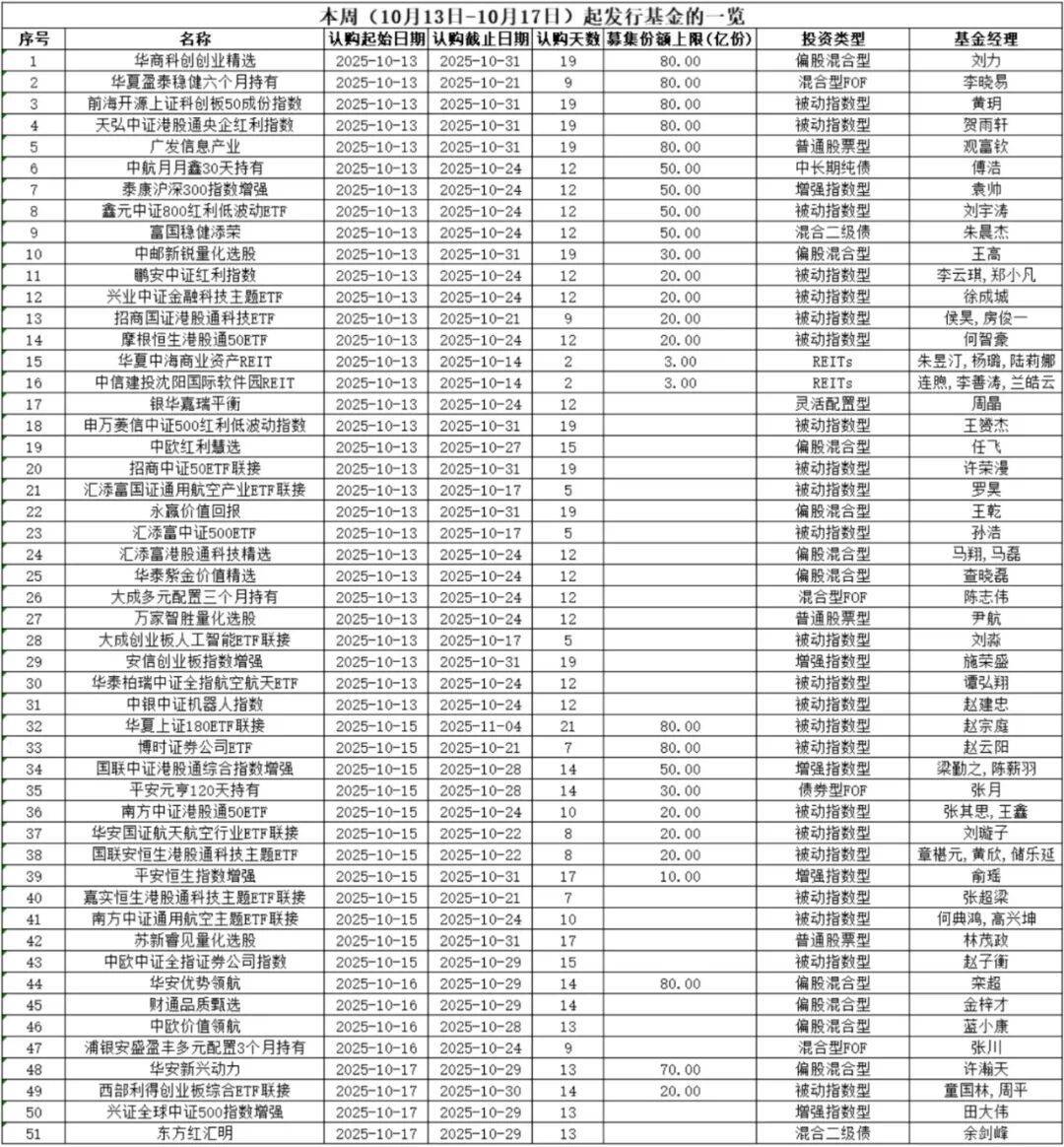
Core Insights - The recent surge in new fund issuances, with 51 new funds launched and 82% being equity products, signals a potential market recovery, but underlying patterns suggest caution [1][11][12] Fund Issuance Overview - A total of 51 new funds were launched in the first trading week after the National Day holiday, with 31 funds starting their fundraising on the same day [1] - Equity products accounted for 82% of the new fund offerings, indicating a strong interest in this asset class [1][11] Market Behavior and Trends - Historical parallels are drawn to the 2007 bull market, where similar patterns of fund issuance were observed, suggesting that current enthusiasm may not be sustainable [1][12] - The market has seen a strong recovery since April, with the banking sector rising over 12% and micro-cap stocks increasing by 35% [3] Investment Strategies and Risks - The current earnings season is highlighted as a critical period where stock performance becomes closely tied to earnings reports, but this can also lead to misleading market movements [5][6] - The concept of "fake drops" and "real declines" is introduced, emphasizing the need for investors to be wary of market manipulations that can mislead retail investors [5][6] Data-Driven Investment Approach - The importance of using quantitative data to analyze market trends and fund performance is stressed, as it can reveal underlying truths that are not apparent through traditional analysis [11][12] - Investors are advised to remain calm amidst market excitement and focus on data-driven decision-making rather than emotional reactions [12][13]
公募密集布局权益市场 新发基金聚焦科创和港股
Zheng Quan Shi Bao· 2025-10-12 22:04
Core Viewpoint - The recent surge in new fund issuance in October indicates a strong market interest in equity assets, particularly in the context of a high-level fluctuation of the Shanghai Composite Index, suggesting a positive outlook for the fourth quarter [1][2][3]. Group 1: Fund Issuance Trends - A total of 86 new funds have been confirmed for issuance as of October 11, with equity products (stock and mixed funds) accounting for 76.7% of the total [1]. - Stock funds dominate the issuance with 47 new products, reflecting renewed investor interest in equity assets [1]. - The issuance of mixed funds stands at 19, while bond funds account for 9, and other categories like QDII, public REITs, and FOF funds have 1, 2, and 8 new products respectively [1]. Group 2: Market Focus Areas - The launch of theme funds related to the Sci-Tech Innovation Board has become a hot topic, with 9 related products recently introduced [1]. - High-end manufacturing is also a focal point, with 6 new products targeting this high-growth sector [1]. - The Hong Kong stock market is gaining traction, with 7 new Hong Kong Stock Connect ETFs launched, indicating a growing interest in this market [2]. Group 3: Management Company Participation - In October, 31 fund companies participated in new fund issuance, showing a significant increase in market participation enthusiasm [3]. - Leading public funds like Huaxia Fund and Jiashi Fund have launched 4 to 5 new products each, while smaller firms are also actively competing with differentiated products [3]. - The increase in new fund issuance is attributed to improved investor confidence due to A-share valuation recovery, proactive product launches by public funds, and enhanced regulatory approval processes [3].