
嘉实恒指港股通ETF

Search documents
嘉实基金:港股调整后性价比更优 核心资产配置价值凸显
Xin Lang Cai Jing· 2025-12-09 10:22
Core Viewpoint - The Hong Kong stock market is experiencing fluctuations, but there is a continuous inflow of capital from mainland China. The recent adjustments are influenced more by liquidity expectations and short-term sentiment rather than significant changes in the fundamentals, making it an opportune time to focus on Hong Kong stocks, especially in sectors with reasonable valuations and long-term growth potential [1][2]. Group 1: Market Conditions - The Hong Kong stock market has seen a correction since Q4 2025, primarily due to fluctuations in expectations regarding the Federal Reserve's interest rate cuts, concerns over valuation bubbles in the AI sector, and seasonal factors affecting liquidity at year-end [1]. - The market is highly sensitive to global liquidity, and following the Federal Reserve's interest rate cuts in October 2025, there was a temporary pessimism regarding future rate cuts due to the prolonged U.S. government shutdown, which affected economic data availability [1]. Group 2: Economic Fundamentals - The economic fundamentals of the Hong Kong stock market are closely tied to the performance of mainland China. Since the beginning of 2025, macroeconomic data from China has shown resilience, with strong export figures indicating the international competitiveness of Chinese products, supporting a mild recovery in corporate earnings [2]. - The AI-driven market rally has led to significant gains, but some technology stocks are now at relatively high valuations, raising discussions about potential bubble risks. However, ongoing advancements in AI technology suggest that the market may not yet be at a bubble-bursting stage [2]. Group 3: Investment Opportunities - As the year-end approaches, there is an increase in profit-taking behavior among investors, which may exert some short-term pressure on market liquidity. Nevertheless, the current environment is viewed as a favorable window for positioning in core assets with long-term value [2]. - According to Wind data, as of December 5, the TTM price-to-earnings ratio of the Hang Seng Index ETF tracked by 嘉实基金 is 11.68, lower than that of the Hang Seng Index (11.79), CSI 300 Index (13.81), and A500 Index (16.21). Additionally, the dividend yield of the Hang Seng Index ETF exceeds 3%, indicating a relatively attractive investment opportunity [3].
近一个月22只ETF公告上市,最高仓位98.80%
Zhong Guo Jing Ji Wang· 2025-11-04 05:09
Core Insights - Two stock ETFs have recently announced their listing, with aerospace stocks holding a position of 24.05% and the Xinyuan CSI 800 Dividend Low Volatility ETF at 19.25% [1] - In the past month, 22 stock ETFs have announced their listings, with an average position of only 31.88%. The highest position is held by the Chuangjin Hexin CSI State-Owned Enterprises Dividend ETF at 98.80% [1][2] - The average fundraising for the newly announced ETFs is 421 million shares, with the leading funds being the GF CSI Satellite Industry ETF, the CMB National Index Hong Kong Stock Connect Technology ETF, and the Huaan National Index Hong Kong Stock Connect Consumer Theme ETF, with shares of 1.171 billion, 935 million, and 639 million respectively [1] ETF Positioning - The average institutional investor holding is 15.39%, with the highest proportions in the Penghua Hong Kong Stock Connect Low Dividend ETF (97.57%), the Fortune Creation Board New Energy ETF (66.53%), and the Harvest Hang Seng Index Hong Kong Stock Connect ETF (59.52%) [2] - The lowest institutional holding proportions are found in the Southern CSI Hong Kong Stock Connect 50 ETF (0.57%), the GF CSI Satellite Industry ETF (1.31%), and the Chuangjin Hexin CSI State-Owned Enterprises Dividend ETF (2.20%) [2] Fund Details - The newly listed ETFs include the Aerospace ETF with a position of 24.05%, the Guoshou Anbao CSI A500 Dividend Low Volatility ETF at 0.00%, and the Xinyuan CSI 800 Dividend Low Volatility ETF at 19.25% [2][3] - Other notable ETFs include the CMB National Index Hong Kong Stock Connect Technology ETF with a position of 31.14%, and the Boshi Securities Company ETF at 70.09% [2][3] - The Chuangjin Hexin CSI State-Owned Enterprises Dividend ETF has the highest position at 98.80%, indicating a strong focus on state-owned enterprises [3]
近一个月公告上市股票型ETF平均仓位32.91%
Zhong Guo Jing Ji Wang· 2025-11-03 05:04
Core Insights - The newly launched招商国证港股通科技ETF is set to be listed on November 6, 2025, with a total of 935 million shares available for trading [1] - As of October 30, 2025, the fund's asset allocation consists of 68.85% in bank deposits and settlement reserves, while stock investments account for 31.14% [1] - In the past month, 20 stock ETFs have announced their listings, with an average allocation of 32.91% [1] Fund Statistics - The招商国证港股通科技ETF has a total fundraising of 935 million shares, ranking among the top in terms of trading volume [2] - The fund's establishment date is October 24, 2025, and it has a stock allocation of 31.14% as of the latest announcement [2] - Other notable ETFs include广发中证卫星产业ETF with 1.171 billion shares and华安国证港股通消费主题ETF with 639 million shares [2] Institutional Investor Participation - On average, institutional investors hold 16.04% of the shares in newly listed ETFs, with the highest being鹏华港股通低波红利ETF at 97.57% [2] - The招商国证港股通科技ETF has a relatively lower institutional ownership compared to others, indicating potential for growth in institutional interest [2]
ETF市场日报 | 稀有金属相关ETF领涨!巴西ETF要来了
Sou Hu Cai Jing· 2025-10-30 07:37
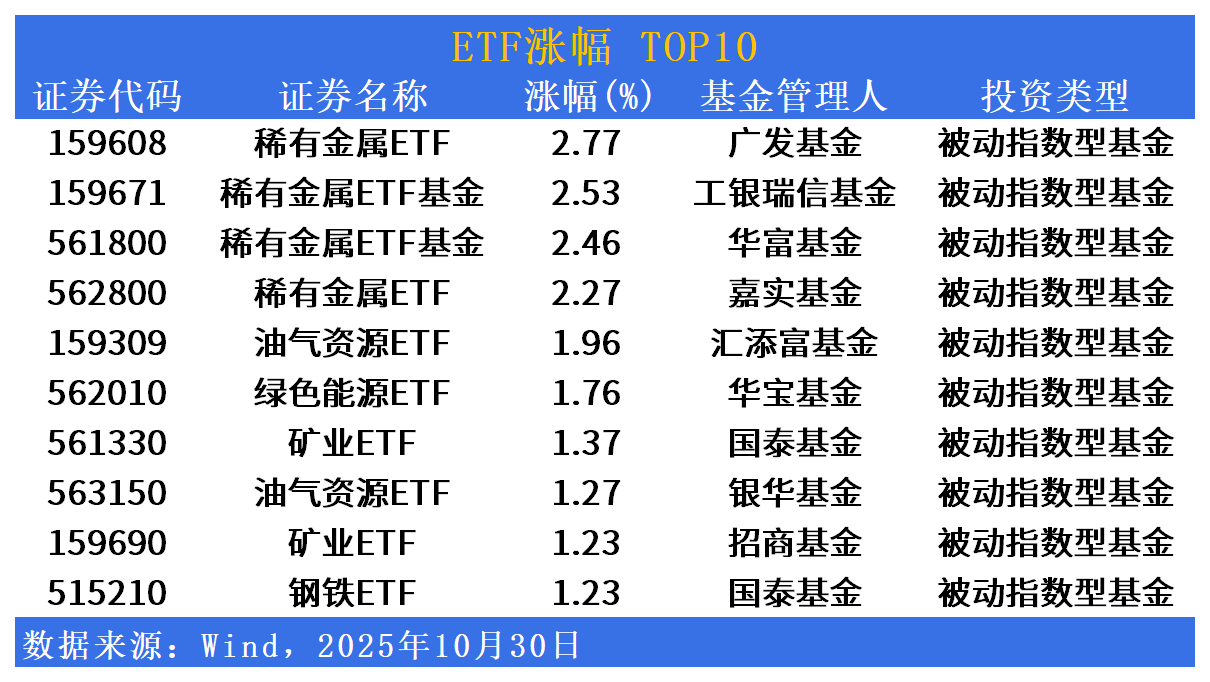
Market Overview - The A-share market experienced a collective pullback, with the Shanghai Composite Index falling below the 4000-point mark, closing down by 0.73% [1] - The total trading volume in the Shanghai and Shenzhen markets reached 24,217 billion [1] Sector Performance - The rare metals sector led the gains, with several ETFs in this category showing positive performance, including a 2.77% increase in the Rare Metals ETF (159608) [2] - Conversely, the innovative drug sector saw significant declines, with the ChiNext 50 ETF (159371) dropping by 9.67% [4][5] Investment Trends - The 20th Central Committee's Fourth Plenary Session emphasized the development of future industries, including quantum technology, biomanufacturing, hydrogen energy, and nuclear fusion, positioning new materials as a key component in supporting sectors like new energy and low-altitude economy [3] - Battery manufacturers are benefiting from dual demand for power and energy storage, with production expected to increase by 10% month-on-month and over 35% year-on-year in October [3] ETF Activity - The Short-term Bond ETF (511360) had the highest trading volume at 372.75 billion [6] - The turnover rate was led by the China-Korea Semiconductor ETF (213310) at 148.58% [8] New ETF Launches - Two Brazilian ETFs, the Huaxia Brazil ETF (159100) and the E Fund Brazil ETF (520870), will begin fundraising, closely tracking the Ibovespa Index, which reflects Brazil's economic performance [9] - The Jiashi Hang Seng Index Hong Kong Stock Connect ETF (520960) is designed for investors looking to access core Hong Kong stocks efficiently [10]

16只ETF公告上市,最高仓位98.80%
Zheng Quan Shi Bao Wang· 2025-10-29 02:53
Core Insights - Three stock ETFs have recently announced their listing, with varying stock positions, indicating a diverse investment strategy among these funds [1] Group 1: ETF Stock Positions - The stock position of the Fortune Country Growth Board New Energy ETF is 71.45%, while the Southern CSI Hong Kong Stock Connect 50 ETF has a stock position of 29.50%, and the E Fund Hang Seng Biotechnology ETF has a stock position of 11.82% [1] - A total of 16 stock ETFs have announced listings in October, with an average stock position of only 33.91% [1] - The highest stock position among the newly listed ETFs is 98.80% for the Chuangjin Hexin CSI State-owned Enterprises Dividend ETF, followed by 82.97% for the Qianhai Kaiyuan CSI Private Enterprises 300 ETF, and 71.45% for the Fortune Country Growth Board New Energy ETF [1] Group 2: ETF Fundraising and Size - The average fundraising for the ETFs announced in October is 416 million shares, with the largest being the GF CSI Satellite Industry ETF at 1.171 billion shares, followed by the Huaan National Index Hong Kong Stock Connect Consumer Theme ETF at 639 million shares, and the Fortune Country Shanghai Stock Science and Technology Innovation Board 100 ETF at 556 million shares [1] - The institutional investor ownership structure shows an average holding of 17.22%, with the highest being 97.57% for the Penghua Hong Kong Stock Connect Low Volatility Dividend ETF [2] - The institutional ownership is notably low for the Southern CSI Hong Kong Stock Connect 50 ETF at 0.57%, the GF CSI Satellite Industry ETF at 1.31%, and the Chuangjin Hexin CSI State-owned Enterprises Dividend ETF at 2.20% [2]
10月以来公告上市股票型ETF平均仓位33.06%
Zheng Quan Shi Bao Wang· 2025-10-28 04:40
Core Insights - The Jiashi Hang Seng Index Hong Kong Stock Connect ETF is set to be listed on October 31, 2025, with a total of 287 million shares for trading [1] - As of October 24, 2025, the fund's asset allocation shows 71.78% in bank deposits and settlement reserves, while stock investments account for 28.22% [1] - A total of 13 stock ETFs have announced listings in October, with an average position of only 33.06% [1] Fund Statistics - The Jiashi Hang Seng Index Hong Kong Stock Connect ETF has a fundraising scale of 287 million shares, with a position of 28.22% as of October 24, 2025 [2] - Other notable ETFs include the Guangfa CSI Satellite Industry ETF with 1.171 billion shares and a position of 33.38%, and the Huaxia SSE 180 ETF with 2.28 billion shares and a position of 19.95% [2] - The average fundraising for newly announced ETFs in October is 452 million shares, with the Guangfa CSI Satellite Industry ETF leading in scale [2] Institutional Investor Participation - Institutional investors hold an average of 15.83% of the shares in the newly listed ETFs, with the Jiashi Hang Seng Index Hong Kong Stock Connect ETF having 59.52% held by institutions [2] - The highest institutional ownership is seen in the Penghua Hong Kong Stock Connect Low Volatility Dividend ETF at 97.57% [2] - ETFs with lower institutional ownership include the Guangfa CSI Satellite Industry ETF and the Chuangjin Hexin CSI State-Owned Enterprise Dividend ETF, with ownership at 1.31% and 2.20% respectively [2]
公募密集布局权益市场 新发基金聚焦科创和港股
Zheng Quan Shi Bao· 2025-10-12 22:04
Core Viewpoint - The recent surge in new fund issuance in October indicates a strong market interest in equity assets, particularly in the context of a high-level fluctuation of the Shanghai Composite Index, suggesting a positive outlook for the fourth quarter [1][2][3]. Group 1: Fund Issuance Trends - A total of 86 new funds have been confirmed for issuance as of October 11, with equity products (stock and mixed funds) accounting for 76.7% of the total [1]. - Stock funds dominate the issuance with 47 new products, reflecting renewed investor interest in equity assets [1]. - The issuance of mixed funds stands at 19, while bond funds account for 9, and other categories like QDII, public REITs, and FOF funds have 1, 2, and 8 new products respectively [1]. Group 2: Market Focus Areas - The launch of theme funds related to the Sci-Tech Innovation Board has become a hot topic, with 9 related products recently introduced [1]. - High-end manufacturing is also a focal point, with 6 new products targeting this high-growth sector [1]. - The Hong Kong stock market is gaining traction, with 7 new Hong Kong Stock Connect ETFs launched, indicating a growing interest in this market [2]. Group 3: Management Company Participation - In October, 31 fund companies participated in new fund issuance, showing a significant increase in market participation enthusiasm [3]. - Leading public funds like Huaxia Fund and Jiashi Fund have launched 4 to 5 new products each, while smaller firms are also actively competing with differentiated products [3]. - The increase in new fund issuance is attributed to improved investor confidence due to A-share valuation recovery, proactive product launches by public funds, and enhanced regulatory approval processes [3].