卡奥斯平台

Search documents
中国制造“换挡提速”步伐铿锵
Jing Ji Wang· 2025-12-02 03:09
Core Insights - The integration of industrial internet platforms is transforming traditional industries by enhancing efficiency and enabling data-driven decision-making [1][2][3][4] - The "14th Five-Year Plan" emphasizes the importance of advancing the productive service industry through digitalization and intelligent upgrades [1][3] - Companies are leveraging AI and digital tools to streamline processes, reduce production cycles, and improve overall productivity [4][5][6] Group 1: Industrial Internet and Digital Transformation - Industrial internet platforms, such as the one developed by Kaos, are key enablers for the deep integration of modern service industries and advanced manufacturing [3] - The application of AI in traditional sectors, like oil extraction, has led to a 70% increase in equipment diagnostic efficiency and a significant reduction in maintenance cycles [2][4] - The shift from experience-based to data-driven operations is reshaping the roles of workers, turning them into decision-makers rather than mere operators [2][4] Group 2: AI and Production Efficiency - AI applications in the fashion industry, such as Fashion Mind, have drastically reduced design time from one month to mere seconds, enhancing overall workflow efficiency [4][5] - The use of AI in garment design has resulted in a 60% reduction in production costs and a ninefold increase in design efficiency for collaborating brands [5] - The integration of AI and automation in the textile industry is expected to drive a complete overhaul of the production chain, enhancing efficiency from design to manufacturing [5][6] Group 3: Flexible Manufacturing and Supply Chain Solutions - Companies like Yunhan Xincheng are addressing the challenges faced by small and medium-sized manufacturers by providing flexible manufacturing solutions that adapt to small batch orders [6][7] - The implementation of data-driven systems has transformed operations, allowing for proactive resource management and improved delivery times by at least 50% for clients [6][7] - The focus on digital supply chain services and collaborative manufacturing models is set to continue, with companies investing in AI and big data to enhance service capabilities [7]
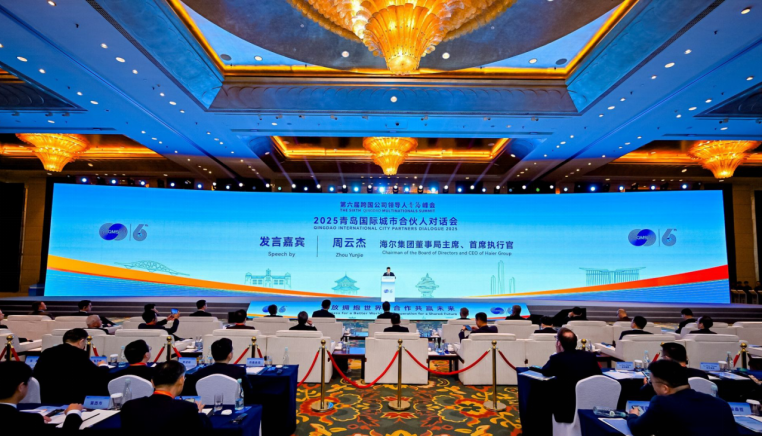
海尔周云杰:以开放、生态、创新诠释中国跨国公司全球化担当
Zhong Guo Jin Rong Xin Xi Wang· 2025-06-20 07:31
Core Viewpoint - The article discusses the insights shared by Zhou Yunjie, CEO of Haier Group, at the Qingdao International City Partners Dialogue, emphasizing the role of Chinese enterprises in global transformation through "openness, ecology, and innovation" Group 1: Globalization and Market Positioning - Haier leverages its local roots in Qingdao to establish a global presence, with a network of 230,000 outlets across over 200 countries and regions [3] - The company has maintained its position as the world's leading home appliance brand for 16 consecutive years, with Haier accounting for 60% of every 10 Chinese brand appliances sold overseas [3] Group 2: Ecological Development and Collaboration - The future of competition is shifting from direct corporate rivalry to ecological dialogue, focusing on creating a multi-dimensional ecosystem that transcends industry boundaries [4] - Haier's ecological strategy includes three main sectors: smart home, health, and industrial internet, fostering extensive collaboration opportunities with global partners [4][5] Group 3: Sustainable Practices and Innovation - Haier's 6-GREEN strategy aims to establish a low-carbon system across the entire industry chain, transforming China's sustainable practices into international standards [5] - The company is enhancing its global cooperation hub in Qingdao by integrating technology innovation, upgrading industrial clusters, and promoting cross-cultural collaboration [6]


【有本好书送给你】黄奇帆:重点抓好五大类型的生产性服务业企业的发展
重阳投资· 2025-03-05 07:36
Core Viewpoint - The article emphasizes the importance of reading as a pathway to growth and understanding, aligning with the belief that knowledge acquisition is essential for wisdom [2][3][6]. Summary by Sections Book Recommendation - The featured book is "China's Economy 2025: Stabilizing Expectations, Promoting Consumption, and Expanding Domestic Demand," authored by Liu Shijin, Huang Qifan, and Huang Hanquan, published by CITIC Press Group [8]. Economic Structure and Development - The article discusses the evolution of industrial organization from the agricultural era to modern industrialization, highlighting the shift from small-scale workshops to complex corporate structures that enhance production efficiency [9][10]. Five Types of Productive Service Enterprises - The article outlines five distinct operational models for productive service enterprises: 1. Numerous specialized and innovative service enterprises across cities [10]. 2. Large enterprise groups that manage both productive services and manufacturing [11]. 3. Fortune 500 companies focused on specific service sectors [11]. 4. Chain enterprises that provide services related to advanced industrial products while outsourcing manufacturing [11]. 5. Industrial internet enterprises that leverage digital technologies for efficient production and sales [12]. Industrial Internet as a New Frontier - The industrial internet is identified as a significant growth area, contrasting with the declining growth of consumer internet, and emphasizes the need for a focus on industrial internet to maintain global competitiveness [12][14]. Three Models of Industrial Internet - The article describes three models of industrial internet: 1. Industrial internet platforms within large enterprises that digitize their entire supply chain [15]. 2. Industry-specific platforms that connect numerous service and manufacturing enterprises [15]. 3. Regional platforms that integrate local industry clusters through digital networks [16]. Characteristics of Industrial Internet - The industrial internet is characterized by: 1. Value-added effects, where the production and sales values can significantly exceed traditional metrics [18]. 2. The ability to revitalize traditional industries and create jobs through digital empowerment [19]. 3. Accelerated development of regional productive services, transforming areas into manufacturing, trade, and logistics centers [20]. Financial Technology Integration - The industrial internet facilitates comprehensive financial technology solutions, addressing the financing challenges faced by small and medium enterprises by providing transparent data for banks [21]. Strategic Importance of Industrial Internet - The article concludes that regions fostering industry-specific internet platforms can attract manufacturing, logistics, trade, and financial services, positioning themselves as competitive centers in the global economy [22].