卫星测试系统

Search documents
霍莱沃:积极布局火箭测试系统业务
Zheng Quan Ri Bao Wang· 2025-12-24 12:18
Group 1 - The core viewpoint of the article is that the company, 霍莱沃, is actively expanding its business into rocket testing systems based on its satellite testing systems and has achieved a breakthrough in orders [1] Group 2 - The company has responded to investor inquiries on an interactive platform, indicating its strategic focus on the rocket testing systems sector [1] - The achievement of order breakthroughs signifies positive momentum in the company's growth and market positioning [1]

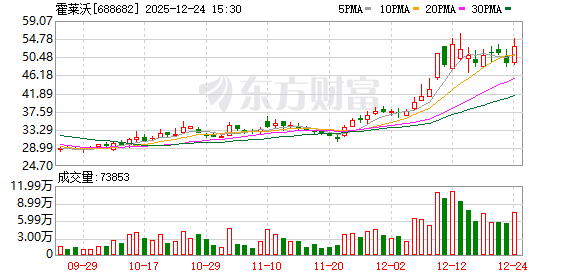
霍莱沃:公司在卫星测试系统基础上积极布局火箭测试系统业务,并实现了订单突破
Mei Ri Jing Ji Xin Wen· 2025-12-24 09:29
Group 1 - The company has experienced rapid growth in orders within the commercial aerospace sector this year, particularly in satellite business with both volume and price increasing [2] - The company is actively expanding its rocket testing system business based on its satellite testing system, achieving a breakthrough in orders [2]

商业航天燃起来了,资本竞逐万亿新赛道
3 6 Ke· 2025-12-17 10:09
Core Insights - The commercial space industry, encompassing rocket launches, satellite manufacturing and operation, and space tourism, is experiencing rapid growth with a potential market size reaching trillions [1][2] - Investor sentiment in the A-share market has been significantly influenced by commercial space concept stocks, with several companies experiencing substantial stock price increases in December 2025 [1][2] Investment and Market Activity - The commercial space sector has seen a surge in investment, with multiple companies like Tongguang Cable and Zhongsteel Luonai hitting trading limits [1] - Significant stock price increases were noted, such as Tianli Composite rising by 18.49% on December 16, and a cumulative increase of nearly 200% over seven trading days [1] - The establishment of "Space Technology City" in Beijing by major state-owned enterprises indicates a strong commitment to developing the commercial space sector [1][2] Industry Developments - The Beijing Economic-Technological Development Area has become a key hub for commercial space enterprises, with a focus on rocket development and satellite applications [3] - A 10-point policy initiative was launched to support the commercial space industry, including a 10 billion yuan investment fund and rewards for successful launches [3] - Local governments are actively promoting commercial space development, with Guangdong aiming for a 300 billion yuan industry scale by 2026 [4] Company Strategies and Innovations - Companies are adopting diverse strategies, with some focusing on high-frequency, low-cost launch services while others are specializing in niche areas within the industry [5][6] - Innovations such as the intelligent framework recovery system by Linghang Star Arrow aim to reduce costs and improve efficiency in rocket design [6] - New companies are emerging, with over 15 commercial space-related firms established in August 2025 alone, indicating a growing interest in the sector [5] Capital Market Dynamics - The capital market is becoming more discerning, with investors seeking companies that can deliver tangible results within the commercial space industry [9] - Companies like Sry New Materials and Superjet Co. are experiencing increased orders and stock price appreciation due to their involvement in the commercial space sector [9][10] - The transition from project-based to assembly line production in satellite manufacturing is reshaping the industry, leading to increased efficiency and order volumes [10] National and Private Sector Collaboration - State-owned enterprises are shifting their focus to commercial markets, with adjustments in their operational structures to enhance competitiveness [13][15] - Collaborations between private companies and state-owned enterprises are becoming more common, with shared resources and expertise aimed at reducing costs and improving efficiency [14][15] - The establishment of "Space Technology City" is intended to foster an open and innovative ecosystem for the commercial space industry, emphasizing collaboration over competition [15]
商业航天燃起来了 资本竞逐万亿新赛道
经济观察报· 2025-12-17 08:50
Core Viewpoint - The commercial space industry, encompassing rocket launches, satellite manufacturing and operation, and space tourism, is experiencing rapid growth and transformation, with a potential market size reaching trillions of yuan, marking a significant shift from policy discussions to a vibrant economic sector by the end of 2025 [1][3]. Market Dynamics - Investor sentiment has been significantly boosted by commercial space concept stocks, with notable price surges in companies like Tongguang Cable and Zhonggang Luoni, reflecting a strong market interest [2]. - The establishment of "Space Technology City" in Beijing, in collaboration with major state-owned enterprises, indicates a strategic push towards developing a robust commercial space ecosystem [2][5]. Government Initiatives - Local governments are actively promoting the commercial space sector, with Guangdong aiming for a 300 billion yuan industry scale by 2026 and offering financial incentives for companies setting international standards [6]. - The Beijing Economic and Technological Development Zone has launched a 10-point plan to support the commercial space industry, including a 10 billion yuan investment fund [5]. Industry Developments - The number of new commercial space enterprises has surged, with over 15 companies established in August 2025 alone, indicating a growing interest in the sector [7]. - Major companies like Star Glory and Blue Arrow are collaborating with local state-owned enterprises to explore ecosystem development [5]. Capital Involvement - The commercial space sector has seen a rise in financing activities, with significant funding rounds for leading companies like Star Glory and Tianbing Technology [8]. - The inclusion of commercial space in the Sci-Tech Innovation Board's listing criteria has opened new avenues for funding, allowing unprofitable companies with core technologies to access capital markets [8]. Competitive Landscape - Companies are adopting diverse strategies, with some focusing on high-capital, high-risk rocket launches, while others are carving niches in specialized segments of the industry [9][10]. - The trend of "R&D in Beijing, production in the Yangtze River Delta" is becoming common among commercial space firms, optimizing their operational efficiency [12]. Market Evaluation - The capital market is increasingly scrutinizing commercial space companies, emphasizing the need for tangible performance and profitability [14]. - Companies like Srey New Materials and Superfast Co. are experiencing growth due to increased orders from the commercial space sector, reflecting a positive market response [15][16]. Role of State-Owned Enterprises - State-owned enterprises are transitioning to compete in the commercial market, focusing on market competitiveness and restructuring to align with commercial objectives [19]. - Collaborations between state-owned and private enterprises are becoming more prevalent, with state-owned firms leveraging their technological advantages while private firms offer efficiency and cost control [20][21]. Future Outlook - The commercial space market is projected to reach $680.25 billion globally, with China's market potentially exceeding 2.5 trillion yuan, highlighting the immense growth potential [21]. - The integration of state-owned and private enterprises is expected to foster innovation and efficiency, positioning them for success in the evolving commercial space landscape [22].



商业航天燃起来了 资本竞逐万亿新赛道
Sou Hu Cai Jing· 2025-12-17 03:21
Group 1 - The commercial aerospace sector in China is experiencing significant growth, with multiple stocks in the sector seeing substantial price increases in December 2025, indicating strong investor sentiment [2][3] - Major developments include the establishment of the "Aerospace Technology City" in Beijing, which aims to enhance collaboration among key players in the industry, including state-owned enterprises and private companies [3][26] - The market for commercial aerospace activities, which includes rocket launches, satellite manufacturing, and space tourism, is projected to reach a scale of trillions of yuan, reflecting a rapid acceleration in industrialization [3][4][5] Group 2 - Local governments are actively promoting the commercial aerospace industry, with Guangdong aiming for a related industry scale of 300 billion yuan by 2026 and other provinces like Shandong and Henan also prioritizing aerospace in their development plans [9][10] - The establishment of a 10 billion yuan industry investment fund in Beijing's Economic and Technological Development Zone is part of the efforts to support the commercial aerospace sector [8] - The number of new commercial aerospace companies has surged, with over 15 new firms established in August 2025 alone, indicating a robust entrepreneurial environment [10] Group 3 - The China Securities Regulatory Commission has included commercial aerospace in the fifth set of listing standards for the Sci-Tech Innovation Board, allowing unprofitable companies with core technologies to go public [11] - Companies are adopting diverse strategies, with some focusing on core rocket launch capabilities while others are specializing in niche areas within the aerospace supply chain [12][13] - The trend of "R&D in Beijing, production in the Yangtze River Delta" is becoming common among commercial aerospace firms, optimizing their operational efficiency [16][17] Group 4 - The capital market is becoming more discerning, with investors seeking companies that can deliver tangible results within the commercial aerospace supply chain [18] - Companies in upstream materials and core components are experiencing increased orders, reflecting a growing demand as the industry expands [19][20] - The shift from project-based satellite production to a more streamlined assembly line approach is transforming the satellite manufacturing sector, leading to increased efficiency and order volumes [21] Group 5 - State-owned enterprises are adapting to market dynamics, with the China Aerospace Science and Technology Corporation restructuring to focus on commercial market competitiveness [24][26] - Collaborations between state-owned and private enterprises are becoming more common, with private firms providing efficiency and cost advantages in non-core areas of the aerospace supply chain [25][26] - The establishment of the "Aerospace Technology City" aims to create an open and innovative industrial ecosystem, emphasizing the importance of collaboration across the aerospace sector [26][27]


承前启后的2025年迎来高光时刻、政策指引 商业航天:迈向下一个黄金十年
Shang Hai Zheng Quan Bao· 2025-12-15 19:19
Core Insights - The commercial aerospace industry in China is entering a new era, with significant advancements in capabilities and a solid foundation for the next decade [2][7] Industry Developments - As of December 12, 2025, China has successfully launched 16 groups of satellites for the National Network Constellation (GW constellation) and 6 groups for the Qianfan Constellation, marking a substantial increase in launch frequency and the number of satellites in orbit [3] - The first batch of network satellites was mass-produced by private company Galaxy Aerospace, significantly reducing the satellite development cycle by 80% and achieving an annual production capacity of over 100 satellites weighing 1000 kg [3] - The Blue Arrow Aerospace's Zhuque-3 rocket conducted its first complete recovery test, marking a significant step towards reusable rocket technology in China, despite the recovery test being unsuccessful [3] - The Hainan Commercial Aerospace Launch Site has successfully conducted 9 launches since its opening at the end of 2024, demonstrating improved operational efficiency with a high-density launch success [3] Regulatory and Market Changes - All three major telecom operators in China have obtained licenses for satellite mobile communication services, enabling them to legally conduct satellite direct connection services [4] - The introduction of the fifth set of listing standards on the Sci-Tech Innovation Board allows unprofitable but technologically advanced commercial aerospace companies to go public, enhancing market confidence and investment enthusiasm [5] - Notable funding rounds include 430 million yuan for Aerospace Yuxing, 700 million yuan for Star Glory, 2.4 billion yuan for Star River Power, and nearly 2.5 billion yuan for Tianbing Technology [5] Future Outlook - The year 2025 is seen as a pivotal year for the commercial aerospace industry in China, transitioning from mere technical demonstrations to building a sustainable commercial aerospace ecosystem [7] - The establishment of the Commercial Aerospace Administration and the "Action Plan for High-Quality and Safe Development of Commercial Aerospace (2025-2027)" provides clear regulatory guidance and support for the industry [7][8] - The Action Plan outlines development directions for various segments of the aerospace industry, emphasizing low-cost, reliable, and reusable commercial launch vehicles [7][8]

多家上市公司 披露商业航天布局
Shang Hai Zheng Quan Bao· 2025-12-14 16:59
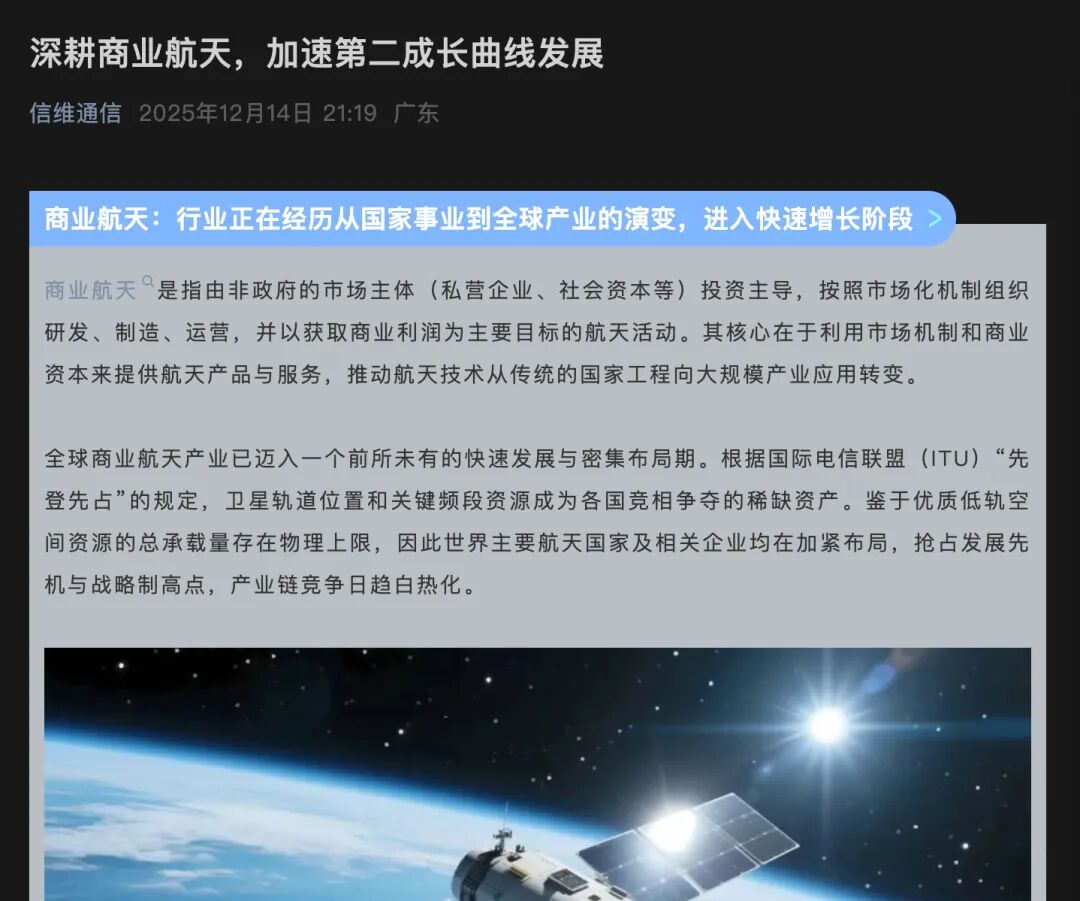
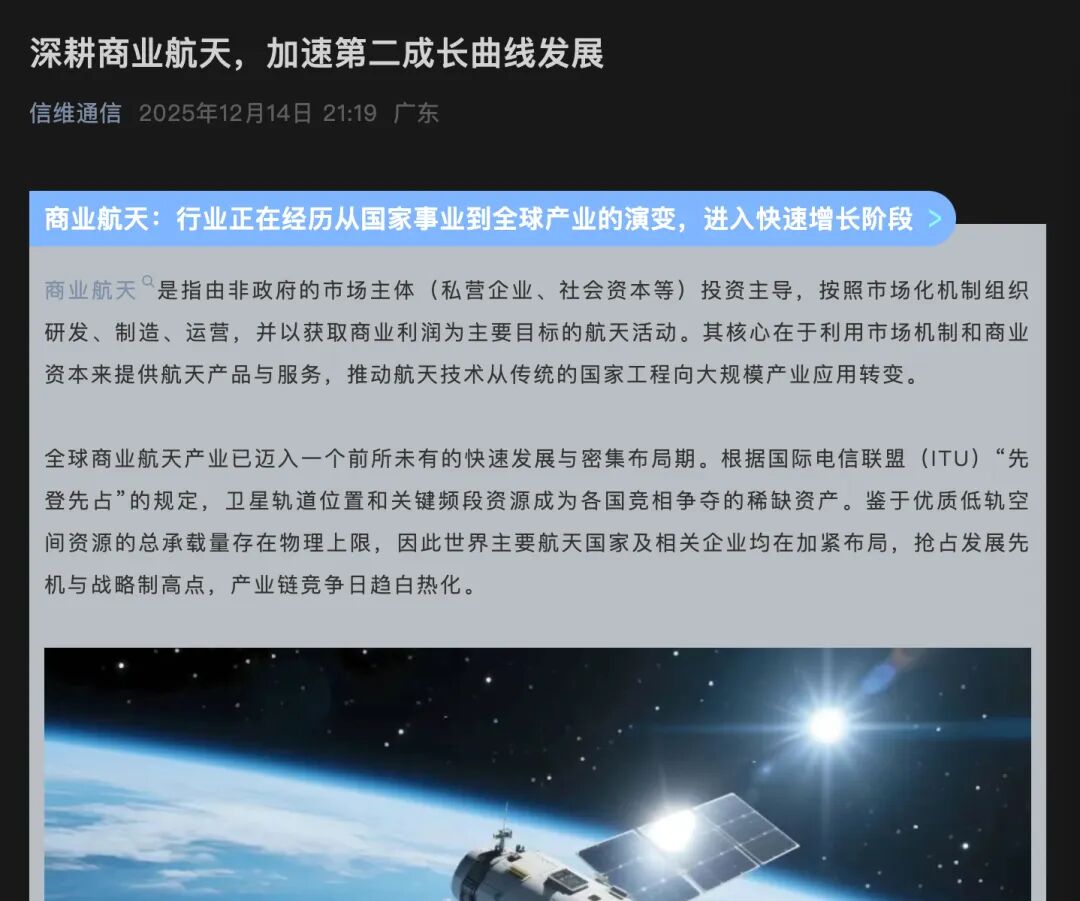
Group 1: Company Developments - XW Communication has established a unique advantage in the commercial aerospace sector, viewing it as a second growth curve, and has integrated a full-chain technical capability from material research to product manufacturing [1][4] - The core products in the commercial satellite field include high-frequency and high-speed connectors, high-performance antennas, precision structural components, and ground receiving terminal ODM, specifically designed for low Earth orbit satellite communication [4] - XW Communication has become a core supplier for leading domestic satellite clients, expanding its product offerings from components to complete systems [4] Group 2: Industry Trends - The global commercial aerospace industry is entering a phase of rapid scaling and industrialization, with companies focusing on technological evolution and market opportunities [5] - The demand for satellite testing systems has surged due to the acceleration of commercial satellite production, with significant contributions from satellite manufacturers [5] - Zhenyou Technology has developed a complete ground core network system for satellite communication, supporting nearly 6 million users in the Tian Tong No. 1 project, and is actively involved in key technology research for low Earth orbit satellite constellations [6]


多家上市公司,披露商业航天布局
Shang Hai Zheng Quan Bao· 2025-12-14 15:53
Group 1: Company Developments - XW Communication has established a unique advantage in the commercial aerospace sector, viewing it as a second growth curve, and has integrated a full-chain technical capability from material research to product manufacturing [1][4] - The core products of XW Communication in the commercial satellite field include high-frequency and high-speed connectors, high-performance antennas, precision structural components, and ground receiving terminal ODM, specifically designed for low Earth orbit satellite communications [4] - XW Communication has become a core supplier for leading domestic satellite clients, expanding its product offerings from components to complete systems [4] Group 2: Industry Trends - The global commercial aerospace industry is entering a phase of rapid scaling and industrialization, presenting significant technological evolution and market opportunities [5] - The demand for satellite testing systems has surged due to the acceleration of commercial satellite production, with major contributions from satellite manufacturers [5] - Zhenyou Technology has developed a complete ground core network system for satellite communications, supporting nearly 6 million users in the Tian Tong No. 1 project, and is actively involved in key technology research for low Earth orbit satellite constellations [6]
预计2026年商业航天业务营收实现较快增长 商业航天概念股20CM涨停 本周机构密集调研相关上市公司
Xin Lang Cai Jing· 2025-12-14 13:57
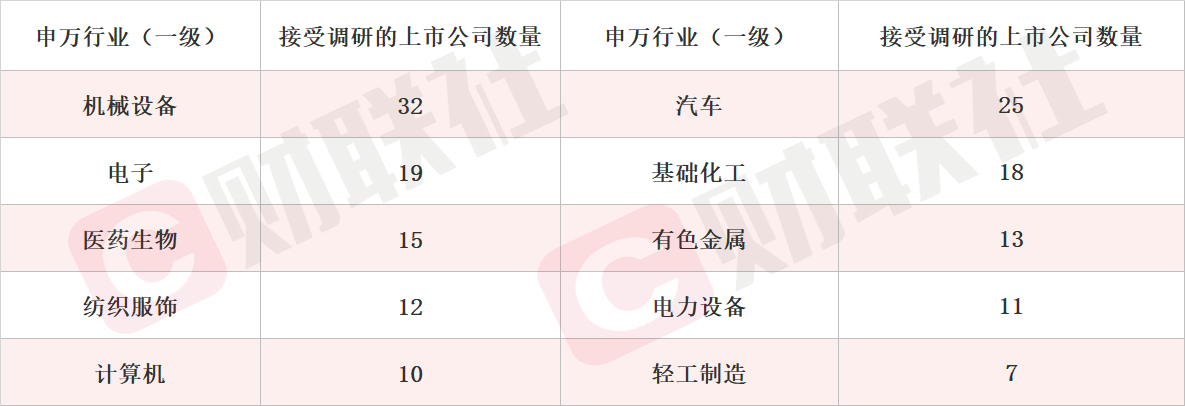
Core Insights - A total of 214 listed companies in the Shanghai and Shenzhen markets have undergone institutional research this week, with the machinery, automotive, and electronics sectors receiving the highest frequency of attention [1] Industry Summary - **Top Industries by Institutional Research**: - Machinery Equipment: 32 companies - Automotive: 25 companies - Electronics: 19 companies - Basic Chemicals: 18 companies - Pharmaceutical Biology: 15 companies - Non-ferrous Metals: 13 companies - Textile and Apparel: 12 companies [2] - **Subsector Focus**: - The top three subsectors attracting institutional interest are automotive parts, specialized equipment, and general equipment. Additionally, interest in industrial metals and home textiles has increased [2] Company Summary - **Most Frequently Researched Companies**: - Both Boying Special Welding and Oke Yi have been researched 4 times each - The top three companies by institutional visit reception are Zhongke Shuguang and Haiguang Information, each receiving 341 visits, followed by Weichuang Electric with 112 visits [3][5] - **Market Performance**: - Companies in the commercial aerospace sector have shown active market performance, with Chaojie Co. reporting significant business developments in commercial rocket manufacturing and expected revenue growth in 2026 [5][6] - Huazhong Cable has secured a market share of 70%-80% in supporting major rocket series and has also reported strong market performance [8] - Sry New Materials has achieved over 17% increase in stock price following successful tests related to reusable rocket engines [10] - Hualaiwo has seen a 20% increase in stock price due to a surge in orders for satellite testing systems [12]


商业航天概念板块大涨!霍莱沃20CM涨停, 四川金顶、华菱线缆涨10%,SpaceX据称寻求明年上市,融资或超300亿美元
Jin Rong Jie· 2025-12-10 08:41
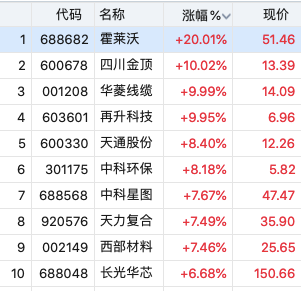
Group 1 - The A-share commercial aerospace sector experienced a significant surge, with stocks like Holowin hitting the daily limit up of 20% and others like Sichuan Jinding and Zaiseng Technology rising by 10% [1][2] - SpaceX is advancing its initial public offering (IPO) plan, aiming to raise over $30 billion, with a target valuation of approximately $1.5 trillion, and plans to go public by mid to late 2026 [2][3] - The establishment of a dedicated Commercial Aerospace Department by the National Space Administration in November provides specialized regulation and guidance for the development of the commercial aerospace industry, presenting new opportunities for the industry [3] Group 2 - Holowin, which saw a 20% increase, reported a rapid growth in satellite testing system orders, primarily from commercial satellite manufacturers and testing service providers, establishing deep and stable collaborations with various state-owned and private satellite manufacturers [4] - Holowin's CAE electromagnetic simulation software is leading in the domestic market, having secured large-scale procurement from major state-owned enterprises and initiating AI+CAE research and development [4]