
参股型并购贷款

Search documents
招商银行南昌分行成功落地江西省首笔参股型并购贷款
Zhong Guo Jin Rong Xin Xi Wang· 2026-02-14 07:51
Core Viewpoint - The successful issuance of equity-based merger loans by China Merchants Bank's Nanchang branch marks a significant innovation in financial services, supporting the construction of a modern industrial system in Jiangxi Province [1][2]. Group 1: Financial Innovation - The equity-based merger loan breaks the traditional framework of merger loans, which primarily focus on control acquisitions, providing compliant and efficient financing support for non-controlling strategic investments [2]. - This loan type addresses diverse financing needs such as industrial synergy integration, emerging sector layout, and local investment attraction, offering clear policy support and financial tools for commercial banks [1][2]. Group 2: Service and Strategy - A specialized service team was formed, consisting of merger, credit, industry, and legal experts, to conduct comprehensive risk assessments and design solutions based on new regulations [2]. - The bank optimized its approval process and shortened handling times, achieving efficient service that responds immediately to policy releases and client needs [2]. Group 3: Future Focus - China Merchants Bank's Nanchang branch aims to deepen strategic cooperation with local state-owned assets and quality enterprises, continuing to focus on the merger finance sector [2]. - The bank plans to concentrate on industrial structure upgrades and corporate restructuring needs, providing more professional and systematic financial services to support high-quality regional economic development [2].

并购贷款新规落地“满月” 参股型模式成创新焦点
Zhong Guo Jing Ying Bao· 2026-01-30 18:53
Core Insights - The implementation of the new regulations on merger loans has led to increased demand for acquisition financing, particularly in the technology and green sectors [1][2] - The introduction of "equity acquisition loans" has become a focal point for market innovation, prompting banks to explore new opportunities while facing heightened risk management requirements [1][6] Group 1: Market Dynamics - The new regulations have revitalized the merger loan business, with major banks like Industrial and Commercial Bank of China (ICBC) quickly launching compliant acquisition loan products across various provinces [2] - The demand for merger loans is driven by the need for consolidation among state-owned enterprises and large investment firms, as well as the increasing management needs of quality listed companies [2][3] - Competition among banks for high-quality projects has intensified, with multiple banks often participating in the approval process for the same project [3] Group 2: Regulatory Impact - The new regulations set tiered standards for conducting merger loans, with higher thresholds for equity acquisition loans, which may limit access for smaller banks [4] - Major banks have the advantage of robust capital and risk management capabilities, allowing them to quickly implement new loan products, while smaller banks tend to focus on local businesses and conservative lending practices [4] Group 3: Loan Structure and Risk - The new regulations allow for equity acquisition loans, which require a minimum stake of 20% in the target company, thus lowering barriers while ensuring strategic alignment [6] - The maximum loan-to-value ratio for equity acquisition loans is set at 60%, compared to 70% for control-type loans, reflecting a cautious regulatory approach to mitigate risks [6][7] - Banks face unique risks with equity acquisition loans, including potential information asymmetry and limited decision-making power, necessitating stricter risk assessment and management protocols [7][8] Group 4: Risk Management Strategies - Banks are advised to enhance their risk management frameworks, focusing on thorough due diligence, compliance monitoring, and ongoing evaluation of target companies post-acquisition [8] - A specialized management team with expertise in merger financing is recommended to ensure effective implementation of risk control measures across all stages of the loan process [8]




并购贷款新规实施20天 四大行率先落地首批项目
2 1 Shi Ji Jing Ji Bao Dao· 2026-01-21 08:23
Core Viewpoint - The implementation of the new merger and acquisition loan management regulations by the National Financial Supervision Administration has enabled major state-owned banks to quickly respond and support the real economy through targeted financing solutions, enhancing the effectiveness of financial services in the context of China's economic transformation [1][6]. Group 1: Regulatory Changes - The new regulations, effective from January 1, 2026, introduce several key features, including the inclusion of equity-based merger loans and an increase in the upper limit of controlling merger loans from 60% to 70% of the transaction price [1][6]. - The loan term for controlling merger loans has been extended from seven years to ten years, providing a compliant and efficient financing path for non-controlling strategic investments [1][6]. Group 2: Bank Responses - Major state-owned banks, including ICBC, ABC, BOC, and CCB, have quickly launched equity-based merger loans in various provinces, demonstrating their ability to adapt to regulatory changes and support local economic needs [2][5]. - ICBC's Anhui branch has focused on green industry investments, while ABC and BOC have successfully issued loans to support local enterprises in strategic sectors such as environmental protection and semiconductors [2][5]. Group 3: Market Impact - The new regulations are expected to stimulate the merger and acquisition market by facilitating industry consolidation and transformation, particularly as traditional industries undergo optimization and new industries continue to grow [6][7]. - The financial support for equity investments is seen as a crucial innovation to enhance capital flow, promote resource optimization, and improve the overall efficiency of financial services to the real economy [6][7].

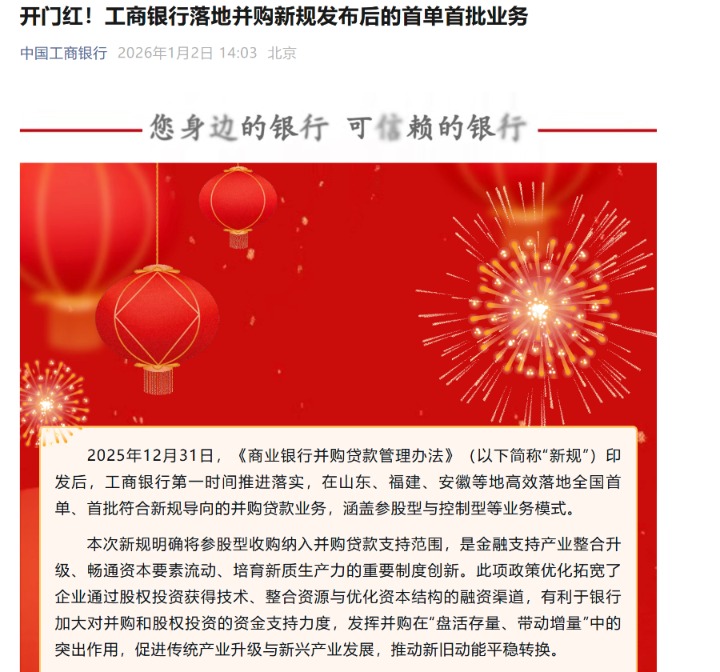
并购市场需求旺盛 贷款投放密集落地
Zhong Guo Jing Ying Bao· 2026-01-16 20:35
Group 1 - The core viewpoint of the article highlights the increasing activity in the domestic merger and acquisition (M&A) market, driven by a series of supportive policies from regulatory authorities, particularly the new guidelines on M&A loans issued by the National Financial Regulatory Administration [1][2][3] - The new M&A loan management regulations allow for a higher proportion of controlling M&A loans in the transaction price, increasing the limit from 60% to 70%, and extending the loan term from seven years to ten years, thereby facilitating financing for M&A transactions [3][4] - The implementation of these regulations has led to a rapid increase in M&A loan projects being approved and disbursed by various commercial banks within a short period, indicating a positive market response to the new policies [2][3][4] Group 2 - The new regulations specifically include minority stake acquisitions in the scope of M&A loans, which aligns with current industrial upgrade needs and is expected to promote industrial integration and high-quality economic development [4][7] - Several banks, including Industrial and Commercial Bank of China and Agricultural Bank of China, have successfully issued the first M&A loans under the new regulations, demonstrating proactive engagement with local enterprises to meet their financing needs [4][5][6] - The regulatory environment is further supported by multiple government departments encouraging industrial mergers and acquisitions, particularly in technology sectors such as electronics and biomedicine, which are seeing increased M&A activity [8][9]



【金融服务】工商银行上海市分行完成并购新政下首单参股型并购贷款业务
Xin Lang Cai Jing· 2026-01-07 10:06
Core Insights - The Industrial and Commercial Bank of China (ICBC) Shanghai Branch has completed the first approval of a new policy on equity mergers and acquisitions loans following the release of the "Commercial Bank Mergers and Acquisitions Loan Management Measures" [1][2] - The new policy, effective from December 31, 2025, includes equity mergers as part of the supported scope, aiming to enhance the modern industrial system and new productivity development [1][2] Group 1 - Since August of the previous year, ICBC Shanghai Branch has actively responded to the incremental policy requirements, organizing learning and deployment during the consultation phase of the new policy [1][2] - The branch has proactively engaged with high-quality enterprises' merger financing needs, preparing project reserves and service readiness [1][2] - A tailored financing plan was designed for a specialized "little giant" enterprise in the heavy truck battery swap sector to improve its industrial chain layout and market competitiveness [1][2] Group 2 - The efficient collaboration among branches allowed for rapid completion of project due diligence, evaluation, and approval, demonstrating ICBC's commitment to serving the real economy and promoting the integration of transportation and energy industries [1][2] - In the next phase, ICBC Shanghai Branch aims to seize development opportunities brought by the new policy through innovative products, supporting the real economy with a merger and full-chain service approach [1][2]