双曲线一号

Search documents
汉中火箭创业者,一举拿下50亿融资
2 1 Shi Ji Jing Ji Bao Dao· 2026-02-14 08:06
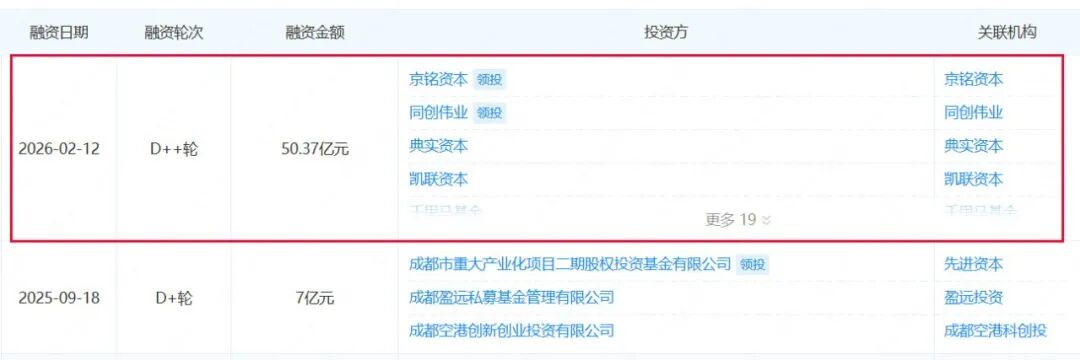
Core Insights - The private aerospace company, Galactic Glory, has completed a record-breaking D++ round financing of 5.037 billion yuan, marking the largest single financing in China's private rocket sector [1][2]. Financing Details - The financing round was led by Tongchuang Weiye and Jingming Capital, with follow-up investments from Ganquan Capital, Chengdu Industrial Investment, and over ten new institutions including Dian Shi Capital and Longxin Venture Capital [2][3]. - The previous financing round (D+ round) occurred on September 18, 2025, raising 700 million yuan, led by Chengdu's major industrialization project equity investment fund [3]. Company Development - The funds raised will primarily accelerate the development and commercialization of the "Hyperbola-3" rocket, enhancing capabilities in assembly, testing, sea recovery, and experimental launches [4]. - The "Hyperbola-3" is a medium to large reusable rocket using liquid oxygen and methane, crucial for achieving land launch and sea recovery [5]. Leadership Background - Founder Peng Xiaobo, a veteran in the aerospace industry, has a history of working on the Long March series rockets and founded Galactic Glory in 2015 after leaving a state institution [6][7][8]. - The company achieved a significant milestone in 2019 by successfully launching its first major product, the "Hyperbola-1" rocket, becoming the first private company in China to reach orbit [9]. Challenges and Strategic Shift - Following initial successes, the company faced setbacks with three launch failures of the "Hyperbola-1" between 2021 and 2022, prompting a strategic shift towards reusable technology [12]. - The current focus is entirely on the "Hyperbola-3," which is designed to meet high-frequency, low-cost launch demands for satellite constellations and cargo transport to space stations [13][14]. Future Plans - The "Hyperbola-3" is scheduled for its first flight with orbit and sea recovery by the end of 2026, with significant testing already completed [15]. - Other companies, such as Deep Blue Aerospace and Tianbing Technology, are also expected to enter the reusable rocket market in 2026, intensifying competition [16]. - The first company to achieve orbit is likely to compete for the title of "the first commercial aerospace stock on the Sci-Tech Innovation Board" [17].


星际圈地:马斯克万亿估值登顶,中国航天正加速开启另一条路 | 深网
Xin Lang Cai Jing· 2026-02-12 12:13
Core Viewpoint - The commercial space industry is gaining significant attention globally, with a surge in IPO activities among leading companies, driven by technological advancements and policy support [2][19]. Group 1: Market Dynamics - SpaceX plans to complete its IPO by mid-June 2025, with a valuation potentially reaching $1.5 trillion, which could make it the largest IPO in history [2][15]. - The domestic commercial space market is projected to reach a scale of 2.8 trillion yuan by 2025 and exceed 7.8 trillion yuan by 2030 [2][15]. - Over 10 commercial space companies have initiated IPO counseling, focusing on key areas such as rockets and satellites [3][16]. Group 2: Company Developments - Blue Arrow Aerospace is the fastest in progress, having started its IPO counseling in July 2025 and submitted its prospectus by December 30, aiming to raise 7.5 billion yuan for reusable rocket development [3][16]. - Zhongke Aerospace has passed the IPO counseling acceptance, with its core product, the "Liarrow-1" solid rocket, successfully launching 11 times and sending 84 satellites into space [3][16]. - Tianbing Technology is developing the "Tianlong-3," China's first large liquid launch vehicle, with a near-Earth orbit capacity of 17-22 tons, directly competing with SpaceX's Falcon 9 [4][17]. Group 3: Competitive Landscape - The competition in the commercial space sector is intensifying, with companies racing to meet IPO technical requirements, particularly in reusable rocket technology [18][26]. - The industry is characterized by high investment and long cycles, with companies facing significant financial pressures and often relying on external financing [22][23]. - Analysts predict that only 3 to 5 companies will survive in the rocket sector, emphasizing the importance of technological breakthroughs and cost control for future success [26]. Group 4: Financial Performance - Blue Arrow Aerospace reported revenues of 780,000 yuan in 2022, increasing to 3.643 million yuan in the first half of 2025, but has accumulated losses exceeding 3.5 billion yuan [23][24]. - The cost of launching commercial rockets has significantly decreased, with the "Zhuque-3" rocket achieving a cost of 14,000 to 20,000 yuan per kilogram, lower than SpaceX's Falcon 9 [24][25]. - The industry is still in its early stages, with many companies facing losses and lacking a mature profit model [23][24].

汇聚全球资源 共促商业航天 二〇二六北京国际商业航天展览会见闻
Jin Rong Shi Bao· 2026-01-27 02:07
Group 1 - The "2026 Beijing International Commercial Aerospace Exhibition" was held from January 23 to 25, focusing on the theme "Gathering Global Resources to Promote Commercial Aerospace" [1] - The exhibition showcased over 300 commercial aerospace companies and related institutions from both domestic and international markets, creating a high-end platform for global industry exchange and cooperation [1] - Notable products included the world's first continuously launched liquid oxygen-methane rocket, the Zhuque-2 improved model, and the Zhuque-3 model, which successfully completed China's first large reusable rocket launch [1] Group 2 - In the space application and exploration sector, Galaxy Aerospace presented China's first flexible solar wing flat satellite, the Lingxi-03, and a satellite model capable of direct communication between space and ground [2] - A dedicated "Aerospace Investment and Financial Services" area was established, showcasing the deep integration of financial capital with the aerospace industry, featuring customized financial service solutions from major banks [2] - Preliminary statistics indicated significant procurement and cooperation intentions were reached during the exhibition, reflecting global market recognition of China's commercial aerospace supply chain capabilities and cooperation potential [2]
商业航天:可回收运载火箭的高价值量环节和成本构成(附PPT)
材料汇· 2026-01-15 15:38
Core Viewpoint - The article provides an in-depth analysis of rocket structures, engines, and the application of 3D printing technology in the aerospace industry, highlighting advancements in rocket design and manufacturing processes. Section 1: Rocket Structure - The article explores various components of rocket structures, including the rocket engine, fuel tanks, and recovery technologies, emphasizing the importance of materials and design in enhancing performance and reliability [5][6][8]. - Liquid rocket engines are categorized into two main types: liquid and solid propellants, with a focus on the efficiency and reusability of liquid engines like the Merlin engine [9][11]. - The cost structure of rockets is detailed, with the Falcon 9 rocket's first stage costing approximately $30 million and the second stage around $10 million, totaling about $45 million for a new rocket [10]. Section 2: Rocket Enterprises and Their Rockets - The article discusses various rocket companies, including state-owned and private enterprises, highlighting their contributions to the commercial space sector [51]. - China’s Long March rockets are noted for their extensive launch capabilities, with Long March 8 and Long March 9 being key models for future missions [54]. - Private companies like Blue Arrow and Tianbing Technology are recognized for their innovative approaches, such as the development of reusable liquid oxygen and methane rockets [52][51]. Section 3: 3D Printing Technology in Rocket Engines - 3D printing technology is identified as a transformative force in rocket manufacturing, significantly reducing production time and costs while allowing for complex designs [19][18]. - The article mentions that companies like Tianbing Technology have achieved nearly 90% of their engine components through 3D printing, leading to a 70%-80% reduction in manufacturing cycles and a 40%-50% decrease in costs [19][18]. - The advantages of 3D printing include the ability to create lightweight structures and complex geometries that traditional manufacturing methods cannot achieve [17]. Section 4: Rocket Recovery Technologies - Various rocket recovery methods are discussed, including vertical landing, sea recovery, and innovative techniques like the "chopstick" capture method, which aims to reduce costs and improve efficiency [40][50]. - The article highlights successful recovery missions, such as SpaceX's Falcon 9, which has demonstrated the feasibility of reusing rocket stages [46][50]. - The development of a net recovery system for rockets is noted as a significant advancement in enhancing recovery reliability and reducing operational costs [47].

一年亏损1.8亿元,国内首家商业火箭公司拟易主
Mei Ri Jing Ji Xin Wen· 2026-01-07 08:04
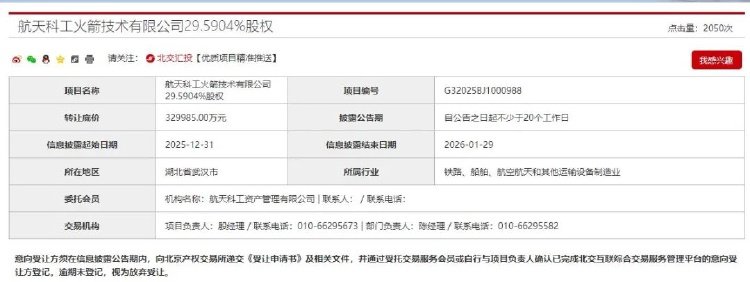
Core Viewpoint - The transfer of a 29.5904% stake in Aerospace Science and Industry Corporation Rocket Technology Co., Ltd. is set to take place, with a base price of approximately 3.3 billion yuan, indicating a significant shift in ownership and potential strategic direction for the company [1][2]. Group 1: Company Overview - Aerospace Science and Industry Corporation Rocket Technology Co., Ltd. was established in February 2016 and is recognized as China's first specialized rocket company operating under a commercial model [2]. - The company primarily operates solid rockets, including the "Kuaizhou-1A" and "Kuaizhou-11" [2]. Group 2: Financial Performance - The company has reported poor financial performance, with revenues of 63.81 million yuan in 2024 and a net loss of approximately 180 million yuan [2]. - For the period from January to November 2025, the company generated revenues of 67.36 million yuan and incurred a net loss of about 136 million yuan [2]. - As of November 30, 2025, the total assets of the company amounted to 3.033 billion yuan, with total liabilities of 472 million yuan [2]. Group 3: Market Competition - The solid rocket launch market is highly competitive, with domestic private aerospace companies achieving breakthroughs in both technology and market presence [2]. - Competing products include the "Liqian-1" from Zhongke Yuhang, which has a near-Earth orbit capacity of 2 tons, and the "Yingli-1" from Dongfang Space, which can carry up to 6.5 tons [2]. Group 4: Future Developments - The company is currently developing a liquid oxygen-methane launch vehicle as part of its Kuaizhou series [3]. - The reusable technology test vehicle for the Kuaizhou rocket has completed vertical takeoff and landing tests, although progress is lagging behind competitors such as Blue Arrow Aerospace and the Eighth Academy of Aerospace Science and Technology [3]. - The company has previously considered an IPO and was listed as a "seed" enterprise for the Hubei Province Science and Technology Innovation Board, but its progress has been slower than peers [3].
一年亏损1.8亿,国内首家商业火箭公司将易主
Guan Cha Zhe Wang· 2026-01-07 06:53
Core Viewpoint - The transfer of 29.5904% equity in Aerospace Science and Industry Rocket Technology Co., Ltd. (referred to as "Kegong Rocket") signifies a significant shift in the ownership structure, indicating a potential strategic adjustment by its controlling shareholder, China Aerospace Sanjiang Group Co., Ltd. (referred to as "Sanjiang") [1][5] Company Overview - Kegong Rocket, established in February 2016, is China's first commercial rocket company operating under a purely commercial model for the research and application of launch vehicles [1] - The company has completed two rounds of financing: 1.2 billion RMB in A round financing in December 2017, and 1.585 billion RMB in B round financing in June 2022 [2] Financial Performance - The company has faced continuous financial challenges, reporting revenues of 63.8078 million RMB in 2024 and a net loss of approximately 180 million RMB; in the first 11 months of 2025, revenues were 67.3565 million RMB with a net loss of about 136 million RMB [3] - As of November 2025, total assets were approximately 3.033 billion RMB, with liabilities around 472 million RMB [3] Market Position and Competition - Kegong Rocket's current active rocket products include "Kuaizhou-1A" and "Kuaizhou-11," but it faces intense competition from several private companies in the commercial space launch market, particularly in the solid rocket sector [3] - Competitors include Zhongke Yuhang's "Lijian-1," Xinghe Power's "Gushenxing-1," and others, with Kegong Rocket's payload capacities being significantly lower than some competitors [3] Industry Trends - The commercial space launch market is evolving towards larger capacity and reusable rockets, posing significant technical and market challenges for Kegong Rocket, which primarily relies on existing expendable solid rocket technology [5] - The equity transfer is viewed as a milestone in the development of China's commercial space industry, reflecting a trend towards resource integration and increased market concentration amid rising competition and higher expectations for profitability [5]

2025中国航天战报:全年92次发射创下新高,民营火箭亮出成绩单
Xin Lang Cai Jing· 2026-01-05 05:19
Core Insights - In 2025, global launch frequency reached 329 times, with China's share nearing 30%, indicating that approximately 1 in every 3 rockets launched globally originated from China [1] - China's total launches for the year amounted to 92, representing a 35.3% increase from 68 launches in 2024, with a high success rate of 97.8% [1] Launch Contributions - Multiple commercial rockets achieved significant launch results in 2025, contributing to the overall increase in launch volume [1] - Zhongke Aerospace's Lijian-1 completed 5 launches, placing 27 satellites into orbit with a total payload of about 6 tons, handling all external orders for commercial rockets [1] - Xinghe Power's Gushenxing-1 had 6 launches, successfully placing 27 satellites into orbit with a total payload of approximately 1 ton [1] - Blue Arrow Aerospace's improved Zhuque-2 had 2 launches, placing 6 satellites into orbit with nearly 1 ton of payload, while Zhuque-3 had its maiden flight without carrying any satellites [1] - Interstellar Glory's Hyperbola-1 completed 1 launch, placing 1 satellite into orbit with a payload of nearly 100 kilograms [1] - Dongfang Space's Gravitational-1 had 1 launch, successfully placing 3 satellites into orbit with a total payload of about 500 kilograms [1] Broader Achievements - Beyond rocket launches, China's aerospace sector made significant advancements in satellite constellation networking, commercial space investment and financing, rocket technology, and supporting infrastructure [1]
商业航天,进入深度洗牌期
3 6 Ke· 2026-01-04 10:22
Core Insights - The Chinese commercial space industry is transitioning from a "technical validation period" to a commercialization and scaling phase, with 2026 marking a pivotal year for the sector [1] - Increased investment from social capital and state-owned funds is driving the market, while challenges such as tight launch site availability and the need for cost-effective solutions are emerging [1][2] - The industry is undergoing a deep reshuffle focused on cost, capacity, and delivery capabilities, moving away from exploratory phases to a more structured competitive environment [1][4] Investment Trends - Recent surges in interest for leading commercial space projects have led to a rapid consumption of existing shares, with state-owned institutions actively seeking to invest [2] - The market's recognition of top commercial space companies is becoming clearer, leading to a more concentrated investment focus [2][3] - The total financing for commercial space reached 18.6 billion yuan in 2025, a 32% increase year-on-year, with rocket manufacturing and satellite applications being the primary areas attracting capital [4] Policy Support - The Chinese government has been increasingly supportive of the commercial space sector since 2015, with recent reports emphasizing the promotion of commercial space industry clusters [3] - New guidelines for commercial rocket companies to access the domestic capital market have improved long-term capital expectations for the sector [3] Industry Dynamics - The number of commercial rocket launches in China exceeded 92 in 2025, marking a 48% year-on-year increase, indicating a significant uptick in industry activity [6] - Major players like Blue Arrow Aerospace and Starry Sky Power are leading advancements in reusable rocket technology, which is crucial for reducing launch costs [7][10] - The competitive landscape is expected to consolidate, with only 5-6 leading companies likely to survive due to the high sensitivity of pricing in the industry [8] Launch Infrastructure - The availability of launch sites is a critical bottleneck, with only 18 operational commercial launch sites as of mid-2025, leading to long wait times for launches [13][15] - New launch facilities are being planned to alleviate the pressure, but the timeline for these developments means that resource constraints may persist in the near term [15] Satellite Manufacturing - The shift from traditional satellite manufacturing to a more industrialized, batch production model is underway, driven by the need for large-scale satellite constellations [16][17] - Companies are adopting advanced manufacturing techniques to enhance production efficiency, significantly reducing the time required to manufacture satellites [18] - The growth of commercial space enterprises is contributing to the evolution of satellite production, with a focus on automation and modular assembly [17][18] Future Outlook - The year 2026 is anticipated to be a critical year for the development of reusable rockets, with multiple models set to compete in the market [12][9] - The industry's focus will shift towards long-term, stable, and low-cost operations, determining the success of commercial space companies [18]
商业航天2026:老股或遭疯抢
财联社· 2026-01-03 04:36
Core Viewpoint - The Chinese commercial aerospace industry is transitioning from a technology validation phase to a commercialization and scaling phase, with 2026 marking a critical turning point for the industry [2][3]. Group 1: Investment Trends - There is a surge in social capital and state-owned fund investments in leading commercial aerospace projects, with a notable increase in inquiries about the transfer of existing shares [4]. - The demand for old share transfers has significantly increased since the second half of 2025, indicating a growing interest from institutions in entering the commercial aerospace sector [5]. - The commercial aerospace sector is now recognized as a strategically significant emerging industry, with state-owned capital increasingly participating in this space [4][5]. Group 2: Policy and Market Dynamics - The government has been actively promoting the development of commercial aerospace, with recent reports emphasizing the need for industry cluster development [6]. - The introduction of specific listing standards for commercial rocket companies on the Sci-Tech Innovation Board has opened up new funding avenues for these firms [6][7]. - The overall financing in the commercial aerospace sector reached 18.6 billion yuan in 2025, a 32% increase year-on-year, with rocket manufacturing and satellite applications being the primary areas attracting investment [7]. Group 3: Industry Competition and Challenges - The commercial rocket launch industry is undergoing a significant reshuffle, with at least 10 companies initiating IPO processes, indicating a rapid acceleration in the market [8]. - The number of rocket launches in China exceeded 92 in 2025, marking a 48% increase, reflecting the industry's growing capabilities [9]. - The competition is intensifying, particularly around the development of reusable rockets, which are crucial for reducing launch costs and achieving market dominance [10][11]. Group 4: Technological Advancements - The focus on reusable rockets is becoming critical, with companies aiming to reduce launch costs significantly, targeting a cost of under 20,000 yuan per kilogram [11][12]. - The domestic reusable rocket technology is still in a catch-up phase, with various companies pursuing different technical routes [13]. - By 2026, multiple models of reusable rockets are expected to compete, with significant advancements anticipated in the first half of the year [14][15]. Group 5: Satellite Manufacturing Evolution - The traditional model of satellite manufacturing is shifting towards batch production, driven by the large-scale requirements of low Earth orbit satellite constellations [18][19]. - Companies are adopting industrialized production methods to enhance efficiency and reduce manufacturing cycles, with some firms achieving an 80% reduction in production time [20]. - The growth of satellite manufacturing capabilities is essential for supporting the deployment of large satellite constellations, which is becoming a critical aspect of the commercial aerospace landscape [19][20].

除了蓝箭,中国商业航天还有哪些玩家?
财联社· 2025-12-06 12:09
Core Viewpoint - The article discusses the rapid development of China's commercial aerospace industry, highlighting the significance of reusable rockets and the emergence of various companies in the sector, particularly focusing on the recent launch of the Zhuque-3 rocket by Landspace, which marks a pivotal step towards reusable rocket technology in China [4][10]. Group 1: Rocket Launch Companies - Landspace is recognized for its Zhuque-3 rocket, which is a large liquid oxygen-methane launch vehicle aimed at large satellite constellation missions. It represents China's first attempt at orbital launch and recovery verification for reusable rockets, despite the initial recovery attempt being unsuccessful [4][5]. - Tianbing Technology is developing the Tianlong-3 liquid rocket, which aims to achieve a near-Earth orbit capacity exceeding 20 tons, positioning it as a competitor to SpaceX's Falcon 9 [5]. - Xingji Glory is the first private company in China to successfully launch a rocket into orbit, utilizing both solid and liquid reusable rocket technologies [6]. - Xingshe Power focuses on solid rocket launches and is developing the Zhishenxing-1 reusable liquid rocket, targeting the small satellite market with low-cost and rapid response capabilities [6]. Group 2: Satellite Manufacturing Companies - Galaxy Space is a key player in the construction of low Earth orbit broadband communication satellite constellations, with advantages in reducing the cost per satellite [8]. - Changguang Satellite is known for its Jilin-1 satellite constellation, which is the largest commercial optical remote sensing satellite constellation globally, providing high-resolution Earth observation data [8]. - Tianyi Research Institute specializes in synthetic aperture radar (SAR) satellites, offering all-weather imaging capabilities and reducing data acquisition costs through innovative business models [8]. Group 3: Ground Service Providers - Geshihangtian is a core participant in the "Thousand Sails Constellation" low Earth orbit communication satellite project, responsible for satellite manufacturing and operational support [9]. - Aerospace Yuxing provides comprehensive lifecycle services for satellites, including monitoring and collision warning, having successfully serviced over 500 satellites and rocket combinations [9]. - Xi'an Huanyu Satellite is the first state-owned commercial control enterprise in China, having served over 300 satellites and developed an AI-based satellite health monitoring system [10]. Group 4: Industry Outlook - The Chinese commercial aerospace industry is expected to benefit from the launch of several new reusable rocket models starting in late 2025, which could accelerate the deployment of low Earth orbit satellite constellations [10]. - The establishment of a dedicated regulatory body for commercial aerospace by the National Space Administration signifies a commitment to high-quality and safe development in the sector [10]. - The industry is anticipated to become a significant focus of China's 14th Five-Year Plan, with ongoing regulatory improvements expected to drive high-quality growth across the entire aerospace value chain [10].