
固定收益类理财

Search documents
走好共富之路 兴业银行持续擦亮“财富银行”名片
Hua Xia Shi Bao· 2026-02-27 09:05
Core Insights - The article highlights the significant growth of wealth management at Industrial Bank, with AUM increasing from 2.52 trillion yuan to 3.95 trillion yuan and the number of wealth clients rising from 3.46 million to 4.81 million since the start of the 14th Five-Year Plan [1] - The bank emphasizes its commitment to promoting common prosperity by making wealth management accessible to a broader population, focusing on serving the majority rather than a minority [1] Group 1: Wealth Management Growth - Industrial Bank has helped clients achieve asset appreciation exceeding 200 billion yuan over the past three years, showcasing its effectiveness in wealth management [1] - The bank's wealth management AUM reached 3.95 trillion yuan, reflecting an 11.48% growth since the beginning of the year [6] Group 2: Customer Engagement and Services - The "11·18 Wealth Management Festival" was launched with a theme of "Wealth Together, Towards Prosperity," featuring a three-pronged approach of online interaction, offline salons, and customized services to engage the public [2] - The bank has introduced a diverse range of low-risk to medium-high yield financial products tailored to meet the varied needs of the population, including a special retirement product for the elderly [3] Group 3: Inclusivity and Accessibility - Industrial Bank aims to make wealth management services available to all income groups and age demographics, integrating inclusivity into its core strategy [4] - The bank has partnered with over 560 small and medium-sized banks to distribute wealth management products to rural and underserved areas, lowering entry barriers with products starting from 1 yuan [5] Group 4: Professional Development and Technology Integration - The bank is enhancing its wealth management capabilities by training over 1,000 financial managers through systematic programs, ensuring they can provide tailored financial solutions [6] - Industrial Bank is leveraging technology to transform its wealth management approach, utilizing tools like knowledge graphs and AI to improve service delivery and customer engagement [7]

1.38万款理财到期,业绩下限达标率超8成
2 1 Shi Ji Jing Ji Bao Dao· 2026-02-10 08:59
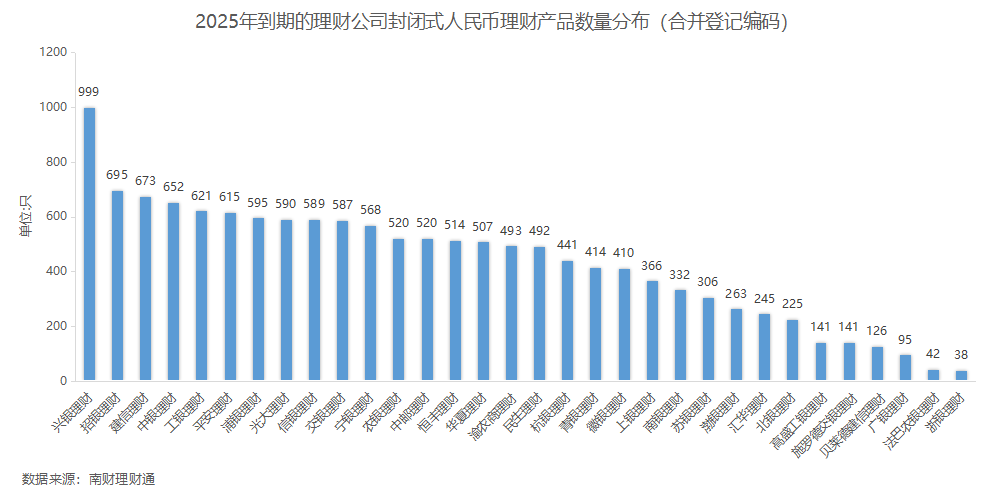
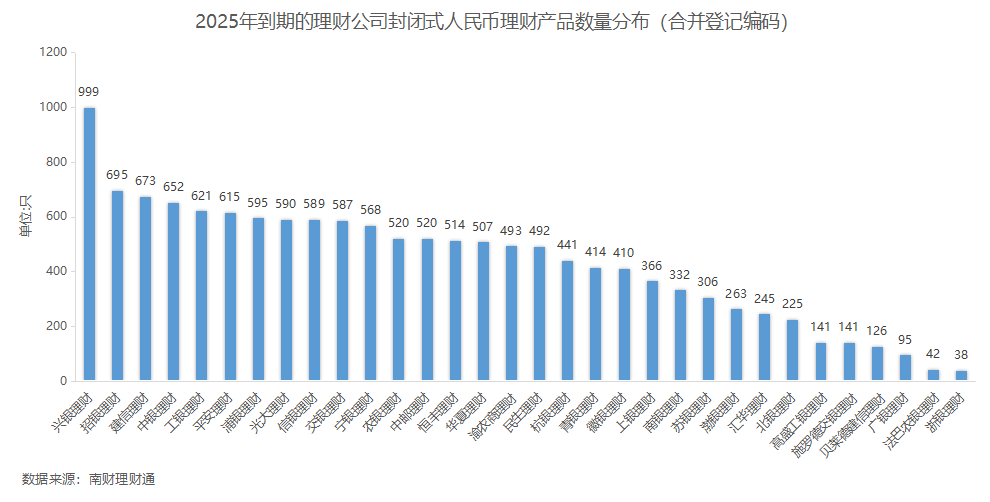
Core Insights - In 2025, a total of 13,815 closed-end public products from 32 wealth management companies will mature, representing a 51.53% increase compared to 2024 [1][2] Group 1: Product Maturity Overview - The majority of maturing products are fixed income, with 13,218 products, followed by mixed products (509), equity products (62), and commodity and financial derivatives (26) [2] - Leading institutions such as Xingyin Wealth Management will have nearly 1,000 maturing products, while other major firms like Zhaoyin Wealth Management, Jianxin Wealth Management, Bank of China Wealth Management, Industrial Bank Wealth Management, and Ping An Wealth Management will each have over 600 maturing products [2] Group 2: Investment Period Analysis - Products maturing in the 6-12 month period are the most numerous, totaling 4,667, accounting for 33.8% of the total; the 3-6 month period follows with 3,600 products (26.1%), and the 1-2 year period has 3,502 products (29.6%) [4] Group 3: Performance Metrics - The overall performance threshold achievement rate for 11,092 maturing products is 48.76%, with a lower limit achievement rate of 82.36% [7] - Fixed income products have a lower limit achievement rate of 84.28% and a mid-point achievement rate of 49.66% [7] - Short-term products (1-3 months) show high performance, with lower limit achievement rates exceeding 90% [7] Group 4: Yield Performance - The average annualized yield for fixed income products is 3.02%, with products maturing in over 3 years yielding the highest average at 4.16% [10] - Mixed products have a lower average annualized yield of 2.27%, with the highest yield for those maturing in over 3 years at 7.04% [10]

理财年度盘点③丨1.38万款理财到期,业绩下限达标率超8成
2 1 Shi Ji Jing Ji Bao Dao· 2026-02-10 08:39
Core Viewpoint - In 2025, a total of 13,815 closed-end public products from 32 wealth management companies will mature, representing a 51.53% increase compared to 2024, with fixed income products dominating the maturity landscape [1][2]. Group 1: Product Maturity Overview - The number of maturing products is significantly higher, with fixed income products accounting for the majority, totaling 13,218, while mixed, equity, and commodity/financial derivative products have 509, 62, and 26 respectively [2]. - Leading institutions such as Xingyin Wealth Management will have nearly 1,000 maturing products, while other major firms like Zhaoyin, Jianxin, Bank of China, ICBC, and Ping An will each have over 600 maturing products [2]. Group 2: Investment Cycle Analysis - Products with a maturity period of 6-12 months lead in quantity, totaling 4,667, which is 33.8% of the total; followed by 3-6 months with 3,600 products (26.1%), and 1-2 years with 3,502 products (29.6%) [4]. Group 3: Performance Metrics - The overall performance threshold achievement rate for 11,092 maturing products is 48.76%, with a lower limit achievement rate of 82.36% [7]. - Fixed income products show a lower limit achievement rate of 84.28% and a mid-point achievement rate of 49.66%, with short-term products (1-3 months) performing particularly well [7][9]. - Long-term products (2-3 years and over 3 years) have significantly lower achievement rates, at 30.86% and 31.58% respectively [7]. Group 4: Yield Performance - The average annualized yield for fixed income products is 3.02%, with products over 3 years yielding the highest at 4.16% [9]. - Mixed products have a lower average annualized yield of 2.27%, with the highest yield for those over 3 years at 7.04% [9].
【银行】如何看待理财三季报的3个“异象”?——《中国银行业理财市场季度报告(2025年三季度)》点评(王一峰/董文欣)
光大证券研究· 2025-10-25 00:06
Core Viewpoint - The report highlights the growth and stability of the Chinese banking wealth management market as of Q3 2025, despite market fluctuations in equities and bonds, with a notable increase in total assets under management and a shift in asset allocation strategies [5][6]. Group 1: Wealth Management Scale and Growth - As of Q3 2025, the total wealth management scale reached 32.13 trillion, with a quarterly increase of 1.46 trillion, reflecting a year-on-year growth of approximately 600 billion, and a growth rate of 9.4% compared to Q2 2025 [6][8]. - The estimated total scale may have exceeded 33 trillion by the end of Q3, driven by the "deposits outflow" phenomenon [6]. Group 2: Product Structure and Composition - The structure of wealth management products remained stable, with fixed-income products accounting for 97.1% of the total, maintaining a narrow fluctuation around this central point since 2024 [7]. - Open-ended wealth management products accounted for 80.6% of the total, with a slight decrease of 0.3 percentage points from Q2 2025, while closed-end products saw an increase in their market share [7]. Group 3: Asset Allocation Trends - By the end of Q3 2025, the total asset allocation reached 34.33 trillion, with a quarterly increase of 1.36 trillion, primarily driven by cash and deposits, which increased by 1.27 trillion [8]. - The proportion of cash and deposits rose to 27.5%, marking a recent high, while bond assets saw a decrease to 53.5% [8]. Group 4: Market Position of Wealth Management Companies - Wealth management companies' market share surpassed 90% for the first time, reaching 91.1% as of Q3 2025, with a continuous expansion of distribution channels [9]. - The number of distribution channels increased to 583, reflecting a year-on-year growth of 35 channels, indicating a strengthening competitive position for wealth management companies [9].

固收类产品平均到期年化收益率跌破3%
2 1 Shi Ji Jing Ji Bao Dao· 2025-07-30 09:03
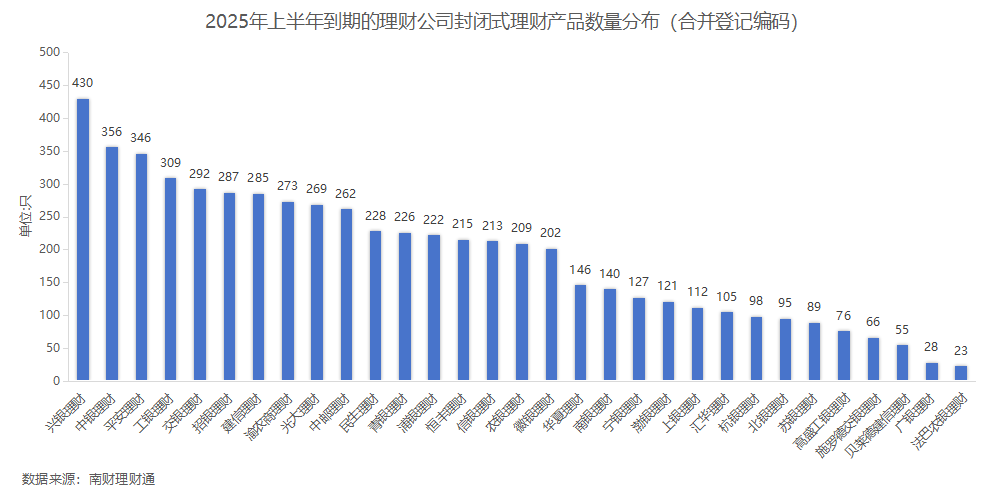
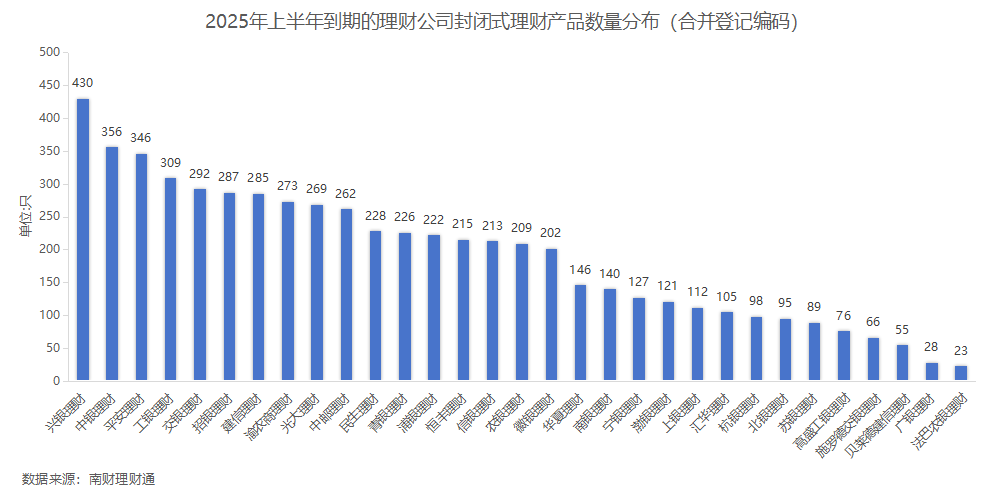
Core Insights - The performance benchmark compliance rate for fixed-income wealth management products with a maturity of less than six months exceeds 90% [1][5][6] Group 1: Product Expiration and Compliance Rates - In the first half of 2025, 31 wealth management companies will have a total of 5,905 closed-end public products maturing, representing a 35.44% increase compared to the first half of 2024 [1] - Among the maturing products, fixed-income products account for 5,759, mixed products for 145, and commodity and financial derivatives for 1 [1] - The compliance rate for the performance benchmark lower limit of fixed-income public products maturing in the first half of 2025 is 83.88%, with a central performance benchmark compliance rate of 50.02% [5][6] Group 2: Performance by Investment Period - The highest number of maturing products falls within the 6-12 month period, totaling 2,074 products, which accounts for 35.1% of the total [3] - The compliance rate for the performance benchmark lower limit for products with a maturity of 3-6 months is the highest at 93.91%, while the compliance rate for products with a maturity of 2-3 years is only 28.17% [5][8] Group 3: Average Yield and Comparison - The average annualized yield for fixed-income wealth management products is 3.09%, with the highest yield for products with a maturity of 1-2 years at 3.42% [6][8] - The average annualized yield for mixed products is 2.14%, which is lower than that of fixed-income products [6][8] - The average annualized yield for closed-end fixed-income public products, excluding foreign currency products, is 2.92% [7] Group 4: Institutional Performance - Institutions such as Bo Yin Wealth Management, Goldman Sachs ICBC Wealth Management, and Guangyin Wealth Management achieved a 100% compliance rate for the performance benchmark lower limit [10] - 17 other institutions also reported compliance rates of 80% or higher for the performance benchmark lower limit [10] - Institutions with lower compliance rates are often affected by rapidly declining static interest rates and higher pricing of products [9]
银行理财半年度盘点③丨固收类产品平均到期年化收益率跌破3%
2 1 Shi Ji Jing Ji Bao Dao· 2025-07-30 09:02
Core Insights - The performance of fixed-income wealth management products with a maturity of less than six months has exceeded 90% in terms of meeting the lower performance benchmark [1] - In the first half of 2025, 31 wealth management companies had a total of 5,905 closed-end public products maturing, representing a 35.44% increase compared to the first half of 2024 [1] Product Maturity Analysis - The highest number of maturing products falls within the 6-12 month period, totaling 2,074 products, accounting for 35.1% of the total; followed by 3-6 months with 1,814 products (30.7%); and 1-2 years with 1,378 products (23.3%) [3] Performance Metrics - The annualized yield of closed-end fixed-income wealth management products has dropped below 3%, with a total of 5,587 products analyzed, showing a lower performance benchmark compliance rate of 82.46% [5] - The performance lower benchmark compliance rate for fixed-income products maturing in the first half of 2025 is 83.88%, while the performance central benchmark compliance rate is 50.02% [5] - For products with a maturity of less than 6 months, the compliance rate exceeds 90%, with the highest compliance rate of 93.91% for the 3-6 month maturity products [5] Yield Analysis - The average annualized yield for fixed-income wealth management products is 3.09%, with the highest yield for 1-2 year products at 3.42% [6] - Excluding foreign currency products, the average annualized yield for RMB fixed-income products is 2.92% [6] - Mixed products have a lower performance lower benchmark compliance rate of 27.14% and an average annualized yield of 2.14%, underperforming fixed-income products [6] Institutional Performance - Among the 5,446 closed-end fixed-income public products, institutions like Bohai Bank Wealth Management and Goldman Sachs ICBC Wealth Management achieved a 100% compliance rate for the lower performance benchmark [10] - Some institutions with lower compliance rates are affected by rapidly declining static interest rates and the challenges of achieving performance in a generally weak equity market [10]
持续倒挂!长期限产品“定价”跌破2.5%丨机警理财周报
2 1 Shi Ji Jing Ji Bao Dao· 2025-06-17 10:54
Market Overview - The bond market remains stable with an overall balanced and loose funding environment, with the weighted average of DR007 at 1.50% and the 10-year government bond yield at 1.64% [2] - The A-share market experienced declines due to the Israel-Palestine conflict, with the Shanghai Composite Index, Shenzhen Component Index, and CSI 300 Index dropping by 0.25%, 0.6%, and 0.25% respectively [2] - The non-ferrous metals, oil and petrochemical, and agriculture sectors showed the highest weekly gains [2] Product Performance - As of June 15, 2025, there are 24,038 public wealth management products, with 136 products having a cumulative net value below 1, resulting in a comprehensive break-even rate of 0.57% [3] - The break-even rates for equity and mixed products are 51.28% and 6.51% respectively, while fixed income products have a break-even rate of 0.15% [3] - The break-even rates for fixed income products across various maturities remain low, all below 1%, with the 2-3 year and 6-12 month products having slightly higher rates of 0.35% and 0.2% respectively [3] New Product Issuance - A total of 447 wealth management products were issued by 32 wealth management companies from June 9 to June 13, 2025, with joint-stock banks leading in issuance [4] - New products are primarily R2 (medium-low risk), closed-end net value type, and fixed income public products, with only 10 mixed products issued, accounting for 2.2% [4] - Short-term products with maturities of 6 months or less saw an increase in pricing, with 1-3 month products rising by 0.31 percentage points [4] Yield Performance - All categories of RMB public wealth management products recorded positive returns last week, with fixed income products showing an average net value growth rate of 0.0772% [6] - The average weekly net value growth rates for mixed, equity, and commodity and financial derivative products were 0.2038%, 0.8588%, and 0.942% respectively [6] - Cash management products in RMB, USD, and AUD had average annualized yields of 1.421%, 3.936%, and 3.01% respectively [7] Industry Trends - The total scale of bank wealth management products reached a record high of 31.5 trillion yuan as of the end of May 2025, an increase of 0.19 trillion yuan from April and 1.58 trillion yuan from the end of the previous year [8] - The product structure has significantly changed, with fixed income products becoming the core asset driving the rebound in wealth management scale [8]