国际调解院

Search documents
中国代表:国际社会比以往任何时候都更需要遵守《联合国宪章》
Xin Lang Cai Jing· 2026-02-19 03:32
Core Viewpoint - The article emphasizes the importance of multilateralism and the strengthening of the United Nations' role in global governance, as articulated by China's permanent representative to the UN, Fu Cong [1][2]. Group 1: Global Governance Initiatives - China proposes a global governance initiative that advocates for sovereign equality, adherence to international law, and a people-centered approach, aiming to create a more just and reasonable global governance system [1]. - The initiative encourages collaboration among nations to uphold the purposes and principles of the UN Charter and to promote a shared vision of global governance [1]. Group 2: International Peace and Security - Fu Cong highlights that maintaining international peace and security is one of the core purposes of the UN Charter, and China has introduced a global security initiative that promotes a comprehensive, cooperative, and sustainable security perspective [1]. - This initiative aims to address the global peace deficit and security challenges, offering a Chinese solution to these issues [1]. Group 3: International Mediation - Mediation is identified as a crucial method for dispute resolution as per the UN Charter, and China, along with like-minded countries, has established an International Mediation Center that began operations on October 20, 2025, in Hong Kong [2]. - The International Mediation Center aims to fill the gap in international mediation mechanisms and serves as an innovative contribution to the field of international law, enhancing global governance [2]. - China invites more countries to join the International Mediation Center and encourages collaboration with international organizations to promote peaceful resolution of disputes [2].
中国的“印象分”何以不断提高(评论员观察)
Ren Min Ri Bao· 2025-07-31 21:58
Group 1 - The core viewpoint is that China's global image is improving, with more people breaking stereotypes and gaining emotional resonance through positive experiences in China [1][2][3] - Recent policies such as 240-hour visa-free transit and instant tax refunds have contributed to an increase in foreign visitors, enhancing their perception of China [1][2] - The positive perception of China is also linked to its commitment to an open world economy and its role as a stabilizing force amid global challenges [2][4] Group 2 - China's assistance to other countries, such as the introduction of hybrid rice in Burkina Faso and the establishment of vocational training centers in Tajikistan, demonstrates its role in global development [3][4] - The rise in China's cultural soft power is evident through global recognition of Chinese cultural products and events, enhancing its image as a civilizational force [3][4] - The continuous improvement of China's image reflects the successful path of Chinese modernization and its commitment to being a credible, lovable, and respectable global player [4]
创新国际法治完善全球治理(和音)
Ren Min Ri Bao· 2025-05-30 21:52
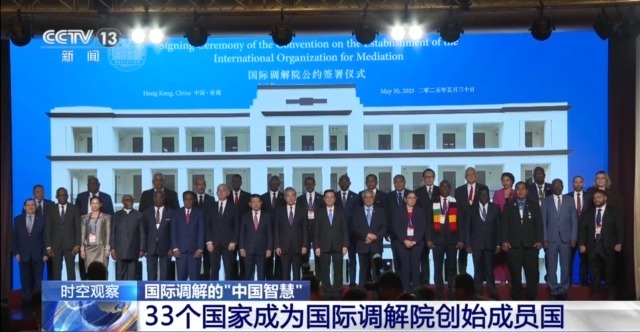
Core Points - The establishment of the International Mediation Institute is an innovative move in the field of international law, showcasing China's commitment to contributing public goods for global development using Eastern wisdom [1][2] - The International Mediation Institute aims to fill a gap in international dispute resolution by providing a neutral platform for mediation, complementing existing mechanisms like litigation and arbitration [1][3] - The initiative has received widespread support from the international community, reflecting a growing demand for effective conflict resolution and stable cooperation among nations [2][3] Summary by Sections Establishment and Significance - The International Mediation Institute was inaugurated in Hong Kong on May 30, with representatives from 85 countries and nearly 20 international organizations attending, and 33 countries signing the convention as founding members [1] - This initiative is seen as a crucial step in enhancing global governance and aligns with the principles of the United Nations Charter, particularly in promoting peaceful resolution of international disputes [1][3] Role of China - China's active role in mediating international conflicts, such as the reconciliation between Saudi Arabia and Iran, and its involvement in various geopolitical issues, underscores its commitment to fostering dialogue and cooperation [2] - The establishment of the International Mediation Institute reflects China's broader strategy of using dialogue to resolve conflicts and promote mutual understanding among nations [2][3] Global South's Contribution - The International Mediation Institute is positioned as a public good contributed by Global South countries, emphasizing their role in maintaining international justice and fairness [3] - The initiative aims to enhance the representation and voice of developing countries in global governance, promoting a more equitable international dispute resolution mechanism [3]
中国牵头的国际调解院 具体都调解什么?专家解读
Yang Shi Xin Wen· 2025-05-30 16:07
Core Viewpoint - The establishment of the International Mediation Institute, led by China, marks a significant development in international dispute resolution, focusing on mediation as a non-confrontational alternative to litigation and arbitration [1][3][4]. Group 1: Overview of the International Mediation Institute - The International Mediation Institute is the world's first intergovernmental legal organization dedicated to resolving international disputes through mediation [1]. - The signing ceremony for the institute's convention took place in Hong Kong, with representatives from 33 countries becoming founding members [3]. Group 2: Scope and Advantages of Mediation - The institute will mediate disputes between states, between states and foreign investors, and international commercial disputes, including emerging issues in blockchain and digital trade [4]. - Mediation is characterized by its non-confrontational nature, lower costs, flexibility in procedures, and high efficiency compared to traditional litigation and arbitration [6]. Group 3: International Support and Expectations - Representatives from various countries, including Zimbabwe and Serbia, expressed their support for the institute, emphasizing the importance of peaceful dispute resolution [8][10]. - The establishment of the International Mediation Institute is seen as a significant step for developing countries to achieve mutual benefits in international relations [12]. Group 4: Background and Development Process - The initiative to establish the International Mediation Institute began three years ago, with a joint declaration signed in 2022, leading to the formation of a preparatory office in Hong Kong in 2023 [13]. - The convention negotiations were completed in October 2024, with the institute expected to officially open in early 2026 [13]. Group 5: China's Role and Global Governance - China's leadership in establishing the institute reflects its commitment to providing solutions for current international relations and fostering cooperation with developing countries [14][15]. - The institute's creation is viewed as a response to the need for reform in the international order, particularly from the perspective of non-Western countries [15]. Group 6: Location Significance - Hong Kong was chosen as the headquarters for the International Mediation Institute due to its status as an international free port and its unique legal environment, which combines elements of both common law and civil law systems [16][17].