
均线

Search documents
我突然悟了!用好这一招,在A股赚钱就像呼吸般简单!
Sou Hu Cai Jing· 2026-02-17 12:33
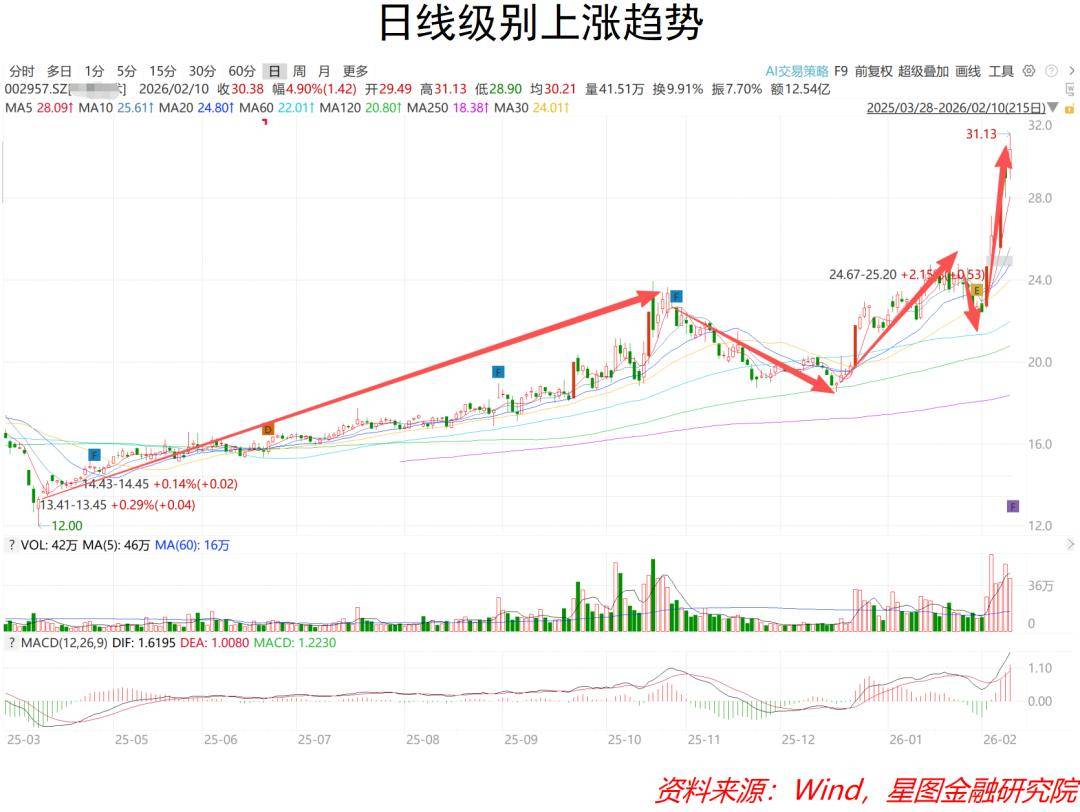
Group 1 - The core principle of successful stock market investing is to follow the trend, as emphasized by historical figures like Livermore, who stated that profit comes from major trends rather than minor fluctuations [1][2] - Understanding trends is crucial, which can be categorized into upward trends, downward trends, and sideways movements. Once a trend is established, it tends to persist for a significant period, making it difficult to reverse [2][3] - Investors should respect and align with the prevailing trend. For instance, when a downtrend shifts to an uptrend, it is advisable to seize opportunities during pullbacks rather than hesitating [3][4] Group 2 - Distinguishing between upward and downward trends can be done through K-line analysis, where rising highs and lows indicate an upward trend, while falling highs and lows signify a downward trend [6] - Two practical methods for trend identification include the Moving Average method, which reflects trends through the arrangement of moving averages, and the MACD method, which uses the relationship between short-term and long-term moving averages to assess market conditions [10][13] - The stock market is inherently volatile, and there is no one-size-fits-all investment strategy. Continuous learning and adaptation to market dynamics are essential for building a robust investment framework [15]

技术分析系列:双维框架研究之动能驱动与风险管控
Soochow Securities· 2025-05-05 13:31
Investment Rating - The report maintains an "Overweight" investment rating for the financial products industry [1]. Core Insights - The report emphasizes the importance of momentum-driven technical analysis and risk management in the financial products sector, highlighting the dual framework of momentum and risk control [1][2]. Summary by Sections 1. Momentum-Driven Technical Analysis - The report discusses the momentum effect, indicating that assets generally exhibit a certain degree of trend persistence in the short term [13]. - Moving averages (MA) are defined as a key indicator for assessing momentum, helping to smooth price fluctuations and identify potential trends [14][15]. - The report categorizes moving averages into short-term, medium-term, and long-term, each serving different market analysis needs [16]. - The MACD (Moving Average Convergence Divergence) is introduced as a significant technical analysis tool, consisting of the DIF line, DEA line, and MACD histogram, which helps investors grasp market trends [25][26]. - The report also covers the JAX (Jian Line) indicator, which combines price and volume data to assess medium to long-term trends and trading opportunities [34][35]. 2. Risk Management - The report introduces the Risk Degree Indicator (TR), which evaluates the relative position of assets in terms of risk, considering both spatial and temporal dimensions [45]. - The TR indicator operates within a normal range of 0 to 100, with higher values indicating increased investment risk and lower values suggesting reduced risk [50]. - Statistical analysis shows that the TR indicator effectively identifies local tops and bottoms in the A-share market, with a 45.74% probability of local lows occurring when TR is below 20 [50][51]. 3. Risk Trend Model - The report outlines a risk trend model that incorporates both momentum and risk dimensions to score assets, aiding in the development of timing strategies [44][49]. - It emphasizes the need for dynamic adjustments in parameters based on market conditions to enhance the accuracy of the JAX indicator [41][42]. 4. Timing Strategies - The report suggests constructing timing strategies based on historical data, with a focus on both periodic and non-periodic models to improve predictive effectiveness [44][49].