增强现实(AR)眼镜

Search documents
AI「看见」实验,哈佛颠覆性突破,一副AR眼镜,新手秒变资深专家
3 6 Ke· 2025-11-18 12:19
Core Insights - The article discusses the emergence of Human-AI Co-Embodied Intelligence systems, which integrate human researchers with AI and mixed reality technologies to enhance scientific experimentation and manufacturing processes. This paradigm shift aims to redefine the collaboration between humans and AI, allowing for real-time interaction and decision-making in physical environments [1][13][39]. Group 1: Challenges in Scientific Research and Manufacturing - Common issues in scientific research include human errors during complex procedures, leading to wasted resources and time. For instance, a novice may input incorrect parameters, resulting in the loss of an entire batch of devices [5][11]. - The lack of detailed documentation and the reliance on implicit knowledge make it difficult for new researchers to replicate successful experiments, often requiring extensive trial and error [7][10]. - Traditional AI systems are limited in their ability to perceive and interact with the physical world, which hampers their effectiveness in real-time experimental settings [12][18]. Group 2: Human-AI Co-Embodied Intelligence Systems - The APEX system developed by Harvard's Liu Jia team utilizes mixed reality (MR) technology to capture human actions and environmental changes, allowing AI to understand and respond to real-world scenarios [21][22]. - APEX consists of four collaborative intelligent agents that work together to plan, track, and analyze experimental processes, significantly improving accuracy and efficiency in manufacturing environments [23][24]. - The Agentic Lab system applies similar principles in biological research, enabling AI to assist researchers in real-time by providing visual and auditory feedback during experiments [25][28]. Group 3: Benefits of the New Paradigm - APEX provides real-time error correction, alerting researchers immediately when incorrect parameters are set, thus preventing potential losses [34]. - The systems automatically record and analyze experimental data, creating structured digital logs that enhance traceability and facilitate knowledge transfer [36]. - New researchers can quickly acquire skills through guided interactions with the systems, reducing the time required to reach expert-level proficiency [38]. Group 4: Future Implications - The integration of AI into both manufacturing and biological research signifies a shift from viewing AI as a replacement for human labor to recognizing it as a collaborative partner [39][43]. - This new paradigm is expected to expand across various fields, including flexible electronics and biomedicine, fostering a cross-disciplinary and self-evolving experimental ecosystem [42][45].


新材料产业周报:存储器价格持续上涨,神舟二十一号发射圆满成功-20251102
Guohai Securities· 2025-11-02 11:58
Investment Rating - The industry investment rating is "Recommended (Maintain)" [1] Core Views - The new materials sector is a crucial direction for the chemical industry, currently experiencing rapid growth in downstream demand. With policy support and technological breakthroughs, domestic new materials are expected to accelerate their long-term growth. The report emphasizes that "one generation of materials supports one generation of industry," highlighting the foundational nature of the new materials industry for other sectors [4]. Summary by Relevant Sections 1. Electronic Information Sector - Focus on semiconductor materials, display materials, and 5G materials [5] - As of October 31, 2025, global AI server shipments are projected to grow by over 20% annually, with AI applications driving demand [6][20]. 2. Aerospace Sector - Key areas of interest include PI films, precision ceramics, and carbon fibers [7]. 3. New Energy Sector - Focus on photovoltaic materials, lithium-ion batteries, proton exchange membranes, and hydrogen storage materials [8]. - In 2025, China's new energy heavy trucks have seen sales exceed 10,000 units for seven consecutive months, with September sales surpassing 20,000 units, marking a record high [9]. 4. Biotechnology Sector - Emphasis on synthetic biology and scientific services [10]. - A strategic cooperation agreement was signed between Zhejiang University and Shanghai Chemical Industry Park Development Co., focusing on project applications and technology exchanges [11]. 5. Energy Conservation and Environmental Protection Sector - Focus on adsorption resins, membrane materials, and biodegradable plastics [12]. - The Henan provincial government has issued an action plan for upgrading the steel industry, aiming for significant improvements in energy efficiency and environmental performance by 2025 [13]. Industry Rating and Investment Strategy - The new materials sector is expected to enter a prosperous cycle driven by downstream application sectors, maintaining a "Recommended" rating [14]. Key Companies and Earnings Forecast - A list of key companies with their stock prices and earnings per share (EPS) forecasts for 2024-2026 is provided, indicating various investment ratings such as "Buy" and "Increase Holdings" [14].
AI赋能第22届东博会 大批“硬核科技”亮相
Huan Qiu Wang Zi Xun· 2025-09-19 01:24
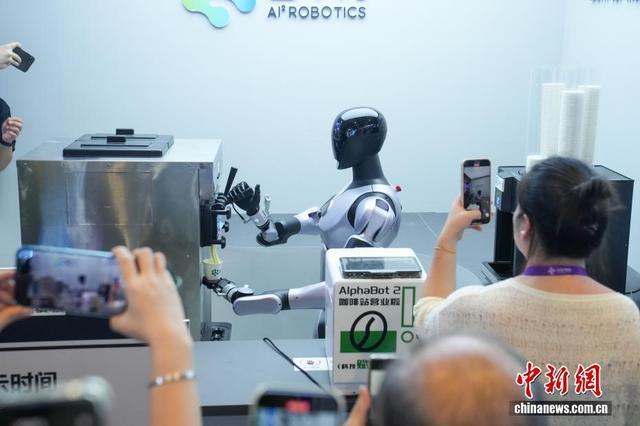
Core Insights - The 22nd China-ASEAN Expo is showcasing advanced technology products, with a significant focus on artificial intelligence (AI) as both the theme and highlight of the event [2][4][6]. Group 1: AI and Technology Highlights - AI-enabled products make up over 50% of the Chinese exhibition area, featuring high-tech products tailored to meet the market demands of ASEAN countries [2]. - Various innovative technologies are on display, including a hybrid cargo drone and a robotic "barista" making specialty coffee for attendees [2][6]. - Attendees are engaging with augmented reality (AR) glasses to experience the scenic beauty of Guangxi, showcasing the integration of AI in enhancing visitor experiences [10]. Group 2: Interactive Exhibits - A demonstration featuring a robot engaging in a "boxing match" with a Nigerian internet celebrity attracted considerable attention from visitors [4]. - A robotic dog was showcased, demonstrating its load-bearing capabilities as part of the exhibition [8]. - An "air drum" performance by staff members captivated many attendees, highlighting the interactive nature of the exhibits [12]. Group 3: Safety and Innovation - An intelligent firefighting helmet was displayed, indicating advancements in safety technology [14]. - A model train was also part of the exhibition, reflecting ongoing innovations in transportation technology [16].
小扎一夜反水,背刺开源,亲手葬送「Llama神话」,股价大涨12%
3 6 Ke· 2025-08-01 02:22
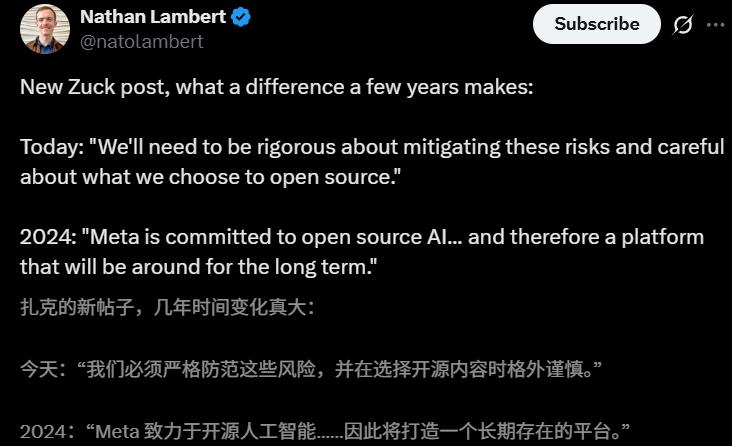
Core Viewpoint - Meta is shifting its stance on open-sourcing AI models, with CEO Mark Zuckerberg indicating that not all superintelligence models will be open-sourced due to potential security risks [1][6][9]. Financial Performance - Meta reported a net profit of $18.337 billion for Q2, exceeding expectations, leading to a stock price increase of over 12% [1][23]. - The company's revenue for Q2 reached $47.516 billion, a 22% year-over-year increase, while net income grew by 36% compared to the previous year [23][25]. AI Strategy and Development - Zuckerberg's vision includes creating "personal superintelligence" and emphasizes the importance of careful evaluation of security risks before deciding on open-sourcing technologies [1][21]. - Meta has invested significantly in AI talent and infrastructure, with plans to invest $72 billion in AI infrastructure by 2025 [27]. - The company is focusing on developing closed-source models, which allows for better control over commercialization compared to open-source models [6][9]. Competitive Landscape - Meta aims to differentiate itself from competitors like OpenAI and Google DeepMind by developing superior open-source AI models, although recent statements suggest a potential pivot towards closed-source strategies [3][6]. - The competitive environment is intensifying, with Meta actively recruiting talent from leading AI firms to bolster its capabilities [7][27]. Future Outlook - Zuckerberg believes that the next few years will be crucial for determining the trajectory of superintelligence technology, which could either empower individuals or pose societal risks [21][22]. - Meta's strategy includes leveraging AI to enhance advertising effectiveness and user engagement on its platforms [25][27].