
多模态ADHD行为治疗管理系统

Search documents
A股脑机接口概念风起:十日涨出千亿市值,多只个股坐上“过山车”
Bei Ke Cai Jing· 2026-01-16 11:29
Core Viewpoint - The brain-computer interface (BCI) sector in the A-share market has shown significant activity at the beginning of 2026, with a cumulative increase of 18.04% in the BCI theme index as of January 16, 2026, indicating a strong interest and potential for commercialization in this emerging industry [2][4]. Industry Overview - The BCI industry is projected to reach a market size of trillions, transitioning from laboratory research to commercial applications, driven by advancements in technology and supportive government policies [3]. - The Ministry of Industry and Information Technology and other departments have emphasized the importance of BCI in their strategic plans, including its inclusion in the "14th Five-Year Plan" for future industrial development [3]. Market Performance - As of January 16, 2026, the total market capitalization of 26 listed companies in the BCI sector has increased by approximately 108.7 billion yuan over ten trading days [8]. - Notable companies like Innovation Medical and Meihua Medical have experienced significant stock price fluctuations, reflecting the volatile nature of the market and investor sentiment towards BCI technologies [5][7]. Company Developments - Innovation Medical's subsidiary, Boling Brain Machine Technology, has launched products aimed at rehabilitation for stroke patients, although it reported operating losses of 6.6 million yuan and 8.66 million yuan in 2023 and 2024, respectively [6]. - Meihua Medical, a leader in cochlear implants, is actively collaborating with BCI clients to facilitate the transition from laboratory research to commercial production, highlighting the interconnectedness of BCI and existing medical technologies [7]. Strategic Collaborations - Companies like Yahui Long and Shenzhen Brain Machine Star Chain Technology have entered strategic partnerships to develop BCI-related products, aiming to enhance diagnostic and treatment capabilities in central nervous system diseases [9]. - Aipeng Medical is also expanding its business into BCI applications, focusing on pain management and sleep disorders, indicating a broader trend of diversification within the medical device sector [9]. Technical Insights - The core technological barriers in the BCI industry are concentrated in the upstream supply chain, including hardware components and surgical techniques, with significant potential for growth in domestic market penetration and localization [10].



脑机接口竞赛打响 多家公司预订2026里程碑
2 1 Shi Ji Jing Ji Bao Dao· 2026-01-07 23:08
Core Insights - The brain-computer interface (BCI) market is poised for significant growth, driven by advancements in technology and supportive policies, with a projected global market size reaching $40 billion by 2030 and $145 billion by 2040 in medical applications alone [3][4]. Industry Overview - BCI technology connects the brain with external devices for information exchange, categorized into three types: invasive, semi-invasive, and non-invasive, each with varying signal quality and safety [2]. - The medical sector is the primary application area for BCI technology, accounting for 56% of its applications, significantly improving the quality of life for patients with severe motor disabilities [3]. Market Dynamics - The A-share market has seen a surge in BCI-related stocks, with over 50 billion yuan flowing into the sector, indicating strong investor interest following announcements from Neuralink about large-scale production plans [1][5]. - Companies like Beiyikang, Sanbo Neurosurgery, and Aipeng Medical are actively involved in BCI development, with significant advancements in both invasive and non-invasive technologies [5][6]. Investment Landscape - Neuralink's recent funding round raised $650 million, valuing the company at $9 billion, highlighting the market's optimism for invasive BCI technologies [8]. - The BCI sector in China has experienced nearly 100 financing events in the past five years, with total funding exceeding 10 billion yuan, indicating robust investment activity [8]. Challenges and Considerations - Despite the optimistic outlook, the BCI industry faces challenges such as high development costs, lengthy clinical validation processes, and reliance on imported core components [9]. - The commercial viability of BCI products is still in its early stages, with a need for clearer pathways to market for both invasive and non-invasive products [9].
A股超50亿元涌入,脑机接口概念狂掀涨停潮
21世纪经济报道· 2026-01-07 05:40
Core Viewpoint - The article highlights the rapid growth and investment potential in the brain-computer interface (BCI) sector, driven by technological advancements and significant market interest, particularly following announcements from Neuralink regarding large-scale production and automation of BCI devices [1][4][14]. Market Performance - The A-share BCI concept sector experienced a surge, with over 5 billion yuan flowing into the market, and the BCI index showing a cumulative increase of over 14% in the first three trading days of the year [1][8][11]. - Notable stocks in the BCI sector include Meihao Medical, which saw a 19.81% increase, and Innovation Medical, which rose by 9.99% [2]. Industry Overview - BCI technology connects the brain with external devices for information exchange, categorized into three types: invasive, semi-invasive, and non-invasive, each with varying levels of signal quality and risk [4]. - The healthcare sector is identified as the primary application area for BCI technology, accounting for 56% of its applications, with projections estimating the global BCI medical application market to reach $40 billion by 2030 and $145 billion by 2040 [4][6]. Policy and Development - The Chinese government has included BCI in its "14th Five-Year Plan," with goals for core technology breakthroughs by 2027 and positioning the industry among the world's leaders by 2030 [5][6]. - In 2025, several companies, including Boryeong and Ladder Medical, completed significant implantation trials, marking China's entry into clinical trials for invasive BCI after the U.S. [6]. Company Developments - Companies like Beiyikang and Aipeng Medical are actively involved in BCI, with Aipeng focusing on non-invasive technologies and partnerships for rehabilitation systems [10][12]. - Other firms, such as Xiangyu Medical and Xinwei Medical, are developing various BCI products and are expected to see rapid revenue growth in the coming years [10][12]. Investment Landscape - The BCI sector has attracted significant investment, with nearly 100 financing events in the past five years totaling over 10 billion yuan, and a notable 30% year-on-year increase in financing activities in 2025 [14]. - Analysts suggest that the BCI industry is on the verge of commercial growth, supported by policy and technological advancements, while also cautioning about the challenges of clinical validation and high costs [14][15].


2只脑机接口概念股年内股价翻倍!政策持续加码 中国有望领跑
2 1 Shi Ji Jing Ji Bao Dao· 2025-11-29 23:53
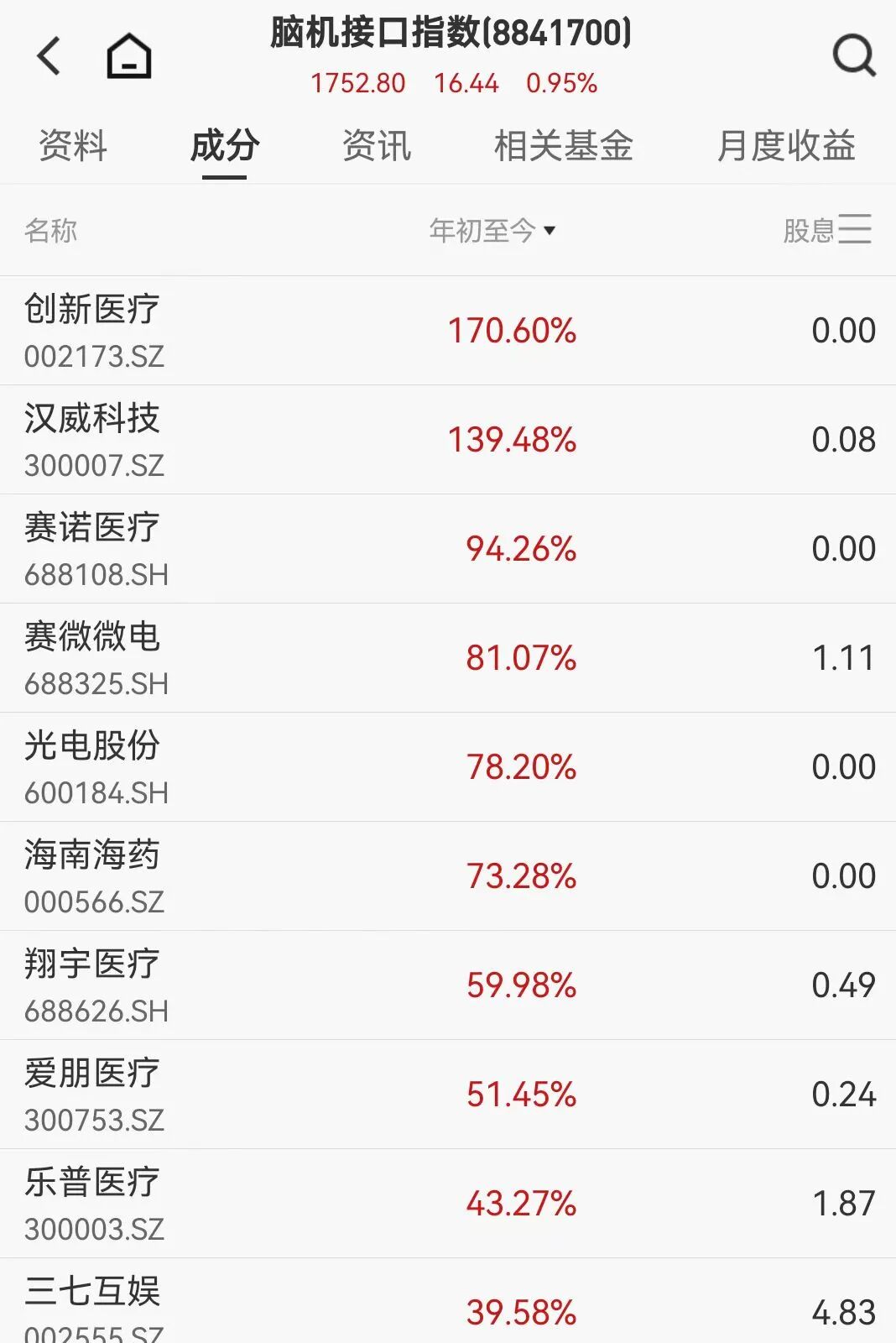
Core Insights - The year 2025 is viewed as a pivotal year for China's "brain-computer interface" (BCI) industry, with significant policy support and investment activity driving growth [2][5][7] Policy Support - The "14th Five-Year Plan" emphasizes BCI as one of the six key future industries, indicating strong governmental backing [7] - In July, multiple departments released implementation opinions to promote innovation and development in the BCI sector, establishing clear timelines for industry growth [5] - By 2027, breakthroughs in key technologies are expected, with the establishment of advanced technical, industrial, and standard systems [6] Market Performance - As of November, the BCI sector in China has seen 28 financing rounds totaling over 5 billion yuan [2] - The BCI concept index in the A-share market has surged by 52.13% over the past year, significantly outperforming the CSI 300 index, which rose by 15.04% [2] - Notable A-share companies in the BCI space, such as Innovation Medical and Hanwei Technology, have seen stock price increases of 170% and 139.48%, respectively [2] Industry Development - Shanghai has proactively laid out plans for BCI development, aiming for high-quality brain control and clinical applications by 2027 [8] - The BCI industry in China is rapidly advancing, with over 800 core enterprises identified, primarily located in China and the U.S. [9] - China is positioned to potentially lead in the BCI sector, with significant clinical advancements, including the first invasive clinical trial conducted in June [9][10] Financial Performance - In the A-share market, 24 companies related to BCI reported an average revenue of 3.428 billion yuan and an average net profit of 431 million yuan for the first three quarters [11] - Despite high gross profit margins, with 18 companies exceeding 30% and 9 over 60%, some companies are facing negative growth in revenue and net profit [12] Company Initiatives - Companies like Lepu Medical and Meihua Medical are actively pursuing commercialization of BCI products, with Lepu focusing on deep brain stimulation devices and Meihua collaborating with leading cochlear implant firms [13][14] - Aipeng Medical has received regulatory approval for its EEG collection products, which are part of a new ADHD treatment system, and is working with hospitals to implement these solutions [14]

2只脑机接口概念股年内股价翻倍
2 1 Shi Ji Jing Ji Bao Dao· 2025-11-29 23:36
Core Insights - The brain-computer interface (BCI) industry in China is expected to enter a significant development phase by 2025, driven by strong policy support and capital investment [1][5][6] - The BCI sector has seen substantial investment activity, with 28 financing rounds completed in 2023, totaling over 5 billion yuan [1] - The A-share market has recognized BCI as a hot investment trend, with the BCI concept index rising by 52.13% over the past year, significantly outperforming the Shanghai and Shenzhen 300 index [1] Policy Support - The "14th Five-Year Plan" emphasizes BCI as one of the six key future industries, with a clear timeline for technological breakthroughs and industry development by 2027 and 2030 [5][6] - In July, a joint initiative from seven departments outlined strategies for BCI innovation and development, aiming to establish a robust industry ecosystem [5] - Shanghai has proactively developed a BCI action plan, targeting clinical applications and technological advancements by 2027 and 2030 [6] Market Performance - The BCI concept index (8841700.WI) has shown a remarkable increase, with notable stocks like Innovation Medical and Hanwei Technology experiencing gains of 170% and 139.48% respectively [2][1] - A total of 24 A-share companies are involved in the BCI sector, with an average revenue of 3.43 billion yuan and an average net profit of 431 million yuan for the first three quarters of the year [11] Industry Landscape - The BCI industry in China is rapidly evolving, with over 800 core enterprises identified, positioning China among the leading countries in this field [8] - Recent clinical trials, including the first invasive clinical trial in China, indicate significant advancements in BCI technology [8][9] - The launch of the "North Brain No. 1" GCP multi-center clinical trial marks a new phase in large-scale clinical validation of BCI systems [9] Company Developments - Companies like Lepu Medical and Aipeng Medical are actively pursuing commercialization of BCI products, with Lepu focusing on deep brain stimulation devices and Aipeng on EEG collection products [12][13] - Aipeng Medical has established a joint laboratory for ADHD treatment, indicating a focus on integrating BCI technology into clinical applications [13] - Recent regulatory changes, including the establishment of a "green channel" for insurance coding of innovative medical products, are expected to accelerate the clinical application of BCI technologies [13]


2只脑机接口概念股年内股价翻倍
21世纪经济报道· 2025-11-29 23:34
Core Viewpoint - The article highlights the rapid development and investment opportunities in China's brain-computer interface (BCI) industry, which is expected to become a key focus area by 2025, supported by strong government policies and significant capital market activity [1][6][9]. Policy Support - The "14th Five-Year Plan" emphasizes BCI as one of the six key future industries, with increasing policy support and strategic importance [6][7]. - In July, multiple government departments released implementation opinions to promote BCI innovation, setting clear development milestones for the industry [6]. - By 2027, breakthroughs in key technologies are expected, with the establishment of advanced technical, industrial, and standard systems [6]. - Shanghai has initiated a plan to cultivate the BCI industry from 2025 to 2030, aiming for clinical applications of semi-invasive BCI products by 2027 [7][8]. Market Performance - The BCI concept index in the A-share market has seen a significant increase of 52.13% over the past year, outperforming the Shanghai and Shenzhen 300 index, which rose by 15.04% [1]. - Notable BCI-related stocks include Innovation Medical and Hanwei Technology, with year-to-date increases of 170% and 139.48%, respectively [2][1]. Industry Landscape - China is positioned to lead in the BCI sector, with over 800 core enterprises in the industry, primarily located in China and the U.S. [10]. - The first invasive clinical trial in China was successfully conducted in June, marking a significant milestone in the country's BCI technology development [10][11]. - The "North Brain No. 1" GCP multi-center clinical trial was launched in October, representing a new phase in large-scale clinical validation of BCI systems [11]. Financial Performance - In the A-share market, 24 companies related to BCI reported an average revenue of 3.428 billion yuan and an average net profit of 431 million yuan for the first three quarters [13]. - 18 companies have a gross margin exceeding 30%, indicating strong profitability, although many companies are facing challenges in revenue and profit growth [13]. - Companies like Lepu Medical and Aipeng Medical are actively working on commercialization and product development in the BCI space, with recent regulatory approvals and strategic partnerships [14].

爱朋医疗:公司围术期脑状态监测产品麻醉深度监护仪已获得3张注册证
Zheng Quan Ri Bao· 2025-10-17 09:38
Core Insights - Aipeng Medical announced the successful registration of its perioperative brain state monitoring product, the anesthesia depth monitor, which has received three registration certificates and has been launched in over 20 provinces, generating sales [2] - The company has introduced a new treatment system for refractory insomnia, which has begun clinical treatments in hospitals and is now being commercially promoted, with charges based on actual treatment projects [2] - Aipeng Medical has obtained registration certificates for two EEG collection products, which are core components of its "multimodal ADHD behavioral treatment management system," and has established a joint laboratory with Fudan University Children's Hospital to integrate research innovation with clinical applications for ADHD children [2] - The ADHD behavioral treatment has a corresponding fee schedule in hospitals, and regions like Hubei, Zhejiang, and Jiangsu have introduced pricing for non-invasive brain-computer interface services, with a fee of 966 yuan per session [2] - A new regulation from the National Healthcare Security Administration on September 24 has opened a "green channel" for insurance coding of innovative medical products like brain-computer interfaces, accelerating their clinical practice and application [2]
爱朋医疗:脑机接口产品入院及收费进展顺利,多地出台相关医疗服务价格项目
2 1 Shi Ji Jing Ji Bao Dao· 2025-10-17 04:22
Core Insights - The company Aipeng Medical has received three registration certificates for its perioperative brain state monitoring product, the anesthesia depth monitor, and has completed network access in over 20 provinces, generating sales [1] - A new treatment system for refractory insomnia has been launched and is currently undergoing clinical treatment in hospitals, with commercialization efforts initiated based on actual treatment project execution [1] - The company has established a joint laboratory for brain-machine interface behavioral therapy in collaboration with the Children's Hospital affiliated with Fudan University, focusing on cognitive behavioral therapy for children with ADHD [1] - The core component of the multimodal ADHD behavioral management system has received registration certification, and non-invasive brain-machine interface adaptation fees have been set at 966 yuan per session in regions such as Hubei, Zhejiang, and Jiangsu [1] - The National Medical Insurance Administration has opened a "green channel" for innovative products like brain-machine interfaces, facilitating the acceleration of clinical application [1]
爱朋医疗(300753) - 300753爱朋医疗投资者关系管理信息20251016
2025-10-17 03:50
Group 1: Company Overview - Aipeng Medical focuses on medical devices, particularly in pain management and nasal airway management, while also exploring brain-computer interface innovations [4] - The company has established a partnership with Ruishen'an Medical, a leading player in the domestic neuroregulation field [4] Group 2: Product Development and Market Position - The company has launched a perioperative brain state monitoring product, which has received 3 registration certificates and is generating sales across over 20 provinces [5] - The newly introduced treatment system for refractory insomnia has begun clinical applications, with pricing based on specific treatment projects [5] - The non-invasive brain-computer interface adaptation fee is set at 966 RMB per session, with recent regulations facilitating insurance coverage for innovative medical products [5] Group 3: Technological Advancements - The anesthesia depth monitoring device utilizes a proprietary index, collecting EEG data at 2,000 times per second, providing a comprehensive analysis of anesthesia depth [8] - The company’s new generation ADM series anesthesia depth monitor offers enhanced performance, usability, and stability, with features including EEG spectrum analysis and anesthesia depth assessment [8] Group 4: Strategic Collaborations - Aipeng Medical's investment in Ruishen'an in 2019 was driven by strategic synergies in chronic pain treatment, particularly with the development of implantable vagus nerve stimulators [9][10] - The collaboration has expanded to include various products for epilepsy and pain management, achieving significant sales [10] Group 5: Future Research and Development Plans - The company aims to deepen research in sensors, electrodes, and EEG signal processing, focusing on clinical applications for sleep disorders, ADHD, and epilepsy [11] - An Artificial Intelligence and Brain-Computer Engineering Research Institute has been established to drive innovation in pain management, anesthesia, and mental health treatment [11]
爱朋医疗:公司积极开拓脑机接口创新业务
Zhong Zheng Wang· 2025-10-15 13:14
Core Viewpoint - Aipeng Medical (300753) is focusing on the medical device sector, particularly in pain management and upper airway management, while also expanding into brain-computer interface innovations [1] Group 1: Business Focus - The company is engaged in two main segments: acute and chronic pain management, and nasal and upper airway management [1] - Aipeng Medical is actively developing brain-computer interface applications, including perioperative brain state monitoring and treatment systems for insomnia and ADHD [1] Group 2: Product Development - The company has developed a multimodal ADHD behavior management system that connects data from in-hospital training centers to home training environments, utilizing scientific EEG monitoring and multimodal intervention training [1] - Aipeng Medical possesses advanced technology in anesthesia depth monitoring, which is crucial for perioperative monitoring, diagnosis, and early warning applications [1] Group 3: Future Innovations - The company is researching a seizure warning platform and aims to advance clinical applications for perioperative brain state monitoring, ADHD, sleep disorders, and epilepsy [1] - Aipeng Medical has invested in Ruishen'an Medical, which specializes in the development, production, and sales of brain nerve regulation and intracranial electrode medical devices [1]