
天弘恒生沪深港创新药精选50ETF联接A

Search documents
公募2025年自购超5600亿
2 1 Shi Ji Jing Ji Bao Dao· 2026-01-08 23:36
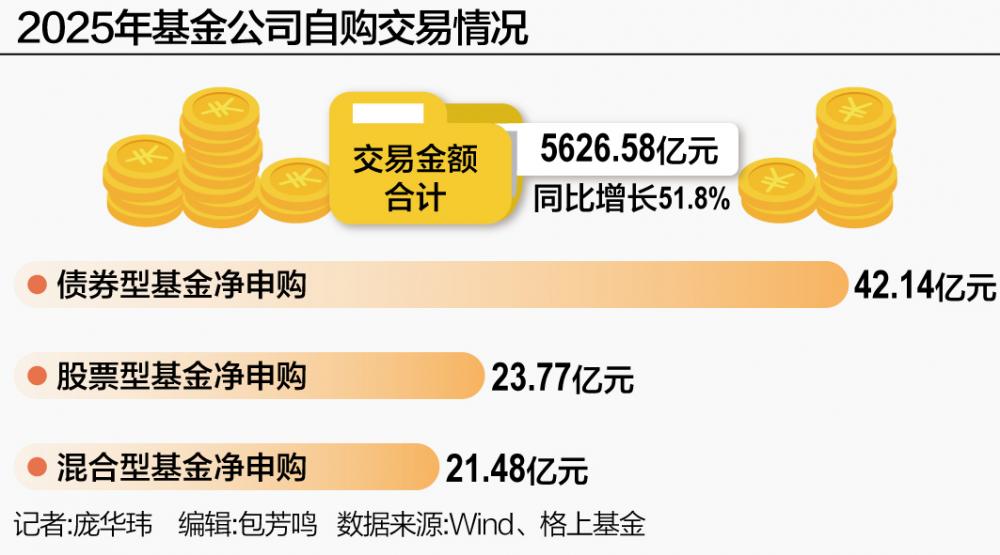
Core Insights - The public fund industry in 2025 demonstrated strong confidence in the market through a large-scale "self-investment" initiative, with total self-purchase transactions amounting to 562.66 billion yuan, a significant increase of 51.8% compared to 370.65 billion yuan in 2024 [1][3][9] - The structure of self-purchases underwent significant changes, with non-monetary funds seeing a net subscription of 9.34 billion yuan, a year-on-year surge of 130%, while monetary funds faced nearly 200 billion yuan in net redemptions [1][4][9] Self-Purchase Scale and Structure Changes - In 2025, the total self-purchase amount for public non-monetary products reached 9.34 billion yuan, up from 4.06 billion yuan in 2024, marking an increase of 5.28 billion yuan [4][12] - Among non-monetary funds, bond funds led with a net subscription of 4.21 billion yuan, while stock and mixed funds saw net subscriptions of 2.38 billion yuan and 2.15 billion yuan, respectively [4][12] - In stark contrast, monetary funds experienced a net redemption of 193.95 billion yuan, compared to a net subscription of 2.53 billion yuan in 2024, indicating a shift of institutional funds from traditional cash management tools to assets with higher return expectations [4][12] Focus on Index Funds - Index funds have become a key focus for public institutions in their self-purchase strategies, with passive index bond funds, passive index funds, and enhanced index funds collectively accounting for 49.55 billion yuan, representing over 53% of the total self-purchase amount for non-monetary funds [5][14] - Notably, the E Fund's index products received a total of 1.8 billion yuan in self-purchases, with eight index products exceeding 100 million yuan in net subscriptions [5][14] Market and Policy Drivers - The A-share market exhibited a "W-shaped" trend in 2025, with major indices showing impressive annual performances, including a rise of 18.41% for the Shanghai Composite Index and 49.57% for the ChiNext Index, creating a favorable environment for fund self-purchases [6][15] - Regulatory policies have played a crucial role, with the China Securities Regulatory Commission's action plan in May 2025 enhancing the evaluation criteria for self-purchases, thereby incentivizing long-term self-investment behavior among fund managers [6][15] Long-term Investment Trends - The self-purchase behavior in 2025 reflects a shift towards "increasing non-monetary investments, long-term orientation, and normalization," moving from a short-term market stabilization tool to a systematic arrangement for long-term value investment [7][16] - The industry is witnessing a growing emphasis on aligning self-purchases with long-term performance, which is expected to drive the public fund industry towards a high-quality development phase, moving away from a focus on scale expansion [8][17]
公募自购升温 去年交易金额大增51.8%,锚定长期价值投资
2 1 Shi Ji Jing Ji Bao Dao· 2026-01-08 23:36
Core Viewpoint - In 2025, the public fund industry demonstrated strong confidence in the market through a large-scale "self-investment" initiative, indicating optimism for future market performance [1][11]. Group 1: Self-Investment Scale and Structure Changes - The total self-purchase transaction amount by fund companies reached 562.658 billion yuan in 2025, a significant increase of 51.8% compared to 370.651 billion yuan in 2024 [2][4][16]. - Non-monetary fund net subscriptions amounted to 9.339 billion yuan, a staggering increase of 130% year-on-year, while monetary funds faced nearly 200 billion yuan in net redemptions [2][12]. - Among non-monetary funds, bond funds led with a net subscription of 4.214 billion yuan, while stock and mixed funds saw net subscriptions of 2.377 billion yuan and 2.148 billion yuan, respectively, marking a reversal from net redemptions in 2024 [5][17]. Group 2: Focus on Index Funds - Index funds have become a key focus for self-purchases by public fund institutions, with passive index bond funds, passive index funds, and enhanced index funds collectively accounting for 49.55 billion yuan, representing over 53% of non-monetary fund self-purchases [6][19]. - Notably, eight index products had net subscription amounts exceeding 100 million yuan, indicating strong market interest [19]. Group 3: Market and Policy Drivers - The A-share market exhibited a "W-shaped" trend in 2025, with major indices showing impressive annual gains: the Shanghai Composite Index rose by 18.41%, the Shenzhen Component Index by 29.87%, and the ChiNext Index by 49.57% [8][21]. - Regulatory policies, particularly the China Securities Regulatory Commission's action plan released in May 2025, have incentivized long-term self-purchase behaviors by aligning the interests of fund managers and investors [21]. Group 4: Long-term Investment Trends - The self-purchase behavior in 2025 reflects a shift towards "increasing non-monetary, long-term, and normalized" investment strategies, moving away from short-term market stabilization tools [22]. - Companies are increasingly committing to long-term holdings, with many pledging to maintain self-purchased shares for no less than one year, signaling a focus on long-term value [23].

2025年公募自购升温:金额大增51.8%,锚定长期价值投资
2 1 Shi Ji Jing Ji Bao Dao· 2026-01-08 13:05
Core Insights - The public fund industry in 2025 demonstrated strong confidence in the market through a significant self-investment action, with total self-purchase transactions amounting to 562.66 billion yuan, a substantial increase of 51.8% compared to 370.65 billion yuan in 2024 [1][2] Group 1: Self-Purchase Trends - The structure of self-purchases changed notably, with non-monetary funds seeing a net subscription of 9.34 billion yuan, a dramatic increase of 130% year-on-year, while monetary funds faced nearly 200 billion yuan in net redemptions [1][3] - Among non-monetary funds, bond funds led with a net subscription of 4.21 billion yuan, while stock and mixed funds saw net subscriptions of 2.38 billion yuan and 2.15 billion yuan, respectively, marking a reversal from net redemptions in 2024 [3] Group 2: Index Fund Focus - Index funds have become a key focus for public institutions' self-purchases, with passive index bond funds, passive index funds, and enhanced index funds collectively accounting for 49.55 billion yuan, over 53% of the total non-monetary fund self-purchases [4] - Notably, eight index products had net subscription amounts exceeding 100 million yuan, indicating strong market interest [4] Group 3: Market and Policy Drivers - The A-share market exhibited a "W" shaped trend in 2025, with major indices showing impressive annual gains: the Shanghai Composite Index rose by 18.41%, the Shenzhen Component Index by 29.87%, and the ChiNext Index by 49.57%, providing a favorable environment for fund self-purchases [5] - Regulatory policies, particularly the China Securities Regulatory Commission's action plan in May 2025, have incentivized long-term self-purchase behaviors by linking fund managers' interests with those of investors [5][6] Group 4: Long-term Investment Shift - The self-purchase behavior in 2025 reflects a shift towards long-term value investment, moving away from short-term market stabilization tools [6] - The demand for stable, transparent, and responsible investments is rising, prompting institutions to adopt self-purchases as a demonstration of their commitment and accountability [6][7] Group 5: Future Outlook - The trend of self-purchases is expected to become a standard practice among fund companies, with passive index funds likely to remain the preferred choice due to their low costs and transparent rules [6][7] - Future self-purchases will increasingly be linked to long-term performance, serving as a core reflection of fund companies' research capabilities and responsibility [7]
股混基金自购规模超40亿元 新规强化公募机构与投资者利益绑定
Zhong Guo Zheng Quan Bao· 2025-12-09 23:23
Core Viewpoint - The recent issuance of the "Guidelines for Performance Assessment Management of Fund Management Companies (Draft for Comments)" by regulatory authorities aims to enhance the long-term incentive and constraint mechanisms within the fund management industry, promoting a stronger alignment of interests between fund management companies and fund shareholders [2][6]. Group 1: Guidelines and Requirements - Fund management company executives and key business department heads are required to invest at least 30% of their total performance compensation in public funds managed by their company, while fund managers must invest at least 40% of their total performance compensation in the public funds they manage [2][4]. - The guidelines emphasize the concept of "performance compensation holding base," mandating that the holding period for these investments must be no less than one year [2][3]. Group 2: Self-Purchase Trends - As of December 7, 2023, 136 public fund companies have initiated self-purchases, totaling 8,400 instances, with net subscriptions for equity funds exceeding 4 billion yuan [4][6]. - Notably, Guotai Fund has recorded the highest number of self-purchases at 782 times, followed by Invesco Great Wall Fund with 607 times [4]. Group 3: Market Implications - The self-purchase trend reflects fund companies' confidence in their investment management capabilities and the long-term value of their products, which is expected to stabilize investor expectations and enhance confidence in holding [6][7]. - The focus on equity products for self-purchases indicates a positive outlook on market valuation recovery and economic fundamentals, suggesting that fund companies will prioritize long-term performance over short-term gains [6][7].
股混基金今年自购规模超40亿元
Zhong Guo Zheng Quan Bao· 2025-12-09 20:22
Core Viewpoint - The recent issuance of the "Guidelines for Performance Assessment Management of Fund Management Companies (Draft for Comments)" by regulatory authorities aims to enhance the long-term incentive and constraint mechanisms within the fund management industry, promoting better alignment of interests between fund management companies and fund shareholders [2][3]. Group 1: Regulatory Guidelines - The guidelines require senior management and key business department heads of fund companies to invest at least 30% of their annual performance compensation in public funds managed by their company, while fund managers must invest at least 40% of their performance compensation in the public funds they manage [2][3]. - The guidelines emphasize "performance compensation holding," mandating that the holding period for these investments must be no less than one year [2][3]. Group 2: Self-Purchase Trends - As of December 7, 2023, 136 public fund companies have initiated self-purchases, totaling 8,400 instances, with net subscriptions for equity mixed funds exceeding 4 billion yuan [3][4]. - Notably, Guotai Fund has the highest number of self-purchases at 782 times, followed by Invesco Great Wall Fund with 607 times, and several other companies exceeding 500 times [3]. Group 3: Investment Focus - The self-purchase trend indicates a strong focus on equity products, reflecting the industry's confidence in the long-term value of equity assets and expectations for market valuation recovery and economic improvement [4][5]. - Fund companies' self-purchase actions are seen as a commitment to long-term development, enhancing risk control and sustainable investment value, which may lead to improved long-term performance stability [5].
年内自购8400次!“硬核”绑定或将上演
Zhong Guo Zheng Quan Bao· 2025-12-08 12:11
Group 1 - A total of 136 public fund companies have initiated self-purchases this year, with a cumulative self-purchase count of 8,400 times, indicating a strong trend in self-investment among fund companies [1][2] - The net subscription amount for stock mixed funds has exceeded 4 billion yuan, with significant net subscriptions also seen in bond funds, totaling 4.21 billion yuan [2] - Among fund companies, Guotai Fund has the highest self-purchase count at 782 times, followed by Jingshun Great Wall Fund with 607 times, and others like Zhongou Fund and Hongde Fund exceeding 500 times [2] Group 2 - The regulatory body has issued a draft guideline for performance assessment and compensation management for fund management companies, aiming to strengthen the binding of interests between fund managers and investors [3] - The guideline emphasizes "performance salary holding base," requiring senior management and fund managers to invest a certain percentage of their performance compensation into the funds they manage, with a minimum holding period of one year [3] - It is anticipated that the self-purchase volume of fund companies will continue to increase, particularly in equity funds, as this practice enhances investor confidence and aligns the interests of fund managers with those of investors [3]