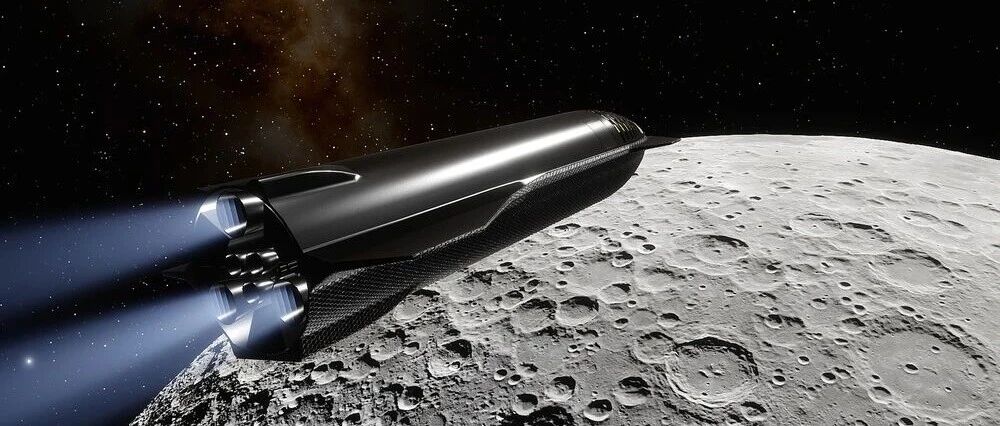
太空算力卫星星座

Search documents
满屏涨停!商业航天再“起飞”,巨力索具等22股封板
2 1 Shi Ji Jing Ji Bao Dao· 2026-02-03 08:47
Group 1 - The A-share market rebounded on February 3, with the Shanghai Composite Index and the ChiNext Index both rising over 1%, and the Shenzhen Component Index increasing by more than 2% [1] - The commercial aerospace sector experienced significant growth, with companies like Robotech and Dike Co. hitting the 20% daily limit, alongside 22 other stocks such as Urban Construction Development and Giant Rope [1] - SpaceX, founded by Elon Musk, announced the acquisition of AI startup xAI to integrate innovative resources across AI, rockets, and space internet [1] Group 2 - According to a report by CITIC Securities, SpaceX is actively advancing its IPO process and has submitted an application to the FCC for a million AI satellites, aiming to create a space computing satellite constellation [1] - Apple and SpaceX are planning to collaborate on satellite direct connection services for mobile phones, indicating potential expansion in the downstream applications of the commercial aerospace sector [1]






商业航天股逆势上涨,通光线缆涨超14%,通宇通讯涨超5%
Ge Long Hui· 2026-02-02 04:03
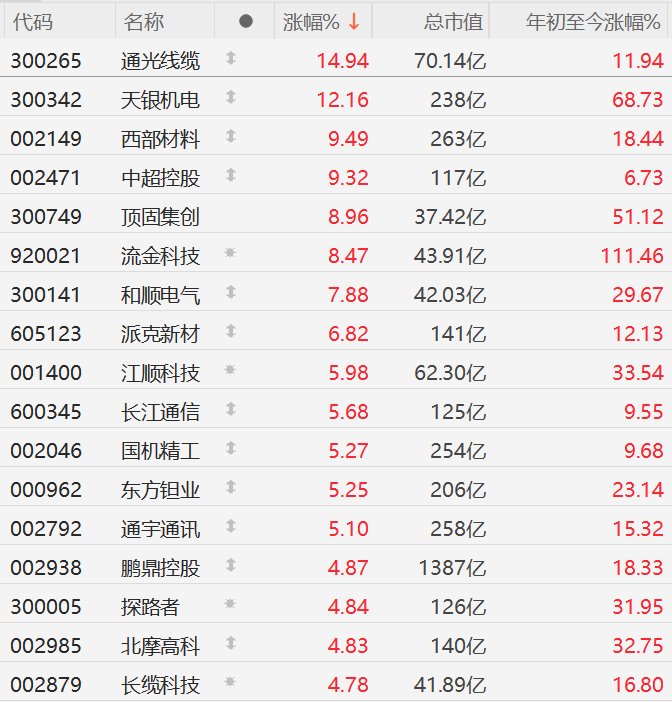
Core Viewpoint - The A-share market for commercial aerospace stocks has seen a significant increase, with several key stocks rising sharply amid positive developments from SpaceX, including plans for a satellite constellation and potential collaborations with Apple [1] Group 1: Stock Performance - Tongguang Cable (300265) rose by 14.94%, with a total market value of 7.014 billion [2] - Tianyin Electromechanical (300342) increased by 12.16%, with a market capitalization of 23.8 billion [2] - Western Materials (002149) saw a rise of 9.49%, with a market value of 26.3 billion [2] - Zhongchao Holdings (002471) grew by 9.32%, with a market cap of 11.7 billion [2] - Other notable increases include Dinggu Jichuang (300749) at 8.96%, Liujin Technology (920021) at 8.47%, and Heshun Electric (300141) at 7.88% [2] Group 2: SpaceX Developments - SpaceX has submitted an application to the FCC to launch up to 1 million satellites, aiming to create a satellite constellation for space computing [1] - The company is actively advancing its IPO process and plans to integrate xAI into its business [1] - SpaceX is collaborating with Apple to promote direct satellite services for mobile phones, indicating potential expansion in downstream applications within the commercial aerospace sector [1] Group 3: Analyst Outlook - CITIC Securities maintains a bullish outlook on commercial aerospace stocks, highlighting the positive developments from SpaceX and the potential for growth in the industry [1]


百万颗卫星!SpaceX,剑指“太空算力”
证券时报· 2026-01-31 12:50
Core Viewpoint - SpaceX is planning to deploy an unprecedented satellite constellation of up to 1 million satellites to provide computational infrastructure for global artificial intelligence development, aiming to support billions of users with necessary computing power for large-scale AI applications [1]. Group 1: SpaceX's Satellite Constellation - SpaceX's satellite system will operate at altitudes between 500 km and 2000 km, utilizing a solar-synchronous orbit with a tilt of approximately 30 degrees, and will be confined to a narrow orbital shell of no more than 50 km in width to avoid orbital conflicts [1]. - The constellation will be powered by solar energy and will connect to the existing Starlink network via laser, enabling the routing of computational results to ground users globally [1]. Group 2: Comparison of US and China in Space Computing - The US, led by tech giants like SpaceX, Google, Amazon, and Nvidia, is accelerating the commercialization of space computing due to severe energy and cooling constraints faced by ground data centers, aiming for breakthroughs in technology prototypes and early commercial applications [2]. - In contrast, China is adopting a government-led approach, with top research institutions and state-owned enterprises driving the development of space computing constellations, emphasizing technological self-sufficiency and long-term strategic capabilities [2][3]. Group 3: Advantages of Space Data Centers - Space data centers can achieve significantly higher energy efficiency compared to ground facilities, with marginal power generation costs projected to be one-twentieth to one-eighth of those in developed economies [4]. - The modular integration and higher light speed in vacuum conditions of orbital data centers provide a feasible technological path for constructing high-coupling, low-latency, and high-bandwidth large-scale AI training platforms, which are essential for future AI models requiring substantial computational clusters [4].