
高水平开放

Search documents
以确定性应对不确定性-十五五-规划-纲要-解读
2026-03-24 01:27
Summary of Key Points from the Conference Call Industry or Company Involved - The discussion revolves around the "14th Five-Year Plan" and its implications for China's economic development and policy direction. Core Points and Arguments 1. **High-Quality Development Focus**: The "14th Five-Year Plan" emphasizes high-quality development to address internal and external uncertainties, with an implicit GDP growth requirement of approximately 4.17% annually to achieve a doubling of per capita GDP by 2035 [1][2][6]. 2. **Shift in Policy Focus**: The policy focus has shifted from "supply-side new and old alternation" to "supply-demand rebalancing," prioritizing industrial development and the transformation of technological achievements into a modern industrial system [1][2][4]. 3. **Investment in Green Transition**: The plan anticipates a total green investment of 17.5 trillion yuan during the "14th Five-Year Plan," averaging 3.5 trillion yuan annually, which is expected to contribute approximately 1.2 percentage points to GDP growth each year [1][6][11]. 4. **Structural Policies to Boost Domestic Demand**: The plan aims to enhance consumer capacity and willingness through structural policies such as increasing property income, raising minimum wages, and improving secondary distribution mechanisms like pension adjustments [1][2][13]. 5. **Employment and Income Growth**: The urban survey unemployment rate target is set to remain below 5.5%, with a focus on synchronizing residents' disposable income growth with GDP growth [7][14]. 6. **Innovation and R&D Investment**: The plan maintains a target for R&D expenditure growth of over 7% annually, with an emphasis on increasing the digital economy's contribution to GDP [7][11]. 7. **Greenhouse Gas Emission Targets**: The goal is to reduce carbon intensity by 17% during the "14th Five-Year Plan," with a focus on transitioning from energy consumption control to carbon emission control [11][12]. 8. **Macro Policy Choices**: The divergence between China's economic fundamentals and asset prices is attributed to different policy responses compared to the U.S., with China focusing on structural reforms rather than short-term stimulus [8][10]. 9. **Reform in Fiscal and Monetary Systems**: The plan includes reforms in the fiscal and monetary systems, emphasizing the need for a stable tax burden and adjustments in the distribution of resources [3][19][20]. Other Important but Possibly Overlooked Content 1. **Digital and Population Development**: The plan highlights the importance of digital development and the quality of population growth, indicating a strategic shift towards embracing digital technology and addressing demographic changes [4][5]. 2. **Service Sector Expansion**: There is a strong emphasis on expanding the service sector, particularly in areas like elderly care, childcare, and health services, which are expected to receive targeted support [15][17]. 3. **Public Service Improvements**: The plan aims to enhance the equality of basic public services, with specific measures to improve healthcare and social security systems [14][15]. 4. **Investment in New Infrastructure**: The focus on new infrastructure includes significant investments in digital and energy sectors, with a projected 4 trillion yuan investment in smart grid technology [11][16]. 5. **International Trade and Investment**: The plan outlines strategies for balancing imports and exports, promoting high-standard trade rules, and enhancing the role of the RMB in international trade [17][18]. This summary encapsulates the key themes and strategic directions outlined in the conference call regarding China's "14th Five-Year Plan," highlighting the focus on high-quality development, green transition, and structural reforms to stimulate economic growth and improve living standards.
中国 “十五五” 规划:高质量增长的三大支柱-China‘s 15th FYP_ Three pillars for high-quality growth
2026-03-24 01:27
Summary of China's 15th Five-Year Plan (2026-30) Industry and Company Focus - **Industry**: China's economic and social development - **Company**: The Hongkong and Shanghai Banking Corporation Limited (HSBC) Key Points and Arguments Pillar 1: Industrial Modernisation - Focus on boosting productivity through technological breakthroughs and industrial modernisation, prioritising high-tech industrialisation, digitalisation, and green transformation [3][19] - Emphasis on upgrading traditional industries and scaling up future industries like chips and humanoid robots [3][24] - Shift from maintaining a stable manufacturing share of GDP to ensuring a reasonable share, indicating a pragmatic approach to avoid premature deindustrialisation [20][21] Pillar 2: Strong Domestic Market - Domestic market to become the primary growth engine, with measures to boost household spending through job creation and income growth [4][9] - Investment policy shifts towards "effective investment," focusing on quality and efficiency, including investments in human capital and healthcare [4][45] - Creation of a unified national market to dismantle local protectionism and enhance market efficiency [48][49] Pillar 3: High-Level Opening Up - Emphasis on two-way trade and investment flows, encouraging imports of agricultural products and advanced technology [5][63] - Policies to attract foreign direct investment (FDI) and support outbound direct investment (ODI) to localise production and ease trade frictions [5][69] - Institutional opening up to align with international rules and standards, enhancing market access for foreign firms [70][71] Reform as the Glue - Reform is positioned as the essential link between the three pillars, aimed at strengthening SOE governance and enhancing the business environment for private sectors [6][78] - Focus on building a high-standard socialist market economy to boost confidence and productivity [79][80] Economic Growth Targets - The plan sets a minimum average annual GDP growth rate of approximately 4.2% from 2026 to 2030 [15] - Specific targets include urbanisation rate reaching 71% by 2030 and growth of R&D expenditure exceeding 7% [16] Domestic Consumption and Investment - Major initiatives to boost domestic consumption, with a focus on service consumption and improving the consumer environment [39][40] - Shift towards effective investment, targeting projects that enhance quality of life and consumer spending [46] Urbanisation and Integration - Urbanisation is integrated into the broader population strategy, focusing on converting migrant workers into settled urban residents [53][54] - Emphasis on improving transport connectivity and public services to facilitate integrated growth across cities [58][59] Conclusion - The 15th FYP aims for a dynamic, resilient, and globally competitive economy through industrial modernisation, a strong domestic market, and high-level opening up, supported by comprehensive reforms [75][83]
中金:以确定性应对不确定性——“十五五”规划《纲要》解读
中金点睛· 2026-03-19 00:11
Core Viewpoint - The "14th Five-Year Plan" emphasizes high-quality development to address uncertainties in both internal and external environments, focusing on structural reforms and sustainable growth [1][2][3]. Group 1: Development Environment and Goals - The "15th Five-Year Plan" outlines a complex development environment with increasing external uncertainties and internal challenges, emphasizing the need for high-quality development [4]. - The plan aims to achieve a reasonable GDP growth rate while optimizing economic structure and improving quality, with a focus on people's well-being [5][6]. Group 2: Structural Reforms - The plan highlights structural reforms such as promoting innovation, improving livelihoods, transitioning to a green economy, and enhancing institutional autonomy [2][4]. - It emphasizes the importance of supply-side reforms, including optimizing supply structure and promoting green investments [2][15]. Group 3: Investment and Consumption - The plan aims to enhance consumer capacity and stimulate consumption by combining investment in goods and people, focusing on major projects in strategic and future industries [2][24]. - It stresses the need for policies that improve employment quality and income distribution to boost consumer spending [25][26]. Group 4: Major Projects - The "15th Five-Year Plan" includes 109 major projects focusing on strategic industries, future industries, and improving livelihoods, marking a shift towards high-quality development [30][31]. - Key areas include energy and transportation, with projects aimed at enhancing resilience and expanding development space [31][32]. Group 5: Green Transition - The plan sets a carbon intensity reduction target of 17% over the next five years, marking a shift to a dual control system for carbon emissions [19][21]. - It emphasizes the need for significant green investments, estimated at 3.5 trillion yuan annually, to achieve carbon peak goals [22]. Group 6: Innovation and Technology - The plan prioritizes the integration of technology and industry, aiming to enhance the application of scientific achievements in production [16][17]. - It highlights the importance of digital transformation and the development of a unified computing network to support economic growth [18].


吉林“十五五”规划建议
Zhong Shang Chan Ye Yan Jiu Yuan· 2026-03-07 00:05
Investment Rating - The report does not explicitly provide an investment rating for the industry Core Insights - The "14th Five-Year" period has seen significant achievements in Jilin's revitalization and development, with stable economic growth and structural optimization [8][9] - The "15th Five-Year" period is crucial for building a modern socialist Jilin, focusing on high-quality development and overcoming challenges [10][11] - Jilin's development environment is complex, with both opportunities and risks, necessitating strategic efforts to address deep-seated issues [12][13] Summary by Sections Economic and Social Development Goals - The guiding ideology emphasizes Marxism, socialism with Chinese characteristics, and the importance of high-quality development [13][14] - Key principles include the Party's leadership, prioritizing people's needs, and promoting comprehensive reform [15][16] - Major goals include significant advancements in high-quality development, technological innovation, and social civilization [17][18] Modern Industrial System - The focus is on strengthening the real economy, optimizing traditional industries, and fostering strategic emerging industries [21][22] - Emphasis on nurturing new industries such as renewable energy, advanced manufacturing, and biotechnology [23][24] - Future industries like artificial intelligence and hydrogen energy are prioritized for development [26][27] Infrastructure and Technological Innovation - Infrastructure development will balance new construction and upgrades, with a focus on digital and smart technologies [25][30] - Technological innovation is seen as a key driver for revitalization, with efforts to enhance original innovation and integrate technology with industry [26][28] Demand Expansion and Economic Reform - Expanding effective demand is crucial, with strategies to boost consumption and investment [31][32] - Economic reforms aim to enhance market vitality and improve the business environment [34][35] Open Economy and Regional Development - Jilin aims to deepen integration into the Belt and Road Initiative and enhance its role as a hub for Northeast Asia [39][40] - Regional coordination is essential for overall revitalization, focusing on urbanization and border area development [47][48]
新版《鼓励进口服务目录》公布 新增包含“医疗与健康服务”类别
Xin Lang Cai Jing· 2026-02-26 10:22
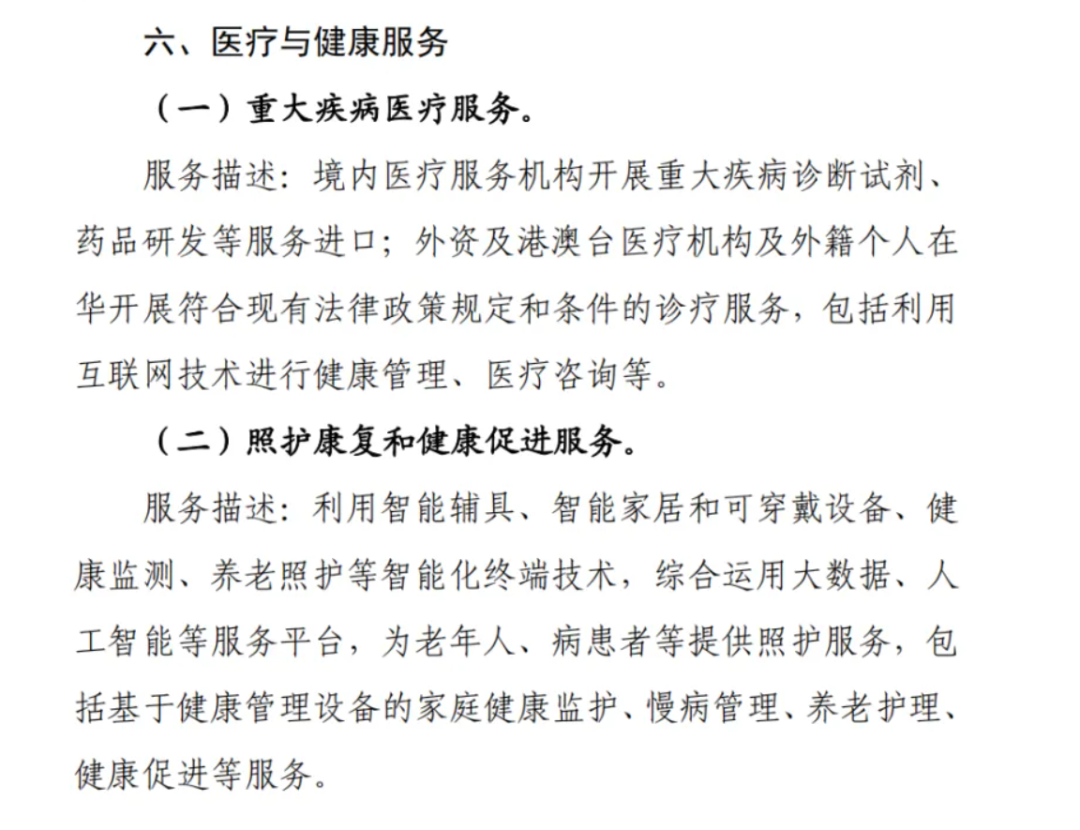
Core Insights - The Ministry of Commerce and six other departments jointly released a revised version of the "Encouragement of Import Services Directory" on February 25, highlighting new categories and signals for the service trade sector [1][5]. Group 1: New Categories - The most noticeable change is the addition of "Other Professional Services" and "Medical and Health Services" categories [1][5]. - "Medical and Health Services" includes "Major Disease Medical Services" and "Care Rehabilitation and Health Promotion Services" [2][6]. Group 2: Major Disease Medical Services - The directory describes Major Disease Medical Services as the import of diagnostic reagents and drug research and development services by domestic medical institutions; foreign and Hong Kong, Macau, and Taiwan medical institutions and foreign individuals can provide diagnostic services in China, including health management and medical consultation using internet technology [2][5]. Group 3: Care Rehabilitation and Health Promotion Services - Care Rehabilitation and Health Promotion Services involve the use of smart assistive devices, smart homes, wearable devices, health monitoring, and elderly care technologies, integrating big data and artificial intelligence to provide care services for the elderly and patients, including home health monitoring, chronic disease management, elderly care, and health promotion [2][6]. Group 4: Optimization of Existing Services - The directory also optimizes and adjusts certain encouraged import service contents, removing services that no longer require encouragement, with a focus on optimizing entries such as "Digital Technology Development Services," "Technical Testing and Analysis Services," and "Resource Utilization Services" [5][8]. - The revised directory is a significant policy document aimed at guiding and supporting innovation in service trade, representing China's proactive approach to expanding imports and achieving high-quality development [5][8].
新版《鼓励进口服务目录》公布 释放哪些信号?
Yang Shi Wang· 2026-02-26 09:09
Core Viewpoint - The Ministry of Commerce and six other departments have jointly released a revised version of the "Encouragement of Import Services Directory," which aims to support service trade innovation and promote high-quality development in China [6]. Group 1: New Additions - The revised directory introduces new categories such as "Other Professional Services" and "Medical and Health Services" [3]. - "Other Professional Services" includes green building (engineering) and other low-carbon related design, assessment, or certification services, as well as supply chain management services [3]. - "Medical and Health Services" encompasses major disease medical services and rehabilitation and health promotion services [3]. Group 2: Adjustments and Optimizations - Certain encouraged import service contents have been adjusted and optimized, with some services removed from encouragement due to improved domestic service capabilities [5]. - Specific entries such as "Digital Technology Development Services," "Technical Testing and Analysis Services," and "Resource Utilization Services" have been optimized [5]. - Services related to air pollution control that no longer require encouragement for import have been removed [5]. Group 3: Significance of the New Directory - The revised directory is a significant policy document aimed at guiding and supporting the innovation and development of service trade [6]. - It is an important measure for China to actively expand imports and achieve high-quality development [6]. - The directory is expected to promote the development of related industries, improve the quality of life for citizens, and facilitate high-level openness [6].
新版《鼓励进口服务目录》公布,新在何处、释放哪些信号
Sou Hu Cai Jing· 2026-02-26 05:50
Core Viewpoint - The revised "Encouragement of Import Services Directory" released by the Ministry of Commerce and six other departments introduces new categories and optimizes existing content to support service trade innovation and high-quality development in China [1][2]. Group 1: New Categories - The new categories added include "Other Professional Services" and "Medical and Health Services" [1]. - "Other Professional Services" encompasses "green building (engineering) and other low-carbon related design, assessment, or certification services" and "supply chain management services" [3]. - "Medical and Health Services" includes "major disease medical services" and "care rehabilitation and health promotion services" [3]. Group 2: Content Optimization - The directory has optimized certain encouraged import service contents, removing those that no longer require encouragement, such as services solely focused on air pollution control [1]. - Specific entries like "digital technology development services," "technical testing and analysis services," and "resource utilization services" have been adjusted [1]. Group 3: Policy Significance - The revised directory serves as an important policy document to guide and support the innovation and development of service trade, contributing to the expansion of imports and achieving high-quality development [1]. - It is significant for promoting the development of related industries, improving people's quality of life, and advancing high-level openness [1].
新版《鼓励进口服务目录》公布 新在何处、释放哪些信号
Sou Hu Cai Jing· 2026-02-26 04:40
Core Insights - The revised "Encouragement of Import Services Directory" introduces new categories such as "Other Professional Services" and "Medical and Health Services," signaling a shift towards low-carbon and health-related service imports [1][2] - The directory also optimizes existing service categories, removing those that no longer require encouragement for import, reflecting an improvement in domestic service capabilities [1] Group 1 - The new category "Other Professional Services" includes services related to green building and supply chain management [1] - The "Medical and Health Services" category now encompasses major disease medical services and health promotion services [1] - The directory has been revised since its initial release in 2016, with previous updates in 2019 and the latest in 2024 [1] Group 2 - The updated directory serves as a significant policy document aimed at guiding and supporting innovation in service trade [2] - It is a crucial measure for China to actively expand imports and achieve high-quality development [2] - The revisions are expected to promote industry development, enhance quality of life, and facilitate high-level openness [2]
构筑通道 开拓新局
Shan Xi Ri Bao· 2026-02-12 00:59
Core Viewpoint - The article emphasizes that Shaanxi is overcoming its limitations in openness to drive high-quality development and become a model for the western region of China [2][4][16]. Group 1: Policy Empowerment and Support - Shaanxi is actively implementing policies to support foreign trade enterprises, with the Chen Cang District providing nearly 2 million yuan in subsidies to help businesses expand internationally [3]. - The province has established a comprehensive support system that addresses key challenges faced by enterprises in logistics and customs, enhancing their ability to navigate international markets [3][4]. - The "Shan Yao Global" initiative has facilitated significant cooperation agreements, including a total of 160 million yuan in contracts with clients from Poland, Turkey, India, and Kazakhstan [3]. Group 2: Trade and Market Expansion - Shaanxi's foreign trade resilience has improved, with the province's import and export volume reaching 244.51 billion yuan in 2025, a year-on-year increase of 7.5%, surpassing the national growth rate of 4.6% [4]. - The province is shifting from simple product sales to brand and model exports, as seen with companies like Yalan Bedding, which has established a presence in the high-end hotel market in South Korea [4]. Group 3: Infrastructure and Logistics Development - The operation of the China-Europe Railway Express (Xi'an) has significantly enhanced Shaanxi's logistics capabilities, with a total of 6,037 trains operated in 2025, marking a 21.1% increase [9]. - The establishment of the China-Xi'an Kazakhstan terminal has reduced port transfer times from several days to just 3 hours, boosting the number of cross-Caspian trains [9][10]. - Shaanxi is developing a multi-modal transport network that integrates land and air logistics, facilitating smoother domestic and international circulation [10]. Group 4: Tourism and Cultural Exchange - In 2025, Shaanxi received 926,700 inbound tourists, a remarkable increase of 98.14%, highlighting the province's strong international appeal in tourism [12]. - The expansion of the "visa-free" policy has contributed to the rising popularity of Shaanxi as a travel destination [12]. Group 5: Innovation and Economic Growth - Shaanxi is focusing on building a multi-layered open platform system, including free trade zones and comprehensive bonded zones, to enhance its open economy [13][14]. - The province's free trade zones account for 70% of its total import and export trade, despite occupying less than 1/1700 of the land area [15]. - The provincial government aims to achieve greater breakthroughs in reform and high-level openness, positioning Shaanxi as a key player in the global economy [15][16].
“驰骋万里、通达世界”:高水平开放看金华金东
Xin Lang Cai Jing· 2026-02-11 16:40
Core Insights - During the "14th Five-Year Plan" period, Jindong District in Jinhua City, Zhejiang Province, has experienced significant reforms and openness, enhancing its global connectivity and hub capabilities [1] Infrastructure Development - The completion of Jin Yi Central Avenue and Jianjin Expressway, along with the operation of Jin Yi East Urban Rail Transit, has positioned the road network density among the highest in Zhejiang Province [1] - The establishment of the East China International Intermodal Port as a key international land port hub is progressing rapidly, with ongoing projects such as the expansion of the Jinhua Railway Hub and the Smart Logistics Park [1] Trade and Logistics - Jinhua (Yiwu) has been approved as one of the 14 national collection centers for China-Europe freight trains, integrating platforms to enhance collection and distribution efficiency [1] - The sea-rail intermodal service between Jinhua South and Beilun has achieved a daily operation, expanding the transport channels to the "sixth port area" [2] - Zhejiang's China-Europe freight trains have opened 26 routes, covering over 50 countries and 160 cities, with a 12% year-on-year increase in operational volume expected by 2025 [2] Economic Zones and Innovation - The Jinyi Comprehensive Bonded Zone has introduced innovative trade models and is expected to add over 3 billion yuan in import and export value and 500 million yuan in industrial output by the completion of its second phase in November 2025 [3] - The integration of the bonded zone with the East China International Intermodal Port allows for efficient logistics, with goods being transferred within 30 minutes post-customs clearance [3] Talent and Employment - The "Yiqi Lai" large-scale recruitment event successfully facilitated employment intentions for 3,200 individuals, with over 10,000 university students arriving annually, contributing to a net population inflow of over 140,000 [4] Strategic Focus - Jindong District is focusing on four major initiatives: strengthening channels, innovation, industry, and main axes, leveraging port development to enhance regional growth and openness [5]