祖冲之三号量子计算原型机

Search documents
安徽数字经济核心产业企业营收突破万亿元
Xin Lang Cai Jing· 2025-12-26 11:53
Core Insights - Anhui Province is accelerating its digital transformation as a pilot for the national data element comprehensive experimental zone, with the digital economy core industry revenue expected to exceed 1 trillion yuan for the first time during the 14th Five-Year Plan period, reaching an estimated 1.3 trillion yuan by 2025, with an average annual growth rate of 12% [1] Group 1 - The first domestic fifth-generation ultra-low power double-speed dynamic random-access memory has achieved mass production, and the "Zuchongzhi No. 3" quantum computing prototype leads globally [1] - Key core technology breakthroughs are being implemented, with the establishment of high-level research institutions such as data space and artificial intelligence research institutes to accelerate the output of digital technology innovation [1] - The digital core industry is focusing on extending, supplementing, and strengthening industrial chains, with over 2,200 enterprises gathered in strategic emerging industry clusters, including integrated circuits, new display devices, and artificial intelligence, expected to generate over 350 billion yuan in revenue by 2025, doubling from the end of the 13th Five-Year Plan [1] Group 2 - All industrial enterprises above designated size in Anhui have initiated digital transformation, while the province actively cultivates new models and formats such as live e-commerce and short video e-commerce, exploring new digital consumption scenarios [2] - The province's online retail sales are projected to grow from 300 billion yuan in 2021 to nearly 500 billion yuan by 2024, with an average annual growth rate of 16.9% [2] - The agricultural production informationization rate in Anhui has reached over 52%, ranking among the top in the country [2]
“合肥科技”闪耀2025十大科技新闻榜单
Xin Lang Cai Jing· 2025-12-25 17:23
Core Insights - Hefei has emerged as a focal city in the technology sector due to breakthroughs in nuclear fusion and quantum computing, as highlighted by the Central Radio and Television General Station's announcement of the "Top Ten Science and Technology News of 2025" [1][2] - The achievements include the "artificial sun" nuclear fusion device setting a record of "hundred million degrees for a thousand seconds" and the "Zuchongzhi No. 3" quantum computing prototype achieving a new world record [1][2] - China's initiation of an international scientific program in the field of fusion energy underscores its leading position in global technological competition [1] Nuclear Fusion Developments - The world's first fully superconducting Tokamak EAST device achieved significant results on January 20, successfully maintaining a high-confinement mode plasma operation at over a hundred million degrees for 1066 seconds, setting a new world record [1] - This achievement marks a critical turning point in fusion research, transitioning from basic scientific research to engineering practice, and significantly advances the development of fusion energy [1] Quantum Computing Advancements - On March 3, the University of Science and Technology of China announced the successful construction of the 105-qubit superconducting quantum computing prototype "Zuchongzhi No. 3," which solved the "quantum random circuit sampling" task at a speed one trillion times faster than the current fastest supercomputer [2] - This breakthrough reinforces the superiority of superconducting quantum computing systems [2] International Collaboration in Fusion Research - On November 24, the International Scientific Program for Burning Plasma initiated by the Chinese Academy of Sciences was launched, introducing the compact fusion energy experimental device BEST research plan [2] - Scientists from over ten countries, including France, the UK, Germany, and Italy, signed the "Hefei Fusion Declaration," advocating for enhanced international cooperation and a spirit of open sharing in fusion research [2]
【央视网】中央广播电视总台发布2025年度国内、国际十大科技新闻
Yang Shi Wang· 2025-12-24 10:19
Group 1: Artificial Intelligence Developments - The State Council issued opinions on the implementation of the "Artificial Intelligence+" initiative, focusing on six key areas including scientific technology and industrial development, while promoting the construction of eight foundational support systems such as models, data, and computing power [3] - China's DeepSeek AI model has gained global attention for its low-cost and open-source characteristics, marking a significant breakthrough in the field of AI foundational models [8][9] Group 2: Space Exploration and Technology - The successful launch of the Tianwen-2 probe marks China's first mission to explore and sample an asteroid, aimed at deepening the understanding of the solar system's origins [4] - The Shenzhou-22 spacecraft achieved a historic milestone with its fully automated operation during an emergency launch, demonstrating advanced capabilities in space launch and control technology [13] Group 3: Energy and Quantum Computing - China's "artificial sun" EAST device achieved a record temperature of 100 million degrees Celsius for 1000 seconds, advancing the pursuit of controlled nuclear fusion [6] - The "Zuchongzhi-3" quantum computing prototype demonstrated processing speeds that are 10 trillion times faster than the fastest supercomputers, showcasing the immense potential of quantum computing in solving complex problems [11] Group 4: Renewable Energy Leadership - In 2025, China produced approximately 80% of the world's solar batteries, 70% of wind turbines, and 70% of lithium batteries, solidifying its position as a key player in the renewable energy sector [20][21] Group 5: Robotics and AI in Healthcare - The humanoid robotics sector in China has gained global attention with multiple competitions showcasing advancements in hardware, algorithms, and data [17] - An international team developed a microelectronic chip that provides "form vision" to blind patients, successfully restoring sight to individuals suffering from late-stage age-related macular degeneration [25]


乘风四海“皖”象俱新
Zhong Guo Zheng Quan Bao· 2025-12-05 20:23
Group 1: Innovation as a Driving Force - Anhui's focus on innovation is highlighted as a key principle for its development during the "15th Five-Year Plan" period, emphasizing that innovation remains a top priority for the province [2][3] - The province has established itself as a significant "source of innovation" in the national landscape, with major advancements in original innovations and a shift from factor-driven to innovation-driven industrial development [1][3] Group 2: Technological Breakthroughs and Achievements - Notable technological achievements include the "Zuchongzhi No. 3" quantum computing prototype, the EAST nuclear fusion experiment achieving a world record, and the successful flight of the "Tiandu" dual satellites [3][11] - The establishment of major scientific facilities like EAST and BEST is crucial for advancing clean energy and positioning Anhui as a leader in scientific research [2][3] Group 3: Mechanisms for Technology Transfer - Anhui is addressing the challenge of technology transfer through innovative mechanisms, such as the "empowerment + transfer + agreed revenue" model, which allows research teams to gain full intellectual property rights and share profits with universities [4][5] - The "Keda Silicon Valley" initiative has successfully fostered over 2,500 tech companies, demonstrating the effectiveness of government-led innovation platforms [3][4] Group 4: Financial Support for Innovation - Financial resources are integrated with industrial policies and scientific resources to create a "technology-industry-finance" ecosystem, essential for supporting innovation and commercialization [5][6] - The establishment of a multi-tiered "fund jungle" in Anhui, including a 300 billion yuan guiding fund, has provided significant financial backing for over 200 innovative projects [6][7] Group 5: Industrial Growth and Strategic Positioning - Anhui's automotive industry has seen substantial growth, with production reaching 86.8 million vehicles in 2023, positioning the province as a national leader in the sector [10][11] - The province aims to build a modern industrial system by focusing on strategic emerging industries, including new energy vehicles, artificial intelligence, and quantum technology [10][12] Group 6: Regional Coordination and Development - Anhui is actively promoting regional coordination, particularly in the northern regions, to ensure balanced development and resource allocation [16][17] - The province's strategy includes leveraging its industrial strengths and fostering collaboration with neighboring regions to enhance its economic landscape [15][17]
长城基金赵凤飞:量子科技未来怎么看?
Xin Lang Ji Jin· 2025-11-19 08:06
Core Insights - Quantum technology is transitioning from laboratory research to commercial applications, with significant advancements made by global tech giants and Chinese prototypes like "Zu Chongzhi" and "Jiu Zhang" [1] - The Chinese government has identified quantum technology as a key future industry in its 14th Five-Year Plan, aiming to foster its development as a new economic growth point [1] Industry Development - The quantum technology market in China is projected to reach $9.758 billion by 2029, with a compound annual growth rate (CAGR) of 37.45% from 2024 to 2029 [3] - The industry is currently in a critical transition phase, moving from "0 to 1" to "1 to N," indicating a mix of differentiation and localized breakthroughs [3] Bottlenecks in Industrialization - The main bottlenecks for quantum technology industrialization are technological maturity and supply chain support, particularly in quantum bit stability and error correction efficiency [5] - Key breakthroughs are needed in core technologies like quantum bit stability and the domestic production of essential equipment to ensure the technology's successful application [5] Commercialization Prospects - Quantum communication is expected to be the first area to achieve large-scale commercialization in China, supported by early investments and infrastructure development by major telecom operators [6] - Quantum computing is anticipated to have significant potential in sectors such as biomedicine, new materials development, and logistics optimization, where classical computers struggle with large-scale optimization problems [6] Supply Chain and Domestic Production - There is a strong demand for domestic alternatives for upstream core components and critical equipment, driven by cost reduction and the need for technological independence from Western suppliers [7] Market Sentiment and Investment Evaluation - The recent surge in quantum technology stocks is attributed to technological advancements and policy support, although it is primarily driven by short-term trading sentiment [8] - For evaluating the investment value of quantum technology companies that are still in the R&D phase, the price-to-sales (PS) ratio can be a useful metric, alongside assessments of the company's research team, product positioning, and regional policy support [9]
研发投入超千亿省份10年增加8个,安徽跻身研发强度前七
Di Yi Cai Jing Zi Xun· 2025-10-09 11:53
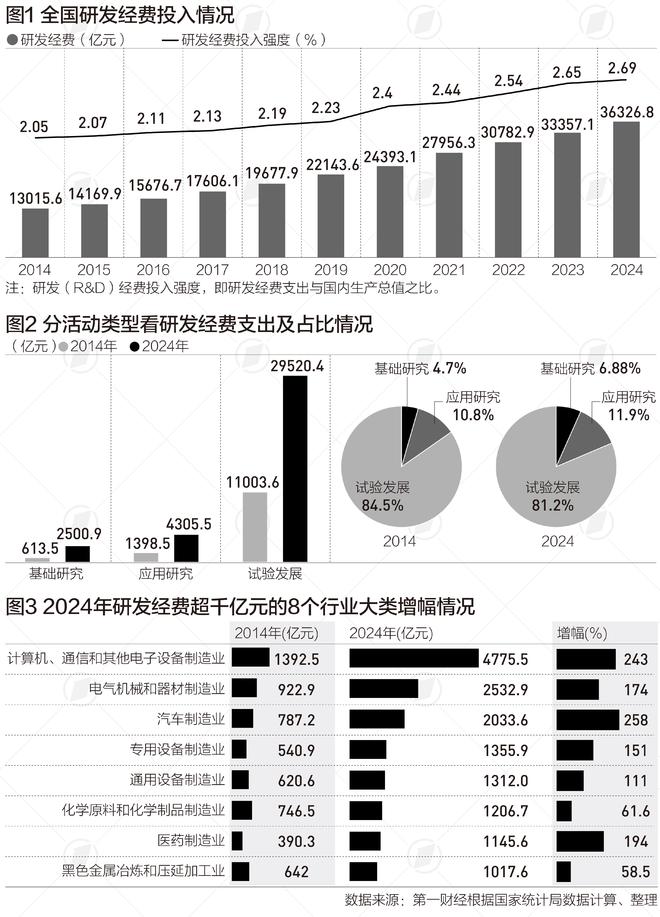
Core Insights - China's total R&D expenditure has surpassed 3.6 trillion yuan, with the number of provinces investing over 100 billion yuan in R&D increasing from 4 in 2014 to 12 in 2024 [1] - The national R&D investment intensity has risen from 2.05% to 2.69% over the past decade, with basic research expenditure's share increasing by 2 percentage points and an average annual growth rate exceeding 10% [1][2] - In 2024, China's R&D expenditures are projected to reach 36,326.8 billion yuan, ranking second globally, only behind the United States [2] R&D Expenditure Breakdown - In 2024, the expenditures for basic research, applied research, and experimental development are expected to be 250.9 billion yuan, 430.55 billion yuan, and 29,520.4 billion yuan, respectively, reflecting growth rates of 10.7%, 17.6%, and 7.6% compared to the previous year [1][2] - Basic research funding is growing faster than overall R&D funding, indicating a strong focus on foundational scientific inquiries [2] Regional Analysis - R&D expenditures in China's eastern, central, western, and northeastern regions for 2024 are projected to be 23,773.0 billion yuan, 6,582.1 billion yuan, 4,759.8 billion yuan, and 1,211.9 billion yuan, respectively, with growth rates of 9.0%, 8.4%, 9.2%, and 8.6% [3] - The western region shows the fastest growth rate in R&D expenditure [3] Sectoral Insights - The manufacturing sectors with the highest R&D expenditure growth from 2014 to 2024 include computer, communication, and other electronic equipment manufacturing (243% increase), automotive manufacturing (258% increase), and electrical machinery and equipment manufacturing (174% increase) [7] - Provinces such as Anhui, Hubei, Sichuan-Chongqing, and Shaanxi have seen R&D expenditure growth rates exceeding the national average [8] Policy and Future Directions - The government aims to enhance basic research coordination and improve original innovation capabilities as part of the upcoming "14th Five-Year" plan [2] - The focus will be on expanding R&D funding channels and strengthening support systems for technology finance, venture capital, and fiscal policies [9]
数说“十四五”发展成绩单 102项重大工程取得重大进展
Nan Fang Du Shi Bao· 2025-10-05 12:15
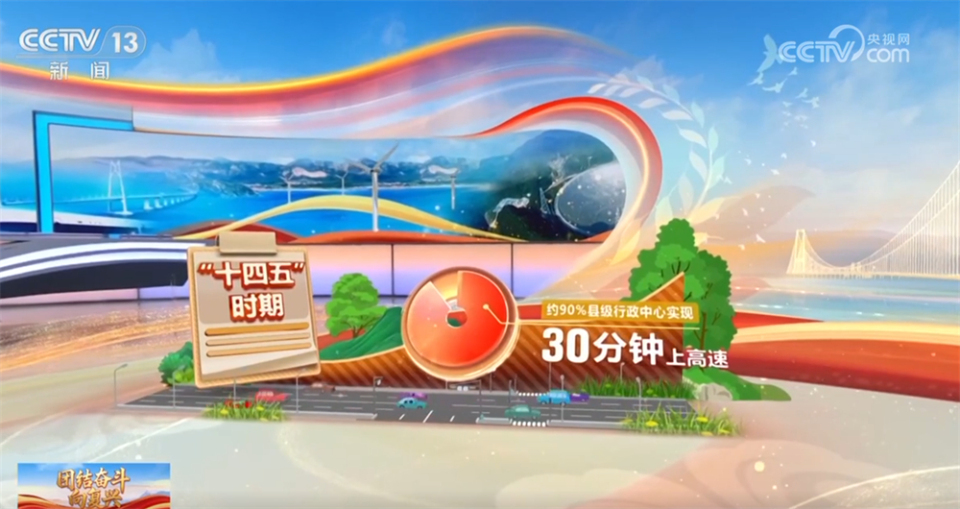
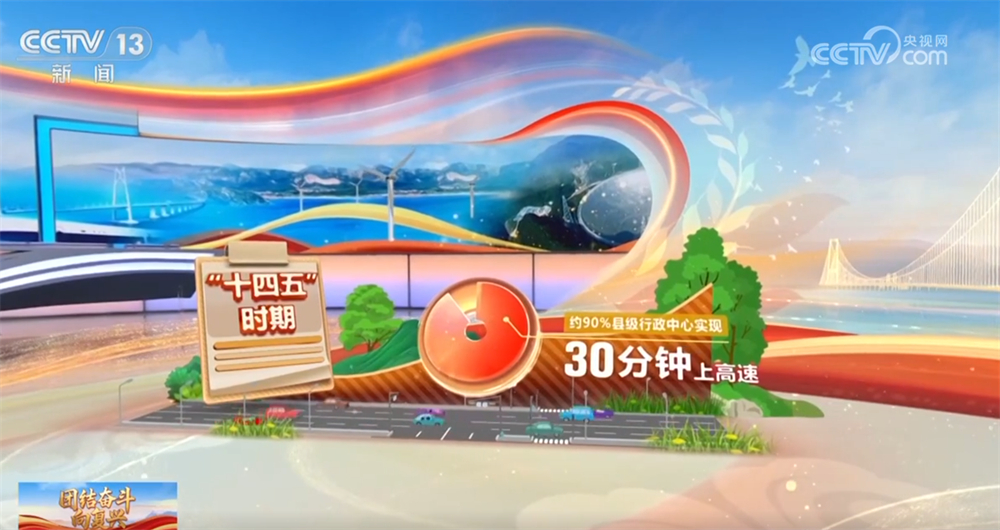
Core Insights - The "14th Five-Year Plan" is nearing completion, with 102 major projects making significant progress and expected to meet all planning goals by the end of the year [1] Infrastructure Development - Major transportation infrastructure projects such as the China-Laos Railway and the Guiyang-Nanning High-Speed Railway have been completed and are operational, while the Sichuan-Tibet Railway and the Pinglu Canal are under steady construction [3] - Approximately 90% of county-level administrative centers have access to highways within 30 minutes, and cities with populations over 500,000 have a high-speed rail coverage rate of 97% [3] Technological Advancements - Significant breakthroughs in cutting-edge technology have been achieved, including the successful landing of the "Zhurong" Mars rover, the return of lunar soil by the "Chang'e 5" mission, and the global leadership of the "Zuchongzhi 3" quantum computing prototype [5] - The "East Super Ring" nuclear fusion experimental device has achieved a world record of 1 million degrees Celsius and maintained stable plasma operation for 1,066 seconds [5] Ecological Construction - The ecological construction efforts have created new miracles for a beautiful China, with the "Three-North" project completing construction tasks covering 16.4 million acres [7] - Significant progress has been made in combating desertification, including the establishment of a green barrier along the edge of the Taklamakan Desert, spanning over 3,000 kilometers [7]
数说“十四五”发展成绩单 102项重大工程取得重大进展、重大成效
Yang Shi Wang· 2025-10-05 08:29
Core Points - The "14th Five-Year Plan" is nearing completion, with 102 major projects making significant progress and expected to meet all planning goals by the end of the year [1] Group 1: Infrastructure Development - Major transportation infrastructure projects such as the China-Laos Railway and the Guiyang-Nanning High-Speed Railway have been completed and are operational [3] - Approximately 90% of county-level administrative centers have access to highways within 30 minutes, and cities with populations over 500,000 have a high-speed rail coverage rate of 97% [3] Group 2: Technological Advancements - Significant breakthroughs in cutting-edge technology have been achieved, including the successful landing of the "Zhurong" Mars rover, the return of lunar soil by "Chang'e 5," and the global leadership of the "Zuchongzhi 3" quantum computing prototype [5] - The "East Super Ring" nuclear fusion experimental device has achieved a world record of 100 million degrees Celsius and maintained plasma operation for 1,066 seconds [5] Group 3: Ecological Construction - The ecological construction efforts have led to remarkable achievements in creating a beautiful China, with the "Three-North" project completing 164 million acres of construction tasks [7] - Effective measures have been taken to combat desertification, including the establishment of a green barrier along the edge of the Taklamakan Desert, spanning over 3,000 kilometers [7]
安徽“十四五”经济总量连跨两个万亿台阶
Zhong Guo Xin Wen Wang· 2025-09-28 10:01
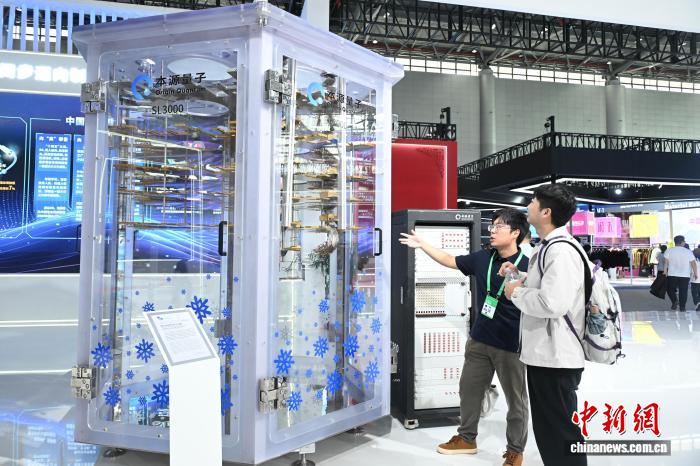
Core Insights - Anhui Province's GDP is projected to increase from 3.87 trillion yuan at the end of the 13th Five-Year Plan to 5.06 trillion yuan by 2024, marking a significant leap across two trillion yuan thresholds during the 14th Five-Year Plan [1][3] - The province's innovation capabilities and industrial performance rank among the top 10 nationally, and first in Central China, indicating a strong competitive position [1] Economic Growth - The expected GDP increment of 1.4 trillion yuan over five years highlights robust economic growth [1] - The province's major emerging industry bases are projected to increase in output value from 750 billion yuan at the end of the 13th Five-Year Plan to 1.35 trillion yuan by 2024 [3] Industrial Development - Anhui's automotive industry has achieved historic breakthroughs, with production rankings rising from 8th to 1st nationally for both total vehicles and new energy vehicles during the 14th Five-Year Plan [3] - The province has established over 5,000 foreign-funded enterprises from more than 110 countries and regions, with an annual investment growth rate of 27.7% from countries involved in the Belt and Road Initiative [3] Technological Advancements - Significant advancements in quantum computing and other high-tech sectors have positioned Anhui as a leader, with notable projects like the "Zuchongzhi No. 3" quantum computing prototype and the "Benyuan Wukong" quantum computing service [3] - The province's four major strategic emerging industry clusters, including integrated circuits and artificial intelligence, rank third in China for excellence [3]
郑栅洁:加快稳就业、稳企业、稳市场、稳预期,常态化开展政策预研储备|宏观经济
清华金融评论· 2025-09-21 11:02
Core Viewpoint - The report emphasizes the need for a stable yet progressive approach to economic work in the second half of the year, focusing on maintaining employment, supporting enterprises, and stabilizing market expectations while promoting domestic and international economic circulation [2][3][13]. Economic Performance - In the first half of the year, China's GDP grew by 5.3% year-on-year, an increase of 0.3 percentage points compared to the previous year. Urban employment increased by 8.2 million, achieving 68% of the annual target, with an average urban unemployment rate of 5.2% [6][11]. - The total value of goods imports and exports in RMB increased by 3.5%, with exports rising by 7.3%. Foreign exchange reserves remained stable at over $3.2 trillion [6][11]. Policy Implementation - The government is committed to implementing proactive fiscal policies and moderately loose monetary policies to enhance policy effectiveness. Key areas of spending, such as social security and education, saw increases of 9.8% and 5.7%, respectively, in the first seven months [7][10]. - The report highlights the importance of evaluating policy implementation and optimizing measures based on assessment results to enhance policy effectiveness [3][14]. Domestic Demand and Consumption - The report outlines efforts to boost domestic demand, including the introduction of consumption stimulus measures and the promotion of effective investment. By the end of July, over 670,000 vehicles were replaced under the old-for-new policy [7][10]. - Infrastructure investment and manufacturing investment grew by 3.2% and 6.2%, respectively, in the first seven months [7][10]. Industrial Development - The report notes significant advancements in technology and industrial innovation, with high-tech manufacturing output increasing by 9.5% in the first seven months. The production of industrial robots surged by 32.9%, and the production and sales of new energy vehicles approached a 40% increase [8][10]. Reform and Opening Up - The government is focused on deepening reforms and expanding high-level opening up, with the establishment of a unified national market framework and the implementation of the Private Economy Promotion Law [8][10]. - The report mentions that the number of countries with visa-free access has increased to 46, and the number of countries with mutual visa exemptions has reached 29 [8][10]. Regional and Urban-Rural Development - The report emphasizes the importance of regional coordination and urban-rural integration, with significant economic growth in provinces like Jiangsu, Shandong, and Zhejiang, which saw GDP growth rates of 5.7%, 5.6%, and 5.8%, respectively [9][10]. - Efforts to consolidate poverty alleviation achievements and promote rural revitalization are ongoing, with a focus on improving living conditions and infrastructure in rural areas [9][10]. Social Welfare and Safety - The report highlights measures to improve social welfare, including employment support and public service enhancements. The unemployment rate for migrant agricultural workers was reported at 4.9% in July [10][11]. - Safety measures in food production and energy supply are being strengthened to ensure stability and security in these critical areas [10][11].