学习设备

Search documents
横盘震荡9个月再遇高管“组团减持”,好未来(TAL.US)好业绩却没有好股价?
智通财经网· 2026-02-03 11:57
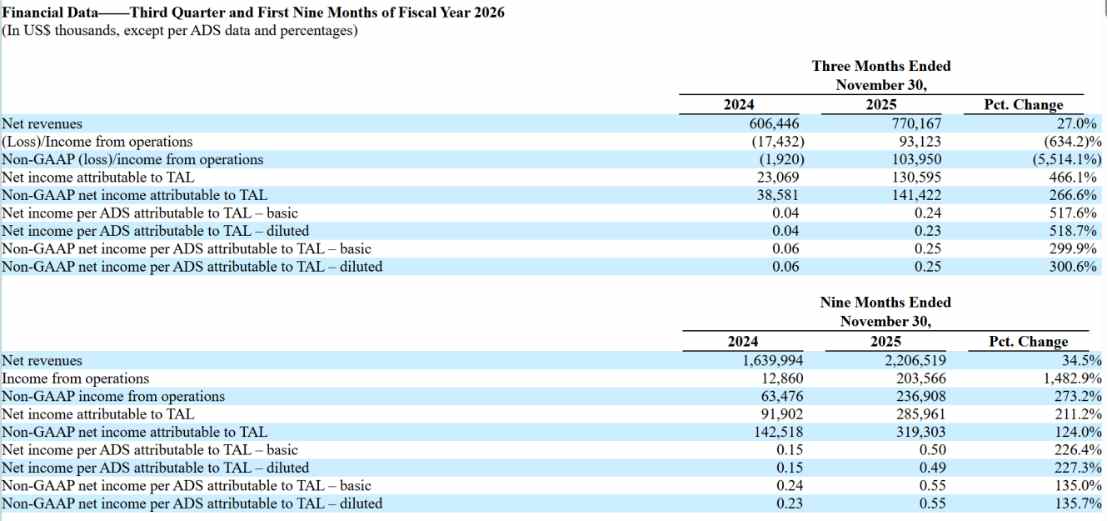
Core Viewpoint - TAL Education Group (好未来) reported strong financial results for the quarter ending November 30, 2023, with significant growth in revenue and profitability, leading to a notable increase in stock price, although subsequent executive sell-offs raised concerns about future performance [1][2][5]. Financial Performance - The company achieved net revenue of $770.17 million for the quarter, a year-over-year increase of 27% [4]. - Non-GAAP net income reached $141.42 million, reflecting a substantial growth of 266.6% compared to the previous year [2][4]. - Cumulative net revenue for the first three quarters of fiscal year 2026 was $2.21 billion, up 34.5% year-over-year [4]. Profitability Improvement - Operating profit for the quarter was $93.12 million, marking a significant turnaround from a loss in the previous year [4]. - The gross margin improved to 56.1%, an increase of 3.3 percentage points year-over-year, while the Non-GAAP net profit margin reached 18.4%, up 12 percentage points [4]. Revenue Drivers - The growth in revenue was driven by the learning services segment, which includes both offline small classes and online courses, with deferred revenue increasing by 73.2% to $1.16 billion [2][4]. - The company's core business solutions segment saw its revenue contribution rise from 16.3% in fiscal year 2023 to over 30% [2]. Cost Management - The company reduced its sales expense ratio to 28.6%, down 8.8 percentage points year-over-year, due to decreased marketing expenses [4]. - Management expenses also decreased by 30.2% to $108 million, contributing to overall profitability [4]. Stock Performance and Executive Actions - Following the positive earnings report, the stock price surged by 18.03% on January 29, 2024, reaching $12.70, marking the third time it surpassed the $12 threshold in three months [1][5]. - However, the stock experienced a decline shortly after, attributed to executive sell-offs, with several executives reducing their holdings significantly [5][8]. - The trading volume increased to 15.09 million shares on the day of the earnings report, indicating heightened market interest [6].


好未来:2026财年第三季度净利润增长466%
Sou Hu Cai Jing· 2026-01-30 13:44
Core Insights - TAL Education Group reported a net revenue of $770 million for the third quarter of fiscal year 2026, representing a year-over-year growth of 27% [1] - The net profit attributable to TAL was $130.5 million, showing a significant increase of 466.1% year-over-year [1] Group 1: Business Performance - The learning devices segment experienced growth in both revenue and sales, with a strong market share during the "Double Eleven" promotional period [1] - User engagement metrics are robust, with a weekly active rate of approximately 80% and an average daily usage time of about 1 hour [1] - The average transaction value for learning devices is below 4,000 yuan, although this segment is still operating at a loss [1] Group 2: AI Integration - The AI assistant "Xiao Si" achieved over 1 billion activations by December 2025, providing hundreds of thousands of hours of guided learning [1] Group 3: Learning Services - Revenue from learning services, including offline small classes and online offerings, saw year-over-year growth [1] - The offline small class revenue increased due to a rise in enrollment numbers, supported by stable average transaction values and strong demand for high-quality courses [1] - Online literacy course revenue also grew, driven by sustained market demand for quality online education [1] Group 4: Financial Outlook - Despite the significant profit growth, the company cautioned against using the current profit margin as a benchmark for future periods, attributing improvements to fluctuations in sales and marketing expenses [2] - The company anticipates that the year-over-year growth rate for the second half of fiscal year 2026 will be lower than that of the first half [2] - For the first three quarters of fiscal year 2026, TAL's net revenue reached $2.207 billion, a 34.5% increase year-over-year, with a net profit of $285.9 million, up 211.2% [2] - As of November 30, 2025, TAL had a total balance of cash, cash equivalents, and short-term investments amounting to $3.617 billion [2]
好未来(TAL):FY26Q3业绩点评:收入增长稳健,控费带动利润超预期
EBSCN· 2026-01-30 11:41
Investment Rating - The report maintains a "Buy" rating for the company, indicating a projected investment return exceeding the market benchmark by more than 15% over the next 6-12 months [6]. Core Insights - The company reported a revenue of $770.2 million for FY26Q3, representing a year-on-year growth of 27.0%. The net profit attributable to shareholders reached $130.6 million, a significant increase of 466.1% year-on-year. The Non-GAAP net profit was $141.4 million, up 266.6% year-on-year [1]. - The learning services and other segments showed robust growth, with offline small class revenues increasing due to higher enrollment numbers and stable pricing. The online quality courses also saw growth driven by technological innovations and enhanced user experience [1][2]. - Cost control measures led to a notable improvement in profit margins, with the Non-GAAP net profit margin reaching 18.4%, an increase of 12.0 percentage points year-on-year [3]. Financial Projections - The company has revised its net profit forecasts for FY2026 to FY2028 upwards to $369 million, $482 million, and $606 million respectively, with corresponding PE ratios of 21x, 16x, and 13x [4]. - Revenue projections for FY2024 to FY2028 are set at $1.49 billion, $2.25 billion, $2.975 billion, $3.764 billion, and $4.606 billion, with growth rates of 46.2%, 51.0%, 32.2%, 26.5%, and 22.4% respectively [5][10].
TAL(TAL) - 2026 Q3 - Earnings Call Transcript
2026-01-29 13:00
Financial Data and Key Metrics Changes - The company's net revenues for Q3 FY 2026 were $770.2 million, representing a year-over-year increase of 27.0% in USD and 26.8% in RMB terms [10][15] - Non-GAAP income from operations was $104.0 million, compared to a non-GAAP loss from operations of $1.9 million in the same period last year [18] - Gross profit increased by 35.0% year-over-year to $431.8 million, with gross margin rising to 56.1% from 52.7% [16][18] Business Line Data and Key Metrics Changes - Peiyou Small Class Enrichment Programs showed stable operations with year-over-year growth driven by increased enrollment [11] - Online enrichment learning programs maintained year-over-year growth, leveraging technology-driven innovations to enhance user engagement [12] - The learning device business reported year-over-year growth in both revenue and sales volume, with an average weekly active rate of approximately 80% [13][14] Market Data and Key Metrics Changes - The learning device market is evolving with advancements in hardware, software, and AI technologies, leading to a highly competitive environment [7][8] - The company is focusing on enhancing its devices with AI-enabled capabilities to improve user learning experiences [8][9] Company Strategy and Development Direction - The company aims to integrate technology with its industry expertise to enhance product design and service delivery [20] - A focus on long-term sustainable development is emphasized, with a commitment to building capabilities across core business lines [22] - The company is exploring new product formats and enhancing AI functions to support personalized learning experiences [9][21] Management's Comments on Operating Environment and Future Outlook - Management acknowledges potential variability in financial performance due to seasonal demand shifts and competitive pressures [5] - The company remains focused on long-term capabilities despite short-term fluctuations in financial performance [5][22] - There is an expectation of moderated revenue growth in the second half of FY 2026 due to a higher comparison base [30] Other Important Information - The company has authorized a new share repurchase program, allowing for up to $600 million in common share purchases over the next 12 months [19] - As of November 30, 2025, the company had $2,146.3 million in cash and cash equivalents [19] Q&A Session Summary Question: Update on Learning Center network expansion and Peiyou revenue drivers - Management indicated that Peiyou offline enrichment programs delivered year-over-year revenue growth aligned with Learning Center network expansion, driven by increased enrollments [24][25] Question: Reasons for top-line growth slowdown and revenue outlook for learning devices - The moderation in growth was attributed to a deceleration in the learning device business and timing of product launches affecting sales patterns [28][30] Question: Q3 sales performance of learning devices and competitive landscape - Year-over-year volume growth was noted, with the learning device business still in an investment phase, reporting an adjusted operating loss [32][33] Question: Drivers of operating margin performance and outlook - The improvement in operating margin was driven by lower selling and marketing expenses and disciplined cost management across business lines [37][39]
好未来Q2净利翻倍:8.61亿美元营收背后,素质教育+智能学习迎政策红利
Zhong Guo Jing Ying Bao· 2025-11-03 09:30
Core Viewpoint - The report highlights significant revenue and profit growth for TAL Education Group in Q2 of FY2026, driven by advancements in smart education solutions and favorable national policies supporting the education technology sector [1][2]. Financial Performance - In Q2 of FY2026, the company achieved a net revenue of $861 million, a 39.1% increase from $619 million in the same period last year [1]. - Operating profit reached $96.1 million, up approximately 101.8% from $47.6 million year-over-year [1]. - Net profit attributable to TAL was $124 million, representing a 116.1% increase compared to $57.4 million in the previous year [1]. - Non-GAAP net profit, excluding stock-based compensation, was $136 million, reflecting an 82.7% year-over-year growth [1]. - Basic and diluted net profit per ADS were $0.22 and $0.21, respectively, both significantly higher than the previous year's figures [1]. Half-Year Performance - For the first half of the fiscal year, net revenue totaled $1.436 billion, a year-over-year increase of approximately 39.0% [2]. - Operating profit for the half-year was $110 million, showing a substantial growth of about 264.6% [2]. - Net profit attributable to shareholders was $155 million, up 125.7% from the previous year [2]. - Non-GAAP net profit for the half-year was $178 million, a 71.1% increase year-over-year [2]. - Cash and cash equivalents, along with short-term investments, amounted to $3.249 billion, providing a solid financial foundation for ongoing investments in R&D and content development [2]. Industry Background and Policy Drivers - The education sector is transitioning from traditional exam-oriented education to a focus on "capability cultivation, quality education, and technology empowerment" [3]. - National policies explicitly support this transition, emphasizing the need for quality education to foster innovation and practical skills among students [3]. - The "double reduction" policy has led to stricter regulations on extracurricular academic training, pushing the industry towards quality education and smart learning solutions [3]. Market Size and Growth - The Chinese digital education market is projected to reach approximately 468.5 billion yuan in 2024, with a year-over-year growth of about 13.35% [4]. - The user base in the education sector is expected to grow to 355 million by 2024, reflecting an 11.14% increase [4]. - The smart education hardware market is anticipated to reach around 96.2 billion yuan in 2024, with a growth rate of approximately 19.21% [4]. - The "AI + education" sector is expected to grow significantly, with market size projected to reach about 160 billion yuan by 2027 and nearly 180 billion yuan by 2030 [4]. Strategic Opportunities - The favorable policies and market data present two key opportunities for TAL: alignment with the quality education direction and the potential for growth in smart learning hardware and AI-driven educational solutions [5]. - The company's strategy of integrating "content, hardware, and intelligent systems" aligns well with industry trends, positioning it for future growth [5].
好未来发布2026财年第二季度财报 净收入8.61亿美元
Zhong Guo Jing Ji Wang· 2025-10-31 07:08
Core Viewpoint - The company, TAL Education Group, reported significant growth in its financial performance for the second quarter of fiscal year 2026, indicating a strong recovery and positive momentum in its core business segments. Financial Performance Summary - For the second quarter of fiscal year 2026, net revenue reached $861.35 million, up from $619.36 million in the same period last year, representing a 39.1% increase [2][7]. - Operating profit for the same quarter was $96.10 million, compared to $47.62 million in the previous year, marking a 101.8% increase [2][7]. - Non-GAAP operating profit (excluding stock-based compensation) was $107.85 million, up from $64.52 million, reflecting a 67.2% increase [2][7]. - The net profit attributable to TAL was $124.08 million, significantly higher than $57.43 million in the prior year, showing a 116.1% increase [3][7]. - Non-GAAP net profit attributable to TAL was $135.84 million, compared to $74.33 million, an increase of 82.7% [3][7]. Half-Year Performance Summary - For the six months ending August 31, 2025, net revenue totaled $1.44 billion, up from $1.03 billion year-over-year, a growth of 39.0% [4][9]. - Operating profit for the half-year was $110.44 million, a substantial increase from $30.29 million, representing a 264.6% rise [5][9]. - Non-GAAP operating profit for the half-year was $132.96 million, compared to $65.40 million, reflecting a 103.3% increase [5][9]. - The net profit attributable to TAL for the half-year was $155.37 million, up from $68.83 million, a 125.7% increase [6][9]. - Non-GAAP net profit attributable to TAL for the half-year was $177.88 million, compared to $103.94 million, an increase of 71.1% [6][9]. Earnings Per ADS - Basic and diluted net profit per ADS for the second quarter were $0.22 and $0.21, respectively, compared to $0.09 in the previous year, marking increases of 129.6% and 130.0% [3][7]. - Non-GAAP basic and diluted net profit per ADS were both $0.24, up from $0.12, reflecting increases of 94.2% and 94.6% [8]. Strategic Focus - The company's President and CFO, Peng Zhuangzhuang, emphasized progress in core business areas, with revenue growth in quality courses and learning devices, supported by ongoing investments in user experience, technology, and educational innovation [9]. - The company aims to prioritize resources in core areas critical for long-term development, focusing on providing innovative learning solutions and quality educational content to a broader audience [9].
好未来2026财年第二季度净收入8.61亿美元
Zhong Guo Jing Ji Wang· 2025-10-30 11:51
Core Viewpoint - TAL Education Group, a provider of intelligent learning solutions in China, reported its unaudited financial results for the second quarter of fiscal year 2026, ending August 31, 2025, showing significant growth in revenue and profits [1]. Financial Performance Summary - For the second quarter of fiscal year 2026, net revenue reached $861.35 million, a 39.1% increase from $619.36 million in the same period last year [4]. - Operating profit for the same quarter was $96.10 million, up from $47.62 million year-over-year [4]. - Non-GAAP operating profit, excluding stock-based compensation, was $108 million, compared to $64.52 million in the previous year [4]. - Net profit attributable to TAL was $124.08 million, a substantial increase from $57.43 million year-over-year [5]. - Non-GAAP net profit attributable to TAL, excluding stock-based compensation, was $135.84 million, compared to $74.33 million in the same period last year [5]. Half-Year Performance Summary - For the six months ending August 31, 2025, net revenue totaled $1.44 billion, a 39.0% increase from $1.03 billion in the same period last year [6]. - Operating profit for the half-year was $110.44 million, a significant rise from $30.29 million year-over-year [6]. - Non-GAAP operating profit for the half-year was $132.96 million, compared to $65.40 million in the previous year [6]. - Net profit attributable to TAL for the half-year was $155.37 million, up from $68.83 million year-over-year [6]. - Non-GAAP net profit attributable to TAL for the half-year was $177.88 million, compared to $103.94 million in the same period last year [6]. Management Commentary - The President and CFO of TAL stated that the core business made progress, with revenue from quality courses and learning devices showing both sequential and year-over-year growth [7]. - The company emphasized its commitment to investing in user experience, technology, and educational model innovation to support business development [7]. - From a strategic perspective, TAL plans to prioritize resources in core areas important for long-term development, aiming to provide innovative learning solutions and quality educational content to a broader audience [7].
好未来2026财年二季度净利润同比增长116.1%
Bei Jing Shang Bao· 2025-10-30 10:49
Core Insights - The company reported a net revenue of $861 million for the second quarter of fiscal year 2026, representing a year-over-year growth of 39.1% [1] - Operating profit reached $96.1 million, showing a significant increase of 101.8% year-over-year [1] - Net profit attributable to the company was $124 million, which is a year-over-year growth of 116.1% [1] Business Performance - The core business of the company made progress during the quarter, with revenue from quality courses and learning equipment both experiencing sequential and year-over-year growth [1] - Continuous investment in user experience, technology, and educational model innovation has been a key driver for business development [1]
教育巨头生存样本:2025上半场分化加剧,AI重构行业分水岭
3 6 Ke· 2025-07-23 00:54
Financial Performance Divergence - New Oriental's total revenue for the latest quarter was $1.18 billion, a slight decrease of 2% year-on-year, but core education business revenue reached $1.04 billion, up 21.2% [2] - TAL Education reported a revenue of $610 million, a year-on-year increase of 42.1%, but its operating loss expanded to $16 million [3] - Duolingo's total revenue was $230.7 million, a year-on-year increase of 38%, with a net profit of $35.1 million, up 30% [4] - Gaotu's quarterly revenue was approximately $207 million, a year-on-year increase of 57.7%, with a net profit of $12.4 million [5] - NetEase Youdao's revenue was $1.3 billion, a year-on-year decrease of 7%, but operating profit surged by 247.7% to $104 million [5] Strategic Adjustments and Innovations - New Oriental's strategic adjustment led to a significant increase in its core education business, with overseas exam preparation and adult education providing growth drivers [2] - TAL Education emphasized a "demand-driven" offline expansion strategy, focusing on high-potential markets while enhancing online course retention through AI [3] - Duolingo's AI-driven model allowed for rapid course development, achieving a daily active user count of 46.6 million, a year-on-year increase of 49% [4] - Gaotu's non-subject tutoring business saw an 80% growth, supported by AI tools that improved operational efficiency [5] Technological Transformation - AI is reshaping content production logic, with Duolingo developing 148 language courses in a short time using AI tools [6] - New Oriental introduced AI assessment tools for essay scoring and oral correction, optimizing operational costs [6] - The competition in the education sector is increasingly reliant on the maturity of data platforms rather than just content or channel advantages [8] Market Dynamics and Trends - The adult education market is experiencing a resurgence, with New Oriental's adult and university business growing by 17% year-on-year [10] - Quality education is evolving from a compliance-driven choice to a user-recognized value service, as seen in the growth of non-subject tutoring courses [11] - New Oriental's overseas exam preparation and learning consulting business remains a crucial revenue pillar, with a year-on-year growth of 7.1% [12] Challenges and Future Outlook - The "double reduction" policy continues to impact the industry, with some companies facing profit declines due to regulatory pressures [13] - The education sector's technology investments are characterized by long-term returns, requiring management to balance between spending and profitability [14] - The demand for education is shifting towards capability cultivation, necessitating a reconfiguration of product logic by educational institutions [15]