机构资金撤离

Search documents
安信基金明星产品突发人事变动,揭开共管真相?
Xin Lang Cai Jing· 2026-02-27 16:26
Core Viewpoint - The departure of Chen Zhenyu, the deputy general manager of Anxin Fund, from the management of Anxin Value Growth Mixed Fund, despite its solid performance, indicates a significant internal restructuring and power dynamics within the company [1][4]. Group 1: Management Changes - Chen Zhenyu's resignation from Anxin Value Growth, where he achieved an annualized return of 13.71%, raises questions about the internal governance and the dynamics of power within Anxin Fund [1][3]. - The management structure, characterized by a "deputy general manager nominally in charge with junior managers executing," suggests a potential "shadow management" scenario, prompting discussions about the actual contributions of senior leaders in fund management [2][3]. Group 2: Institutional Investor Behavior - The recent departures of multiple fund managers from Anxin New Growth Fund, following significant outperformance, coincide with a sharp withdrawal of institutional investors, indicating a strategic exit aligned with profit-taking and tax considerations [3][4]. - The high institutional ownership of 96.22% in Anxin New Growth Fund prior to the mass exit highlights the fund's tailored nature for large investors, raising concerns about the implications for retail investors left behind [3][4]. Group 3: Implications for Fund Stability - The frequent changes in fund managers, with 42 products experiencing management changes since 2025, pose challenges to the stability of investment research and management within Anxin Fund [3][4]. - The transition of power and the shift from a focus on scale and star managers to addressing sustainability pressures post-institutional exits reflect a critical juncture for Anxin Fund [4].
比特币惊魂雪崩!58万人爆仓蒸发26亿美元,谁在暗抽梯子?
Sou Hu Cai Jing· 2026-02-07 08:29
Market Overview - The cryptocurrency market experienced a significant crash, with Bitcoin dropping from around $70,000 to a low of $59,800, marking a maximum decline of over 17% within 24 hours [1] - Over 586,000 traders were liquidated globally, with a total liquidation amount reaching $2.665 billion, of which $2.314 billion was from long positions [1] Regulatory Impact - On February 6, the People's Bank of China and other regulatory bodies issued a joint statement reiterating that virtual currencies do not have legal tender status and prohibited the issuance of stablecoins linked to the RMB [3] - This regulatory action heightened market fears, prompting many investors to withdraw their funds to avoid regulatory repercussions [3] Institutional Behavior - On February 5, approximately $740 million flowed out of cryptocurrency-themed ETFs, with a total outflow of nearly $4 billion over the past three months [3] - Many institutional investors are facing significant losses, as the average cost of Bitcoin holdings in U.S. spot Bitcoin ETFs is around $84,100, while the current price is over $60,000 [3] Leverage and Market Dynamics - The use of high leverage in cryptocurrency trading exacerbated the market decline, with over $2.3 billion in long positions liquidated, creating a vicious cycle of further price drops [4] - Bitcoin's correlation with tech stocks has increased, with a correlation coefficient of 0.72 with the Nasdaq 100 index, indicating that Bitcoin is moving in tandem with tech stock fluctuations [4] Investor Sentiment - The market's "Fear & Greed Index" dropped to 10, indicating extreme fear among investors, leading to a mass exit from the market [1] - The perception of Bitcoin as a hedge against inflation has diminished, as it failed to perform as a safe haven during rising global risk aversion [4] Conclusion - The recent Bitcoin crash is attributed to a combination of tightened regulations, institutional withdrawals, leveraged trading, and a collapse of investor confidence [5] - The volatility and lack of legal protection in the cryptocurrency market suggest that ordinary investors should exercise caution and consider managing their investments in more stable assets [5][6]

一边抢黄金疯涨,一边炒币爆仓!2026年最刺激理财大戏上演
Sou Hu Cai Jing· 2026-02-06 04:32
Group 1: Gold Market Dynamics - On February 4, gold prices surged, with New York gold futures reaching a peak of $5082.2 per ounce, marking a single-day increase of $53.4 [3][4] - The Shanghai gold spot market also reacted, with prices hitting a high of 1096.85 yuan per gram, reflecting a rebound of over $600 from a low of $4400 per ounce just two days prior [3][4] - The increase in gold prices is attributed to heightened "risk aversion" among investors, driven by geopolitical tensions and concerns over U.S. debt, leading to significant inflows into the gold market [5][6] Group 2: Cryptocurrency Market Challenges - On the same day, Bitcoin experienced a significant drop, falling 5.4% to a low of $72047, marking its lowest point since November 2024, with a year-to-date decline exceeding 16% [4][6] - Ethereum also faced a decline of over 5.8%, closing at $20.48, down nearly 60% from its peak last year [4][6] - The cryptocurrency market saw a total liquidation of approximately 18.6 million people, with a total liquidation amount of $8.87 billion (around 64 billion yuan), indicating severe market distress [4][6] Group 3: Investor Sentiment and Behavior - The contrasting performance of gold and cryptocurrencies is largely due to differing investor sentiments, with gold being viewed as a "safe haven" asset, while cryptocurrencies are seen as speculative investments [5][8] - Retail investors in the gold market reported significant profits, with one individual stating they earned over 4000 yuan in just two days from a gold purchase, highlighting the appeal of gold as a stable investment [6][8] - Conversely, many retail investors in the cryptocurrency market faced substantial losses, with reports of individuals losing significant amounts in a short period, reflecting the high volatility and risks associated with crypto trading [7][8]

德银:比特币暴跌背后,美联储鹰派 + 监管扯皮 + 机构出逃 + 持有者跑路,五大杀招下还有生路吗?
美股IPO· 2025-11-29 01:27
Core Viewpoint - Deutsche Bank identifies five major pressures facing Bitcoin, including increased correlation with the Nasdaq, hawkish Fed comments dampening rate cut expectations, stalled regulatory legislation, large-scale withdrawals of institutional funds via ETFs, and record sell-offs by long-term holders [1][5][25]. Group 1: Market Performance and Correlation - Bitcoin has dropped nearly 35% from its peak of approximately $125,000 in early October to around $80,000 [3]. - The entire cryptocurrency market has seen a staggering $1 trillion evaporate in market capitalization, reflecting a 24% decline [3]. - Bitcoin's volatility surged from a low of 20% in August to 39%, with its correlation to the Nasdaq and S&P 500 rising to 46% and 42%, respectively [5][7]. Group 2: Macroeconomic Factors - The narrative of Bitcoin as a safe-haven asset has been disproven during this downturn, as its sell-off coincided with declines in the U.S. stock market and other risk assets [6][10]. - The Fed's hawkish stance has created a strong negative correlation between Bitcoin prices and interest rates, with historical data showing a correlation of -90% during the 2022 rate hike cycle [11][13]. - Following hawkish comments from Fed officials, Bitcoin experienced significant price drops, including a 6% decline on November 4 [12]. Group 3: Regulatory Environment - The lack of regulatory clarity is undermining market confidence, with the CLARITY Act stalled in the Senate due to political disagreements [14][15]. - The absence of regulatory momentum is hindering institutional investor participation and market liquidity [15]. Group 4: Institutional Dynamics - Institutional funds that previously fueled Bitcoin's bull market are now exiting, creating a negative feedback loop that exacerbates price declines [16][20]. - Recent data indicates significant daily net outflows from U.S. spot Bitcoin ETFs, contrasting sharply with earlier inflows [19]. Group 5: Long-term Holder Behavior - Long-term holders have sold over 800,000 Bitcoins in the past month, marking the highest level of sell-offs since January 2024 [21][22]. - The Crypto Fear and Greed Index dropped to 11, indicating extreme fear in the market, further reinforcing bearish sentiment [23][24]. Group 6: Future Outlook - The potential for Bitcoin's recovery is uncertain and hinges on several key factors, including regulatory clarity, adoption of stablecoins by mainstream institutions, and growing interest from governments and central banks in crypto assets [27][28][29].

跌至8万美元 比特币坠入熊市
Bei Jing Shang Bao· 2025-11-23 15:32
Core Viewpoint - The cryptocurrency market is experiencing a significant downturn, with Bitcoin dropping below the $80,000 mark, reflecting a decline of over 30% from its historical peak of $126,000 in early October, marking a new low in seven months [1][3]. Market Performance - Bitcoin's latest price is $86,161, with a daily increase of 2.91% but a weekly decline of 8.32% [1]. - Ethereum is priced at $2,805, with a weekly drop of 10.12% and a monthly decline of 26% [3]. - Other cryptocurrencies like SOL, BNB, and Dogecoin have also suffered significant losses, exceeding 20% [3]. Market Dynamics - The downturn is attributed to multiple factors, including reduced expectations for a Federal Reserve interest rate cut in December, tightening liquidity, and a strong negative correlation between Bitcoin and the US dollar index [3]. - Institutional funds that previously supported Bitcoin's rise are showing signs of withdrawal, influenced by a cooling of pro-crypto policies post-US elections and a correction in tech stocks [3]. Investor Sentiment - The market is experiencing heightened fear, with a significant number of liquidations occurring; over $1 billion in contracts were liquidated in 24 hours, affecting approximately 183,500 traders [3]. - The current situation is seen as a notable indicator of a deep correction in the cryptocurrency market, with widespread panic impacting market confidence [3]. Risk Factors - Investors face several risks, including liquidation risk due to leveraged trading, market liquidity risk, and policy risk, which can exacerbate market volatility [4]. - The fear of a bear market is prevalent among cryptocurrency participants, prompting discussions about the sustainability of the $80,000 support level [4]. Future Outlook - Analysts suggest that if the $80,000 support level holds, there may be a potential for a rebound, although the strength and sustainability of such a rebound remain uncertain due to ongoing adverse factors [4]. - Long-term price movements for Bitcoin are expected to be driven by macro liquidity, institutional participation, and regulatory policies [5].

比特币一度跌破8.1万美元关口,或创2022年来最大月度跌幅
Hua Er Jie Jian Wen· 2025-11-21 21:46
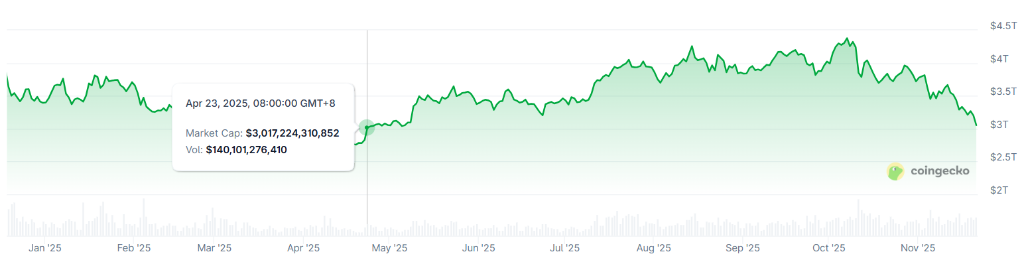
Core Viewpoint - Bitcoin is experiencing its worst monthly performance since the industry collapse in 2022, with a drop of over 30% from its historical high of $126,000 in early October, leading to a monthly decline of approximately 25% in November, marking the worst performance since 2022 [1][2] Market Performance - Bitcoin's price fell to $80,553, while Ethereum also suffered a significant drop of 8.9%, falling below $2,700 [1] - The total market capitalization of the cryptocurrency market has fallen below $3 trillion for the first time since April [2] Market Dynamics - A large-scale liquidation event on October 10 led to the forced closure of $19 billion in leveraged positions, resulting in a market value loss of approximately $1.5 trillion [4] - In the past 24 hours, an additional $2 billion in leveraged positions were liquidated, with open interest in perpetual futures contracts decreasing by 35% from the October peak of $94 billion, indicating a significant reduction in risk exposure by investors [5][4] Investor Sentiment - Institutional investors have shown no interest in buying the dip, with $903 million net outflow from 12 U.S. Bitcoin ETFs, marking the second-largest single-day redemption since their launch in January 2024 [8] - The cryptocurrency investor sentiment index has dropped to its lowest level since the 2022 crash, indicating that traders are in a state of "extreme fear" [8] Selling Pressure - The convergence of forced liquidations and structural sell-offs from ETFs has created a particularly fragile market state, with significant selling pressure from long-term holders [6][3] - A notable wallet, identified as "Owen Gunden," has sold a total of $1.3 billion worth of Bitcoin since the end of October, highlighting a trend of large-scale selling by long-term investors [12][7] Liquidity Concerns - Market liquidity is expected to diminish as the holiday season approaches, which could exacerbate price volatility if investors continue to reduce their positions [7][8] - The mNAV ratio of Strategy companies, which are attempting to replicate Michael Saylor's Bitcoin accumulation strategy, has fallen to just above 1.2, raising concerns about their positions in major indices [10]
比特币跌穿9万!有人亏到失眠,这波血洗真不怪空头
Sou Hu Cai Jing· 2025-11-20 17:49
Core Viewpoint - The recent Bitcoin crash is attributed to a combination of factors rather than a sudden attack from short sellers, indicating that the bubble was bound to burst eventually [8] Group 1: Market Dynamics - Bitcoin experienced a dramatic decline from a peak of $126,000 to a low of $89,385 within 72 hours, representing a nearly 30% drop and erasing approximately $400 billion in market value [6][28] - The decline was exacerbated by a high leverage environment in the derivatives market, leading to forced liquidations of long positions when Bitcoin fell below critical support levels [17][20] Group 2: Economic Influences - The Federal Reserve's decision to maintain high interest rates (5.5%-5.75%) in response to persistent inflation (4.2% year-on-year in October) has made riskier assets like Bitcoin less attractive compared to safer investments like government bonds [11][13] - Institutional investors, as indicated by the decline in the Grayscale Bitcoin Trust's premium from 18% to -5%, have been pulling out of Bitcoin, signaling a lack of confidence in the asset [15][28] Group 3: Investor Behavior - Long-term investors have been selling off their Bitcoin holdings, with over 127,000 Bitcoins sold in the first two weeks of November, resulting in cashing out over $15 billion [28] - The correlation between Bitcoin and the Nasdaq index has reached 0.82, suggesting that Bitcoin is behaving more like a tech stock rather than a hedge against inflation [24]

暴击!比特币失守9.5万美元,较年内高点跌去24%
Bei Jing Shang Bao· 2025-11-16 13:06
Core Viewpoint - The cryptocurrency market is experiencing significant downward pressure, with Bitcoin and Ethereum prices declining sharply, indicating a broader market downturn [1][3][4]. Market Performance - Bitcoin's price has fallen to $95,563, down 24% from its yearly high of $126,200, with a daily drop of 0.54%, a weekly decline of nearly 10%, and a monthly decrease of 14% [3]. - Ethereum is also under pressure, currently priced at $3,174, with a daily drop of 1.55% and a monthly decline of 20% [3]. Market Dynamics - A total of 97,824 investors faced liquidation in the past 24 hours, with a cumulative liquidation amount of $251 million, reflecting significant volatility in the market [3]. - The decline in Bitcoin's price is attributed to two main factors: its "scarcity" and "dollar liquidity," with the immediate trigger being the contraction of dollar liquidity [4]. Trust Crisis - A recent event where the U.S. Department of Justice seized 127,000 Bitcoins from a Cambodian fraud group, valued at approximately $15 billion, has undermined the perceived security of cryptocurrency [4]. - The belief that cryptocurrencies are absolutely secure has been challenged, leading to a potential long-term bear market if trust in transaction security continues to erode [4]. Institutional Behavior - There are clear signs of institutional capital withdrawal, with net outflows observed in Bitcoin and Ethereum ETFs since November, compounded by ongoing regulatory uncertainties [4][5]. Future Outlook - If dollar liquidity continues to tighten, Bitcoin may test the $90,000 support level; conversely, if the Federal Reserve resumes rate cuts, a rebound could occur [5]. - The long-term outlook for the cryptocurrency market remains uncertain, with a need for investors to recognize the high-risk nature of these assets [5]. - Bitcoin is transitioning from a speculative asset to an institutional asset, with its future value increasingly dependent on liquidity conditions, regulatory policies, and the rebuilding of trust [5].