迷你基金

Search documents
财通资管任命邹广航为副总经理 管理总规模缩水近500亿元
Xi Niu Cai Jing· 2026-01-09 05:32
Group 1: Management Changes - The company appointed Zou Guanghang as the new Deputy General Manager and Chief Financial Officer, effective January 1, 2026 [3] - Frequent management changes occurred in 2025, including the promotion of Lu Zhen to Assistant General Manager and the elevation of Chang Nana to Deputy General Manager [1][3] - Fund manager Jiang Yongming resigned due to personal career planning, having managed underperforming products [2][4] Group 2: Fund Performance and Management Scale - Jiang Yongming's managed products significantly underperformed, with cumulative returns of -30.43% for "Caitong Asset Management Value Growth Mixed C" over three years and -21.88% for "Caitong Asset Management Value Discovery Mixed C" over four years [2] - The company's total management scale decreased from a peak of 155 billion to 105 billion, a reduction of nearly 50 billion over three years [4] - The company has seen the emergence of several mini-funds, with the Caitong Asset Management Xinrui Mixed Fund having a net asset value of only 18.64 million [4]


迷你基金难逃清盘 多只绩优产品退场
Zhong Guo Zheng Quan Bao· 2025-12-28 21:08
Core Insights - Over 270 public funds have been liquidated this year, primarily due to insufficient scale, indicating a trend towards normalization of fund closures in the industry [1][2][4] - Even some small-sized high-performing funds have faced liquidation, as investors redeem their shares after achieving profits or breaking even, leading to insufficient scale [3][4] Fund Liquidation Details - As of mid-December, 21 funds have been liquidated in December alone, contributing to the total of over 270 funds this year [2] - The types of funds affected include bond funds, actively managed equity funds, ETFs, and FOFs, with both small and large fund companies involved [2] - Funds are terminated if their net asset value falls below 50 million RMB for 60 consecutive days or if the number of shareholders drops below 200 [2] Performance and Scale Issues - Some funds, despite achieving high returns, such as a 21.99% return for a healthcare fund in Q1 and a 71.03% return for another fund, still faced liquidation due to low asset values [3] - As of the end of Q3, there were still 2,924 funds with assets below 50 million RMB, including 324 funds with assets below 10 million RMB [3] Market Dynamics - The lowering of approval and issuance thresholds for new funds has diminished the "shell" value of funds, allowing fund companies to discontinue underperforming or small-scale products [4] - The market is experiencing a natural selection process, where mini funds and fund liquidations are becoming a common occurrence [4] - Investors are advised to prioritize funds with moderate scale and to avoid those with high institutional ownership, as large-scale redemptions can lead to rapid declines in fund size [4]
绩差基金密集清盘 公募加速“断舍离”
Sou Hu Cai Jing· 2025-12-20 03:13
Core Insights - The article highlights the ongoing trend of mutual fund liquidations in the Chinese market, with 274 funds being liquidated in 2023, marking the second-highest number since 2018, following 293 in the previous year [2][6] - The trend is attributed to the increasing competition in the mutual fund industry, leading companies to focus resources on more competitive products and actively choose to liquidate underperforming "mini funds" [5][6] Fund Liquidation Details - Four mutual funds from Changjiang Asset Management, PICC Asset Management, Invesco Great Wall Fund, and Chuangjin Hexin Fund announced liquidation on December 19, 2023, due to underperformance against benchmarks and small asset sizes [2][4] - The reasons for liquidation include failing to meet minimum asset thresholds, such as having net assets below 50 million yuan for 50 consecutive working days or failing to reach 200 investors [4][5] Performance Analysis - The four funds that were liquidated reported significant underperformance, with losses of 34% and 12.26% against their respective benchmarks, which yielded returns of 23.97% and -11.54% [5] - The trend of underperformance is exacerbated by the market's shift towards larger, more successful funds, leading to a concentration of capital among top fund managers [6][7] Fund Types and Trends - There has been a notable increase in the liquidation of money market funds and Funds of Funds (FOFs), with 11 and 35 funds respectively being liquidated this year, marking a record high for FOFs [3][7] - The rise in money market fund liquidations is linked to declining yields and increased competition, prompting investors to seek higher returns in alternative products [7][8] FOF Specifics - The number of liquidated FOFs has increased from 4 in 2022 to 35 in 2023, driven by poor performance and the expiration of three-year terms for many newly launched funds [8] - The challenges faced by FOFs include underwhelming returns, dual fee structures, and a lack of investor confidence, leading to persistent underperformance and subsequent liquidations [8]

270只基金年内退场
Di Yi Cai Jing Zi Xun· 2025-12-17 15:58
Core Insights - The fund liquidation process is accelerating as the year-end approaches, with 270 funds having announced their exit this year, primarily due to insufficient scale or number of investors [2][5] - The trend of fund liquidation has become normalized, reflecting poor performance and loss of investor trust, pushing the industry towards a more refined product offering [2][5] Fund Liquidation Trends - As of December 18, 2023, the 17th fund of the month entered liquidation, with 47 additional funds issuing warnings about potential liquidation due to low asset values [3][4] - Equity funds are the most affected, with many newly established funds under a year old facing liquidation risks [4][5] Performance and Investor Trust - Over 60% of the funds that have exited this year are equity funds, attributed to poor performance and lack of investor confidence [5] - The market volatility has exacerbated the risks for "mini funds," which are funds with low asset values [5][9] Regulatory Changes and Fund Management - Fund companies are modifying automatic termination clauses to extend the liquidation period and provide more options for "mini funds," requiring investor input for decisions [6][8] - Failed attempts to hold shareholder meetings indicate low investor engagement, which complicates the decision-making process for fund companies [7][8] Market Dynamics - The current market environment has led to a significant number of funds struggling to maintain minimum asset values, with 2061 equity funds below 60 million yuan and 1586 below 50 million yuan [9]

270只基金年内退场,次新基金与债基均难幸免
Di Yi Cai Jing Zi Xun· 2025-12-17 14:21
Group 1 - The core viewpoint of the article highlights the ongoing trend of fund liquidations as the year-end approaches, with 270 funds having announced their exit this year, primarily due to insufficient scale or number of investors [1][3][4] - A total of 47 funds have issued liquidation warnings this month, indicating a significant number of products are at risk of being forced out of the market [2][3] - Equity funds are identified as the most affected category, with 171 out of the 270 liquidated funds being equity funds, representing over 60% of the total [3][4] Group 2 - The article notes that many newly established funds, including those less than a year old, are facing liquidation, reflecting a broader trend of underperformance and loss of investor confidence [1][2] - The bond market's continued adjustment in the fourth quarter has also led to several bond funds facing liquidation or warning signs, indicating a challenging environment for these products [3][4] - The industry is witnessing a shift towards a more selective approach, with resources likely concentrating on more competitive products as the number of funds exceeds ten thousand [1][5] Group 3 - Fund companies are modifying their automatic termination clauses to extend the liquidation period and provide more options for "mini funds," but the decision to liquidate or continue operations still requires investor input [5][6] - Instances of failed shareholder meetings to decide on fund continuance are becoming common, reflecting low investor engagement and interest in these products [6][7] - The article suggests that the decision to maintain or liquidate a fund often depends on the strategic positioning of the product within the company's portfolio, with some companies willing to retain funds that may have future potential [7][8]
达诚基金旗下两位基金经理“清仓”卸任基金 存在多只迷你基金
Xi Niu Cai Jing· 2025-12-02 06:02
Group 1 - The announcement from Dacheng Fund on November 28 indicates that fund manager Chen Ji has resigned from multiple funds due to personal reasons, leaving no other funds under his management [2] - Fund manager Wu Haoyang also resigned from several funds for personal reasons, with no remaining funds under his management [3] - Chen Ji managed two mini funds before his resignation, with net asset values of 0.11 billion and 4.1895 million respectively as of the third quarter [3] - Wu Haoyang's four funds were also mini funds, with net asset values of 0.34 billion, 0.49 billion, 0.47 billion, and 0.35 billion respectively as of the third quarter [3] Group 2 - The Dacheng Zhongzheng Interbank Certificate of Deposit AAA Index 7-Day Holding Period Fund was established on January 26, 2024, with an initial subscription amount of approximately 5.08 billion, but has seen significant redemptions within two years [3] - The third-quarter report for the fund indicates a complex market environment, with underwhelming performance attributed to declining deposit rates and short-term interbank rates, affecting the issuance rates of interbank certificates of deposit [4] - The fund's reliance on coupon income has led to decreased yield capabilities, as it follows a passive index tracking strategy, limiting its ability to enhance returns through active management [5]

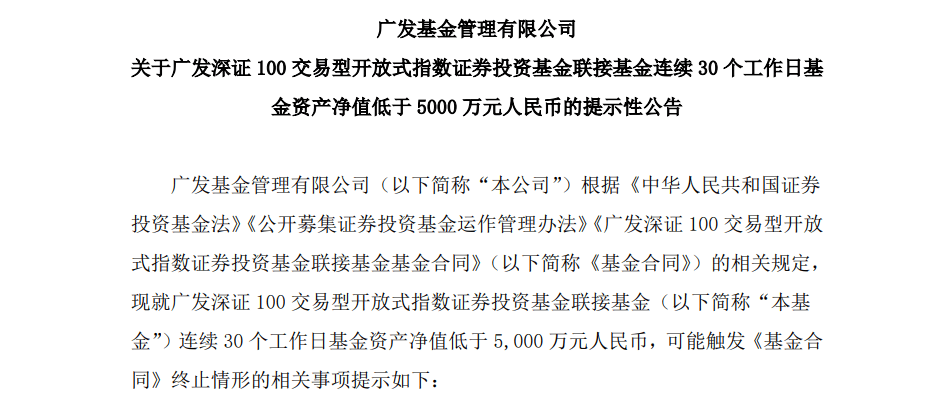
广发深证100联接基金触发清盘预警,迷你基金风险再现
Sou Hu Cai Jing· 2025-08-20 03:31
Group 1 - The core point of the news is that the "Guangfa Shenzhen 100 ETF Linked Fund" has triggered a termination clause due to its net asset value being below 50 million yuan for 30 consecutive working days, indicating a potential for liquidation or transformation if the situation does not improve [1][4]. - ETF linked funds are designed to invest directly or indirectly in target ETFs to achieve index tracking, allowing investors to participate in the market with a lower threshold. However, these funds require a certain scale to operate, and falling below the regulatory threshold of 50 million yuan makes liquidation or merger almost inevitable [4]. - The number of "mini funds" in the public offering market has been high in recent years, with over a hundred funds terminating operations this year, primarily due to insufficient scale triggering contract termination clauses [4]. Group 2 - Guangfa Fund currently has 31 funds with net asset values below 50 million yuan, including "Guangfa Jusheng Mixed A" with a combined scale of only 6.11 million yuan and "Guangfa Xinyu Mixed A" with 10.26 million yuan [5]. - The proportion of institutional holders in these two mixed funds has remained above 95%, but with institutional redemptions, they have become mini funds. If they cannot achieve "rebirth" through mergers or transformations, they face significant liquidation risks [5]. - The company has a large product line across equities, fixed income, and ETFs, but some products have long lacked market interest, reflecting a "long-tail dilemma" in market competition. Retaining these mini funds incurs high operational costs and may drag down the overall product structure, leading to a potential future cleanup of inefficient products as regulatory tolerance decreases [5].
超20只,逆市亏损!
Zhong Guo Ji Jin Bao· 2025-08-19 13:12
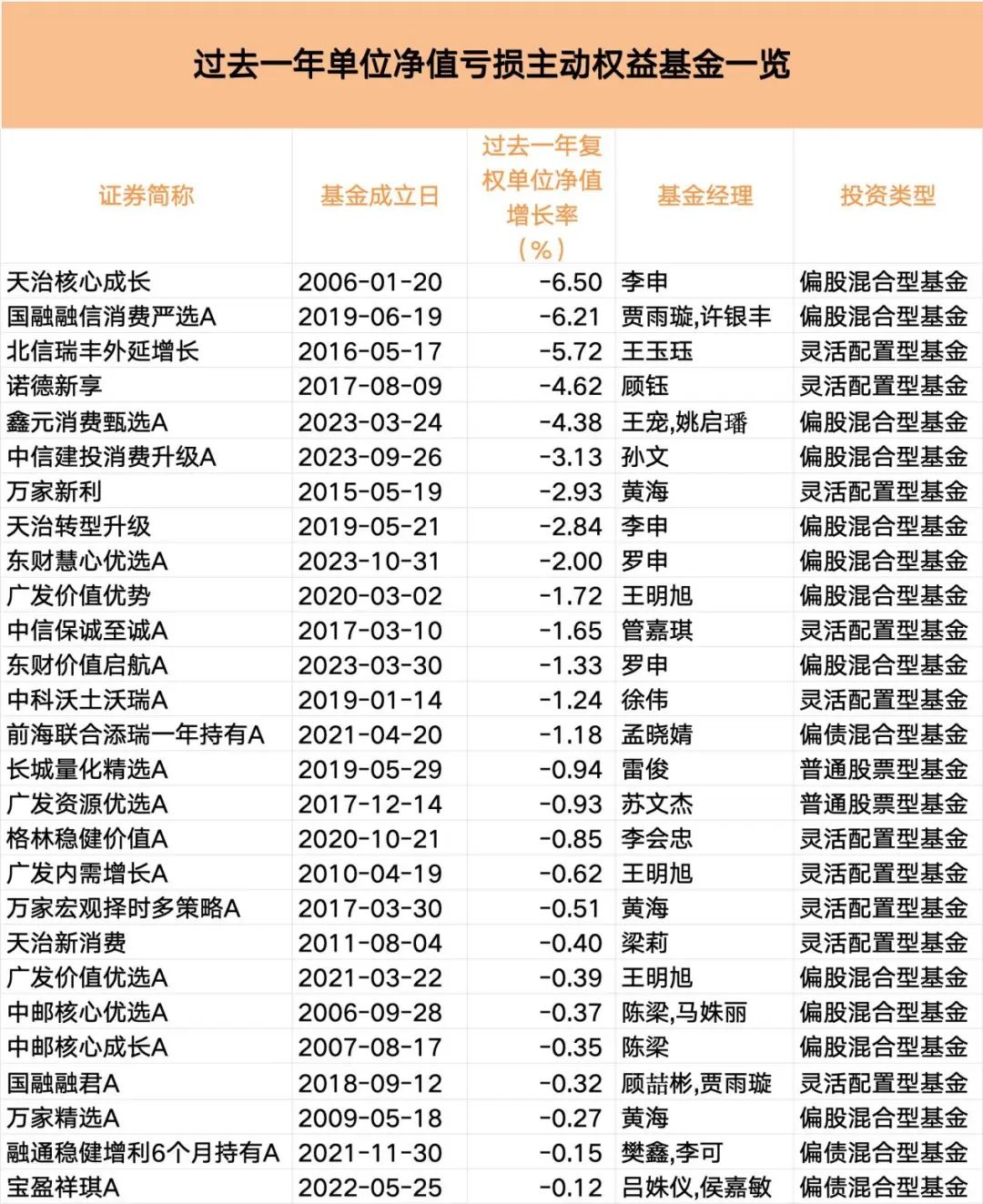
Core Insights - The equity market has experienced a bullish trend over the past year, with most active equity funds showing positive net value growth, yet over 20 funds have reported negative returns [1][2][3]. Performance Overview - As of August 18, the Shanghai Composite Index, Shenzhen Component Index, and ChiNext Index have recorded cumulative gains of approximately 30%, 40%, and 60% respectively [3]. - The average net value growth rate for 5,033 active equity funds is 34.65%, with a median of 30.65%, and 99.56% of these funds have positive returns [3]. Notable Fund Performance - Three funds have achieved over 200% growth, with the highest reaching a net value growth rate of 249.27% [3]. - 83 funds have doubled their net value, primarily investing in advanced manufacturing and innovative pharmaceuticals, benefiting from policy support and technological breakthroughs [3]. Underperforming Funds - Despite the overall positive performance, over 20 active equity funds have recorded negative returns, with the worst-performing fund declining over 6%, resulting in a 255 percentage point difference from the top-performing fund [3][4]. - These underperforming funds have also lagged behind their performance benchmarks, with some underperforming by more than 25 percentage points [4]. Investment Strategy Issues - Many of the underperforming funds have misaligned their investment strategies with market trends, often holding positions in sectors that are not currently favored [5]. - A significant number of these funds are classified as "mini funds," with assets under management below 50 million yuan, facing operational challenges due to their small size [5]. Specific Fund Examples - Tianzhi Core Growth Fund has a net value growth rate of -6.5% over the past year, significantly underperforming compared to the average return of 40.97% for similar funds [6]. - Guorong Rongxin Consumer Select Fund has seen a decline of 6.21%, trailing its benchmark by nearly 17 percentage points [6]. - Beixin Ruifeng External Growth Fund has also reported a decline of over 5%, underperforming its benchmark by more than 25 percentage points [7]. Summary of Underperforming Funds - A list of underperforming funds includes Tianzhi Core Growth, Guorong Rongxin Consumer Select A, and Beixin Ruifeng External Growth, among others, with varying degrees of negative returns [9].
汇安基金陆丰卸任两只基金 均是迷你基金
Xi Niu Cai Jing· 2025-08-19 05:45
Core Viewpoint - The announcement of fund manager Lu Feng's resignation from Huian Fund due to company work adjustments raises concerns about the management of two mini funds, Huian Value Blue Chip Mixed Fund and Huian Balanced Growth Mixed Fund, which are facing regulatory scrutiny due to low asset values [2][3]. Fund Manager Resignation - Fund manager Lu Feng has resigned from Huian Value Blue Chip Mixed Fund and Huian Balanced Growth Mixed Fund as of August 11, 2025, due to company work adjustments [2][3]. - Lu Feng will take on other roles within the company [3]. Fund Performance and Regulatory Issues - As of the end of Q2 2025, Huian Value Blue Chip Mixed Fund had a net asset value of 15.6964 million yuan, while Huian Balanced Growth Mixed Fund had a net asset value of 19.8375 million yuan [3]. - Huian Value Blue Chip Mixed Fund has reported a net asset value below 50 million yuan for over 60 consecutive working days, prompting the fund manager to submit a resolution plan to the China Securities Regulatory Commission (CSRC) [3]. - The fund's contract stipulates that if the number of fund holders falls below 200 or the net asset value remains below 50 million yuan for 60 consecutive working days, the fund manager must report to the CSRC and propose solutions within 10 working days [3]. Fund Performance Metrics - As of August 13, 2025, Huian Value Blue Chip Mixed Fund A class has seen a decline of 25.31% since inception, while Huian Balanced Growth Mixed Fund A class has increased by 32.85% since inception [4]. - Huian Value Blue Chip Mixed Fund A class has a unit net value of 0.7469, with a recent performance of -0.24% [5]. - The fund has underperformed its benchmark by 19.89 percentage points since inception and by 12.82 percentage points over the past year [5]. - The fund's stock allocation is 93.17%, with no bond holdings, primarily investing in banking and insurance stocks [5]. Investment Strategy - The fund aims to invest in undervalued blue-chip companies with stable dividend rates and growth potential, focusing on achieving stable net value growth [6].

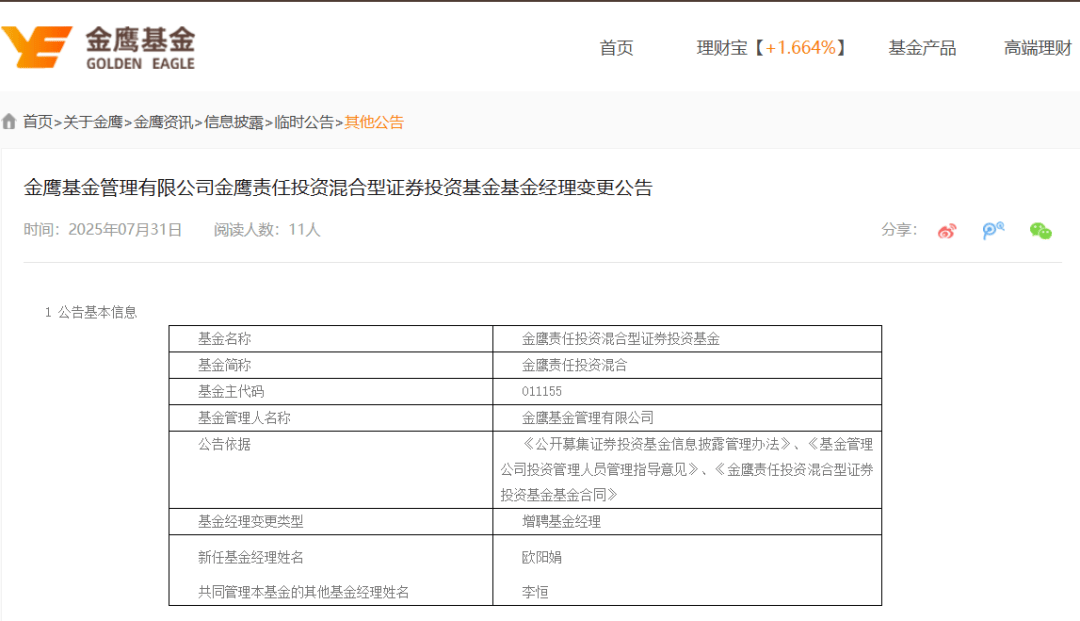
金鹰责任投资混合基金增聘欧阳娟!高换手双经理能否盘活“五毛基”
Sou Hu Cai Jing· 2025-08-01 05:24
Core Viewpoint - The appointment of Ouyang Juan as a co-manager for the Jin Ying Responsible Investment Mixed Fund is seen as a significant self-rescue action for this struggling "mini-fund" [1][3]. Fund Management Changes - Jin Ying Fund announced the appointment of Ouyang Juan to co-manage the Jin Ying Responsible Investment Mixed Fund alongside the existing manager Li Heng [1][2]. - This change is part of a routine operation in the public fund industry, but it carries more weight due to the fund's poor performance [1][3]. Fund Performance - Since its inception on March 16, 2021, the fund has consistently underperformed, with a unit net value of 0.5482 as of July 31, 2023, ranking 2750 out of 3719 funds in the industry [3]. - The fund's turnover rate reached 1285.94% in Q4 2023, but this high trading frequency did not capture market opportunities and instead eroded the fund's net value due to high transaction costs [3][7]. - The fund's net asset value has significantly declined from approximately 305.93 million yuan at the end of 2023 to 22.76 million yuan by the end of 2024, and further down to 15.24 million yuan in 2025, falling below the 50 million yuan liquidation threshold [3][7]. Manager Performance - Li Heng, who took over management on June 20, 2023, has also faced challenges, with his other managed funds showing poor performance, raising questions about the effectiveness of his investment strategy [5][6]. - Ouyang Juan, despite her extensive research background, has similarly struggled with the funds she managed, with significant losses recorded in multiple products [7][8]. Market Reaction - Investor sentiment has turned negative, with complaints about the fund's performance and management, leading to a continuous decline in fund size [10]. - The collaboration between Ouyang Juan and Li Heng is viewed as a critical gamble for the fund's future, with uncertainty surrounding whether this partnership can reverse the fund's fortunes [12].