宏利睿智领航

Search documents
被特斯拉起诉的宏利基金:高管更迭频繁,权益发展疲软!
Sou Hu Cai Jing· 2026-01-16 10:50
Core Viewpoint - Manulife Fund is facing challenges in its growth and development, particularly in equity investments, due to frequent executive turnover and talent loss [1][3][17]. Group 1: Legal Issues - Manulife Fund and its executive Li Cheng are being sued by Tesla (Shanghai) for trade secret infringement, with the case set to be heard on February 4 [2][5]. - The company has not publicly responded to the lawsuit, and there is no record of the case in the Shanghai High Court [2][7]. Group 2: Fund Management Scale - As of the end of Q3 2025, Manulife Fund's public management scale is 98.271 billion yuan, with fixed income accounting for 76.846 billion yuan, nearly 80% of the total [2][11]. - The fund's overall development has lagged behind competitors, with its scale not surpassing 100 billion yuan, ranking 62nd in the industry [7]. Group 3: Executive Turnover - The company has experienced significant executive turnover, including changes in the chairman, general manager, and other key positions [3][21]. - The instability in the executive team has been linked to the company's challenges in product application, fundraising, and scale [14][17]. Group 4: Equity Fund Performance - Manulife Fund's equity products have struggled, with the scale of equity funds reaching a peak of 53.735 billion yuan in Q2 2015, but dropping to 19.158 billion yuan by Q3 2025 [10]. - The performance of many equity funds has been disappointing, with 21 out of 58 funds underperforming their benchmarks by over 10 percentage points [12]. Group 5: Talent Loss - The company has seen a significant loss of key talent in its equity investment team, impacting its research and investment capabilities [15][16]. - Notable departures include experienced fund managers and executives, which has raised concerns about the stability of the investment decision-making team [15][16]. Group 6: Compliance Issues - Manulife Fund has faced compliance challenges, including a fine from the State Administration of Foreign Exchange for violating foreign exchange registration regulations [23].
百亿级增量资金,即将入市
天天基金网· 2025-06-25 05:03
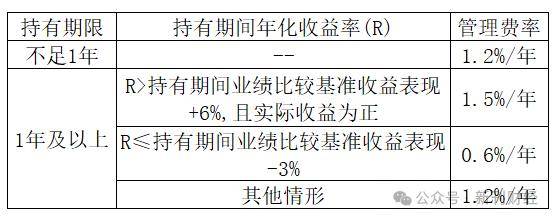
Core Viewpoint - The first batch of 26 new floating-rate funds has seen 13 established with a total fundraising scale exceeding 12.6 billion yuan, indicating strong market interest and a shift towards performance-based fee structures [1][3][6]. Fund Establishment and Performance - As of June 24, 13 out of 26 new floating-rate funds have announced their establishment, raising over 12.6 billion yuan in total [1][3]. - The top three funds by fundraising scale are: - Dongfanghong Core Value managed by Zhou Yun at 1.991 billion yuan - E Fund Growth Progress managed by Liu Jianwei at 1.704 billion yuan - Ping An Value Enjoy managed by He Jie at 1.322 billion yuan [3][4]. Fee Structure and Investor Alignment - The floating-rate funds implement a tiered management fee structure with a "reward for excellence and punishment for poor performance" mechanism, aligning the interests of fund managers with those of investors [1][6]. - If a fund's annualized return lags the benchmark by more than 3 percentage points, the management fee is halved to 0.6%. Conversely, if excess returns exceed 6 percentage points, the fee increases to 1.5% [6]. Investment Strategies and Manager Profiles - Fund managers are divided into three styles: growth, value, and balanced strategies, with a focus on A-shares and Hong Kong stocks for diversification [6][7]. - Growth-style managers focus on sectors like technology and emerging consumption, while value-style managers prefer low-valuation, high-return on equity companies [7][10]. Market Trends and Opportunities - Fund managers are encouraged to identify investment opportunities amid uncertainty, with a focus on sectors such as AI and pharmaceuticals [11]. - The dynamic adjustment of investment strategies is emphasized, with a slower pace in bullish markets and an accelerated approach in bearish conditions [11].


基金忠言|宏利基金缺大将,孟杰再次作“先锋”
Sou Hu Cai Jing· 2025-06-09 06:17
Core Viewpoint - The article highlights the challenges faced by Hongli Fund, the first domestic public fund company to transition from a Sino-foreign joint venture to a wholly foreign-owned entity, particularly due to significant personnel changes and management issues [1][2][3]. Group 1: Personnel Changes - The former general manager, Gao Guixin, with over 20 years of experience, resigned after less than two years, transitioning to Chief Information Officer [1]. - Wang Peng, a key fund manager known for his strong historical performance, left the company in January after resigning from six funds simultaneously [1]. - Following Wang's departure, Meng Jie took over the management of the Hongli Transformation Opportunity Fund, experiencing a significant increase in management scale from 2 billion to over 5 billion [1]. Group 2: Performance Issues - Since Meng Jie became the fund manager, the unit net value of the Hongli Transformation Opportunity Fund has significantly declined, with a drop rate two to three times higher than other funds he managed [1]. - Meng Jie has maintained a stock position above 70% for the Hongli Ruizhizheng Fund over the past five years, despite the fund's contract allowing for a flexible range of 0% to 95% [1]. Group 3: Cultural and Structural Concerns - The ongoing loss of talent within the investment research team raises questions about the stability of the fund's product performance [3]. - The chairman, Jin Xu, has a history of prioritizing scale expansion over sustainable growth, which has contributed to the current issues faced by the fund [3]. - The article suggests that the problems at Hongli Fund reflect broader industry challenges, emphasizing the need for a cultural shift towards valuing professional integrity and respect for contractual obligations [3].
首批浮动费率基金发行!宏利基金孟杰“7管5亏”能否胜任
Sou Hu Cai Jing· 2025-05-27 05:35
Core Viewpoint - The introduction of new floating-rate funds by various fund companies, including Manulife, aims to address long-standing issues in the public fund industry, particularly the "guaranteed returns" problem, by linking management fees more closely to performance [5][22]. Group 1: New Floating-Rate Funds - The first batch of 26 new floating-rate funds received approval from the CSRC on May 23, 2025, with issuance starting on May 27, 2025 [1][5]. - These funds have a tiered management fee structure with three levels: 1.2% for the base rate, 1.5% for the upper tier, and 0.6% for the lower tier, depending on performance relative to a benchmark [1][3]. - The management fee will be adjusted based on the fund's annualized return compared to the performance benchmark after one year of holding [1][5]. Group 2: Fund Managers and Performance - The appointment of experienced fund managers for these new funds is seen as a strategic endorsement of the new model, with managers like Zhou Yun from Dongfanghong Core Value having over 10 years of experience [5][7]. - However, some fund companies are criticized for appointing managers with less impressive track records, raising concerns about their ability to generate significant returns under the new fee structure [7][12]. - Manulife's fund manager Meng Jie has a mixed performance record, with five out of seven funds he manages showing negative returns, leading to skepticism about the company's research capabilities [12][22]. Group 3: Industry Context and Challenges - The introduction of floating-rate funds is part of a broader initiative to improve the quality of public funds, as outlined in the "Public Fund High-Quality Development Action Plan" [5][22]. - The industry has faced significant personnel changes, particularly at Manulife, which has seen a wave of departures among key investment personnel, raising questions about the stability of its investment research framework [21][22]. - The shift to a foreign-owned structure for Manulife has coincided with ongoing personnel turmoil, which may impact the company's ability to effectively manage complex products like floating-rate funds [22].
16只首批新型浮动费率基金发行 业绩基准对标沪深300等主流宽基指数
Huan Qiu Wang· 2025-05-27 03:00
Group 1 - The first batch of 26 new floating rate funds has officially launched, with 16 funds from companies like Huatai-PB, GF, and Ping An leading the way [1] - The performance benchmarks for these floating rate funds primarily target mainstream broad-based indices such as CSI 300, CSI A500, CSI 500, and CSI 800, with a focus on equity investments [3] - The equity portion of these funds typically maintains a stock allocation around 80%, with A-shares accounting for 55% to 80% of the performance benchmarks and Hong Kong stocks ranging from 5% to 20% [3] Group 2 - The new floating rate funds feature a more refined management fee structure, which is expected to be charged based on each investor's holding time and annualized return [3] - The floating management fee mechanism is designed to be linked to fund performance, with specific conditions for fee increases and decreases, emphasizing the need for significant outperformance against benchmarks [4] - For example, the management fee for the Jiashi Growth Win-Win Mixed Fund can only increase if it significantly exceeds the performance benchmark and achieves positive absolute returns [4]