宝马225L M运动套装

Search documents
宝马开年挥刀,2026豪华车卷生卷死
3 6 Ke· 2026-01-08 01:08
Core Viewpoint - The luxury car market is experiencing significant changes due to price adjustments by major brands like BMW, which are interpreted as a response to increased competition from domestic manufacturers and shifting consumer preferences towards technology and value rather than traditional luxury symbols [2][3][4]. Group 1: Price Adjustments and Market Response - BMW announced price reductions on 31 key models in China, with 24 models seeing reductions of over 10% and 5 models over 20%, including the iX1 eDrive25L with a 24% drop and the i7 M70L with a maximum reduction of 301,000 yuan [2]. - The adjustments have led to an increase in the number of BMW models priced below 300,000 yuan, indicating a shift towards more competitive pricing in the luxury segment [2]. - BMW claims these price changes are part of a value upgrade strategy rather than a price war, although market interpretations suggest otherwise, especially following reports of Porsche closing several showrooms in China [3]. Group 2: Market Dynamics and Competitive Landscape - The luxury car market, particularly the BBA (BMW, Benz, Audi) trio, is facing declining profits, with net profits dropping significantly: Mercedes-Benz by 55.8%, Audi by 37.5%, and BMW by 29% in the first half of 2025 [3]. - The traditional dominance of BBA is being challenged by domestic brands like BYD and Xiaomi, which are gaining traction among younger consumers who prioritize technology and personalized experiences over brand prestige [5][7]. - The penetration rate of domestic electric vehicles in the 300,000 to 500,000 yuan price range has surged from under 10% in 2020 to over 40% by 2025, directly impacting BBA's sales [7]. Group 3: Strategic Challenges for BBA - BBA's transition to electric vehicles is perceived as slow, with Mercedes-Benz and Audi adjusting their electrification goals and timelines, while BMW has also revised its electric vehicle sales expectations downward by over 20% [9][11]. - The traditional luxury brands are struggling with high production costs and lengthy product development cycles, which hinder their ability to compete effectively with agile domestic brands [11]. - BBA's marketing strategies, rooted in traditional luxury branding, are becoming less effective in an era where consumers seek innovation and technological engagement [12]. Group 4: Future Outlook and Consumer Impact - The ongoing price competition may lead to increased efficiency and technological advancements in the luxury car sector, ultimately benefiting consumers [13][14]. - Analysts predict that more luxury brands may be forced to adjust their strategies or exit the Chinese market in the coming years due to intensified competition [13].


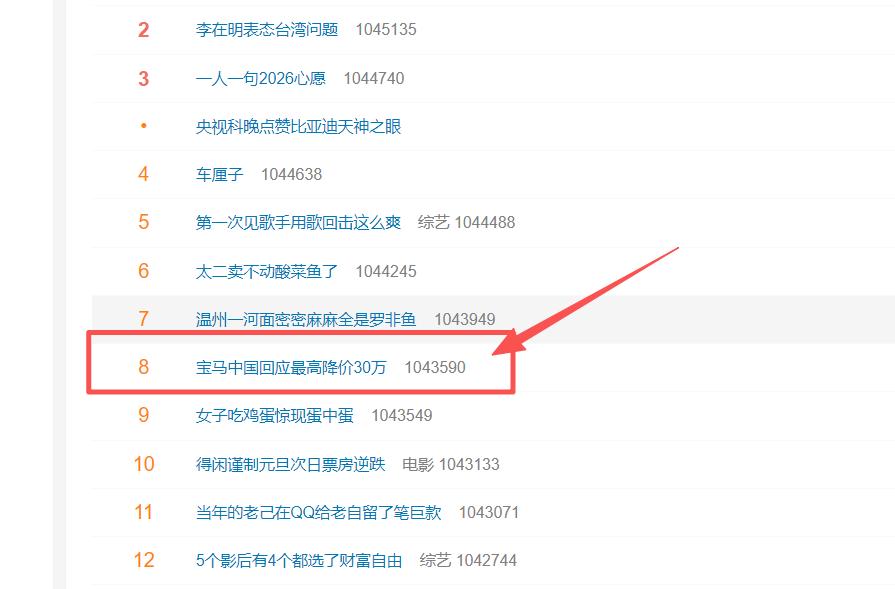
德系豪华车新年搞“突袭”?宝马开年官降最高30万
Zhong Guo Jing Ji Wang· 2026-01-05 11:49
Core Viewpoint - BMW has initiated a significant price reduction across 31 key models, with discounts reaching up to 300,000 yuan, marking a departure from its previous stance against price wars in the luxury car market [1][4]. Group 1: Price Reduction Details - The price cuts affect a wide range of models, with reductions generally exceeding 10%, and 24 models seeing cuts over 10%, while 5 models have reductions over 20% [2]. - The model with the largest price drop is the BMW i7 M70L, which saw a reduction from 1.899 million yuan to 1.598 million yuan, a decrease of 301,000 yuan [3][4]. - The entry-level BMW 225L M Sport model's price was reduced from 259,900 yuan to 208,000 yuan, lowering the entry barrier for consumers [2]. Group 2: Market Context and Strategy - BMW's price reduction is framed as a "value upgrade" rather than a price war, indicating a strategic response to market dynamics [4]. - The luxury car market in China is undergoing rapid restructuring, with traditional German brands like BMW, Mercedes-Benz, and Audi facing declining sales, as evidenced by a 14.7% drop in BMW's sales from January to November 2025 [6]. - The rise of Chinese brands, which have seen significant sales growth, poses a challenge to established luxury brands, with companies like Hongmeng Zhixing and Zeekr achieving sales of 589,000 and 575,000 units respectively in 2025 [7][8]. Group 3: Regulatory Environment and Implications - The Chinese government has been actively regulating price wars in the automotive sector, emphasizing compliance with pricing guidelines to promote healthy market development [9]. - BMW's decision to lower prices may attract consumer interest in the short term but could undermine its brand's pricing integrity and consumer perception in the long run [9]. - The competitive landscape may prompt other luxury brands like Mercedes-Benz and Audi to reconsider their pricing strategies in response to BMW's actions, potentially reshaping the market dynamics further [10].
宝马大降价,最高直降30万元!20.8万元就能买到宝马车,公司:这不是“价格战”
Mei Ri Jing Ji Xin Wen· 2026-01-02 16:43
Group 1 - BMW has significantly reduced the suggested retail prices for 31 key models, with 24 models seeing a decrease of over 10% and 5 models over 20%, including the iX1 eDrive25L with a maximum drop of 24% [1][3] - The highest price reduction is for the BMW i7 M70L, amounting to 301,000 yuan, while the lowest priced model, the BMW 225L M Sport Package, has dropped from 259,900 yuan to 208,000 yuan, making it competitive with many domestic SUVs [1][3] - A total of 16 automotive brands have announced promotional policies for January, affecting nearly 70 models, which include direct price cuts, cash discounts, and various subsidies [1] Group 2 - BMW China clarified that the price adjustment is not a "price war" but a proactive response to market dynamics and a value upgrade for certain products [3] - The company emphasizes a long-term development strategy focused on providing higher value and competitive product experiences, rather than short-term profit maximization [3]
宝马突然大范围调价,最高降30万,宝马中国回应
Xin Lang Cai Jing· 2026-01-02 13:35
Core Viewpoint - BMW China will adjust the suggested retail prices of 31 key models starting January 1, 2026, with significant price reductions across various models, indicating a strategic response to market dynamics rather than a price war [2][6]. Price Adjustment Overview - The price adjustment affects 31 models, with 24 models seeing reductions of over 10% and 5 models over 20%, including a maximum reduction of over 300,000 yuan for certain models [2][8]. - Prior to the adjustment, only 3 models had suggested retail prices below 300,000 yuan, which will increase to 10 models post-adjustment [2][8]. Specific Model Price Changes - The flagship model i7 M70L will see a price drop of 301,000 yuan, from 1,899,000 yuan to 1,598,000 yuan, representing a 16% reduction [4][10]. - The iX1 eDrive25L will have the highest percentage drop of 24%, with its price reduced from 299,900 yuan to 228,000 yuan [5][11]. - The fuel version of the X1 will also see reductions, with the xDrive25Li dropping from 349,900 yuan to 288,800 yuan (18% reduction) and the sDrive25Li from 316,900 yuan to 258,000 yuan (19% reduction) [5][11]. - The entry-level 735Li of the 7 Series will decrease from 919,000 yuan to 808,000 yuan, while the 740Li will drop from 1,069,000 yuan to 938,000 yuan, both reflecting a 12% reduction [5][11]. Strategic Intent - BMW China emphasizes that this price adjustment is not a price war but a value upgrade for certain products, reflecting a proactive adjustment of product strategy in response to market dynamics [6][12]. - The company aims for long-term sustainable development rather than short-term profits, focusing on enhancing consumer value through upgrades in comfort, aesthetics, and digital features [6][12].