
实体机器人

Search documents
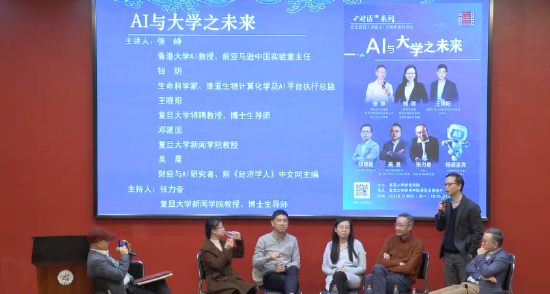
复旦大学邓建国:未来是人机共生的世界,大学的使命是让人成为更好的人
Xin Lang Cai Jing· 2025-12-08 12:31
Core Insights - The future of human-machine coexistence is an inevitable trend, and universities should move beyond traditional knowledge transmission to focus on cultivating meta-knowledge, tacit knowledge, and practical knowledge while enhancing human empathy and collaborative abilities to address the challenges posed by changes in communication forms [3][7]. Group 1: AI Development and Challenges - The foundation of artificial intelligence is based on three elements: chips, data, and algorithms, driven by Moore's Law, which has led to the emergence of large language models through massive data generated by mobile sensors and powerful chip analysis capabilities [3][7]. - Large language models have a critical shortcoming due to their lack of physical embodiment, which prevents them from providing essential variables such as gender, age, and region necessary for human communication, making it difficult to establish stable trust relationships [3][7]. Group 2: Human Interaction and Education - Despite the presence of AI with physical forms, humans still desire real-life interactions and connections, emphasizing that the essence of human learning and communication is a multi-faceted, multi-channel, and social process that cannot be satisfied by mere artificial voice or online interactions [3][7]. - AI may replace certain types of knowledge production and some cognitive tasks, but human empathy and collaborative abilities, rooted in carbon-based life, remain irreplaceable core competencies [4][8]. Group 3: The Role of Universities - The mission of universities is to help individuals become better people in a future characterized by human-machine coexistence, maintaining their social and practical characteristics while cultivating core knowledge and unique abilities [4][8]. - In the face of communication changes and knowledge iteration brought about by AI, universities must assist humanity in maintaining core values amid competition and collaboration with technology, achieving harmonious coexistence between humans and machines [4][8].

华业天成孙业林:未来最重要的生产力工具是机器人
投中网· 2025-04-21 03:37
将投中网设为"星标⭐",第一时间收获最新推送 规模引入工业AI专用算力,配合柔性生产和软硬件升级,将是一次非常大的变革性机会。 整理丨 鲁智高 来源丨 投中网 时代的潮流,将科技投资推上前台。抓住其中的投资机会,关键在于洞察科技发展、产业发展的底层规律。 在华业天成创始合伙人孙业林看来,从工业革命到科技革命,生产力工具一直持续产生重大进化,从而带动产业生态产生了几次关键跃迁, " 未来,最 重要的生产力工具是机器人,一种是带身体的实体机器人,一种是没有身体的数字机器人。 " 与此同时,对于全球最大的工业制造国 —— 中国,孙业林认为这一波智能科技,将使工业连接从有线逐渐升级为 5G 等无线连接方式,规模引入工业 AI 专用算力,配合柔性生产和软硬件升级,将是一次非常大的变革性机会。 2025 年 4 月 16-18 日,由投中信息、投中网共同主办的第 19 届中国投资年会 · 年度峰会在中关村国际创新中心隆重召开。在活动现场,孙业林发 表了题为 " 智能科技投资策略探讨 " 的主题演讲。 以下为嘉宾现场演讲实录,由投中网整理: 各位嘉宾上午好,非常感谢投中的邀请,来做一个关于智能科技投资的分享。 锁定未来行业 ...