宽基指数型基金

Search documents
今天的100万,十年后值多少
第一财经· 2025-11-13 05:49
Core Viewpoint - The article discusses the evolution of wealth and investment strategies over the past decade in China, emphasizing the importance of asset allocation to maintain purchasing power and quality of life in the face of economic changes and inflation [5][18]. Historical Context - The past decade marked a transition in China's economy from high-speed growth to high-quality development, with significant asset differentiation [7]. - The Consumer Price Index (CPI) in China averaged an annual increase of approximately 2.2% from 2015 to 2024, while economic growth remained above 5% annually [7]. Real Estate Market - The real estate sector experienced a boom, particularly in first-tier cities, with prices doubling between 2015 and 2016, followed by significant increases in second-tier cities [8]. - However, by 2020, property prices began to decline, with an average correction of at least 40% from peak levels, leading to situations where homeowners could not sell properties for enough to cover their mortgages [9]. A-Share Market - The A-share market has seen significant volatility, with the Shanghai Composite Index rising from around 2000 points in 2014 to 5100 points in 2015, followed by a sharp decline [10]. - Despite this, structural opportunities emerged, particularly in sectors like consumption, pharmaceuticals, and technology, with notable stocks like Kweichow Moutai and CATL achieving substantial gains [11]. Fixed Income Assets - The domestic monetary policy has been persistently accommodative, leading to a decline in the yield on ten-year government bonds from approximately 4.5% in 2015 to around 1.8% currently [13]. - Bond funds have yielded annual returns of about 4% to 6%, while bank wealth management products have seen yields drop from around 5% to 2% [13]. Gold Market - Gold prices have surged from $1200 per ounce in 2015 to over $4000 per ounce, reflecting a more than 300% increase [14]. - The article raises questions about the sustainability of this upward trend in gold prices amid geopolitical risks and currency devaluation [15]. Future Economic Landscape - The next decade is expected to witness profound changes in China's economy and social structure, with GDP growth projected to average between 4% and 5% [20]. - Key trends include a shift from investment-driven to consumption and innovation-driven growth, alongside a rising service sector and advanced manufacturing [21]. Asset Allocation Strategies - Holding cash in a bank is projected to result in a significant loss of purchasing power, with estimates suggesting that 1 million yuan could be worth only 600,000 yuan in ten years due to inflation [28]. - Real estate investment is deemed risky, with only prime locations in first-tier cities likely to retain value, while other areas may not offer investment potential [24]. - The A-share market is expected to reflect economic quality more accurately, with sectors like high-end manufacturing and green energy seen as promising [25]. - Gold and REITs (Real Estate Investment Trusts) are suggested as potential hedges against inflation and as alternatives to traditional fixed-income investments [26]. Conclusion - The article concludes that the future value of today's 1 million yuan will heavily depend on strategic asset allocation decisions made now, emphasizing the need for financial literacy and informed investment choices to navigate economic fluctuations [30].

今天的100万,十年后值多少
Di Yi Cai Jing· 2025-11-13 03:37
Core Viewpoint - The article discusses the significant decline in purchasing power of wealth over the past decade and emphasizes the importance of strategic asset allocation to preserve and grow wealth in the future [2][10][20]. Group 1: Economic Context - The past decade has seen a transition in China's economy from high-speed growth to high-quality development, with an average annual GDP growth rate of over 5% [3][12]. - The Consumer Price Index (CPI) has averaged an annual increase of approximately 2.2% from 2015 to 2024, indicating inflationary pressures on purchasing power [3][10]. Group 2: Real Estate Market - The real estate market experienced a significant boom, particularly in first-tier cities, with prices doubling between 2015 and 2016, followed by substantial increases in second-tier cities [4][5]. - However, the rental yield in the real estate sector is generally below 2%, which is significantly lower than the global average, and many cities have seen property prices decline by at least 40% from their peak [5][16]. Group 3: A-share Market - The A-share market has undergone dramatic fluctuations, with the Shanghai Composite Index rising from around 2000 points in 2014 to 5100 points in 2015, followed by a sharp decline [6]. - Despite the volatility, there have been structural opportunities, particularly in sectors like consumption, healthcare, and technology, with some stocks experiencing significant growth [6][16]. Group 4: Fixed Income Assets - The yield on ten-year government bonds has decreased from approximately 4.5% in 2015 to around 1.8% currently, leading to a steady increase in bond prices [7]. - Bond funds have provided annualized returns of about 4% to 6%, while bank wealth management products have seen yields drop from around 5% to 2% [7]. Group 5: Gold Market - Gold prices have surged from $1200 per ounce in 2015 to over $4000 per ounce, reflecting a more than 300% increase, driven by geopolitical risks and inflation concerns [9][10]. Group 6: Future Economic Outlook - The next decade is expected to witness profound changes in China's economic and social structure, with GDP growth projected to stabilize between 4% and 5% [12]. - Key trends include a shift from investment-driven growth to consumption and innovation, alongside a rising elderly population and increasing demand for healthcare and quality services [13]. Group 7: Asset Allocation Strategies - Holding cash in a bank is projected to lead to a significant loss in purchasing power, with estimates suggesting that 1 million yuan could be worth only 600,000 yuan in ten years due to inflation [19]. - Diversified asset allocation strategies, including investments in equities, real estate, and alternative assets like REITs and gold, are recommended to preserve and grow wealth [16][17][20].
新基金发行火热,新老基金如何选?
Guang Zhou Ri Bao· 2025-06-12 16:01
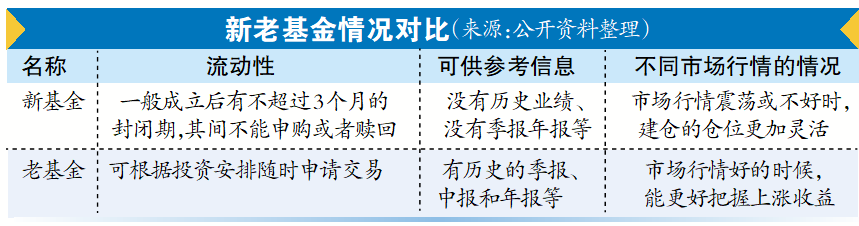
Core Viewpoint - The public fund issuance market is heating up, with 34 new funds launched in the week from June 9 to June 15, leading to investor confusion about choosing between new and old funds [1] Comparison of New and Old Funds - New funds typically have a maximum of three months' lock-up period during which investors cannot buy or redeem, while old funds allow for immediate trading [2][3] - New funds lack historical performance data, making it difficult for investors to assess their potential, whereas old funds provide detailed historical reports [3] - Old funds are seen as more stable due to proven long-term performance, while new funds may offer flexibility in capturing market opportunities during volatile periods [3] Investment Strategies - Investors seeking to capitalize on market uptrends may prefer old funds, while those looking to invest during market downturns might find new funds more appealing due to their gradual investment strategies [4] - It is advisable for investors to choose new funds managed by experienced fund managers to mitigate risks associated with inexperienced management [4] Similarities Between New and Old Funds - Some funds, such as broad-based index funds, show minimal differences between new and old versions, allowing investors to choose based on size and liquidity rather than age [5] - Money market funds also exhibit similar characteristics, with stable returns regardless of whether they are new or old [5]