小微金融债

Search documents
2025普惠金融报告|专访田轩:耐心资本成普惠金融关键
Bei Jing Shang Bao· 2025-12-14 06:20
Core Viewpoint - The development of inclusive finance in China is transitioning from "scale expansion" to "quality improvement," while facing challenges such as long credit repair cycles for low-income groups and high credit risks for small and micro enterprises [1][2]. Group 1: Challenges in Inclusive Finance - Low-income groups experience long credit repair cycles and unstable expectations, affecting their refinancing and consumption expansion capabilities [1]. - Small and micro enterprises and farmers face high credit risks, with traditional collateral models being insufficient, hindering sustainable credit [1]. - Insufficient insurance coverage and relatively stagnant development in the securities industry further complicate the situation [1]. Group 2: Role of Patient Capital - Patient capital aligns well with the financing needs of small and micro enterprises, individual businesses, and low-income groups in the inclusive finance sector [1]. - It is suggested to guide patient capital into the inclusive finance ecosystem through mechanisms of risk sharing, revenue matching, and ecological collaboration [1][9]. - The establishment of a risk compensation fund and the promotion of credit information sharing platforms are recommended to enhance the participation of patient capital [2][9]. Group 3: Transformation of Inclusive Finance - The inclusive finance system is evolving towards diversified service providers, technology-driven operations, and systematic ecological collaboration [4]. - The focus is shifting from single credit support to comprehensive financial services, including payment, insurance, and wealth management, enhancing precision and sustainability [4]. - The application of big data and artificial intelligence in risk control and customer engagement is improving service efficiency and reducing costs [4]. Group 4: Policy Recommendations - A multi-level collaborative mechanism is suggested to balance service delivery and risk coverage, involving central and local governments, regulatory bodies, and market participants [2][11]. - Establishing a risk compensation fund shared by central and local finances is proposed to support inclusive loans in rural areas [12]. - The creation of a development fund for inclusive finance, guided by government initiatives and supported by social capital, is recommended to enhance investment in key areas [9][13]. Group 5: Credit Relief Policies - The People's Bank of China's one-time personal credit relief policy is seen as a significant step towards optimizing the credit ecosystem and boosting consumer confidence [6][7]. - This policy aims to provide a clear path for credit repair for residents facing genuine difficulties, enhancing their future expectations and consumption potential [6][7]. - It is essential to establish clear boundaries and mechanisms to prevent moral hazards and ensure fairness in the implementation of this policy [7]. Group 6: Role of Small and Medium Banks - Small and medium banks are encouraged to deepen the application of asset securitization (ABS) to broaden funding sources and optimize their asset-liability structures [8]. - They should focus on stable cash flow loans from small and micro enterprises and explore combination ABS products to enhance their competitive edge in county markets [8]. - The issuance of small micro-financial bonds and the exploration of diverse capital market tools are recommended to support inclusive finance initiatives [8].


专访田轩:耐心资本成普惠金融关键
Bei Jing Shang Bao· 2025-12-10 11:53
Core Insights - The wave of inclusive finance in China has transitioned from "scale expansion" to "quality improvement" over the past decade [1] - Current challenges include long credit repair cycles for low- and middle-income groups, high credit risks for small and micro enterprises, and insufficient insurance coverage [1][2] - The need for a multi-level collaborative mechanism among central and local governments, regulators, and markets is emphasized to achieve a deeper transformation from "blood transfusion" to "blood production" in inclusive finance [2][4] Group 1: Characteristics of Inclusive Finance - The inclusive finance system is evolving with diversified service entities, technology-driven operations, and systematic ecological collaboration [5] - Services are expanding from single credit support to comprehensive financial services, enhancing precision and sustainability [5] - The application of big data and artificial intelligence is improving service efficiency and reducing costs [5] Group 2: Policy Recommendations - Establish a risk compensation fund shared by central and local governments to balance service delivery and risk coverage [2][14] - Propose a "government guidance, market operation" model for inclusive finance development funds [2][14] - Suggest the creation of a multi-layered collaborative mechanism among various stakeholders to enhance the effectiveness of inclusive finance policies [14][15] Group 3: Credit Repair and Consumer Confidence - The People's Bank of China's one-time personal credit relief policy is seen as a significant step towards optimizing the credit ecosystem and boosting consumer confidence [6][7] - This policy aims to provide a clear path for credit repair for those facing genuine difficulties, enhancing their future expectations and consumption potential [6][7] Group 4: Role of Small and Medium Banks - Small and medium banks are encouraged to deepen the application of asset securitization (ABS) to optimize their funding sources and asset-liability structures [11] - The focus should be on selecting stable cash flow loans from small and micro enterprises and individual businesses as underlying assets for securitization [11] Group 5: Engaging Patient Capital - "Patient capital" is identified as a natural fit for financing needs in the inclusive finance sector, particularly for small and micro enterprises [12] - Mechanisms for risk sharing, yield matching, and ecological collaboration are recommended to attract long-term capital into inclusive finance [12][13] Group 6: Regulatory and Market Mechanisms - The current policy and regulatory framework for inclusive finance is multi-layered and dynamic, but there is room for further optimization [14] - Recommendations include enhancing the precision of policy tools and improving the coordination of regulatory responsibilities [14][15] - A balance between regulatory oversight and market-driven initiatives is essential for fostering innovation while managing risks [15][16]

沪农商行: 上海农村商业银行股份有限公司董事会2025年第七次会议决议公告
Zheng Quan Zhi Xing· 2025-08-29 11:44
Core Viewpoint - The Shanghai Rural Commercial Bank's board of directors held its seventh meeting in 2025, where several key resolutions were passed, including the approval of financial reports and a bond issuance plan totaling up to RMB 36 billion [1][2][3]. Group 1: Board Meeting Resolutions - The board meeting was attended by 14 directors, with 12 present in person, and all resolutions were passed unanimously with 14 votes in favor and no opposition or abstentions [1]. - The meeting included the approval of the 2025 semi-annual report and the mid-term profit distribution plan, which were disclosed on the Shanghai Stock Exchange [2]. Group 2: Bond Issuance Plan - The bank plans to issue bonds with a total scale of up to RMB 36 billion, with issuance scheduled between the second half of 2025 and 2028 [3]. - The bond types include ordinary financial bonds, small and micro financial bonds, green financial bonds, and technology innovation financial bonds, with maturities of 3 or 5 years [3]. - The funds raised will be used to support key areas such as inclusive finance for small and micro enterprises, green finance, technology finance, and manufacturing [3]. Group 3: Nomination and Committee Approvals - The board agreed to nominate Mr. Ye Bo as a non-executive director, pending approval at the shareholders' meeting [2]. - Various committee work rules and management measures were also approved, including those related to sustainable development and transaction control [4][5]. Group 4: Director Background - Mr. Ye Bo holds a master's degree in accounting and has extensive experience in the insurance industry, currently serving as an assistant general manager at China Pacific Life Insurance [6].
浙商银行发行“共同富裕”主题小微专项金融债券
Xin Hua Wang· 2025-08-12 06:17
Group 1 - The core viewpoint of the news is that Zhejiang Zheshang Bank successfully issued a total of 10 billion yuan in microfinance bonds to support the construction of the Zhejiang Common Prosperity Demonstration Zone, enhancing its ability to serve the real economy and significantly reducing financing costs for small and micro enterprises [1][2] - The bond issuance consists of two varieties: the first with a scale of 5 billion yuan, a term of 3 years, and a coupon rate of 2.47%, and the second with a scale of 5 billion yuan, a term of 5 years, and a coupon rate of 2.85%, both attracting strong market interest with oversubscription ratios of 4.06 times and 4.08 times respectively [1] - The lead underwriters for this bond issuance are CITIC Securities and China International Capital Corporation, with a syndicate that includes various major banks and financial institutions, indicating broad market participation [1] Group 2 - In the first half of 2022, Zhejiang Zheshang Bank supported a total financing amount of 863.5 billion yuan within Zhejiang Province, with new loans exceeding 120 billion yuan, of which nearly 60 billion yuan was added within the province, accounting for nearly half of the total, marking a historical high [2] - The bank's bond underwriting in the province grew by 82.8% year-on-year, significantly outpacing the average growth rate of its peers in the province by nearly 80 percentage points, demonstrating its strong market position [2] - The bank has also provided 6 billion yuan in relief to small and micro customers in the first half of the year, implementing fee reductions to lower operational costs for enterprises, thereby injecting "financial vitality" into the real economy [2]

300亿小微金融债落地!平安银行加码支持小微企业融资
Sou Hu Cai Jing· 2025-05-29 03:02
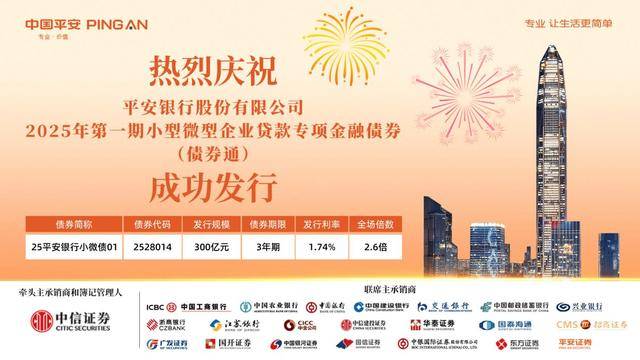
Group 1 - Ping An Bank successfully issued RMB 30 billion microfinance bonds with a 3-year term and an interest rate of 1.74%, demonstrating strong market confidence in the bank's brand and financial health [1] - The funds raised from the microfinance bonds will be specifically used to provide loans to small and micro enterprises, supporting their development [3] - Since 2021, Ping An Bank has been issuing microfinance bonds to secure lower long-term financing costs and enhance its capacity to provide inclusive financial services [3] Group 2 - As of May 20, the microfinance coordination mechanism has disbursed a total of RMB 103.379 billion across 30,967 loans, addressing the financing needs of small enterprises [4] - The successful issuance of the RMB 30 billion microfinance bonds is a concrete action by Ping An Bank to implement the central government's strategy for supporting small enterprise financing [4] - Ping An Bank aims to continue enhancing its financial services for the real economy and small enterprises while strengthening financial risk prevention [4]

以高质量信披促高质量发展,东方证券发布可持续发展报告
Jing Ji Guan Cha Wang· 2025-04-23 02:35
Core Viewpoint - 2024 marks a significant year for the standardization of ESG and sustainable development information disclosure in China, with new guidelines and regulations being implemented across various financial institutions and exchanges [1][4]. Group 1: Regulatory Developments - The China Securities Regulatory Commission has unified the deployment of sustainable development report guidelines for listed companies, while the Ministry of Finance and nine other ministries have released the "Corporate Sustainable Disclosure Standards - Basic Standards (Trial)" [1]. - The Hong Kong Stock Exchange has introduced further requirements for climate-related disclosures for listed companies, effective from the 2025 fiscal year [3]. Group 2: Company Initiatives - Dongfang Securities has released its 2024 Sustainable Development Report, which aligns with new regulations from the Shanghai Stock Exchange and anticipates the Hong Kong Stock Exchange's climate disclosure requirements [2]. - The report employs a dual materiality analysis to identify and assess the importance of ESG issues, enhancing the utility of the disclosed information for stakeholders [2]. Group 3: Financial Contributions - In 2024, Dongfang Securities has actively contributed to national strategies through various financial services, including underwriting technology innovation bonds worth 16.164 billion yuan and green bonds totaling 9.028 billion yuan [5]. - The company has also supported small and micro enterprises with a total of 2.633 billion yuan in financing and has provided personalized pension services to over 50,000 individuals [5]. Group 4: Sustainable Development Goals - Dongfang Securities has guided over 470 billion yuan into sustainable development sectors from 2021 to 2024, with an annual growth rate of over 10% in sustainable financing [7]. - The company has reduced its Scope 1 and Scope 2 greenhouse gas emissions by 3,263.72 tons of CO2 equivalent compared to the baseline year of 2021 [7]. Group 5: Recognition and Ratings - Dongfang Securities has maintained an AA rating from MSCI ESG, ranking in the top 24% globally among peers, and has significantly exceeded the industry average in the S&P CSA score [8]. - The company has been included in various prestigious ESG rankings and has achieved the highest rating of "four and a half stars" among securities firms [8].