
金融‘五篇大文章’

Search documents
中国银行去年营收超6500亿元,拟年度分红超700亿元
Nan Fang Du Shi Bao· 2026-03-30 13:17
Core Viewpoint - In 2025, Bank of China reported a revenue of 659.87 billion yuan, a year-on-year increase of 4.28%, and a net profit of 257.94 billion yuan, up 2.18%, continuing the trend of dual growth in revenue and net profit [2][3] Financial Performance - The bank's total assets reached 38.36 trillion yuan by the end of 2025, growing by 9.4% year-on-year, with a non-performing loan ratio decreasing by 0.02 percentage points to 1.23% [2][5] - The net interest income was 440.71 billion yuan, down 1.83% year-on-year, with a net interest margin of 1.26%, a decrease of 0.14 percentage points [3] - Non-interest income rose to 219.16 billion yuan, a 19.21% increase, accounting for 33.21% of total revenue [3] Loan and Deposit Growth - The balance of technology loans exceeded 4.8 trillion yuan, representing over one-third of corporate loans, ranking first among peers [5][6] - Personal consumption loans reached 515.73 billion yuan, growing by 28.35% year-on-year [6] - Total customer loans amounted to 23.45 trillion yuan, an increase of 8.61% from the previous year [5] Asset Quality and Risk Management - The non-performing loan ratio for corporate loans was 1.22%, down 0.04 percentage points, while personal loan non-performing ratio increased to 1.10%, up 0.13 percentage points [8] - The bank's provision coverage ratio stood at 200.37%, remaining stable compared to the previous year [7] Dividend and Shareholder Returns - The bank plans to distribute a cash dividend of 2.263 yuan per 10 shares, totaling 72.92 billion yuan, with a payout ratio of 30% [2][8]


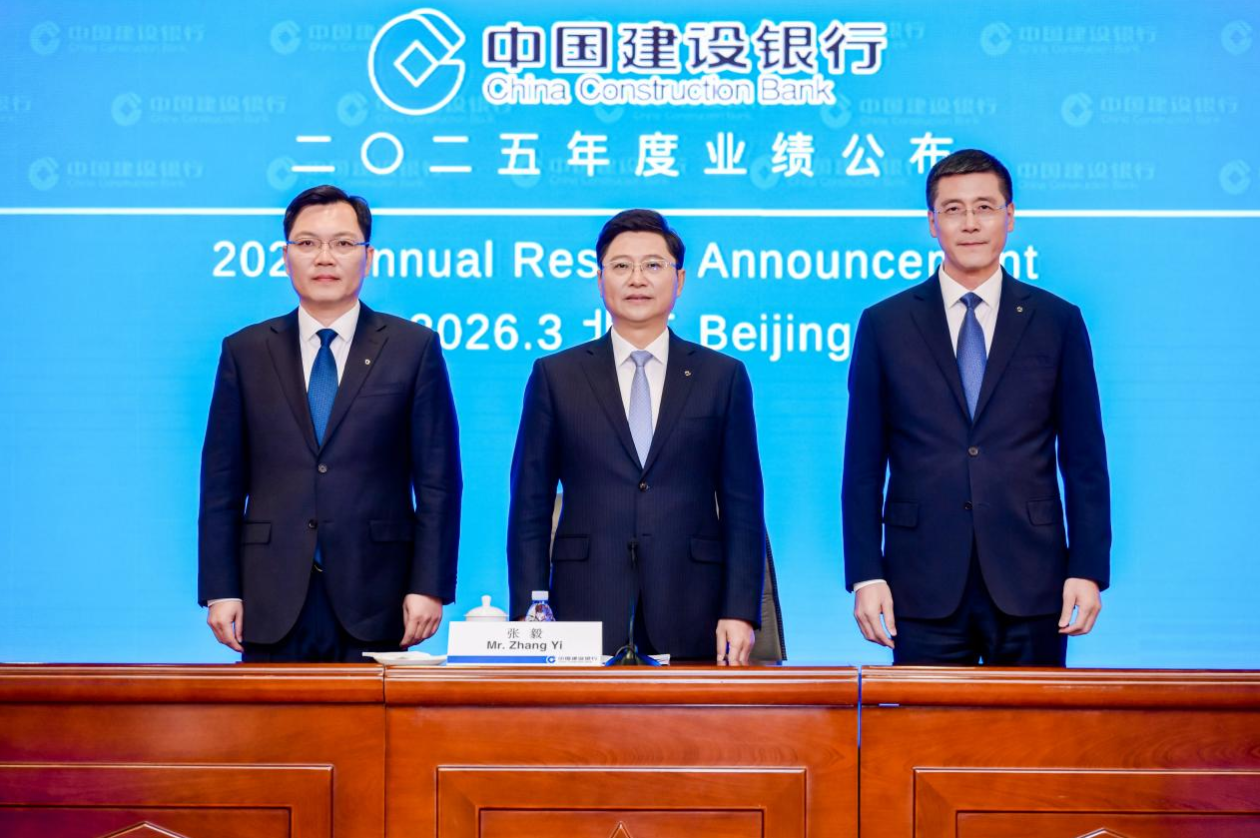
【看年报】稳中有进提质效:中国建设银行交出2025年高质量发展答卷
Huan Qiu Wang· 2026-03-30 09:17
Core Viewpoint - China Construction Bank (CCB) reported steady growth in its financial performance, with total assets reaching 45.63 trillion yuan, a 12.47% increase, and net profit of 339.79 billion yuan, a 1.04% increase, reflecting a commitment to high-quality development and alignment with national strategies [1][3]. Financial Performance - Total assets amounted to 45.63 trillion yuan, with a growth rate of 12.47% [1] - Total liabilities reached 41.95 trillion yuan, increasing by 12.68% [1] - Core Tier 1 capital net amount was 3.46 trillion yuan, up by 9.46% [1] - Operating income was 740.87 billion yuan, with a growth of 1.69% [1] - Net profit stood at 339.79 billion yuan, reflecting a 1.04% increase [1] - Non-performing loan ratio was 1.31%, with a provision coverage ratio of 233.15% [1] Asset and Liability Management - Loan issuance net amount was 26.93 trillion yuan, growing by 7.53% [3] - Bond investments reached 12.43 trillion yuan, increasing by 20.51% [3] - Deposits totaled 30.84 trillion yuan, with a growth of 7.39% [3] - The interest rate on deposits decreased by 33 basis points to 1.32% [3] Customer Base and Service - CCB served 12.73 million corporate clients and 785 million individual customers [1] - Personal consumption loans reached approximately 683.2 billion yuan, with a year-on-year increase of 155.2 billion yuan [8] Strategic Focus Areas - CCB emphasized support for the real economy, with corporate loans growing by 8.70% to 15.69 trillion yuan [5] - In the green finance sector, green loan balance reached 6 trillion yuan, with over 720 billion yuan in green bonds issued [6] - The bank's digital finance initiatives included 546 million users and 30.05 million active digital RMB wallets [8] Risk Management - The non-performing loan ratio decreased by 0.03 percentage points year-on-year, indicating stable asset quality [9] - CCB implemented comprehensive risk management strategies, enhancing its ability to manage various risks [9][10] Future Outlook - CCB aims to enhance its service capabilities and risk management while continuing to support national development strategies [10]

魏革军:引导金融机构完善内部协调机制,统筹做好金融“五篇大文章”|聚焦两会
清华金融评论· 2026-03-08 06:38
Core Viewpoint - The article emphasizes the importance of constructing an internal coordination mechanism within financial institutions to enhance the effectiveness of implementing the "Five Major Financial Articles" strategy, as highlighted by Wei Gejun, a member of the National Committee of the Chinese People's Political Consultative Conference and a consultant at the People's Bank of China [3][4][6]. Group 1: Internal Coordination Mechanism - Financial institutions have made significant progress in implementing the "Five Major Financial Articles," but there remains a mismatch and lack of coordination in their internal management systems [4][6]. - Wei suggests that the People's Bank of China should lead the development of guiding opinions to clarify the core elements and principles for building an internal coordination mechanism within financial institutions [6][7]. - It is recommended that major banks establish specialized committees or leadership groups under their boards to formulate overall strategies and ensure cohesive execution of the "Five Major Financial Articles" [6][7]. Group 2: Performance Assessment and Incentives - There is a need to optimize the performance assessment and incentive mechanisms within financial institutions to align with the goals of the "Five Major Financial Articles," as traditional assessment systems face challenges in adapting to new directions [7]. - Wei highlights the importance of increasing the weight of relevant business areas in performance evaluations and suggests implementing policies that favor loans in key sectors [7]. - The establishment of a "risk tolerance" and "due diligence exemption" system is recommended to alleviate the pressure on credit personnel and encourage innovation and risk-taking [7][8]. Group 3: Risk Management and Data Support - Strong risk identification and management are crucial for the sustainable development of businesses related to the "Five Major Financial Articles" [8]. - Financial institutions should develop differentiated risk assessment models tailored to specific sectors such as technology, green finance, and inclusive finance [8][9]. - There is a call for improved data sharing and system support to enhance management efficiency and service quality across financial institutions [9]. Group 4: Policy Support and Commercial Sustainability - Effective policy support is essential for the successful implementation of the "Five Major Financial Articles," with a focus on the coordination between monetary and fiscal policies [10]. - The government has proposed a special fund of 100 billion yuan to promote domestic demand, reflecting a more targeted and effective macro-control approach [10]. - Attention should also be given to the commercial sustainability of financial institutions, as excessive competition in the market can lead to unsustainable practices, such as offering loans below cost [11].

协同发力 做实金融“五篇大文章”
Jin Rong Shi Bao· 2026-02-26 02:07
Core Viewpoint - The "Fifteen Five" period is crucial for advancing Chinese-style modernization and building a strong financial nation, emphasizing the importance of financial services in supporting high-quality economic development [1] Group 1: Financial "Five Major Articles" - The "Five Major Articles" of finance include technology finance, green finance, inclusive finance, pension finance, and digital finance, which are essential for implementing the Party's 20th Central Committee's directives and promoting structural reforms in the financial supply side [1][3] - By the end of 2025, loans in technology, green, inclusive, pension, and digital economy sectors are projected to grow by 11.5%, 20.2%, 10.9%, 50.5%, and 14.1% respectively, all exceeding the overall loan growth rate [1] Group 2: Collaborative Development - Current progress on the "Five Major Articles" is still in the deepening and improvement stage, with room for enhancement in collaborative development and cross-sector mechanisms [2] - There is a need for improved inter-departmental and inter-industry collaboration, as well as better integration of financial regulation, industry management, and fiscal policies to create a strong synergy for the "Five Major Articles" [2][4] Group 3: Systematic Integration - The "Five Major Articles" are not isolated tasks but are interrelated and mutually supportive, requiring a holistic approach to maximize their collective impact [3] - The transition to high-quality economic development necessitates a shift from single-domain financial support to a more integrated approach that addresses complex development needs [3] Group 4: Policy and Resource Coordination - Strengthening the collaborative development of the "Five Major Articles" requires a focus on policy guidance and practical needs, including establishing a cross-departmental collaboration mechanism and optimizing structural monetary policy tools [4] - Financial institutions should leverage their strengths and collaborate effectively, with large state-owned banks taking the lead and smaller banks focusing on niche markets [4] Group 5: Service Innovation - There is a need to promote cross-domain financial product innovation, developing comprehensive financial products that combine multiple attributes, such as "technology + green + inclusive" credit [4] - Digital finance should empower the other four areas, enhancing service precision and convenience through the use of big data and artificial intelligence [4][5]
履职刚满一年,郑州银行首位女行长李红辞任!高管人事再震荡
Nan Fang Du Shi Bao· 2026-02-13 12:15
Core Viewpoint - The sudden resignation of Li Hong, the first female president of Zhengzhou Bank, after just one year in office, highlights ongoing instability within the bank's management team and raises concerns about its future direction and performance [2][4][12]. Management Changes - Li Hong resigned from multiple positions including executive director and president, effective immediately upon submission of her resignation [4]. - Her tenure lasted exactly one year, having been appointed on November 27, 2024, and officially approved on January 25, 2025 [4]. - The bank's board expressed gratitude for her contributions during her brief tenure [4][6]. Performance During Tenure - Despite her short time in office, Li Hong was credited with achieving significant milestones in business development, including a 44.50% year-on-year increase in policy-based sci-tech financial loans, reaching a balance of 48.269 billion yuan [6]. - Green credit business saw a remarkable growth of 123.73%, with a balance of 9.146 billion yuan [6]. - The bank's total assets reached approximately 743.552 billion yuan by September 30, 2025, marking a 9.93% increase from the previous year [11]. Ongoing Management Instability - Zhengzhou Bank has experienced a series of high-level departures since 2023, with significant turnover in its executive team, including the resignation of three vice presidents and three assistant presidents in early 2025 [8][9]. - The bank is employing a strategy of combining external recruitment and internal promotions to address management gaps [9]. Future Leadership - Wang Sentao has been proposed as the new vice president, pending regulatory approval, and is expected to bring valuable experience from both financial institutions and local government [11]. - The bank's leadership position remains vacant following Li Hong's departure, raising questions about how the bank will stabilize its management and improve operational performance [12].
滨州市保险行业协会召开第七届理事会十七次(扩大)会议
Qi Lu Wan Bao· 2026-02-12 22:31
Group 1 - The meeting of the Binzhou Insurance Industry Association focused on the achievements of 2025 and the work plan for 2026, with key reports being approved by all directors [3] - The association's vice president presented a comprehensive summary of the 2025 work effectiveness and introduced the key work plans for 2026 [3] - The meeting included discussions on financial reports and proposals, all of which were passed unanimously [3] Group 2 - The deputy director of the Binzhou Financial Regulatory Bureau acknowledged the achievements of the association in 2025 and analyzed the current challenges faced by the insurance industry [5] - Emphasis was placed on high-quality development goals, risk prevention, consumer rights protection, and resisting disorderly competition within the industry [5] - The association aims to enhance its role in supporting regulatory functions and providing practical services to its members, contributing to the high-quality development of the insurance sector in Binzhou [5]

2025年债券市场政策回顾:服务实体提质效,深化改革促开放
Lian He Zi Xin· 2026-02-12 11:16
1. Report Industry Investment Rating No information provided in the content. 2. Core View of the Report In 2025, affected by the changing external environment, China's economy advanced steadily, social confidence continued to improve, and new achievements were made in high - quality development. However, the contradiction between strong supply and weak demand was prominent, and there were many risks and hidden dangers in key areas. Against this background, regulatory authorities took multiple measures to continuously improve the bond market system and mechanism, innovatively launched the "Technology Board" in the bond market, promoted the expansion of bonds in green and private sectors, solidly carried out the "Five Major Articles" in finance, continuously promoted the opening - up of the bond market, strengthened credit risk management and control in the bond market, and improved the default disposal mechanism, further enhancing the marketization, legalization, and internationalization levels of China's bond market [2]. 3. Summary by Directory 3.1完善债券市场体制机制 - **规范债券发行业务**: In 2025, the Dealer Association issued a series of notices to regulate bond underwriting behavior, including prohibiting underwriters from distorting market prices and competing with below - cost quotes, and establishing self - disciplinary mechanisms. The exchange launched the pilot of corporate bond continuation issuance, which helps meet the investment and financing needs of market entities and enhance market liquidity. The Dealer Association optimized the bond financing mechanism for mature - layer enterprises, adjusting relevant indicators and requirements to improve enterprise financing convenience and efficiency [4]. - **完善信息披露制度**: In 2025, the Shanghai, Shenzhen, and Beijing Stock Exchanges revised relevant rules and issued guidelines to expand the scope of specific situations to be concerned, strengthen information disclosure and verification requirements for issuers' solvency, and clarify the requirements for information disclosure and verification of honest practice, as well as the management requirements, responsibilities, and self - regulatory arrangements for information disclosure responsible persons, which helps standardize corporate bond information disclosure behavior [5]. - **发展债券指数化产品**: In 2025, the China Securities Regulatory Commission issued an action plan to promote the high - quality development of capital market index investment, including expanding bond ETFs, optimizing registration and issuance arrangements, and improving operation mechanisms. The Shanghai and Shenzhen Stock Exchanges allowed bond ETFs to conduct general pledge - style repurchase transactions, which helps enrich the bond index product system and meet investors' diverse investment needs [7]. - **规范债券估值业务发展**: In 2025, the Dealer Association issued a self - regulatory guidance on bond valuation business, including requirements for the entire valuation production process, measures to improve transparency, a multi - level verification mechanism, and clear prohibitive behaviors, which helps standardize bond valuation management and improve valuation quality and transparency [8]. 3.2创新推出债市"科技板" In 2025, multiple departments issued a series of policies to support the high - quality development of science and technology innovation corporate bonds, including optimizing the issuance and registration process, providing credit enhancement support, exploring new bond products, and establishing a "Technology Board" in the bond market, which helps guide bond funds to be more efficiently, conveniently, and cost - effectively invested in the field of scientific and technological innovation and improve the service level of the bond market for scientific and technological innovation [9][10]. 3.3支持绿色等领域债券扩容 - **做好"绿色金融大文章"**: Multiple departments issued policies to support green bond investment and financing, including optimizing green bond standards, encouraging rating agencies to incorporate environmental information indicators, and supporting green enterprises' bond issuance. The Dealer Association optimized the issuance mechanism of green panda bonds, which helps promote the issuance and investment of green bonds and expand the green bond market [11][12]. - **支持民营企业债券融资**: The Dealer Association and relevant laws provided a series of measures to support private enterprise bond financing, including product innovation, improving the financing environment, and enhancing the service of bond financing support tools, which helps protect the legitimate rights and interests of private enterprises and expand their bond financing scale [13]. - **支持乡村振兴领域债券发行**: The People's Bank of China issued policies to encourage financial institutions to issue special financial bonds for "agriculture, rural areas, and farmers" and support enterprises to issue rural revitalization bonds, which helps guide financial resources to the "agriculture, rural areas, and farmers" field and expand the rural revitalization bond market [14]. - **支持体育领域债券发行**: The People's Bank of China and the State Council issued policies to support the issuance of financial bonds and corporate credit - type bonds in the sports field, which helps promote the development of the sports industry and expand the relevant bond market [15]. - **支持消费领域债券融资**: Multiple departments issued policies to support the issuance of bonds by enterprises in the service consumption field, encourage science and technology innovation enterprises to raise funds through the bond market, and support the issuance of financial bonds by relevant financial institutions, which helps promote the issuance of consumer - related bonds and expand the bond market [15]. - **支持林业领域债券发行**: The People's Bank of China issued a notice to encourage forest - related enterprises to issue bonds and support financial institutions to issue relevant financial bonds, which helps broaden the financing channels for forestry development and expand the relevant bond market [16]. - **支持制造业企业融资**: The People's Bank of China issued a policy to promote the growth of the number of manufacturing enterprises issuing bonds and their scale by 2027, support bond variety innovation, and apply green financial tools in the manufacturing industry's green and low - carbon transformation, which helps broaden the financing channels for manufacturing enterprises and expand the manufacturing - related bond market [16]. - **优化并购票据工作机制**: The Dealer Association issued a notice to optimize the working mechanism of merger and acquisition notes, including clarifying the definition and scope of application, strengthening fund use supervision, and innovating the information disclosure mechanism, which helps improve the issuance efficiency of merger and acquisition notes and expand their scale [17]. 3.4推进债券市场对外开放 - **优化债券通机制安排**: In 2025, the People's Bank of China and the Hong Kong Monetary Authority announced three optimization measures for opening up, including expanding the scope of participants in the South - bound Connect, optimizing the offshore RMB bond repurchase business, and optimizing the Swap Connect operation mechanism, which helps promote the opening - up of China's bond market [18]. - **支持境外投资者参与债券回购业务**: The People's Bank of China and relevant exchanges issued policies to expand the scope of overseas institutional investors participating in bond repurchase business, which helps improve the liquidity value and collateral function of RMB bonds and enhance their attractiveness to global institutions [19]. - **推进上海自贸区离岸债券发展**: The Shanghai Head Office of the People's Bank of China issued measures to optimize the issuance process, expand the issuer types, and encourage product innovation of Shanghai Free Trade Zone offshore bonds, which helps expand the offshore bond market and provide financing channels for Chinese enterprises and countries and regions along the "Belt and Road" [20]. 3.5推动评级行业高质量发展 - **支持评级行业创新发展**: The General Offices of the Communist Party of China Central Committee and the State Council issued an opinion to support the innovation and development of the credit rating industry, including innovating business models, regulating the behavior of credit service institutions, and promoting the internationalization of domestic credit rating agencies [21]. - **支持评级机构服务债市"科技板"**: The People's Bank of China and the China Securities Regulatory Commission, as well as the Dealer Association, issued policies to encourage rating agencies to design special rating methods and models for science and technology innovation enterprises, which helps provide more accurate rating results for the "Technology Board" in the bond market and reduce information asymmetry [22]. 3.6加强债券市场风险管控 - **优化信用风险缓释工具管理机制**: The Dealer Association revised relevant rules and issued notices to optimize the management mechanism of credit risk mitigation tools, including simplifying the filing process, expanding the scope of underlying assets, and strengthening the rights and responsibilities of participants, which helps improve the operation mechanism of credit risk mitigation tools and the credit risk sharing system [23]. - **加强存续期管理**: The Dealer Association and the Shanghai Stock Exchange issued policies to strengthen the supervision of raised funds, standardize the handling of ongoing business, and strengthen the rules for entrusted management, which helps prevent the risk of misappropriation of raised funds, improve the efficiency of information disclosure and risk management, and promote the due performance of entrusted managers [25]. - **完善违约处置机制**: Exchanges and relevant departments issued policies to standardize debt - restructuring bond swaps, optimize bond buy - back business mechanisms, and improve the diversified dispute resolution mechanism, which helps standardize bond default disposal, enrich debt management tools, and improve the efficiency of default bond disposal [26][27].
适度宽松的货币政策效果逐步显现
Mei Ri Jing Ji Xin Wen· 2026-02-12 10:57
Group 1 - The central bank's monetary policy report indicates that the effects of moderately loose monetary policy in 2025 are gradually becoming evident, with social financing scale and broad money supply (M2) growing by 8.3% and 8.5% year-on-year, respectively, significantly outpacing nominal GDP growth [1] - The report highlights a strong credit support, with the growth rate of RMB loans around 7% after adjusting for local government debt impacts, and the interest rates for new corporate and personal housing loans remaining around 3.1% [1] - Key areas of loan growth include technology loans (up 11.5%), green loans (up 20.2%), and loans for the elderly care industry (up 50.5%), indicating a continuous optimization of credit structure [1] Group 2 - Direct financing has accelerated, with significant increases in government bonds, corporate bonds, and non-financial corporate domestic stock financing, particularly through the newly launched "Technology Board" for bond issuance, which exceeded 1.5 trillion yuan [2] - The shift in economic structure from traditional investment-driven growth to technology innovation and consumption-driven growth is emphasized, with direct financing models becoming more aligned with high-growth sectors [2] - The report states that the national economy maintained a steady growth trend in 2025, with GDP increasing by 5% year-on-year, achieving major development goals [2] Group 3 - The report notes that the Consumer Price Index (CPI) remained flat year-on-year, while the core CPI rose by 0.7%, indicating structural characteristics in price movements, with some sectors reflecting price increases due to high-quality economic development [4] - The government has introduced a package of policies to support domestic demand growth, which is expected to positively impact the economy and lead to a moderate recovery in prices [4] - The report highlights the importance of financial services adapting to the requirements of high-quality economic development, with a focus on supporting key areas such as expanding domestic demand and technological innovation [4] Group 4 - The report discusses the enhanced coordination between fiscal and monetary policies, with measures such as the implementation of interest subsidies for small and micro enterprises and the establishment of risk-sharing tools for private enterprises [7] - Three models of policy coordination are outlined: creating a favorable environment for government bond issuance, combining re-lending tools with fiscal subsidy policies, and sharing financing risks between fiscal and monetary policies [9] - The collaboration between fiscal and monetary policies aims to alleviate financing difficulties for small and micro enterprises, thereby promoting private investment [7][9] Group 5 - Recent trends show a slowdown in the growth of household and corporate deposits, while the scale of wealth management and asset management products has increased significantly, indicating a shift in asset allocation [10] - The report suggests that despite some deposits moving towards wealth management products, most will eventually return to the banking system, reflecting a change in deposit structure rather than a decrease in overall liquidity [12] - The central bank's flexible use of various tools has effectively met the liquidity needs of the banking system, with a net injection of 6 trillion yuan through open market operations in 2025 [10]
四大AMC明确2026路线图:锚定主责主业 筑牢风险底线
2 1 Shi Ji Jing Ji Bao Dao· 2026-02-11 05:04
Core Viewpoint - The four major national Asset Management Companies (AMCs) in China are focusing on their core responsibilities and aligning their operations with national strategies to enhance risk management and support high-quality economic development [1][5][9]. Group 1: Focus on Core Responsibilities - The AMCs emphasize the importance of maintaining their core function of handling non-performing assets and aligning their business development with national strategic needs, particularly in relation to the financial "five major articles" [2][5]. - Great Wall Asset Management aims to "precisely expand non-performing asset business" and innovate in real estate revitalization [2]. - CITIC Financial Asset Management stresses the need to "stick to the main battlefield of non-performing assets" and expand high-quality business investments [2]. Group 2: Risk Management - The AMCs are prioritizing risk prevention and management to ensure stable operations, with a focus on creating a robust "safety net" [9][12]. - Great Wall Asset Management has identified "risk prevention" as a key annual work line, while CITIC Financial Asset Management aims to "strengthen bottom-line thinking" [9][12]. - The AMCs are committed to building a comprehensive risk management system that is intelligent and covers all aspects of their operations [12][15]. Group 3: Technological Empowerment - The AMCs are pushing for digital transformation and talent development as key drivers for enhancing their core competitiveness [16]. - Great Wall Asset Management plans to deepen reforms in personnel, incentives, and management [16]. - CITIC Financial Asset Management aims to become a leader in industry transformation through the implementation of a "strong core" project [16].

继续实施好适度宽松的货币政策 央行:引导银行稳固信贷支持力度
Zhong Guo Zheng Quan Bao· 2026-02-10 21:09
Core Viewpoint - The People's Bank of China (PBOC) emphasizes the continuation of a moderately accommodative monetary policy to support stable economic growth and reasonable price recovery, while monitoring liquidity and financial market changes [1] Group 1: Monetary Policy Implementation - The report highlights the importance of maintaining liquidity in the banking system and using various monetary policy tools to ensure reasonable growth in social financing and money supply, aligning with economic growth and price expectations [1] - Experts suggest that the cumulative effects of the moderately accommodative monetary policy will continue to manifest, with both incremental and stock policies working together to support stable economic growth and reasonable price recovery [1] Group 2: Support for Economic Structure Transformation - The report includes measures to optimize financial services to support economic structure transformation, focusing on expanding domestic demand, technological innovation, and support for small and micro enterprises [2] - In January 2026, the PBOC announced policies to lower interest rates on structural monetary policy tools and enhance support for key areas, indicating a comprehensive coverage of financial services for the "Five Major Financial Tasks" [2] Group 3: Financial Support for Consumption and Housing - The report stresses the need to build a robust pension financial system and support the development of the silver economy, while also promoting financial policies to boost service consumption and improve housing finance systems [3] Group 4: Monetary Policy Transmission - The report calls for deepening interest rate marketization reforms and improving the transmission channels of monetary policy, ensuring that short-term market interest rates align with central bank policy rates [4] - It emphasizes the importance of monitoring cross-border capital flows and maintaining the stability of the RMB exchange rate within a reasonable range [4] Group 5: Liquidity Management - Recent statistics indicate that the PBOC has injected a net of 6 trillion yuan into the market through open market operations in 2025, reflecting a relatively loose social financing condition [5] - The adjustment in asset allocation by residents does not imply significant changes in liquidity, as most funds are redirected back into the banking system, indicating a shift in the structure of bank deposits rather than a decrease in overall liquidity [5]