小米增程SUV

Search documents
2026年销量目标现分化:传统车企稳健推进 新势力冲刺高增长
Zhong Guo Zheng Quan Bao· 2026-01-15 22:47
Core Insights - The automotive market in 2026 is characterized by significant differentiation among major car manufacturers, with a total sales target exceeding 21.55 million units, approximately 63% of the 2025 domestic sales volume [1] - Traditional automakers are targeting a steady growth rate of 10% to 30%, focusing on new energy vehicles and international expansion, while new entrants and cross-industry brands are setting aggressive targets of 34% to 67.5% to capture market share [1] Summary by Category Traditional Automakers - Major traditional automakers have set sales targets concentrated around 3 million units, with Geely aiming for 3.45 million units in 2026, a 14% increase from 2025, and a new energy vehicle target of 2.22 million units, achieving a penetration rate of 64.3% [2] - Chery Group has set a target of 3.2 million units, also a 14.03% increase, with plans to launch 17 key models focusing on electrification and intelligence [2] - Dongfeng Group is more aggressive, raising its target from 2.5 million to 3.25 million units, a 30% increase, with a focus on 1.7 million new energy vehicles and 600,000 exports [2] - Great Wall Motors has set a more cautious target of 1.8 million units, reflecting a 36% increase from 2025 [2] New Entrants and Cross-Industry Brands - New entrants like Leap Motor are setting high growth targets, with a goal of 1 million units in 2026, representing a 67.5% increase from 2025's 596,600 units [3] - Xiaomi aims for 550,000 units, a 34% increase, with plans to launch multiple new models to enhance its product matrix [3] - NIO has set a target range of 456,000 to 489,000 units, maintaining a stable growth rate of 40% to 50% [3] Joint Venture Brands - Joint venture brands are generally more conservative, with GAC Toyota setting a target of 800,000 units, a mere 3.6% increase from 2025 [4] - SAIC Volkswagen aims for 1 million units, maintaining its 2025 target, while overall, SAIC Volkswagen targets 1.2 million units through the introduction of seven new energy vehicles [4] Factors Supporting Target Achievement - The differentiation in growth targets reflects a shift from incremental expansion to competition within existing market shares, with the difficulty of achieving these targets closely tied to company fundamentals, product strategies, and operational capabilities [5] - New energy vehicle sales growth targets are significantly higher than overall targets, indicating a consensus that new energy vehicles are becoming the main growth driver in the market [5] - The ability to meet sales targets is influenced by three key dimensions: the rollout of new energy products, success in overseas markets, and the overall capability of the organization [6][7]
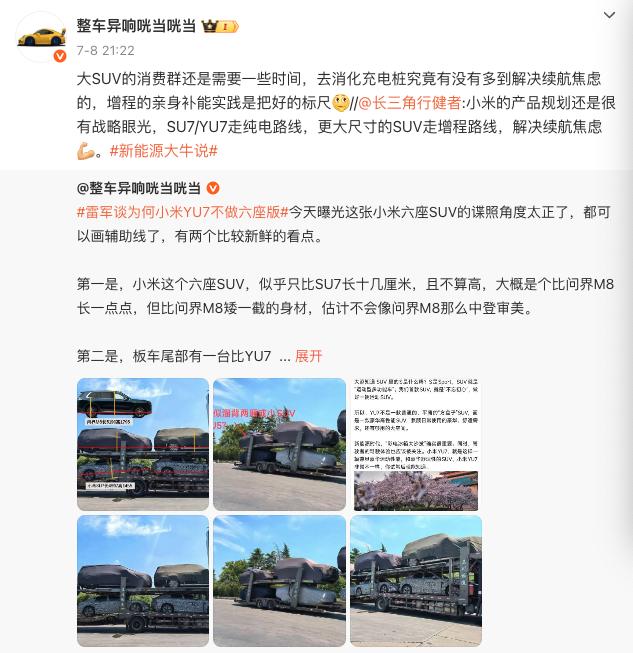
小米再曝 2 款新车,网友:又是爆款的节奏...
3 6 Ke· 2025-07-11 01:57
Core Insights - Xiaomi is rapidly expanding its automotive lineup, with new models including an extended-range SUV and a compact car, aiming to capture the youth market [1][4][20] - The first extended-range SUV, codenamed "Kunlun," is designed as a mid-large six-seat SUV, targeting family users with a sporty design [6][8] - The compact car is speculated to be a new model aimed at the entry-level market, potentially priced between 150,000 to 200,000 yuan, with a focus on electric options [17][19] Summary by Sections New Model Launches - Xiaomi's new extended-range SUV and a mysterious compact car have been revealed through leaked photos, indicating a strategic expansion in their vehicle offerings [4][6] - The SUV features three rows of seating and advanced driver-assistance systems, with a planned launch in 2026 [8][10] Market Positioning - The extended-range SUV enters a competitive market dominated by brands like Li Auto and Aion, which have already established strong sales [10][12] - Xiaomi's unique advantages include brand recognition, ecosystem integration, and a reputation for high value, which could help it penetrate the market despite existing competition [12][14] Production and Delivery - Xiaomi has delivered over 300,000 vehicles in 15 months, indicating a capacity to meet growing demand [14][16] - The company faces challenges related to production capacity and delivery timelines, which will be critical as it introduces new models [16][25] Strategic Approach - Xiaomi's strategy mirrors its smartphone approach, starting with high-performance models to build brand prestige and gradually introducing more affordable options to attract a broader customer base [20][22] - The introduction of a lower-priced entry model could further enhance Xiaomi's market presence and appeal to young families [19][22] Future Outlook - With the successful launch of the SU7 and YU7, along with upcoming models, Xiaomi's automotive prospects appear promising despite potential challenges [25]