
小绿洲

Search documents
帮别人种草的小红书,为什么自己卖不好货?
3 6 Ke· 2026-02-10 01:11
Core Insights - The article discusses the paradox of Xiaohongshu's (Little Red Book) marketing model, where the platform excels in content creation but struggles with direct sales, leading to the closure of its self-operated e-commerce initiatives [1][21][22] - The concept of "lifestyle economy" is introduced, emphasizing the need to return to individual consumer demands, which Xiaohongshu aims to address through its unique positioning in the market [4][10][11] Group 1: Marketing and Consumer Trust - Xiaohongshu's "grass planting" (种草) strategy has been criticized as potentially misleading, with some industry insiders equating it to fraud [1] - The trust factor diminishes when content shifts from being observational to promotional, indicating a fragile balance between user trust and commercial intent [2][3] - The platform's attempt to integrate product links into user-generated content has been deemed ineffective and not user-friendly [4] Group 2: Non-standard Products and Market Positioning - Xiaohongshu's business model focuses on non-standard products, differentiating itself from traditional e-commerce platforms like Taobao and JD [5][8] - The success of brands like Berghaus on Xiaohongshu illustrates the platform's ability to cater to niche consumer needs that mainstream e-commerce may overlook [7][9] - The term "non-mainstream" is used to describe Xiaohongshu's unique market positioning, which allows for the promotion of products that may not perform well on conventional platforms [9] Group 3: Challenges in E-commerce - Xiaohongshu's attempts at e-commerce have faced significant challenges, leading to the closure of its self-operated platforms, including "Xiaolvzhou" and "Welfare Society," which had been operational for nine years [21][22] - The platform's struggle to create a transaction closure despite strong "grass planting" capabilities raises questions about its role in the consumer decision-making process [22][24] - The shift to a buyer model, focusing on non-standard aesthetic transformations, reflects Xiaohongshu's ongoing struggle to balance content purity with commercial viability [23][24] Group 4: Trust and Content Saturation - The proliferation of low-quality content and the rise of industrialized sharing practices have eroded user trust, leading to a decline in the effectiveness of the "grass planting" strategy [17][18] - Users have expressed dissatisfaction with misleading content, which has resulted in a negative perception of the platform, often referred to as the "filter trap" [18] - The saturation of promotional content has diminished the core value of authenticity that Xiaohongshu initially offered [18]
仅运营3个月!小红书关停「最短命」项目,商家斥责「交钱后没人管」
Xin Lang Ke Ji· 2025-12-10 00:56
Core Insights - Xiaohongshu's "Xiaohong Card" project will be suspended from January 1, 2026, after only three months of trial operation, indicating a significant setback in its local lifestyle services initiative [1][7] - The company cited insufficient preparation and failure to meet user and merchant expectations as reasons for the suspension, highlighting widespread dissatisfaction among both users and merchants [2][5] Group 1: Project Overview - The "Xiaohong Card" was launched in September 2025 in Shanghai, Hangzhou, and Guangzhou, aimed at providing discounts for users at selected stores for an annual fee of 168 yuan [1][4] - Users reported poor experiences, including lack of communication regarding card benefits and expiration, leading to dissatisfaction and loss of rights [4][2] Group 2: Merchant Feedback - Merchants expressed frustration over the lack of service and support after paying for certification to become part of the program, with complaints about unfulfilled promises and inadequate follow-up [2][5] - A specific case highlighted a merchant's experience of paying nearly 600 yuan for certification but receiving no support or training, leading to significant disappointment [4][5] Group 3: Market Analysis - Analysts suggest that the rapid failure of the "Xiaohong Card" reflects a misjudgment by Xiaohongshu regarding the local lifestyle market, where convenience and cost-effectiveness are crucial [7][12] - The company's attempt to implement a high-threshold membership model contrasts with competitors like Meituan and Douyin, which offer free options and a wider selection, indicating a potential misalignment with consumer preferences [7][12] Group 4: Broader Business Challenges - The suspension of the "Xiaohong Card" is part of a broader trend of Xiaohongshu facing challenges in its commercialization efforts, including the recent shutdown of its self-operated e-commerce platforms [8][10] - Industry experts note that Xiaohongshu's attempts to integrate e-commerce with social media have not translated into sustainable revenue, as users often prefer to purchase from established platforms like Taobao and JD after being influenced by Xiaohongshu [10][12]

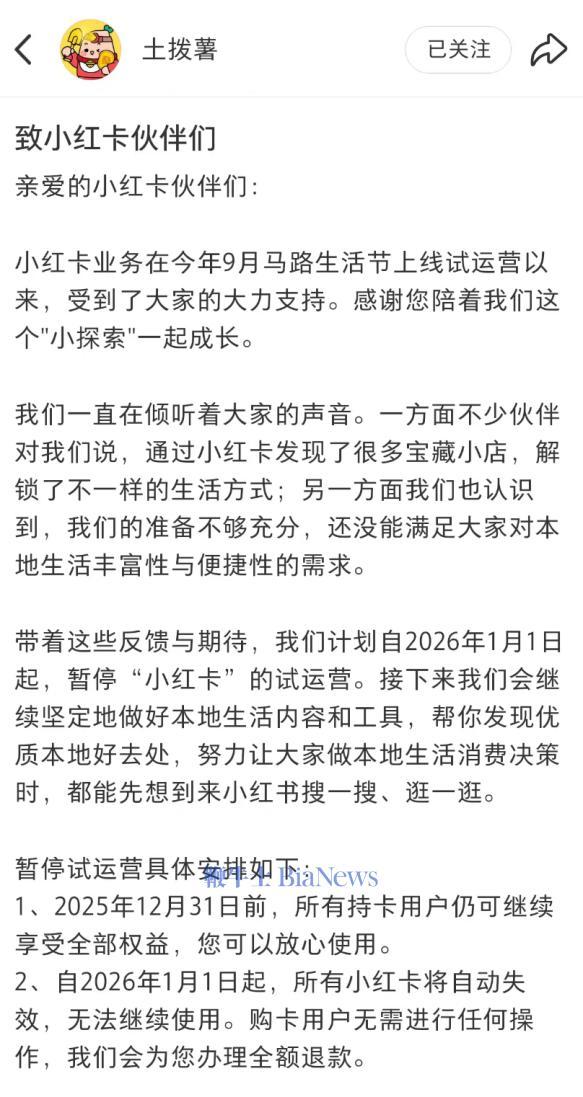
仅运营3个月! 小红书关停“最短命”项目,商家斥责“交钱后没人管” | BUG
Xin Lang Cai Jing· 2025-12-10 00:32
Core Viewpoint - Xiaohongshu's "Xiaohong Card" project, launched in September 2023, will be suspended from January 1, 2026, due to insufficient preparation and failure to meet user and merchant expectations [2][13][18] User Experience - Users reported dissatisfaction with the Xiaohong Card, citing a lack of functionality and unfulfilled benefits, leading to the expiration of their rights [4][15] - Complaints included a lack of reminders for card benefits and usage deadlines, indicating inadequate preparation by the company [4][15] Merchant Experience - Merchants expressed frustration over the lack of service and support after paying for certification, with one merchant stating that promised services were not delivered [5][16] - Merchants were promised various benefits, including platform traffic support and participation in promotional events, but many felt these were not realized [5][16] Market Analysis - Analysts criticized Xiaohongshu's approach to local services, arguing that the membership model lacks price advantages and coverage compared to competitors like Meituan and Douyin [18][21] - The high membership fee of 168 yuan for limited discounts was seen as a barrier for users, contradicting the demand for convenience and value [18][21] Business Challenges - The Xiaohong Card's quick failure reflects broader challenges in Xiaohongshu's commercialization efforts, which have seen multiple setbacks in recent years [9][20] - The company has previously attempted various business models, including self-operated e-commerce, but has faced difficulties in converting user engagement into revenue [20][22] Expert Opinions - Industry analysts described the Xiaohong Card as a "chicken rib," indicating that it offers little value in a competitive market dominated by larger platforms [21][22] - The failure of the Xiaohong Card is viewed as a necessary pause for the company to reassess its strategy in the local service sector [21][22]

小红书“小众旅游”孤掌难鸣
Xin Hua Wang· 2025-08-12 05:55
Core Insights - Xiaohongshu is actively trying to establish a closed-loop e-commerce model by focusing on the camping market, but its current conversion rate remains low, with less than 15% of users making purchases after being attracted to the platform [1][2][3] Group 1: Market Entry and Performance - Xiaohongshu began exploring the camping market in March 2022 and officially entered the market in August 2022, becoming one of the first platforms to do so in China [2] - The platform's "Summer Camping Project" launched in August 2023, offering camping vouchers to attract users, but the actual transaction rate has not met expectations [1][3] - The number of camping-related notes on Xiaohongshu has reached 4.17 million, surpassing the previous leading category of beauty notes [1] Group 2: Challenges in E-commerce - Xiaohongshu has simplified its e-commerce project "Xiaolvzhou" to focus on outdoor lifestyle products, particularly camping gear, but faces challenges in converting user interest into sales [3][4] - The platform's longer transaction chain compared to competitors like Ctrip and Meituan makes it harder for users to complete purchases, as they must navigate through multiple steps [3][4][7] - Xiaohongshu's user base is relatively small, and the platform lacks essential features like flight and hotel bookings, which limits its ability to create a complete commercial ecosystem [4][6] Group 3: Competitive Landscape - The camping market has seen a significant increase in competition, with the number of local camping businesses tripling in early 2023 [2] - Xiaohongshu's marketing efforts have not translated into expected user engagement, with a noticeable decline in users sharing their experiences on the platform compared to previous years [5] - The platform's advertising revenue still constitutes a significant portion of its overall income, with e-commerce revenue remaining below 20% [6]
