
小红书APP

Search documents
亿级 APP 存在大量儿童软色情内容,实名形同虚设
程序员的那些事· 2026-03-15 09:40
Core Viewpoint - The article highlights the prevalence of soft pornography targeting minors on major social media platforms, particularly focusing on the app Xiaohongshu, which has been downloaded nearly 30 billion times. This issue has gained significant attention, especially on Consumer Rights Day, March 15 [1]. Group 1 - The platform Xiaohongshu allows users to bypass real-name authentication by simply setting their age to 15, leading to the promotion of sexually suggestive novels, images, and inappropriate interactions [2]. - Comments sections under tags like "junior high school girls ask anything" and "sixth-grade girls answer questions" are filled with vulgar harassment towards underage girls, with users reporting frequent offensive private messages [2]. - Some accounts on the platform are deliberately creating content that sexualizes children, such as showcasing children in adult-like clothing and poses, which has been legally classified as soft pornography involving minors [2]. Group 2 - Other major apps like Momo, Soul, and Tahu also exhibit similar issues, with ineffective age verification and rampant inappropriate content [2]. - A new regulation effective from March 1, 2026, prohibits the promotion of sexually suggestive content to minors, with platforms facing fines of up to one million for violations [2].


帮别人种草的小红书,为什么自己卖不好货?
3 6 Ke· 2026-02-10 01:11
Core Insights - The article discusses the paradox of Xiaohongshu's (Little Red Book) marketing model, where the platform excels in content creation but struggles with direct sales, leading to the closure of its self-operated e-commerce initiatives [1][21][22] - The concept of "lifestyle economy" is introduced, emphasizing the need to return to individual consumer demands, which Xiaohongshu aims to address through its unique positioning in the market [4][10][11] Group 1: Marketing and Consumer Trust - Xiaohongshu's "grass planting" (种草) strategy has been criticized as potentially misleading, with some industry insiders equating it to fraud [1] - The trust factor diminishes when content shifts from being observational to promotional, indicating a fragile balance between user trust and commercial intent [2][3] - The platform's attempt to integrate product links into user-generated content has been deemed ineffective and not user-friendly [4] Group 2: Non-standard Products and Market Positioning - Xiaohongshu's business model focuses on non-standard products, differentiating itself from traditional e-commerce platforms like Taobao and JD [5][8] - The success of brands like Berghaus on Xiaohongshu illustrates the platform's ability to cater to niche consumer needs that mainstream e-commerce may overlook [7][9] - The term "non-mainstream" is used to describe Xiaohongshu's unique market positioning, which allows for the promotion of products that may not perform well on conventional platforms [9] Group 3: Challenges in E-commerce - Xiaohongshu's attempts at e-commerce have faced significant challenges, leading to the closure of its self-operated platforms, including "Xiaolvzhou" and "Welfare Society," which had been operational for nine years [21][22] - The platform's struggle to create a transaction closure despite strong "grass planting" capabilities raises questions about its role in the consumer decision-making process [22][24] - The shift to a buyer model, focusing on non-standard aesthetic transformations, reflects Xiaohongshu's ongoing struggle to balance content purity with commercial viability [23][24] Group 4: Trust and Content Saturation - The proliferation of low-quality content and the rise of industrialized sharing practices have eroded user trust, leading to a decline in the effectiveness of the "grass planting" strategy [17][18] - Users have expressed dissatisfaction with misleading content, which has resulted in a negative perception of the platform, often referred to as the "filter trap" [18] - The saturation of promotional content has diminished the core value of authenticity that Xiaohongshu initially offered [18]
小红书“管”得住用户吗?
3 6 Ke· 2026-01-22 12:47
Core Insights - Xiaohongshu is undergoing a significant ecological challenge as it balances community values with commercial expansion, highlighted by the launch of its Community Charter 2.0 on January 19, which includes 25 new guidelines aimed at promoting friendly interactions and opposing divisive behavior [1][3][6] Group 1: Community Governance - The platform has evolved from a simple shopping list sharing tool to a content community with over 3.5 billion monthly active users, generating 9 million posts daily and encompassing 2,500 active interest groups [1] - Xiaohongshu's governance has shifted from reactive measures, such as the 2019 KOL cleanup, to a more structured approach with the introduction of Community Charter 1.0 in 2021, which emphasized core values of sincere sharing and friendly interaction [7][10] - The latest Community Charter 2.0 merges community and commercial guidelines, introducing a new section on "orderly operation" to unify community behavior with commercial practices [6][8] Group 2: Content and Commercialization Challenges - The platform faces challenges from issues like flaunting wealth, false marketing, and AI-generated content, which threaten the community's core asset of genuine sharing and friendly interaction [3][10] - Xiaohongshu's rapid growth has led to a complex ecosystem where commercial interests often conflict with community trust, necessitating a delicate balance between governance and user engagement [19][20] - The platform's ambition to expand its e-commerce capabilities is evident, with projections of tripling profits to $3 billion in 2025, despite facing competition and the need for differentiation in a crowded market [23][25] Group 3: Future Directions and Strategies - Xiaohongshu is exploring various e-commerce models, including live-streaming and lifestyle e-commerce, to enhance user engagement and drive sales [23][25] - The platform's governance is not merely a regulatory measure but a strategic necessity to maintain user trust and community integrity, which are essential for long-term competitiveness [25][26] - The ongoing challenge for Xiaohongshu is to find a sustainable balance between community values and commercial interests, ensuring that governance supports rather than hinders growth [25][26]

强攻中长视频,小红书摸着抖音过河?
3 6 Ke· 2025-12-25 02:06
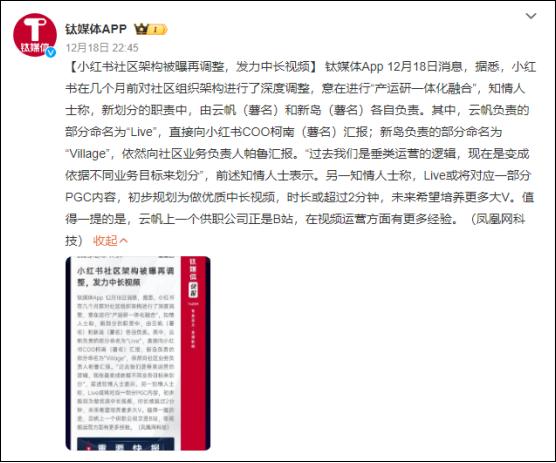
Core Insights - Xiaohongshu is undergoing a significant organizational restructuring, shifting its focus from vertical content operations to a more integrated model that emphasizes mid-to-long video content and top creators [2][5][10] Group 1: Organizational Changes - Xiaohongshu has established two new divisions, "Live" and "Village," to enhance its community structure and focus on different business objectives [2][4] - The "Live" division will concentrate on professional content production (PGC) and aims to cultivate more top influencers, while the "Village" division will focus on increasing user engagement through user-generated content (UGC) [4][5] Group 2: Strategic Shift - The core logic behind this restructuring is to move away from vertical content categorization (e.g., beauty, automotive) to a model based on business goals, such as enhancing user activity and nurturing top creators [5][6] - Xiaohongshu's goal for 2023 is to increase its daily active users (DAU) from 100 million to 300 million, necessitating new content forms to boost user engagement and attract new users [7][9] Group 3: Video Content Focus - Video content consumption and publication have become a significant portion of overall content on the platform, indicating a shift in user preferences [7][8] - The platform's internal research shows a higher demand for video notes compared to the supply of video content, highlighting an opportunity for growth in this area [8] Group 4: Competitive Landscape - Xiaohongshu faces intense competition from platforms like Douyin, Bilibili, and WeChat Video, necessitating a rapid expansion into the video space [9][12] - The push for mid-to-long video content is seen as a response to the success of competitors, with Xiaohongshu aiming to create its own "super influencers" to drive growth [12][17] Group 5: Future Directions - The establishment of the "Live" division marks a new phase in Xiaohongshu's video strategy, with a clear focus on high-quality mid-to-long videos as a core direction [17] - The platform is also evolving into a comprehensive app, expanding into local services, short dramas, and entertainment live streaming, which is a common path for platforms seeking to overcome growth bottlenecks [18]
上春晚,豆包迎来微信红包时刻
3 6 Ke· 2025-12-23 10:29
Core Viewpoint - ByteDance's Doubao has secured its position as the exclusive AI cloud partner for the 2026 Spring Festival Gala, indicating its growing influence in the AI application market and its strategic importance in engaging users through interactive AI features [2]. Group 1: Historical Context of AI Applications in Spring Festival Gala - In 2015, WeChat introduced the "Shake to Grab Red Packets" feature during the Spring Festival Gala, resulting in 10.1 billion total red packets sent and received, and adding 100 million new bank card users overnight [3]. - In 2016, Alibaba's Alipay launched the "Collect Five Blessings" campaign, spending 269 million yuan to enhance its market share and establish a new tradition of collecting blessings during the New Year [3]. - The year 2017 saw a pause in the red packet competition, with no new internet interactive partnerships, marking a period of adjustment for major players [3]. - In 2018, Taobao re-ignited the competition by distributing over 1 billion yuan in cash red packets and integrating shopping with the Spring Festival Gala, significantly boosting its user base [4]. - In 2019, Baidu spent 900 million yuan on red packets, aiming to promote its payment services, although its impact was limited compared to other platforms [5]. - In 2020, Kuaishou became the first non-BAT partner, distributing 1 billion yuan in red packets and introducing a video-like feature, marking its entry into mainstream visibility [5]. - In 2021, Douyin issued 2 billion yuan in red packets, achieving 703 billion interactions and solidifying its position in the short video market [6]. - In 2022, JD.com returned as a partner, offering 1.5 billion yuan in red packets and emphasizing its low-price strategy amid fierce competition [6]. - By 2023, the trend of cash red packets diminished, with major platforms focusing on refined operations rather than large-scale giveaways [6]. Group 2: Doubao's Competitive Landscape and Strategy - In 2025, Doubao faced significant competition from DeepSeek, which achieved 40 million downloads in less than a month, while Doubao only gained 5.7 million downloads during the same period [9]. - ByteDance responded by enhancing Doubao's capabilities, launching version 1.6, which surpassed DeepSeek in technical assessments, achieving a score of 68.04 compared to DeepSeek's 66.15 [10]. - Doubao's cost efficiency improved significantly, reducing the comprehensive cost of its deep thinking capabilities by 63%, making it more attractive to developers [10]. - The marketing strategy shifted towards community engagement, targeting the college demographic and capturing approximately 48 million students through campus initiatives [11]. - By November 2025, Doubao's monthly active users reached 172 million, while DeepSeek's declined to 144 million, marking a decisive shift in market leadership [13].

站在2025年底,小红书商业正跨过一个新门槛
3 6 Ke· 2025-12-19 02:57
Core Insights - Xiaohongshu has achieved significant commercial milestones, with a recent live stream generating a GMV of 1.5 billion, doubling its previous performance and setting a new benchmark for buyers [1] - The company is undergoing a transformation in its business strategy, moving from a cautious approach to a more aggressive commercialization model [3] Group 1: Commercial Strategies - Xiaohongshu has launched the "Red Cat Plan" in collaboration with Alibaba, allowing users to seamlessly transition from product discovery to purchase on Tmall, while also enabling merchants to track data from interest to transaction [4] - Following the "Red Cat Plan," Xiaohongshu introduced the "Red Jing Plan" with JD.com, indicating a broader strategy to partner with multiple platforms for direct product promotion [4] - The introduction of the "Market" feature in August, prominently placed on the app's homepage, signals Xiaohongshu's commitment to enhancing its closed-loop e-commerce capabilities [12] Group 2: User Engagement and Data Insights - Xiaohongshu users exhibit high purchasing intent, with 120 million daily screenshots of notes and over 6 million requests for links in comments, highlighting the platform's unique position in the social media landscape [8] - The "Direct Promotion" feature has led to over 100 products achieving sales exceeding 10 million during the Double 11 shopping festival, demonstrating the effectiveness of Xiaohongshu's commercial strategies [10] - The platform's data openness allows businesses to track the entire user journey from content exposure to interaction and conversion, facilitating user growth and engagement [16] Group 3: Market Adaptation and Future Directions - Xiaohongshu is evolving its marketing approach to emphasize measurable outcomes, responding to businesses' demands for clear results rather than vague metrics like brand exposure [13] - The company is addressing the challenge of balancing open collaboration with maintaining its own e-commerce business, as external partnerships could potentially impact its closed-loop sales [10][12] - As the market landscape changes, Xiaohongshu aims to build a native commercial system that serves various industries, moving beyond traditional advertising and e-commerce [20]

AMA在小红书火了,能否打破增长天花板?
2 1 Shi Ji Jing Ji Bao Dao· 2025-12-18 13:16
Core Insights - The AMA (Ask Me Anything) format is gaining popularity on Xiaohongshu, with notable figures participating, indicating a shift in user engagement and content interaction [1][3][6] - Xiaohongshu is actively seeking to diversify its content and user base, moving beyond traditional areas like beauty and lifestyle to include technology, literature, and other verticals [3][8][9] Group 1: AMA Popularity and Impact - The number of posts related to the ask me anything topic has surged by 17 times in the last three months, with a total reading volume of nearly 370 million [2][6] - The AMA format allows for real-time interaction between users and influential figures, fostering a sense of community and engagement [5][7] - Xiaohongshu's strategy includes inviting prominent figures from various fields to participate in AMAs, which has broadened the platform's content scope [6][9] Group 2: Strategic Shifts and Challenges - Xiaohongshu is transitioning from a "lifestyle guide" to an "interest community," reflecting its ambition to break through growth bottlenecks and explore new content forms [3][8][10] - The platform has faced challenges in monetization and has seen previous projects like "福利社" and "小绿洲" shut down, indicating difficulties in converting traffic into transactions [8][10] - The introduction of the AMA format is part of a broader strategy to attract diverse users and enhance user engagement, but sustainable monetization remains a challenge [10][11]
QuestMobile2025年新媒体生态盘点:五大平台月活用户达11.49亿,多元内容与算法技术差异化竞争,年轻用户更爱跨平台
3 6 Ke· 2025-12-16 05:43
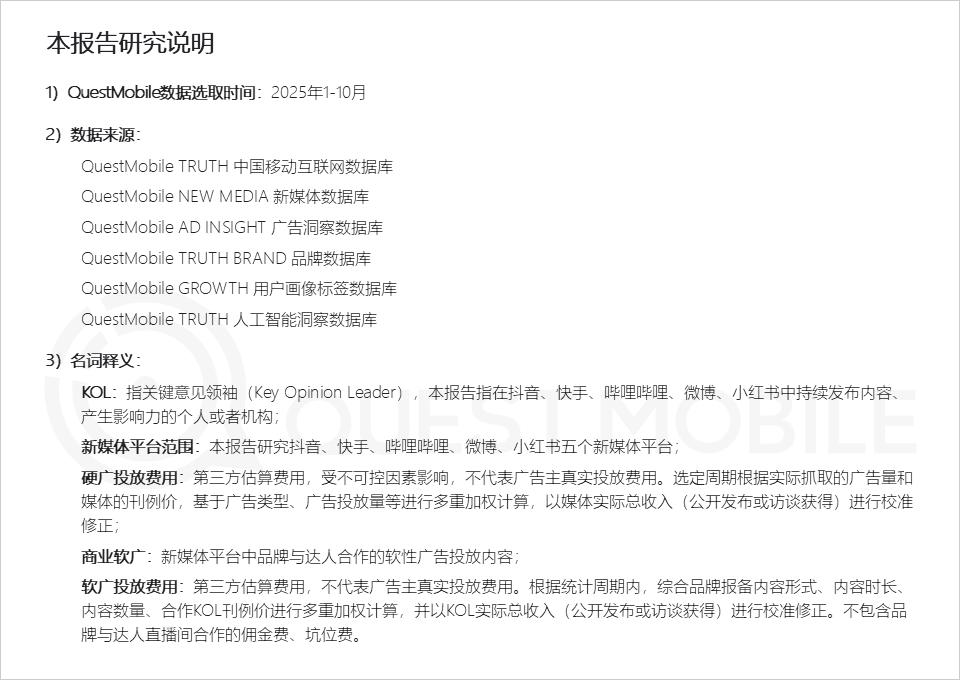
Core Insights - The active user base of typical new media platforms is projected to reach 1.149 billion by October 2025, with an average monthly usage time of 3,367.5 minutes, reflecting year-on-year growth of 7.3% and 5.4% respectively, indicating increasing user engagement driven by diverse content and algorithmic recommendations [1] User Demographics and Behavior - The competitive landscape among platforms has stabilized, with distinct user demographics: platforms like Weibo, Xiaohongshu, and Bilibili have a significant proportion of users under 30 years old, at 58.6%, 54.2%, and 66.5% respectively, while Douyin and Kuaishou have 22.2% and 22.6% of users aged 51 and above [1] - Users are increasingly adopting a multi-platform usage habit, with 39.8% of users engaging with three or more new media platforms, and 54.2% of these users are under 30 years old [1] Content and Platform Dynamics - New media platforms are capturing user attention through enhanced content quality and technology, leading to deeper user engagement [7] - The growth in user engagement time is increasingly reliant on content quality and recommendation technology rather than just user base expansion [12] - Platforms are shifting from merely attracting users to seeking them across various scenarios, enhancing flow through capability output and ecosystem integration [14] User Segmentation and Growth Drivers - The competition is becoming more segmented, with growth driven by diverse user groups, including younger and older demographics, as well as lower-tier markets [17] - Multi-faceted users, primarily young and high-spending, are using different platforms to meet various needs such as socializing, entertainment, and learning, fostering a complementary ecosystem among platforms [20] Content Ecosystem Characteristics - Platforms are transitioning from broad traffic competition to enhancing their unique ecological characteristics, with strategies tailored to their specific user bases [23] - AI-related content has seen a 9.9 percentage point increase in user penetration year-on-year, with younger male users showing a higher interest [26] - The rise of knowledge-based influencers reflects a shift in user demand from entertainment to practical value [32][38] Commercialization Strategies - New media platforms are entering a phase of strategic deepening in commercialization, with hard advertising revenues leading the way [40] - The unique characteristics of platform ecosystems are shaping differentiated advertising models, with soft advertising becoming a significant monetization method [42] - Platforms are enhancing local business strategies, extending their reach from online to offline commerce, with various initiatives to support local merchants [54]
QuestMobile2025年新媒体生态盘点:五大平台月活用户达11.49亿,多元内容与算法技术差异化竞争,年轻用户更爱跨平台
QuestMobile· 2025-12-16 02:01
Core Insights - The article discusses the evolving landscape of new media platforms and their user engagement trends, highlighting the growth in active users and usage duration by 2025 [4][5][6]. User Engagement and Demographics - By October 2025, the active user base of typical new media platforms is projected to reach 1.149 billion, with an average monthly usage time of 3367.5 minutes, reflecting year-on-year growth of 7.3% and 5.4% respectively [5]. - Platforms like Weibo, Xiaohongshu, and Bilibili show a significant concentration of users under 30 years old, with respective proportions of 58.6%, 54.2%, and 66.5%, while Douyin and Kuaishou have 22.2% and 22.6% of users aged 51 and above [5][6]. Multi-Platform Usage - A notable trend is the combination usage of multiple platforms, with 39.8% of users engaging with three or more new media platforms, particularly among users under 30 (54.2%) and those from first and new first-tier cities (31.6%) [6]. Content Quality and User Attention - The article emphasizes that the growth in user engagement is increasingly driven by content quality and algorithmic recommendations rather than just user base expansion [18]. - New media platforms are focusing on enhancing user attention through improved content quality and technology, leading to deeper user participation [13][18]. Competitive Landscape - The competitive landscape among platforms is stabilizing, with distinct user demographics and content strategies emerging. Platforms are shifting from broad traffic competition to focusing on unique ecological characteristics and user engagement [30][32]. - The rise of AI content and tools is reshaping user engagement, with a 9.9 percentage point increase in AI-related content penetration among users by October 2025 [34][36]. Monetization Strategies - New media platforms are entering a phase of strategic deepening in monetization, with hard advertising revenues leading the way. The unique characteristics of each platform are shaping differentiated advertising models [48][50]. - Soft advertising is becoming a significant revenue stream, with brands selecting platforms based on their marketing goals, reflecting the alignment of KOL income with platform content and user expectations [54]. Local Business Integration - Platforms are increasingly integrating local businesses into their ecosystems, transitioning from rapid growth to a more stable phase in local merchant numbers [63].



5家消费公司拿到新钱;豆包手机陷入无法使用微信争议;蜜雪冰城开始卖早餐了|创投大视野
3 6 Ke· 2025-12-07 06:33
Group 1: Company Financing - The high-end gold jewelry brand "寶蘭" has completed over 100 million RMB in Series A financing, led by Challenger Capital, with funds allocated for brand enhancement, multi-channel layout, supply chain resilience, and talent empowerment [1] - The smart delivery company "江苏云闪送" has announced a completion of 30 million RMB in Series A financing, focusing on upgrading its intelligent scheduling system, expanding its national service network, and building a logistics ecosystem [2] - AI video generation platform Pollo AI has raised 14 million USD in financing, with over 20 million registered users and achieving breakeven in May this year [3] - Robotics company "优理奇机器人" has completed a total of 300 million RMB in financing across two rounds, indicating market recognition of its integrated strategy in embodied intelligence [4] - "戴盟机器人" has completed a strategic round of financing worth over 100 million RMB, aimed at advancing technology breakthroughs and global market expansion [5] Group 2: Company Developments - The launch of the "豆包手机助手" on the nubia M153 has faced issues with WeChat login, leading to the discontinuation of this feature by ByteDance [6][7] - The Taiwanese authorities have announced a one-year ban on the app Xiaohongshu, citing security concerns, although the app remains accessible to many users [8][9] - Shanghai Linqingxuan Cosmetics Group has updated its IPO application, reporting a 98.3% year-on-year revenue growth in the first half of 2025 [10][12] - The breakfast initiative by "蜜雪冰城" is currently being tested in select cities, expanding its product offerings [14][15][16] - The launch of the winter product "豆乳黑麒麟" by Tea Baidao has achieved over 200,000 cups sold on its first day [17] - "奈雪的茶" has appointed actress Gao Yuanyuan as its brand ambassador and launched a low-GI fruit tea product [19] Group 3: Industry Insights - The 2025 holiday film season has surpassed 2.5 billion RMB in box office revenue, led by "疯狂动物城2" [20] - China's esports industry revenue reached 29.33 billion RMB in 2025, with a 6.4% year-on-year growth [21] - Global smartphone production reached 328 million units in Q3 2025, marking a 7% year-on-year increase [22]
