工银e生活

Search documents
迈向中国特色世界一流现代金融机构之路:总资产超53万亿后,工行正从“数字工行”向“数智工行”加速转型
财联社· 2026-03-28 03:06
Core Viewpoint - The article highlights the impressive financial performance of Industrial and Commercial Bank of China (ICBC) in 2025, showcasing its total assets exceeding 53 trillion yuan and a steady growth in net profit and operating income, while emphasizing the bank's commitment to digital transformation and financial technology investment [1][2]. Financial Performance - As of the end of last year, ICBC's total assets reached 53.48 trillion yuan, a year-on-year increase of 9.5% [2] - Customer deposits amounted to 37.31 trillion yuan, growing by 7.1% [2] - Total loans stood at 30.51 trillion yuan, with a growth of 7.5% [2] - Operating income was 8013.95 billion yuan, reflecting a 1.9% increase [2] - Net profit reached 3707.66 billion yuan, up by 1.0% [2] Digital Transformation and Financial Technology - ICBC is actively embracing AI and big data technologies, transitioning from a "digital bank" to a "smart bank" [1] - The bank's financial technology investment is projected to reach 285.88 billion yuan by 2025 [3] - ICBC has implemented over 500 AI applications across more than 30 business areas, enhancing investment trading, marketing, risk control, and operational efficiency [10] Talent Development - The bank is focusing on building a comprehensive technology talent system, with over 40,000 technology data professionals and a talent reserve team of more than 3,200 international talents [4] - ICBC emphasizes the importance of "π-type" talents who possess both broad and deep expertise to navigate the challenges posed by AI [5] Technological Achievements - ICBC ranks first in the banking industry for patent filings and has been recognized for its digital transformation capabilities [6] - The bank has received multiple awards for its technological innovations, including recognition from the People's Bank of China for its fintech achievements [6] Security and Reliability - ICBC maintains a high information system availability rate of over 99.99%, ensuring stable operations during critical periods [7] - The bank is enhancing its data security governance mechanisms and conducting regular risk assessments to protect data integrity [7] Future Outlook - ICBC aims to strengthen its digital capabilities and continue integrating advanced technologies like AI into its operations, focusing on intelligent, smart, and efficient financial services [12]



工商银行:春节假期交易量较历史高峰增长近9%
Xin Hua Cai Jing· 2026-02-26 07:21
Group 1 - The core viewpoint of the articles highlights the significant growth in transaction volumes and consumer lending by the Industrial and Commercial Bank of China (ICBC) during the Spring Festival holiday, with transaction volume reaching a new high, up nearly 9% from historical peaks [1] - Payment settlement transactions saw a notable increase, with the number of quick payment transactions rising by nearly 44% year-on-year and transaction amounts increasing by 10% [1] - The number of merchant transactions grew by nearly 12% year-on-year, with transaction amounts increasing by over 19%, particularly driven by a more than 90% increase in transactions and amounts from foreign visitors to China [1] Group 2 - In terms of consumer credit, ICBC issued nearly 29 billion yuan in personal consumption loans since February, with the "Rong E Borrow" credit loan service enabling 24/7 on-demand applications, rapid approvals, and immediate disbursements, resulting in a more than 30% increase in daily loan amounts compared to the same period last year [1] - The bank effectively implemented personal consumption loan interest subsidy policies, with over 330,000 instances of interest subsidies for consumption loans and installment payments during the Spring Festival holiday [1] - Online services saw a significant uptick, with active users of the mobile banking app increasing by over 9% year-on-year and transaction volumes rising by over 10% during the holiday [1] Group 3 - The bank ensured a reasonable number of open branches during the holiday, focusing on service coverage in key areas such as commercial streets, residential areas, major transportation hubs, and popular tourist attractions, resulting in a nearly 23% year-on-year increase in the number of customers served and over 15% growth in business volume [2]
中国工商银行将在10月25日至10月26日对系统进行升级维护
Jin Tou Wang· 2025-10-24 03:30
Core Points - The announcement from Industrial and Commercial Bank of China (ICBC) regarding system upgrades scheduled from October 25 to October 26, 2025, aims to enhance service quality [1] - During the upgrade, various banking services will be temporarily suspended, while others will remain operational [1] Summary by Category System Upgrade Details - The system upgrade will take place from October 25 to October 26, 2025, to improve service quality [1] - Online banking, mobile banking, self-service terminals, telephone banking, and corporate connectivity will continue to operate, but some specific services will be temporarily unavailable [1] Suspended Services - Personal mobile banking will suspend credit card issuance, limit adjustments, and installment services from October 25, 22:30 to 23:30 [1] - ICBC e-Life will halt asset diagnosis, rights exchange, personal risk assessment, and private banking client information queries from October 25, 23:00 to October 26, 01:00 [1] - Personal online banking will pause wish investment, automatic purchases, and other related services from October 25, 22:30 to 23:15 [1] - Corporate mobile banking will suspend various services including settlement package inquiries and fund aggregation from October 26, 04:00 to 06:00 [1] - Telephone banking for corporate clients will be unavailable for authentication and information queries from October 26, 04:00 to 06:00 [1] - Other services such as livelihood fund supervision and smart legal services will be suspended on October 25, 20:00 to 21:30 [1] - Maintenance of ICBC's service agreements across all channels will occur from October 26, 02:00 to 03:20 [1]
那些年,银行追“过头”的潮流
Xin Lang Cai Jing· 2025-10-22 06:43
Core Insights - The banking industry is witnessing a decline in previously popular digital banking services, such as direct banks and credit card apps, which were once seen as innovative solutions in the "internet ecosystem" era [1][3][4] - The shift from internet-based services to AI-driven solutions is becoming evident, with banks now focusing on integrating AI technologies into their operations [8][11] Group 1: Decline of Digital Banking Services - Many banks are shutting down or merging their direct banking services and credit card apps, indicating a significant shift in strategy [3][4] - The direct banking model, initially aimed at creating a fully online banking experience, has struggled to differentiate itself and has often been seen as ineffective [4][5] - The performance of direct banks has been poor, with examples like "邮惠万家" losing over 800 million in three years, highlighting the challenges faced by these services [4] Group 2: Transition to AI - The banking sector is now transitioning from an internet focus to embracing AI technologies, with hopes of improving customer service and operational efficiency [8][11] - Despite the enthusiasm for AI, many banks still struggle with basic app functionality, indicating a gap in meeting user needs [9][11] - The application of AI in banking is still in its early stages, and while it has potential benefits, there are concerns about user experience and the effectiveness of AI-driven customer service [11][12] Group 3: User-Centric Innovation - The success of banking innovations hinges on understanding and addressing user needs rather than merely adopting industry trends [7][11] - The decline in user engagement with banking apps suggests that banks must prioritize improving user experience to remain relevant [6][7]
中行关停“缤纷生活”信用卡APP
3 6 Ke· 2025-10-20 03:04
Core Insights - The article discusses the trend of banks merging multiple apps to streamline operations amid rising competition and high customer acquisition costs, with Bank of China (BOC) announcing the shutdown of its "Bountiful Life" app and migrating its functions to the main "Bank of China" app, marking the end of a 12-year service [1][4] - The credit card apps have historically served dual purposes: connecting online and offline channels for customer acquisition and creating digital profiles for targeted financial services, but the profitability of standalone credit card apps is declining [2][10] Industry Trends - Several banks, including Shanghai Rural Commercial Bank and Beijing Rural Commercial Bank, have closed their credit card apps, shifting functionalities to their main banking apps due to the shrinking credit card business and the need for cost efficiency [4][16] - The credit card business is facing significant challenges, including a drop in loan volumes and increased competition from other financial services, leading to a focus on customer retention rather than acquisition [10][13] User Engagement - User engagement with banking apps is declining, with average daily usage time dropping from 4.93 minutes to 2.70 minutes, indicating a saturation in mobile banking app traffic and a need for improved user experience [9][6] - The competition for user attention is intensifying, with lifestyle apps from companies like Meituan and Douyin entering the market, making it harder for credit card apps to attract new users [15][19] Financial Performance - Data shows that major banks are experiencing a decline in credit card loan volumes, with Bank of China reporting a 13.89% decrease year-over-year, highlighting the overall downturn in the credit card sector [5][16] - The credit card market is transitioning from a growth phase to a more mature stage, with banks needing to adapt their strategies to meet the evolving demands of younger consumers who prefer integrated financial services [17][19] Strategic Recommendations - Banks are encouraged to enhance the synergy between online and offline channels and focus on creating differentiated digital paths that align with their unique characteristics, rather than pursuing a one-size-fits-all approach [23][24] - Implementing advanced data analytics and AI-driven models could help banks better understand customer needs and improve service delivery, ultimately enhancing user experience and operational efficiency [21][22]

首现国有大行关停信用卡App
21世纪经济报道· 2025-10-13 12:35
Core Viewpoint - The recent shutdown of credit card apps, particularly by major state-owned banks like Bank of China, reflects a broader trend in the banking industry towards consolidating digital services and reducing operational costs amid a shrinking credit card business [1][5][16]. Group 1: Credit Card App Shutdowns - Bank of China announced the gradual shutdown of its "Bountiful Life" app, migrating its functions to the main "Bank of China" app, which has drawn market attention [1][4]. - Several banks, including Shanghai Rural Commercial Bank and Beijing Rural Commercial Bank, have previously shut down their credit card apps, indicating a trend towards integrating these services into existing banking apps [5][6]. Group 2: Market Dynamics and User Engagement - The credit card app market is experiencing significant differentiation, with major state-owned banks and some joint-stock banks dominating user engagement metrics [7][8]. - As of June 2025, the top credit card apps by monthly active users include those from major banks, with Bank of China's "Bountiful Life" app ranking 13th with 1.5454 million active users, significantly lower than leading apps [7][8]. Group 3: Credit Card Loan Performance - State-owned banks maintain a strong position in credit card loan volumes, with China Construction Bank reporting a credit card loan scale of 1.0549 trillion yuan, the only bank exceeding 1 trillion yuan [9][10]. - Joint-stock banks also show robust performance, with China Merchants Bank's credit card loan balance reaching 924.49 billion yuan, accounting for 12.99% of its total loans [9][10]. Group 4: Digital Transformation and App Management - The closure of independent credit card apps is part of a broader strategy for centralized management of banking applications, as mandated by regulatory authorities to optimize user experience and reduce redundancy [16][17]. - Banks are increasingly focusing on comprehensive apps that integrate various financial services, moving away from multiple standalone apps to enhance operational efficiency and customer engagement [17].







流量的游戏:冰与火之歌
3 6 Ke· 2025-09-02 08:10
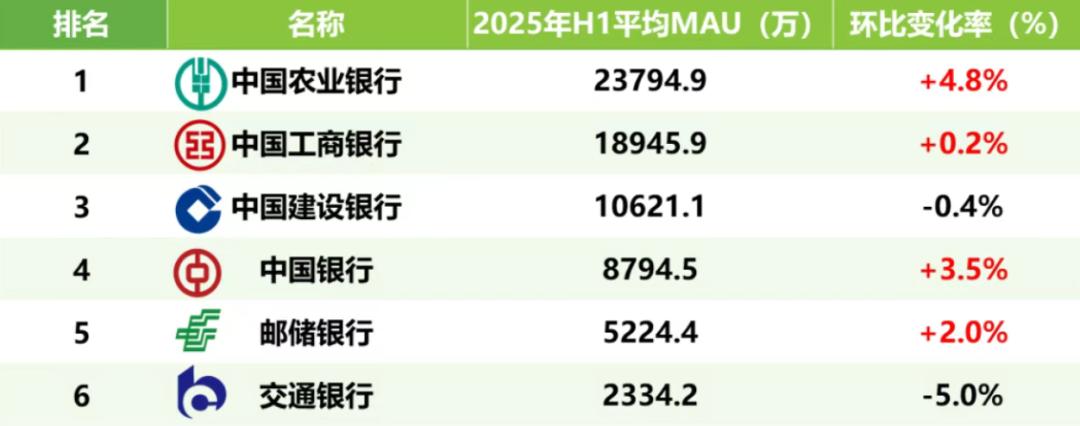
Core Insights - The digital transformation of commercial banks is entering a new phase, with increasing competition in banking apps and challenges such as insufficient personalized recommendations and product service homogenization [1] - Major state-owned banks are solidifying their leading positions by implementing diversified platform strategies, focusing on credit card services to enhance digital life services [2] User Engagement and Market Dynamics - As of the first half of 2025, the mobile banking app market has transitioned to a saturated competition phase, with user growth plateauing and daily usage time decreasing from 4.93 minutes to 2.70 minutes [3][4] - The six major state-owned banks maintain a dominant position in mobile banking user engagement, with Agricultural Bank of China leading with 238 million monthly active users (MAU), a 4.8% year-on-year increase [4][5] Operational Strategies - State-owned banks are shifting from functional apps to ecosystem platforms, integrating financial services into high-frequency life scenarios to maintain user engagement [5][6] - The average MAU for major banks shows a decline in user activity for joint-stock banks, with China Merchants Bank experiencing a 1.2% decrease in MAU [6][7] Challenges for Joint-Stock Banks - Joint-stock banks face challenges from state-owned banks' market penetration and local banks' enhanced services, leading to a squeeze in their middle market [7][8] - The homogenization of financial products and changing user behaviors, with services increasingly embedded in third-party platforms like Alipay and WeChat, are impacting the usage of standalone banking apps [7][10] Future Directions - The evolution of banking apps towards comprehensive financial "super apps" is essential, expanding beyond financial transactions to cover various user needs [10][12] - The integration of AI technologies is crucial for enhancing user experience and operational efficiency, with banks focusing on intelligent interaction, risk control, and personalized marketing [15][16] Conclusion - The management and marketing of mobile banking should adopt an internet mindset, focusing on market, user, traffic, and product thinking to enhance customer acquisition and operational efficiency [18]



工商银行发布第十五届全运会全面金融服务方案
Jing Ji Ri Bao· 2025-08-11 22:02
Group 1 - The 15th National Games will be held in Guangdong, Hong Kong, and Macau in November 2025, marking the first time the event is hosted in Hong Kong and Macau [2] - Industrial and Commercial Bank of China (ICBC) launched financial services for the event, integrating global resources and local strengths to create a comprehensive financial service ecosystem covering the entire lifecycle of the event [2][3] Group 2 - ICBC will launch a "National Games Zone" on its mobile banking and "ICBC e-Life" platform, providing a one-stop service for ticket information, event news, ticket purchases, digital collectibles, and consumer discounts [3] - The bank will issue themed digital RMB wallets in the host cities, promote digital RMB applications, and introduce innovative digital collectibles based on blockchain technology [4] Group 3 - ICBC has established a "full-channel payment matrix" for ticket sales, supporting various payment methods online and offline, enhancing the payment experience for both domestic and international attendees [5] - During the event, ICBC will collaborate with merchants to offer discounts on tickets, hotels, dining, and licensed merchandise, aiming to stimulate consumption and support the event's economic impact [6]